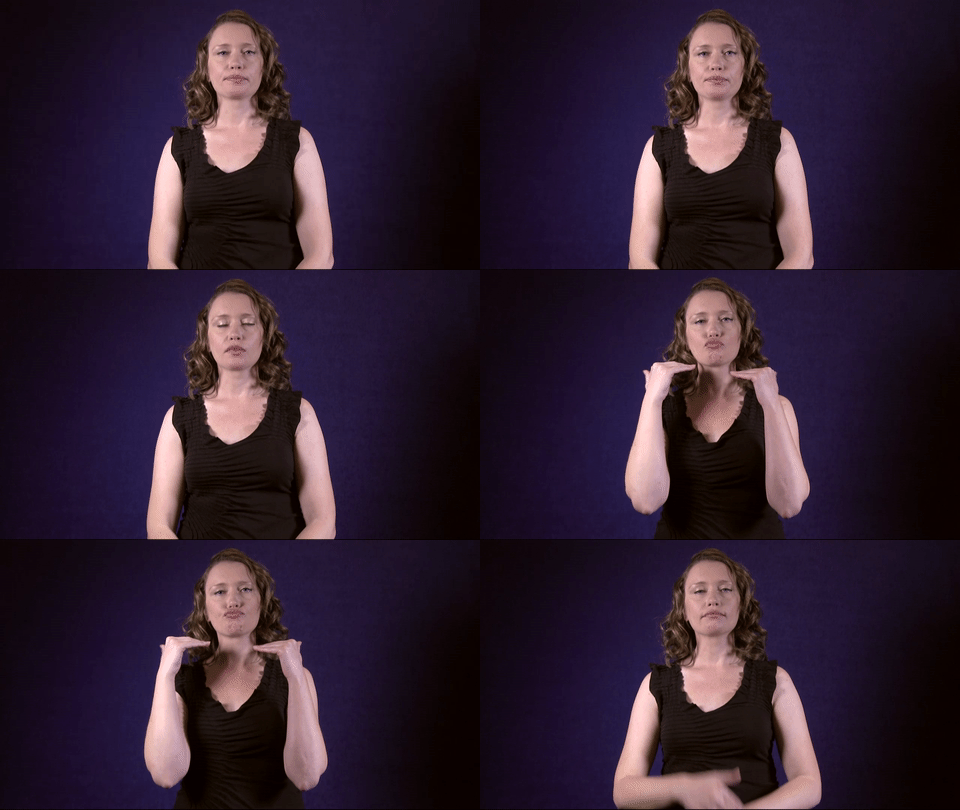
Sign for BOB HAIR CUT in ASL | 💇‍♀️ ASL Dictionary

Definition: A short haircut that is typically straight and even.

Sign for BOB HAIR CUT in ASL 

YouTube player

Practice Activities:

To practice the sign for BOB HAIR CUT in ASL, begin by standing in front of a mirror and practicing the motion repeatedly. Use the appropriate classifier to show the shape of the bob haircut and make sure your hands reflect the curved line typical of that hairstyle. Focus on smooth, deliberate handshapes and facial expressions to support your meaning.

Practice using the sign in isolation by incorporating it into a daily review with other vocabulary related to hairstyles, such as HAIRCUT, HAIR, CURLY, or LONG. After each sign, pause briefly to reinforce recognition and production. Try to quiz yourself by seeing pictures of different haircuts and signing the correct term without hesitation.

Create sample sentences using the sign for BOBHAIRCUT in ASL. For example: MY SISTER GET BOB HAIR CUT LAST WEEK or I THINK BOB HAIR CUT LOOK GOOD ON HER. Sign these sentences slowly, then rehearse them at conversational speed. Record yourself if possible to observe your clarity and flow.

Try storytelling activities to use the sign for BOBHAIRCUT in ASL within context. Invent a short narrative about someone preparing for a special event and deciding on a new haircut. Include other relevant signs like DRESS, NERVOUS, or FRIEND to build a scene. Practice retelling the story multiple times, varying the story details slightly.

Pair with a partner and describe people you know or celebrities, imagining what they would look like with a bob haircut. Ask each other YES/NO or WH questions like YOU THINK BOB HAIR CUT FIT HER FACE? This encourages natural conversation and repeated use of the target sign. You can also play a guessing game where one person signs descriptions including the bob haircut and the other guesses who is being described.

Cultural Context:

In American Sign Language (ASL), the sign for BOB HAIR CUT in ASL represents more than just a hairstyle. It reflects a broader cultural understanding of identity, style, and self-expression within the deaf community. Hair is often a point of pride and individuality, and a bob haircut is a bold, recognizable style that conveys confidence and modern fashion.

As trends change over time, so do the signs that represent them. The sign for BOB HAIR CUT in ASL has evolved to mirror the visual and stylistic elements of the bob haircut. This adaptability shows how living languages like ASL incorporate visual cues from the world around them, making it instantly recognizable to native signers.

Understanding the sign for BOB HAIR CUT in ASL also means appreciating the role of visual and spatial awareness in deaf culture. Because ASL is a visual language, signs often mimic the shape or motion of the thing they describe. The bob haircut, with its distinct blunt edges and symmetrical lines, lends itself well to a descriptive sign that captures its look.

Fashion plays an important role in how people present themselves to the world, and this is no different in deaf culture. The sign for BOB HAIR CUT in ASL may also be used in conversations about beauty standards, personal grooming, or even historical fashion trends. This creates a space for personality and individuality to shine through in everyday ASL conversations.

Style-specific signs like the sign for BOB HAIR CUT in ASL highlight the importance of inclusivity and representation in language. The deaf community often adapts existing signs or develops new ones to acknowledge diversity in hair types, lengths, and cultural significance. This ensures that ASL stays rich and representative of the people it serves.

When learning fashion-related vocabulary in ASL, it’s helpful to understand not just the sign, but the cultural context behind it. The bob haircut has historically symbolized independence and modern womanhood, especially in Western fashion. This meaning can support deeper discussions in ASL related to gender identity, empowerment, and social change.

In ASL, discussing hairstyles is a common topic, just like in spoken languages. The sign for BOB HAIR CUT in ASL can be part of conversations that span salon visits, new looks, or even pop culture influences. Using ASL to talk about these topics allows for a more inclusive dialogue among deaf and hard of hearing individuals.

The popularity of bob haircuts ensures the sign for BOB HAIR CUT in ASL remains relevant.

Extended Definition:

The sign for BOB HAIR CUT in ASL represents a specific hairstyle using visual cues to indicate the distinct shape and cut of a bob. Because bob haircuts have unique characteristics, the sign often includes a hand motion suggesting the even length around the head, typically just above the shoulders. This style is recognized for its symmetrical and clean lines, and the ASL version captures this with clear, simple gestures.

To sign for BOB HAIR CUT in ASL, you usually mimic the act of cutting hair along an even line on both sides of the head, using flat hands or fingers to demonstrate hair length. The emphasis is on showing the balance and alignment of the bob haircut. Your facial expression can help to emphasize the sleek and neat style associated with this haircut.

In ASL, many signs are rooted in concept rather than word-for-word translations. This means the sign for BOB HAIR CUT in ASL might reference both hair and style depending on the setting. If someone is asking for that haircut or talking about someone who wears it, context will determine the exact combination of signs used.

Since the bob style has variations, such as the inverted bob or layered bob, a person might adjust the sign slightly to show the specific cut. However, the foundation remains the same—a clear representation of a short, even haircut using natural hand motions. ASL allows for flexibility, and signing for BOBHAIRCUT in ASL might include classifiers or descriptive gestures to indicate length or volume.

Describing hairstyles in sign language can involve using classifiers, which depict the shape or movement of physical features. For a bob haircut, that might involve CL:4 handshapes moving downward on both sides of the face to show where the bob stops. The fingers may fan out slightly to suggest hair spreading at the ends, or stay close to demonstrate a blunt cut look.

The sign for BOB HAIR CUT in ASL can also be situational. If you’re at a salon, you might see a signer use a general haircut sign first, followed by a descriptive shape to clarify that the requested style is a bob. When describing someone else’s look, the signer might use the general hair sign, followed by pointing to the length and shape that defines a bob.

American Sign Language often incorporates iconic movements for clarity, especially for descriptive ideas like hairstyles. This makes the sign for BOB HAIR CUT in ASL widely understandable in Deaf culture. Thanks to visual cues, others can quickly comprehend what style is

Synonyms: Bob hairstyle, cropped cut, blunt bob, short bob, sleek bob

Educational resources: Find related learning materials in our course bank!

Want more? Check out some of our popular learning activities on the homepage!

Need to look up a sign? Use our highly rated dictionary: https://aslinteractive.com/best-asl-dictionary/

Follow us on tiktok: https://www.tiktok.com/@aslinteractive. More social media links at the bottom of this page!

Long-tail Keywords: how to sign bob haircut in ASL, what is the ASL sign for bob haircut, learn the ASL sign for bob haircut

Categories:

tags: hair styles, appearance, activities, everyday actions, fashion

Parameters

*Handshape*:

The handshape for the sign for BOB HAIR CUT in ASL typically uses a modified “H” or “U” handshape in both hands, resembling scissors ✂️. These hands mimic the action of cutting hair to convey the concept of a bob hairstyle.

The movement simulates the clipping of hair near the shoulder area, emphasizing the short and even cut associated with a bob. The sign for BOB HAIR CUT in ASL captures the specific style by pairing handshapes with clear, concise motions.

*Palm Orientation*:

The palm orientation for the Sign for BOB HAIR CUT in ASL involves both hands using the “H” handshape near the head, mimicking the motion of scissors cutting hair. Palms typically face inward toward the head and slightly downward to follow the natural curve of hair flow.

For the Sign for BOB HAIR CUT in ASL, ensure the wrists are relaxed and the motion comes from a gentle pivot at the elbows. This helps convey the idea of cutting a bob-style haircut accurately ✂️.

*Location*:

The sign for BOB HAIR CUT in ASL is typically produced in the area around the sides of the head, near the ears and slightly in front. This location is chosen to represent the typical shape and placement of a bob haircut, which usually frames the face and ends around the jawline.

Using this position adds clarity and context to the sign for BOB HAIR CUT in ASL, emphasizing the distinctive cut length and shape. The sign remains within the neutral space close to the head while visually referencing hair and haircutting motion ✂️.

*Movement*:

The sign for BOB HAIR CUT in ASL typically uses a dominant hand in an “H” handshape to mimic the motion of scissors ✂️. The movement starts near the side of the head and moves in short, quick upward curves near the ends of the hairline to show the shape of a bob-style cut.

For the sign for BOB HAIR CUT in ASL, the motion emphasizes the rounded bottom edge of the haircut. This movement is often paired with a head nod or slight tilt to enhance clarity and natural expression.

*Non-Manual Signals*:

For the sign for BOB HAIR CUT in ASL, maintain a neutral expression with subtle eyebrow lowering to show precision or detail. Slight head tilt or emphasis may suggest the specific bob style, often associated with a more defined hair length and cut angle ‍♀️. Eye gaze should follow the handshape as it outlines the bob shape to support clarity.

The non-manual signals in the sign for BOB HAIR CUT in ASL help convey the particular look and sharpness of the style. Keep the facial expression engaged to indicate that it’s a recognized and intentional haircut, not just a general trim.

*Prosody, Dominant/Non-Dominant Hand*:

The sign for BOB HAIR CUT in ASL uses the dominant hand in a scissor-like motion near the side of the head to mimic cutting hair. The non-dominant hand remains at rest or may help frame the head slightly, depending on stylistic variation. ✂️

To express the sign for BOB HAIR CUT in ASL accurately, it’s important to convey the short, rounded shape typically associated with a bob hairstyle. Emphasis on hair length and shape ensures clarity during signing.

Tips for Beginners:

When learning the sign for BOB HAIR CUT in ASL, it’s helpful to first understand how to represent the concept of a “bob haircut” nonverbally. Since BOBHAIRCUT is not a standardized sign in ASL, the best practice is to use a combination of classifiers and descriptive gestures or fingerspell the word if clarity is needed. Practice forming a shape around your chin or neck area using both hands to indicate the short, even-cut hairstyle that characterizes a bob haircut.

For beginners, using facial expressions adds clarity and visual support to the sign for BOBHAIRCUT in ASL. You might raise your eyebrows slightly or mimic the shape of the hairstyle with your hands for added emphasis. This descriptive approach improves communication when a specific sign hasn’t entered standardized use and helps reinforce the visual language structure of ASL.

Common mistakes include overcomplicating the classifier movement or not keeping handshapes consistent. Keep your movements smooth and deliberate, and try to mirror the symmetrical look of a bob hairstyle. If fingerspelling is used, make sure each letter in B-O-B-H-A-I-R-C-U-T is clear and spaced well, especially in group conversation or fast-paced signing.

Another helpful tip is to observe native signers or ASL instructors to see how they describe hairstyles. Using the sign for HAIRCUT or combining it with a descriptive gesture can enhance the accuracy of the sign for BOB HAIR CUT in ASL. Don’t hesitate to ask Deaf community members for feedback during practice .

Lastly, recording yourself and watching the playback can reveal unclear movements or inconsistent angles. Accuracy in the handshape and well-timed body language are key when constructing personalized or nonstandard signs like the sign for BOB HAIR CUT in ASL. Keep practicing in front of a mirror or with a peer to build fluency and confidence.

Connections to Other topics:

The sign for BOB HAIR CUT in ASL connects to multiple areas within sign language that deal with descriptions of physical appearance, grooming, and hairstyle. It shares similarities with the signs for HAIRCUT, HAIR, and STYLE, all of which utilize classifiers or specific handshapes to depict hair length or cutting motion. The sign for HAIRCUT generally uses a scissor motion near the head, while the sign for BOBHAIRCUT refines this to visually represent a shorter, chin-length style—allowing for visual specificity in description.

This sign also ties into the broader topic of classifiers, especially size and shape specifiers (SASS). When describing a bob haircut, SASS is often used to indicate the length and shape of the hair on either side of the face. These classifiers are essential when explaining or expanding upon hairstyles, whether talking about a classic bob, angled bob, or curly bob. This makes the sign for BOB HAIR CUT in ASL particularly useful in conversations about personal identity, fashion, or character description.

Additionally, the sign for BOB HAIR CUT in ASL can appear in compound phrases such as PERSON + HAIRCUT or STYLE + HAIRCUT to build more complex meaning. For example, combining CHILD + BOBHAIRCUT refers to a young individual with that specific hairstyle, demonstrating how the sign fits into storytelling or descriptive contexts. It is effective in visual storytelling and character representation, especially in ASL narratives.

This sign also relates to the broader theme of self-care and grooming in deaf culture. Signs for SHAVE, MAKE-UP, and COMB-HAIR are often used in similar social contexts where appearance is discussed. By understanding the sign for BOB HAIR CUT in ASL, learners also build a framework for describing changes in appearance over time, adding richness and clarity to their sign vocabulary.

Summary:

The sign for BOB HAIR CUT in ASL is a unique representation that blends common haircut signs with visual classifiers. This particular sign emphasizes the distinct shape and style of a bob haircut, a style known for its geometric symmetry and cultural prominence throughout fashion history.

To sign BOB HAIR CUT in ASL, one generally uses both hands to indicate the specific jawline level of a bob. The hands move in a slicing motion at the sides of the head near the jawline, suggesting the flat and even cut that defines the bob hairstyle. This directional movement helps convey the shape and length associated with the term.

The sign captures a universally recognized style within Western fashion. The bob has been associated with bold social movements and gender expression, often signifying empowerment and independence. In the scope of ASL, signs that reflect societal and cultural symbols, such as hairstyles, serve not just descriptive but expressive functions.

When using the sign for BOB HAIR CUT in ASL, facial expressions play a key role. A signer’s non-manual markers, such as a satisfied or approving look, can indicate admiration for the style or a current preference. Likewise, paired signs or classifiers can annotate variations, such as angled bobs or layered bobs, when needed for deeper visual clarification.

This sign functions in ASL grammar as a proper noun or as an adjective, depending on use. It can describe someone’s current hairstyle or refer to a past event, such as getting a bob haircut. In storytelling or conversation, it offers a visual summary that replaces long narrative descriptions.

The sign for BOB HAIR CUT in ASL is closely related to haircut signs but adds semantic specificity due to the cultural meaning of a bob. The sign for generic “HAIRCUT” involves scissors-handshapes cutting near the sides of the head or using mime-based classifiers. However, BOB HAIR CUT emphasizes geometric outline, giving it enhanced semantic load.

Linguistically, this sign provides a fascinating example of how classifiers and location features operate in ASL. It leverages spatial referencing aligned with movement and shape symmetry, which is an efficient use of visual-spatial modality. This is especially important in topic-comment sentence structures common in ASL.

In applied linguistics, the sign demonstrates iconicity, where the sign visually resembles its meaning. Unlike abstract signs that are arbitrary, the sign for BOB HAIR CUT capitalizes on visual shape to represent form. This makes it accessible to learners and useful in language acquisition studies.

Through the use of depiction and space, the sign allows room for personalization. One can modify handshape, position, and movement to indicate various types of bob haircuts. For instance, holding hands slightly curled for a wavy bob or tilting one side down to suggest an asymmetrical cut.

Culturally, bob haircuts have been tied to moments of identity redefinition. In the 1920s, a bob symbolized rebellion and women’s autonomy, and more recently it represents chic, professional presentation. The sign in ASL thus carries these connotations, enriching its pragmatic meaning during conversation.

When used in narratives, the sign for BOB HAIR CUT in ASL can convey character identity instantly. It’s employed often in stylized storytelling and identifying someone who has recently undergone a change. In Deaf storytelling traditions, appearance descriptions carry a visually compelling role that signs like this support deeply.

Lexically, there’s a growing role for fashion-specific vocabulary in ASL. As Deaf communities engage with fashion media and social changes, signs like BOB HAIR CUT bridge personal style with linguistic expression. It reflects the adaptive nature of ASL as it incorporates contemporary lexicon.

The sign operates within the broader framework of visual description. ASL inherently depends on the power of visual storytelling, often using space and movement with precision. The sign for BOB HAIR CUT in ASL enhances that storytelling by offering a clear, compact symbol for a widely understood concept.

In teaching or Deaf education settings, BOB HAIR CUT serves as a useful example of how ASL conveys style and fashion terms. Visual learners especially benefit from signs that offer visual association, improving retention and concept comprehension. Teachers often pair this sign with images for clarity.

From a translation perspective, signed literature might use BOB HAIR CUT to reflect metaphorical themes or emotional transitions. For instance, in a poem about change or reinvention, a bob haircut could be symbolically powerful. Translators work with signs like this both literally and poetically.

The sign also connects to identity discourse. A change in hairstyle often aligns with major transitions—new jobs, relationships, or transformations. In ASL, visual markers like BOB HAIR CUT allow Deaf individuals to convey those transitions succinctly and expressively.

Technologically, ASL avatars in digital platforms are slowly incorporating hairstyle-specific signs such as this. As media representation becomes more inclusive of Deaf culture, the need for nuanced signs like the Sign for BOB HAIR CUT in ASL .

https://www.youtube.com/watch?v=nhTjTlP3FhY increases. These enrich both animation and

Want more? Check out some of our popular learning activities!

ASL Interactive Resources

ASLInteractive YouTube Channel

Follow us on tiktok: @aslinteractive.com

Follow us on Instagram: aslinteractive

Facebook page: aslinteractive

Facebook group: aslinteractive

LInkedIn: ASL Interactive LLC

Twitter: @ASL_interactive

*Some information on this page is AI-generated. AI can make mistakes. Please check the information.

Sign for BOB HAIR CUT in ASL 

Responses