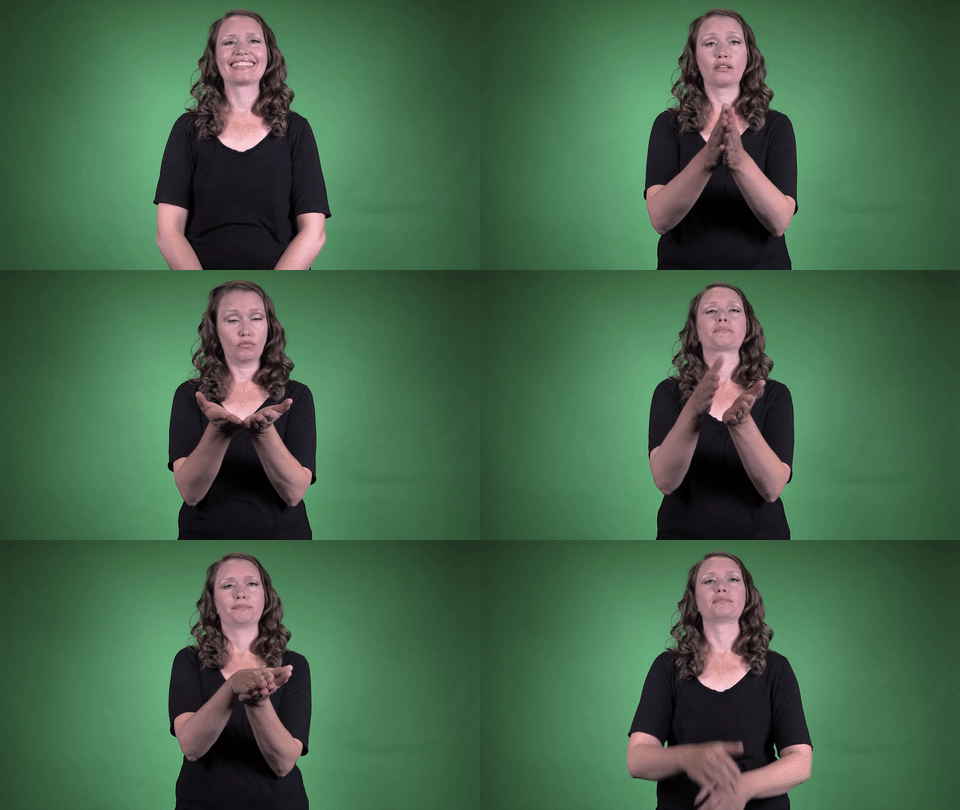
Sign for BOOK CLOSE in ASL | 📕 ASL Dictionary

Definition: To close a book.

Sign for BOOK CLOSE in ASL

YouTube player

Practice Activities:

Start your practice by isolating the sign for BOOK CLOSE in ASL. Sit in front of a mirror and practice opening and closing your hands as if you were closing a book. Focus on the movement and the handshape, making sure your fingers stay aligned during the motion. Repeat the sign slowly, then increase your speed as you become more confident.

Once you are comfortable with the isolated sign, try using it in short phrases. Say and sign phrases like “close the book,” “she closed the book,” and “I forgot to close my book.” Record yourself signing to monitor your accuracy. Watch videos of fluent signers using the sign for BOOK CLOSE in ASL and mimic their rhythm and fluidity.

Practice storytelling by using the sign in context. Tell a short story about a school day, including actions like “I open my book,” “I read,” and “then I close my book.” Add facial expressions to show emotion or intent. Sharing fictional or personal stories using this sign will increase your retention and understanding.

For a partner activity, take turns signing actions while your partner guesses what you’re doing. Use other classroom-related signs along with the sign for BOOK CLOSE in ASL, like WRITE, READ, or STUDY. Create mini skits, taking turns pretending to be in a classroom, using the sign naturally throughout your dialogue.

For receptive practice, have a partner sign several commands using directional cues, such as “close your book,” “close his book,” or “close the big book.” Point to the imagined book’s location while signing. Use emojis and to add visual fun to your storytelling or journaling prompts online. Have fun creating short videos or GIFs of yourself using the sign for use in digital flashcards.

Cultural Context:

The sign for BOOK CLOSE in ASL is commonly used in academic, professional, and casual settings. This sign helps convey the act of ending a study session, putting away reading material, or transitioning from one activity to another.

In American Deaf culture, the use of space and movement in signs like the sign for BOOK CLOSE in ASL is important. This sign not only represents the physical action of closing a book but often symbolizes the completion of a task or idea within a conversation.

Classroom environments are a frequent place where you’ll see the sign for BOOK CLOSE in ASL. Teachers, students, and interpreters use it to signal the end of a reading assignment or to wrap up a literacy lesson. It’s a part of many structured learning routines in Deaf education.

Beyond the classroom, the sign for BOOK CLOSE in ASL is also used in storytelling or narrative contexts. When telling stories or sharing information, users might end with this sign to indicate the conclusion of their message. It’s a natural way to signify closure and transition.

In Deaf community events or educational settings, visual communication is central, so signs like this play a powerful role. The sign for BOOK CLOSE in ASL is understood clearly and helps ensure everyone knows when something is finished or when it’s time to move on.

The metaphorical nature of the sign adds depth to its use. Much like how we use phrases like close the book on something in English, Deaf people may use the sign for BOOK CLOSE in ASL to represent emotional or situational closure. It helps bring structure and emotional clarity to conversations.

Parents teaching their children ASL often integrate signs like this into storytime routines. Saying goodnight with a book and using the sign for BOOK CLOSE in ASL becomes part of the bedtime ritual, reinforcing the language and creating bonding moments between parent and child.

In online ASL classes or video content, you’ll often see the sign for BOOK CLOSE in ASL during lessons that involve reading or study sessions. Instructors sign it to cue students that the lesson is concluding or to reinforce the visual structure of the learning process.

The sign is also popular in formal interpreting settings, especially during lectures or speeches where visual clarity is necessary. Interpreters use the sign for BOOK CLOSE in ASL to help signal transitions between topics or speakers, supporting audience comprehension.

When used in social conversations, the sign for BOOK CLOSE in ASL can be a casual indicator that the topic is done. It’s a culturally appropriate, respectful way to indicate that

Extended Definition:

The sign for BOOK CLOSE in ASL is a compound sign that visually represents the action of closing a book. It typically starts with the sign for BOOK, followed by a movement that mimics closing the covers. This iconic sign helps convey the concept clearly and is easy to learn for both beginners and advanced users of American Sign Language.

To sign BOOK, place your palms together in front of you like you’re holding a closed book. Then, open your hands like a book being opened. For the sign for BOOK CLOSE, start with your hands in that open-book position, then move them back together, closing the imaginary book. This motion captures the meaning and makes it visually intuitive.

The sign for BOOK CLOSE in ASL is often used in educational settings. For example, a teacher might sign it at the end of a reading lesson to indicate it’s time to put books away. Students might also use this sign among themselves in classrooms or library settings where quiet communication is needed.

BOOK CLOSE is a great example of how ASL uses visual-spatial elements to express complete ideas through simple, fluid motions. This sign combines two concepts: the item (BOOK) and the action (CLOSE), turning them into one meaningful expression. Because it’s based on physical gestures, it’s understandable even to people with limited ASL experience.

Using the sign for BOOK CLOSE in ASL also encourages literacy in deaf and hard-of-hearing communities. When educators incorporate ASL into reading time, using signs like BOOK CLOSE helps reinforce routines and communication skills. It’s particularly useful when working with children, as it becomes a visual cue that signifies the end of a task or activity.

The sign for BOOK CLOSE in ASL can also be used metaphorically. In storytelling or narrative contexts, performers might sign BOOK CLOSE to indicate the end of a tale or chapter. It adds a natural, engaging visual element that enhances the emotional tone of the story being told.

In digital educational content, BOOK CLOSE is a commonly used search term. People often look up how to sign specific school-related terms, and this one comes up frequently. Understanding how to perform the sign for BOOK CLOSE in ASL is valuable for interpreters, teachers, parents, and students alike.

The clarity of the sign for BOOK CLOSE in ASL makes it favorable for those building fluency. It’s a gesture that reflects the real-world action. This natural mapping between physical movement and meaning is a cornerstone of ASL and contributes to its visual richness.

When creating ASL learning materials

Synonyms: End of book, book closure, conclusion of book, book completion, final chapter

Educational resources: Find related learning materials in our course bank!

Want more? Check out some of our popular learning activities on the homepage!

Need to look up a sign? Use our highly rated dictionary: https://aslinteractive.com/best-asl-dictionary/

Follow us on tiktok: https://www.tiktok.com/@aslinteractive. More social media links at the bottom of this page!

Long-tail Keywords: what is the sign for book close in ASL, how to sign book close in American Sign Language, what does the ASL sign for book close look like

Categories:

tags: Objects in the Classroom, Commands, Language Learning, Activities, Classroom Picture

Parameters

*Handshape*:

The handshape for the Sign for BOOK CLOSE in ASL uses flat hands, commonly referred to as the “B” handshape. Both palms start facing each other in front of the body, similar to an open book.

To complete the Sign for BOOK CLOSE in ASL, the hands close together at the pinky side, as though shutting the book. Maintain firm, flat handshapes to keep the visual representation clear .

*Palm Orientation*:

In the sign for BOOK CLOSE in ASL, both hands start open with palms facing upward, resembling the covers of a book. As the sign progresses, the hands close together like shutting a book, maintaining the upward palm orientation until the hands meet.

The palm orientation remains consistent throughout the sign for BOOK CLOSE in ASL, helping visually convey the action of closing a book . This natural motion is easy to recognize and supports clear communication in context.

*Location*:

The sign for BOOK CLOSE in ASL is located in front of the chest, slightly below shoulder level. Both hands are used, starting with open palms facing upward and touching at the pinky sides as if holding an open book.

This location mirrors the natural position where a person might read or handle a book, making the sign for BOOK CLOSE in ASL intuitive and visually descriptive . It remains close to the torso to replicate the act of closing a book near the body.

*Movement*:

To perform the sign for BOOK CLOSE in ASL, start with both hands in flat B-handshapes, palms facing each other, fingertips touching. Hands are positioned in front of the body at chest level.

From this position, simulate the motion of closing a book by bringing the palms together like closing a hardcover. The sign for BOOK CLOSE in ASL mimics the physical action of shutting a book, conveying the concept visually.

*Non-Manual Signals*:

The non-manual signals for the sign for BOOK CLOSE in ASL often involve a neutral or slight nod of the head, indicating completion or closure. The facial expression is typically relaxed, showing finality or the end of an activity like reading or studying.

When using the sign for BOOK CLOSE in ASL, your eyes may glance downward briefly as your hands come together, reflecting focus on the action. There’s generally no exaggerated emotion unless contextually emphasized.

*Prosody, Dominant/Non-Dominant Hand*:

For the sign for BOOK CLOSE in ASL, both hands are used symmetrically. The hands start in an open flat-handshape (palms up), positioned like an open book. The dominant and non-dominant hands move toward each other, closing together flat in a clapping motion to mimic the closing of a book. The motion is smooth and deliberate, showing the action clearly.

This representation in the sign for BOOK CLOSE in ASL effectively mirrors the literal closing of a book. Both hands serve the same role and move in unison, making prosody balanced and iconic.

Tips for Beginners:

When learning the sign for BOOK CLOSE in ASL, it’s essential to practice the motion smoothly and clearly. This compound sign mimics the action of closing a book and is made using both hands, starting in an open-book position and then bringing the palms together. Make sure your hands are aligned and flat, moving symmetrically to accurately depict the object.

A common mistake beginners make when signing BOOK CLOSE in ASL is rushing through the motion, which can make the sign appear sloppy or unclear. To avoid this, try practicing in front of a mirror. Focus on the openness of the hands at the beginning and the tight closure at the end—just like closing a real book. ✋

Consistency in the speed and alignment of hand movements can really improve the clarity of the sign. Be sure not to let one hand move faster than the other. They should mirror each other for the sign to be understood properly. Pay attention to your palm orientation—both palms should face upward in the beginning and then come together flatly.

Visual clarity plays a big role, so keep fingers extended and together rather than loosely curled or separated. The more accurate your handshape is, the easier it will be for others to understand that you’re using the sign for BOOK CLOSE in ASL. Take time to isolate the difference between the sign for BOOK, which starts with palms open, and BOOK CLOSE, which adds the closing motion.

Practice during daily routines by pairing the sign with reading habits. When you physically close a book, practice the sign at the same time. This reinforcement helps tie the sign directly to the action and context in which it’s used. Over time, the sign for BOOK CLOSE in ASL will feel more natural and automatic.

Connections to Other topics:

The sign for BOOK CLOSE in ASL shares a strong structural connection with the signs for BOOK and CLOSE, making it an example of how ASL often combines simpler signs into compound ones to efficiently express more complex actions or ideas. This combination reinforces the importance of understanding base signs first, as they often reappear in more intricate or context-specific signs. Learners familiar with the sign for BOOK, which involves the palms together and then opening, will quickly recognize the reverse motion in the sign for BOOK CLOSE.

This sign fits naturally into broader topics like actions involving common objects, such as OPEN-BOOK, CLOSE-WINDOW, or CLOSE-DOOR. Each of these signs uses similar spatial and directional cues, which helps build a pattern of meaning tied to the physical movement involved in closing something. The directional motion in these signs supports the understanding that ASL often uses space and movement to convey function.

In educational settings, the sign for BOOK CLOSE in ASL is especially useful when discussing classroom routines, such as signaling students to finish reading or complete an activity. It can be taught as part of a sequence like READ-BOOK, FINISH, then BOOK CLOSE, fostering narrative flow and time-based actions in ASL storytelling or instruction. This mirrors the way temporal sequencing is often conveyed non-manually and through sign order in ASL.

The sign also connects to discussions about object manipulation in ASL. Other signs like PUT-AWAY, CLOSE-LAPTOP, or SHUT increase a learner’s awareness of using both spatial logic and facial expressions. Understanding how the sign for BOOK CLOSE in ASL fits into this network of object-related signs offers a gateway to mastering descriptors for routines, environmental control, and task transitions, all essential functions in day-to-day ASL use.

Summary:

The sign for BOOK CLOSE in ASL is a compound form, pulling from the base sign for BOOK and modifying it with an action that mimics the closing of a book. It’s visually iconic, replicating the motion and effect of shutting a book’s cover. This representation not only communicates the action but also gives a sense of completion or finality related to reading or activity with a book.

To perform the sign for BOOK CLOSE in ASL, you start with both hands in a flat handshape, palms together, facing inward in mid-air to mimic the closed book. Then, you open them as if opening a book, and to show closing, you simply reverse the movement, bringing the palms together again. The action is smooth and deliberate, reflecting the tactile and visual act of closing a real book.

The sign is commonly used in educational contexts, particularly in classrooms and among young learners. Teachers may use this sign to indicate the end of a reading session or storytelling time. It provides a clear, visual cue that a particular activity involving books has concluded.

Culturally, the sign for BOOK CLOSE in ASL represents more than an action. It carries symbolic meaning, including the conclusion of knowledge-sharing or the end of a specific chapter. Within Deaf culture, where visual-spatial communication thrives, such signs carry both literal and metaphorical weight.

Grammatically, this sign functions fluidly within ASL sentence structures. It can stand alone as a verb or be used within a broader context, such as “FINISH BOOK CLOSE” to signify “I finished closing the book.” Its use is contingent upon spatial organization and non-manual markers that support the meaning in context.

It also connects with other signs like READ, STUDY, or BOOK OPEN. These related signs create a semantic field around education and literacy, making it easier to navigate conversations about learning materials and reading habits. The transition from one sign to another can be smooth, enhancing narrative flow.

The linguistic composition of the sign includes both iconicity and conceptual blending. The handshapes and movements are directly related to their physical-world referents, which supports clarity of meaning and enhances cognitive acquisition, especially in Deaf children. The compound nature demonstrates how ASL builds new signs through meaningful morpho-syntactic patterns.

Applied linguistics reveals the usefulness of such visual metaphors in promoting literacy. The sign for BOOK CLOSE in ASL contributes to storyline comprehension and structuring, especially in educational settings. It helps students internalize the idea of beginning and ending, which is critical in both language development and general conceptual organization.

Educators in Deaf schools heavily rely on the sign for BOOK CLOSE in ASL during structured activities to signal timing and maintain order. It’s often paired with other time-related signs like TIME, START, STOP, and LUNCH, creating a rhythm throughout the school day. This rhythm mirrors what auditory bells or announcements do in hearing classrooms.

When comparing the sign cross-linguistically in international sign languages, one finds similar visual metaphors used to depict book closings or endings of stories. However, the specific handshape and movement may differ slightly due to phonological constraints or cultural tendencies. This illustrates the interplay between universal experience and language-specific expression.

In theater and performance, especially where visual storytelling is key, the sign for BOOK CLOSE in ASL is often used metaphorically. It can indicate “The End” of a story or signify closure of an emotional or narrative arc. Audiences perceive this as a poetic and potent visual gesture tied to knowledge and finality.

For Deaf children acquiring ASL as a first language, the concept of closing a book can be one of their early learned visual metaphors. It supports abstract concepts of “ending” and “completion” and aligns with broader curriculum milestones. It may also be reinforced through storytelling or shared book-reading practices.

Digital communication platforms and e-books have created subtle shifts in how BOOK and BOOK CLOSE are used. While the physical gesture still replicates a traditional book, users adapt the meaning for digital contexts where “closing” a book involves tab-switching or app-quitting. Nonetheless, the visual representation remains tied to the physical world.

The use of space in signing the BOOK CLOSE sign reflects ASL’s inherent use of visuospatial grammar. Bringing the hands back together mimics both the closing action and the retraction of information, suggesting containment or preservation. This spatial metaphor contributes to the language’s richness and depth.

The sign also plays a role in narrative timelines and sequencing. It helps demarcate story events, providing a visual punctuation that helps organize thoughts. For example, in a series of signed book presentations, BOOK CLOSE could act as the visual equivalent of “That’s the end.”

In interpreting situations, especially in school or educational videos, the sign for BOOK CLOSE in ASL enables interpreters to effectively mark the end of reading. It promotes clarity for Deaf viewers, helping them visually process structured signals. It’s part of a toolkit interpreters use to maintain register and

Want more? Check out some of our popular learning activities!

ASL Interactive Resources

ASLInteractive YouTube Channel

Follow us on tiktok: @aslinteractive.com

Follow us on Instagram: aslinteractive

Facebook page: aslinteractive

Facebook group: aslinteractive

LInkedIn: ASL Interactive LLC

Twitter: @ASL_interactive

*Some information on this page is AI-generated. AI can make mistakes. Please check the information.

Sign for CLOSE BOOK in ASL,
Sign for CLOSE BOOK in ASL

Responses