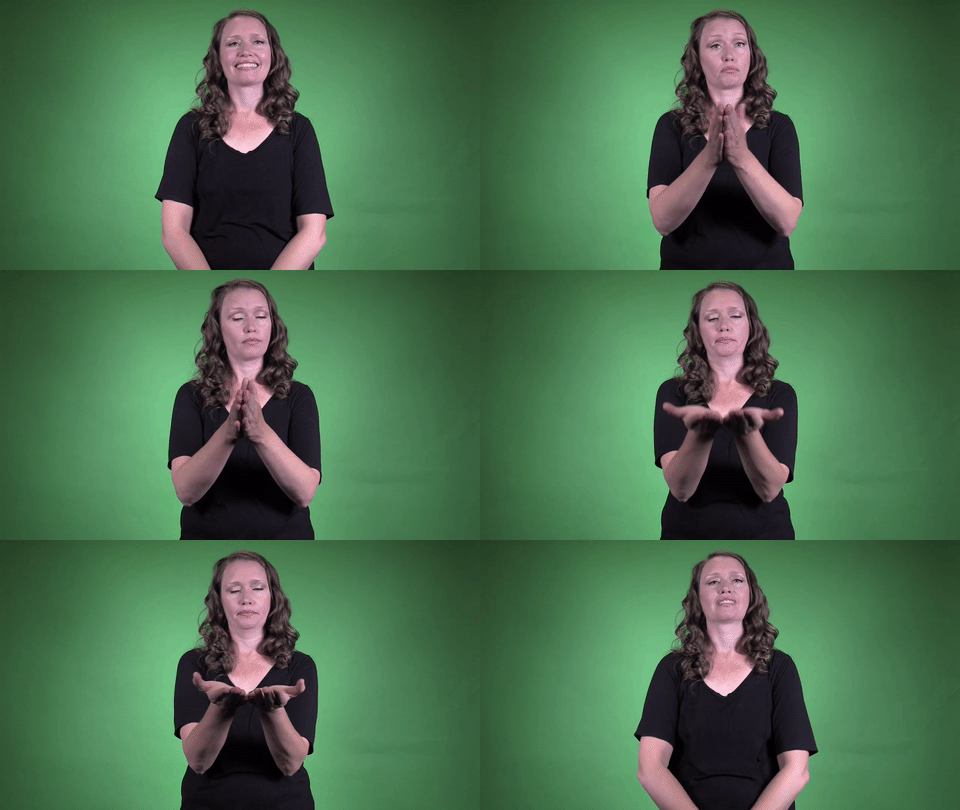
Definition: To open a book.
Sign for BOOK OPEN in ASL

Practice Activities:
To build fluency with the sign for BOOK OPEN in ASL, begin by practicing it in front of a mirror. Repeat the sign slowly and focus on the handshape, movement, and facial expression. Mimic the action of opening a book with both hands, palms together, then opening outward like turning open a cover.
Isolate the sign by using flashcards with pictures of books or a written prompt to encourage you to produce the sign quickly and accurately. Try doing this drill with a timer to increase speed. Practice signing it in silence, focusing on clarity and size of the movement.
Incorporate the sign for BOOK OPEN in ASL into short sentences like “I open the book,” “She opened the book,” or “Book open, read.” Use a mirror to check fluency and facial grammar, especially when expressing time frames like “yesterday” or “now.” Record yourself and review the fluidity and clarity of the sign.
Work with a partner to simulate a library scenario. One person can act as the librarian and the other as a visitor. Practice signs like “book open,” “read,” “which book,” or “this book open.” Take turns creating short dialogues that include the sign for BOOK OPEN in ASL multiple times in a natural setting.
Use storytelling prompts to offer context-rich practice. You could sign a brief story about reading a favorite book, what happens when you open the book, or describe reading outside under a tree. Try to include the sign at various points in the story to strengthen recall and context usage.
Play a charades-type game where you or a friend act out daily routines that involve books. When it’s time to sign that part, clearly include the sign for BOOK OPEN in ASL. Repetition through fun activities leads to targeted muscle memory and confidence in everyday use.
Cultural Context:
In American Sign Language, signs often reflect the cultural context of Deaf experiences, daily life, and how concepts are naturally visualized. The sign for BOOK OPEN in ASL is an excellent example of how signers use space, movement, and imagery to communicate clearly. This sign mimics the act of opening a real book and instantly connects with actions familiar in both Deaf and hearing cultures .
The sign for BOOK OPEN in ASL is iconic, meaning it visually resembles the object or action it represents. Because reading plays a key role in education, storytelling, and communication, the ability to refer to books in signed conversations is essential. Signers often use the sign for BOOK OPEN in classrooms, libraries, and community settings where learning and knowledge sharing take place.
In Deaf culture, access to information has long been centered around visual and tactile modes of communication. The sign for BOOK OPEN in ASL represents more than just an object—it’s a gateway to expression, curiosity, and empowerment. Whether discussing school books, sacred texts, or personal journals, this sign makes it easy to refer to a wide range of experiences tied to reading and discovery.
Deaf children begin learning signs like BOOK OPEN early on as part of vocabulary development. Educators in Deaf schools and mainstream environments that use ASL integrate the sign regularly in lessons to promote engagement and comprehension. The motion of the sign also helps encourage fine motor skills development and spatial understanding.
The cultural value of books and learning is especially important in Deaf communities, where ASL functions as the primary language for many. The sign for BOOK OPEN in ASL fits naturally into group discussions, storytelling sessions, and any setting where ideas are being shared. Visual storytelling is a key cultural heritage in Deaf tradition, and signs related to books and reading support that storytelling process.
When traveling or attending cultural events like Deaf poetry slams or ASL storytelling festivals, you’ll often see this sign used to create vivid visual narratives. As with many ASL signs, context determines whether the sign is used alone or paired with other descriptors like read, study, or close to explain a complete idea. The sign for BOOK OPEN in ASL becomes part of a dynamic flow of concepts and expressions .
Technology has expanded how books are consumed, but the sign for BOOK OPEN in ASL still holds strong relevance. Even discussions about eBooks or digital reading platforms may still use this sign to represent the action of starting a book. It carries both traditional and modern connotations in the Deaf world.
Extended Definition:
The sign for BOOK OPEN in ASL is a commonly used compound sign that visually represents the action of opening a book. This sign is especially useful in educational settings, classrooms, or anytime someone is referring to reading or studying in American Sign Language. By using this sign, communicators can easily convey the idea of beginning to read or accessing information from a book.
To form the sign for BOOK OPEN in ASL, you start with both hands together, palms flat and touching like a closed book. Then you move your hands outward slightly, mimicking the action of opening a book, keeping your palms up. This nonverbal representation closely mirrors the real-life motion, making it intuitive and clear. It is a perfect example of ASL’s use of visual imagery and conceptual accuracy.
This sign is often used in context with other educational or academic vocabulary. For example, a teacher might sign BOOK OPEN to instruct students to begin reading a specific page. It can also appear in storytelling, where a narrator uses the sign at the beginning of a wordless picture book or during a dramatic reenactment. In some cases, the sign may also be used symbolically to represent learning or the start of a journey through knowledge.
The sign for BOOK OPEN in ASL is versatile and appears frequently in both casual and formal communication. Parents, educators, and librarians use it daily with children learning to read or follow along during story time. Because ASL is a visual language, signs like this are useful not just for conveying a physical action but also to express abstract concepts such as attention, focus, or imagination in relation to books.
Digital and video-based ASL resources often include the sign for BOOK OPEN as part of broader lessons on school-related vocabulary. It pairs easily with other signs like READ, STUDY, or SCHOOL, which helps to build descriptive sentences. For those learning ASL, mastering this compound sign supports fluency and adds a natural rhythm to conversations about reading and academics.
The sign for BOOK OPEN in ASL can be adapted slightly depending on the context. Sometimes, for dramatic or storytelling purposes, signers may exaggerate the movement for emphasis. This type of expressive signing helps engage audiences and draws attention to the narrative. It also showcases the creative ways that ASL users adjust signs to match tone, setting, and audience.
Children learning the sign for BOOK OPEN in ASL can benefit from pairing it with tactile or visual cues to strengthen comprehension. Using real books while signing reinforces connections between the physical object
Synonyms: book is open, open book, opened book, book is opened, unclosed book
Educational resources: Find related learning materials in our course bank!
Want more? Check out some of our popular learning activities on the homepage!
Need to look up a sign? Use our highly rated dictionary: https://aslinteractive.com/best-asl-dictionary/
Follow us on tiktok: https://www.tiktok.com/@aslinteractive. More social media links at the bottom of this page!
Long-tail Keywords: what is the sign for book open in ASL, how to sign book open in ASL, ASL sign for book open
Categories:
tags: Book, Objects in the Classroom, Classroom Picture, Language Learning, Activities
Parameters
*Handshape*:
The handshape for the sign for BOOK OPEN in ASL uses both hands flat and together, resembling the closed covers of a book. The palms face each other with fingertips aligned, touching at the edges.
To complete the sign for BOOK OPEN in ASL, the hands then open outward like the pages of a book being spread apart. This motion and handshape clearly represent the action of a book being opened .
*Palm Orientation*:
For the sign for BOOK OPEN in ASL, both hands start in front of the body with palms facing each other and touching, like the covers of a closed book. The palms then rotate upward and outward, ending with both palms facing up to show the book opening.
This palm orientation mimics the physical action of opening a book, making the sign for BOOK OPEN in ASL intuitive and easy to remember.
*Location*:
The sign for BOOK OPEN in ASL is produced in the neutral space in front of the chest. Both hands start together, palms touching, positioned as if holding a closed book.
The hands then move outward and slightly downward, imitating the motion of opening a book. This neutral signing space makes the sign for BOOK OPEN in ASL easily visible and clear to the viewer or conversation partner.
*Movement*:
To show the sign for BOOK OPEN in ASL, start with both hands flat, palms touching each other like a closed book, positioned at chest level. Then move the hands apart horizontally, keeping the pinky sides of the hands anchored near each other while the thumbs rotate outward, simulating the motion of opening a book.
The sign for BOOK OPEN in ASL mimics the visual of a book being opened right in front of you. The motion is fluid and centered, using both hands working together in a smooth, coordinated gesture .
*Non-Manual Signals*:
When performing the sign for BOOK OPEN in ASL, facial expressions should be neutral or mildly inquisitive, as if presenting or demonstrating something. The brows are relaxed, and the eyes may shift slightly downward toward the hands to emphasize the motion of a book opening.
The sign for BOOK OPEN in ASL may be used in storytelling or instructional contexts, so an engaged, attentive gaze can add clarity. Avoid exaggerated expressions unless emphasizing size or emotion related to the book.
*Prosody, Dominant/Non-Dominant Hand*:
The sign for BOOK OPEN in ASL uses both hands. Start with the palms together in front of you, like you’re holding a closed book. Then open the hands outward to mimic opening a book, palms facing up. The dominant and non-dominant hands move in unison.
This sign gives a clear visual representation, making the sign for BOOK OPEN in ASL intuitive and easy to remember. Both hands mirror each other with no dominant-hand variation in motion.
Tips for Beginners:
The sign for BOOK OPEN in ASL mimics the action of opening a book with both hands. To do it correctly, hold your hands together in front of you, palms touching as if you are holding a closed book, then move the palms apart, simulating the motion of opening that book. It’s important to keep your handshapes flat and your movements smooth and clear so the sign is easily understood.
When practicing the sign for BOOK OPEN in ASL, focus on keeping your palm orientation consistent. Both palms should face up slightly or stay vertical as you part them. If your hand angles are off or your motion is too fast, the meaning can easily get lost or confused with other signs like PAPER or OPEN. Practice in front of a mirror to check for symmetry and natural movement.
Many beginners tend to over-exaggerate the opening motion or make it too stiff. Try to keep it relaxed and intentional—think of how a book actually opens with a quiet, smooth glide. Adding facial expression can help convey emphasis or context, like surprise while opening a new book versus casually starting a familiar one. Facial expression is a key part of ASL grammar and can really add depth to your signing.
To use the sign for BOOK OPEN in ASL in real-life conversations, practice pairing it with other relevant signs like READ, STUDY, or LEARN. This helps you understand not just the isolated sign but also its application within phrases. Try practicing in small role-play situations, such as pretending to start reading a book or showing someone a story. The more you use the sign in different contexts, the more natural it will feel in conversation.
sign for BOOK OPEN in ASL, how to sign book open in ASL, ASL book open sign, learn the sign for book open in ASL, American Sign Language book open, sign book open correctly in ASL
Connections to Other topics:
The sign for BOOK OPEN in ASL connects directly to the broader category of educational and instructional vocabulary in sign language. This sign is often used in classroom settings, particularly during storytelling, reading time, or when referring to beginning a lesson. It links naturally with signs such as READ, LEARN, TEACH, and STUDENT, offering a seamless way to describe actions and environments related to knowledge and learning .
BOOK OPEN also shares structural similarities with compound signs like BOOK CLOSED, PAGE TURN, or OPEN BOOK READ, where the directional or functional element (such as OPEN or CLOSE) can be modified to show different actions involving a book. These variations are useful when giving directions in a class, referring to a specific page, or describing the steps in an academic task. For example, a teacher might sign BOOK OPEN, THEN PAGE TURN repeatedly to indicate that students should follow along while reading.
This sign is also frequently paired with temporal markers for more precise context, like TOMORROW BOOK OPEN or NOW BOOK OPEN, helping signers place the action in time. It can also be integrated with location or subject-related signs such as LIBRARY BOOK OPEN or SCIENCE BOOK OPEN, creating fluid and context-rich sentences. These combinations allow for complex thoughts to be expressed clearly and efficiently in ASL .
Another interesting connection is with storytelling and visual descriptions. When narrating a scene involving a character picking up and opening a book, the sign for BOOK OPEN adds visual and narrative clarity. This supports ASL’s broader emphasis on visual-spatial grammar and narrative flow, making it an essential part of any signer’s vocabulary. Using the sign for BOOK OPEN in ASL appropriately demonstrates both technical proficiency and narrative expressiveness.
Summary:
The sign for BOOK OPEN in ASL is an iconic, visually descriptive representation resembling the motion of opening a book. Both hands are flat with palms together, like the closed covers of a book, and then they move outward as if the book is being opened toward the viewer. This motion gives learners a clear visual cue anchoring the sign in real-world experience.
This sign is an example of classifier-based depiction, where handshapes symbolically represent real-life objects. In this case, the hands act as book covers. The motion reinforces the idea of something being revealed or accessed, a powerful metaphor within Deaf education and literacy.
Grammatically, the sign for BOOK OPEN in ASL functions as a verb phrase expressing action. It can be modified depending on context, speed, or emphasis, which is how ASL conveys tone. It is commonly used in classrooms, storytelling, and everyday descriptions within the Deaf community.
When constructing sentences using ASL syntax, this sign may occur before or after the subject and object depending on emphasis. ASL follows a topic-comment structure, so a sentence might look like “BOOK OPEN, I READ,” to emphasize the action before stating who performs it. This places focus on the unfolding of the book, naturally drawing the viewer’s attention.
The sign for BOOK OPEN in ASL belongs to a semantic group of educational and action-related signs such as READ, WRITE, and STUDY. It is often used in conjunction with these signs, providing a dynamic visual toolkit to discuss learning and knowledge. Oftentimes, signs around reading and school mirror each other in concept and form.
This sign plays a noticeable role in early childhood language development. Young Deaf and hard-of-hearing learners often first encounter the sign when introduced to picture books. As they acquire literacy, the repetition of the sign helps them internalize not just language but the concept of accessing stories and education.
Culturally, the sign for BOOK OPEN in ASL communicates more than a physical motion. It represents access to knowledge, learning, and broader participation in literate society. In Deaf culture, where visual access is paramount, the act of engaging with a book supports empowerment.
The tactile quality of the sign bridges experiential learning and communication. It mimics the motion Deaf people physically make when reading printed materials, which shares a connection with the manual, kinetic side of ASL. ASL often reflects real-world motions, grounding signs in daily life for deeper cognitive processing.
From a linguistic standpoint, the sign utilizes symmetry and movement to convey meaning. Both hands begin in a symmetrical position, allowing for balance and visual symmetry, which is a core feature in many ASL signs. The pivot outward emphasizes the idea that something is now visible or accessible.
The morphology of the sign ties into the visual grammar of ASL. The shape and movement pattern can be altered slightly to convey different nuances, such as opening a large book versus a small one. These small modifications are known as inflection and are core to ASL’s rich expressiveness.
Phonologically, the sign for BOOK OPEN in ASL involves specific parameters: handshape, palm orientation, movement, location, and nonmanual markers. The handshape is flat and open, orientation starts palm-to-palm and pivots outward. Movement is simple but loaded with semantic clarity.
There is a poetic rhythm in ASL storytelling where the sign for BOOK OPEN often marks a transition or a beginning. ASL poets and performers may use this sign to indicate the start of a narrative journey. It is both literal and symbolic in these contexts, signaling new chapters or discoveries.
In educational settings, teachers frequently use this sign in songs, routines, and instructions. Morning activities in Deaf schools may begin with the teacher signing BOOK OPEN to signal reading or quiet time. The repetition of this sign attaches it to structure and routine in young children’s lives.
The iconography of the sign plays well into natural language acquisition. Its clear visual correspondence with the object makes it easy to remember and reproduce. This transparency supports second language learners, whether they are Deaf or hearing ASL students.
Technologically, the sign for BOOK OPEN in ASL has found renewed application in digital learning environments. ASL avatars and educational apps frequently use this sign to denote reading sections or interactive lessons. It seamlessly translates to visual interfaces because of its iconic nature.
In signed music videos and accessible media, you often see the sign for BOOK OPEN in introductory sequences or educational moments. Its clarity and significance make it a natural choice for visually guiding audiences. It bridges content and accessibility.
The act of opening a book has spiritual and symbolic resonance within the broader ASL community. It can stand for starting a journey, acquiring truth, or embracing education. Deaf historians and advocates use this motif in visual storytelling and activism materials.
Cross-linguistically, the motivation behind the sign resembles other signed languages’ approaches. For example, British Sign Language and Auslan have similar book-related signs that use handmimicry. This cross-language similarity
Want more? Check out some of our popular learning activities!
ASL Interactive Resources
ASLInteractive YouTube Channel
Follow us on tiktok: @aslinteractive.com
Follow us on Instagram: aslinteractive
Facebook page: aslinteractive
Facebook group: aslinteractive
LInkedIn: ASL Interactive LLC
Twitter: @ASL_interactive
*Some information on this page is AI-generated. AI can make mistakes. Please check the information.


Responses