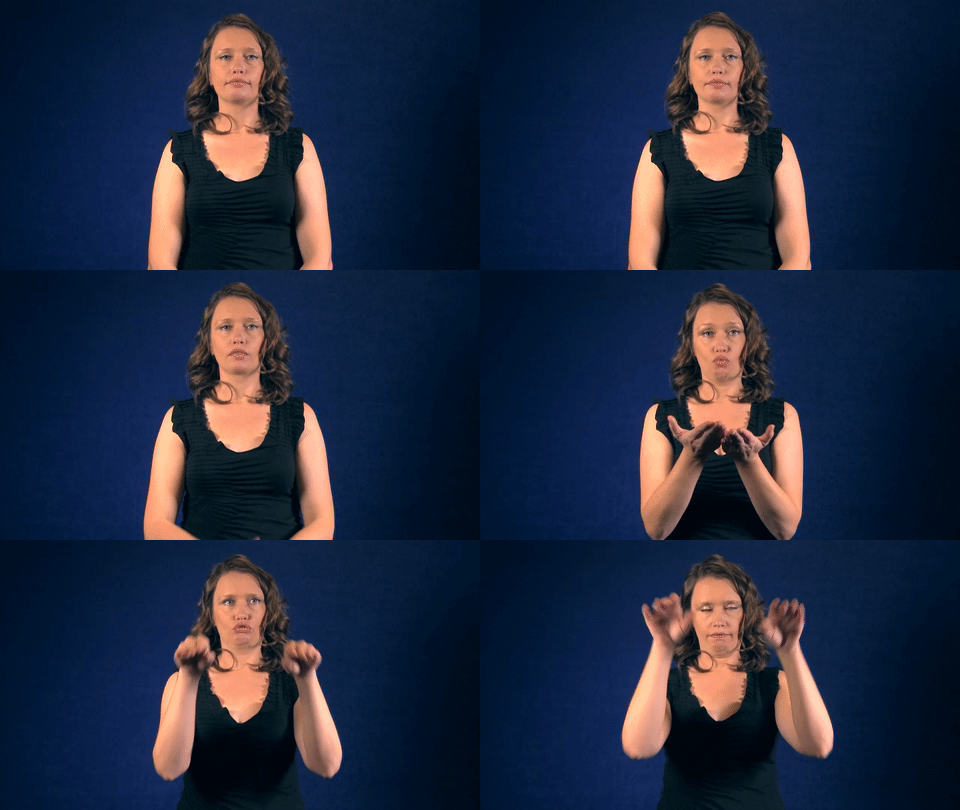
Sign for BOOKSHELVES in ASL | 📚 ASL Dictionary

Definition: Shelves for storing books.

Sign for BOOKSHELVES in ASL

YouTube player

Practice Activities:

To practice the sign for BOOKSHELVES in ASL, begin by focusing on signing it in isolation. Use a mirror while signing to observe your form and handshape, ensuring accurate representation of the concept. Repeat the sign multiple times, varying your speed and facial expressions to become comfortable with fluid motion.

Next, incorporate the sign into simple sentences. For example, sign phrases like “I have bookshelves,” “Bookshelves are in the living room,” or “She cleaned the bookshelves.” Try modifying these by replacing the location or person involved. Record yourself for review or use a webcam to assess your production.

Choose five objects you might place on bookshelves, such as books, photos, trophies, plants, or candles. Sign a short sentence about how each is arranged on the bookshelves to build vocabulary links and improve storytelling fluency. This will also help you internalize both the sign for BOOKSHELVES in ASL and related signs.

Practice storytelling by describing a room. Set the scene with where the bookshelves are, what they hold, and how they are organized. Try phrases like “In the office, the bookshelves are full,” or “The top of the bookshelves has decorations.” Share your short story with a classmate or practice in front of a mirror to get feedback.

Work with a partner to take turns describing different types of bookshelves. One person signs while the other guesses the room or describes their own version back. This encourages both comprehension and expressive skills using the sign for BOOKSHELVES in ASL.

Finally, play a categorization game by sorting visuals into “would go on bookshelves” and “would not.” Sign each item’s name and state whether it belongs. This fun activity reinforces vocabulary and contextual use of spatial concepts.

Cultural Context:

In American Sign Language, the sign for BOOKSHELVES represents more than just a piece of furniture—it’s a reflection of how deaf culture values access to knowledge and visual learning. The sign for BOOKSHELVES in ASL is rooted in the concept of space, structure, and categorization, which are important in both language and daily life in the Deaf community.

When signing BOOKSHELVES in ASL, spatial arrangement is key. ASL often uses classifiers to show shapes, sizes, and positions, which makes the sign for BOOKSHELVES visually descriptive and easy to understand. This visual component aligns with the way Deaf individuals navigate and process information.

The need for BOOKSHELVES is closely tied to how education and information are embraced in Deaf culture. Physical books are a valuable resource for ASL users, even in the digital age. Many Deaf households and classrooms use bookshelves not just for storage, but as a way of organizing stories, lessons, and resources shared within the community.

Using the sign for BOOKSHELVES in ASL during conversation might come up when talking about school, home, libraries, or organizing personal items. It reflects not only a literal object but also the importance of having a structured and knowledge-rich environment. Children learning ASL often learn this sign in early education settings as part of their classroom vocabulary.

In Deaf culture, the sign for BOOKSHELVES in ASL can also symbolize accessibility to language and information. Since ASL is a visual language, being able to point to, reference, or describe objects like bookshelves helps create meaning in context. This makes communication clear and culturally appropriate.

You’ll often see the sign for BOOKSHELVES in ASL used when discussing home design, study environments, or even creating visually appealing backgrounds for video calls. These scenarios show how everyday signs reinforce identity and connection in the Deaf community. It’s not unusual for Deaf creators and educators to sign BOOKSHELVES in ASL when giving virtual tours or describing their workspaces.

The physical presence of bookshelves in Deaf-run spaces also reflects pride in education and community storytelling. The sign for BOOKSHELVES in ASL acts as a bridge between language and lifestyle. It represents a shared understanding of how we relate to our surroundings and communicate our interests.

ASL classifiers are often paired with the sign for BOOKSHELVES in ASL to show specific design details, such as number of shelves, size

Extended Definition:

The sign for bookshelves in ASL involves a combination of signs that represent the concept of books and the structure of a shelf. This compound sign helps communicate the idea of where books are stored by showing both the items and their arrangement. It allows for visual clarity when discussing furniture or storage space in conversations.

To create the sign for bookshelves in ASL, you typically start with the sign for book, which is made by bringing both flat hands together and opening them like a book. Then, to indicate the shelf part, palm-facing hands are held parallel to represent horizontal surfaces, repeating to show multiple levels. This sequence visually conveys shelves that hold books.

The sign for bookshelves in ASL is commonly used when discussing furniture, home organization, libraries, or school settings. When expressing the layout of a room or describing its contents, including the bookshelves helps paint a complete picture. Using this sign aids in giving detailed visual descriptions in both casual and formal ASL conversation.

In everyday conversation, this sign is practical and often necessary, especially when giving directions or describing objects in a room. For instance, mentioning the sign for bookshelves in ASL can help locate an item, suggesting it is stored or placed somewhere on the bookshelf. This makes it a useful sign to learn for storytelling and day-to-day communication.

ASL relies heavily on spatial awareness, and the sign for bookshelves in ASL makes good use of this. By visually mimicking the layout of stacked shelves, the sign makes it easy for the viewer to understand the orientation and number of shelves. Signers can modify the sign based on how many shelves are being referenced, adding even more context.

The sign for bookshelves in ASL also integrates well with other related signs like book, read, or furniture. This flexibility helps in forming complex sentences or detailed descriptions without needing to fingerspell or break the flow of conversation. Over time and with practice, this sign becomes an integral part of a signer’s vocabulary.

Teaching the sign for bookshelves in ASL to students or beginner signers enhances their understanding of spatial references and everyday vocabulary. Because bookshelves are a common object in homes, offices, and classrooms, the sign becomes immediately relevant and easy to practice. It also helps reinforce the concept of compound signs within ASL structure.

When searching for information about this sign or trying to learn it online, it’s helpful to look for clear video demonstrations. Visual learning is a key aspect of acquiring ASL vocabulary, and seeing the sign for

Synonyms: bookcases, shelving units, wall shelves, display racks, library shelves

Educational resources: Find related learning materials in our course bank!

Want more? Check out some of our popular learning activities on the homepage!

Need to look up a sign? Use our highly rated dictionary: https://aslinteractive.com/best-asl-dictionary/

Follow us on tiktok: https://www.tiktok.com/@aslinteractive. More social media links at the bottom of this page!

Long-tail Keywords: what is the sign for bookshelves in ASL, how do you sign bookshelves in ASL, ASL sign for bookshelves

Categories:

tags: Objects in the Classroom, Classroom Picture, Language Learning, Facilities and other locations/needs, Housing

Parameters

*Handshape*:

The handshape for the sign for BOOKSHELVES in ASL typically combines the signs for BOOK and SHELVES. For BOOK, both hands use flat B handshapes, palms together, then open like a book. To represent SHELVES, the dominant hand traces horizontal levels forward from the body using flat B or horizontal 5 handshapes.

This compound format helps clearly illustrate multiple shelf units stacked vertically. When signing the sign for BOOKSHELVES in ASL, be mindful of consistent spacing and fluidity to effectively convey the concept .

*Palm Orientation*:

The palm orientation for the sign for BOOKSHELVES in ASL starts with both palms facing each other and open, resembling a book, as in the sign for BOOK. After that, the dominant hand may mime placing shelves onto a vertical surface, typically using flat hands with palms facing outward or downward, depending on the depiction of multiple shelves .

Throughout the sign for BOOKSHELVES in ASL, the palm orientation remains consistent with how one would naturally indicate stacked horizontal surfaces on a vertical space. Each shelf placement gesture often uses downward or slightly outward palm orientations, visually building the idea of bookshelves.

*Location*:

The sign for BOOKSHELVES in ASL typically takes place in the neutral space in front of the body, approximately at chest level. Both hands are used to mimic the structure of multiple shelves, starting from the top and moving down in an arc or horizontal motion to indicate levels.

For clarity, the location allows enough space to represent the separation between each “shelf” of the bookshelves. This visual cue helps convey the layered concept embedded in the sign for BOOKSHELVES in ASL .

*Movement*:

To show the sign for BOOKSHELVES in ASL, begin by signing BOOK by placing both flat hands together palm-to-palm, then opening them like a book . Next, use your dominant hand in a bent B shape and simulate placing books on invisible shelves in front of you. Move the hand horizontally from left to right at chest level, repeating this shelf-placing motion two or three times.

The sign for BOOKSHELVES in ASL incorporates a combination of classifier use and spatial referencing. Use both hands to trace multiple horizontal lines in the air, each representing a shelf. This mimics the concept of a bookshelf layered with sections, reinforcing the visual structure of the word.

*Non-Manual Signals*:

When performing the sign for BOOKSHELVES in ASL, maintain a neutral to slightly raised eyebrow expression to signal that you are describing a physical object or layout. Your facial expression should show focus and clarity, reinforcing the descriptive nature of the sign.

The non-manual signals help emphasize the spatial aspect of the sign for BOOKSHELVES in ASL. Slight head tilts or directional gaze may support the classifier handshapes, showing the placement or structure of shelves.

*Prosody, Dominant/Non-Dominant Hand*:

The sign for BOOKSHELVES in ASL typically uses both hands. Start by signing BOOK with flat hands opening like a book. Then follow with a depiction of SHELVES by using both dominant and non-dominant hands in flat-B handshapes, moving horizontally outward in layered levels, like placing shelves on a wall.

The dominant hand usually mirrors the non-dominant as you show multiple shelf levels. This spatial structure helps convey the physicality of bookshelves. The sign for BOOKSHELVES in ASL incorporates visual indexing, making the concept clear and intuitive .

Tips for Beginners:

When learning the sign for BOOKSHELVES in ASL, it helps to break it down into the compound parts: BOOK + SHELVES. Start by making sure you have a clear and accurate sign for BOOK. This is usually formed by placing both palms together like a closed book, then opening them outward like the pages of a book. Practice this motion smoothly and cleanly to make the base sign understandable.

For the SHELVES part, you’ll mimic the structure of shelves in space by tracing horizontal lines at different levels in the air. Use your flat hands to “build” the shelves in front of you. It’s common to indicate two or three shelves, depending on the context. Maintain spatial consistency when placing the shelves so your visual representation is logical and clear.

Many beginners forget to use proper space when combining these signs. In the sign for BOOKSHELVES in ASL, visual clarity is everything. Imagine where the bookshelves would be in real life and place the signs where they would naturally appear. This enhances both understanding and expression.

Facial expressions and body orientation also play a role. Keep your hands steady, and don’t rush. One common mistake is placing the shelf signs too close together, making it hard to distinguish multiple shelves. Separate your arms shoulder-width apart when appropriate to show dimension.

If you’re unsure how many shelves to show or how to space them, observe native signers or watch trusted video resources. Practice signing in front of a mirror to track your handshape and movement. The more you internalize the physical layout of the sign for BOOKSHELVES in ASL, the more natural and clear your signing will become. Frequent repetition will help reinforce muscle memory and spatial awareness.

Connections to Other topics:

The sign for BOOKSHELVES in ASL connects directly to the core concepts of physical objects and spatial relationships. It combines the signs for BOOK and SHELF or utilizes classifiers to show multiple shelves stacked vertically. This builds on the learner’s understanding of how ASL illustrates objects in three-dimensional space, a crucial skill when describing locations or interior layouts.

Understanding the sign for BOOKSHELVES in ASL also deepens comprehension of compound signs. BOOK and SHELF can be signed individually or merged smoothly using classifiers to show structured levels, depending on context. For example, in a classroom description or when giving a home tour, showing the number and orientation of the shelves helps provide a more detailed visual picture.

The sign for BOOKSHELVES in ASL ties closely to other signs related to furniture and home or library items. It pairs well with signs like TABLE, CHAIR, and CABINET, allowing users to build descriptive scenes in conversations about rooms. When discussing where items are located, signs such as ABOVE, NEXT-TO, and UNDER help place the bookshelves spatially.

Classifier use is amplified with the sign for BOOKSHELVES in ASL. A descriptive classifier (CL:LL or CL:BB) may show the shape, size, or arrangement of the shelves, while a locative classifier can indicate where they are placed in a room. This approach is also relevant when describing multiple items stored on shelves, such as BOOKS or BOXES, using a sweep motion to indicate repetition.

Lastly, the sign for BOOKSHELVES in ASL encourages visual storytelling, which is essential in ASL narratives. Whether describing a library scene or arranging furniture in a new apartment, combining directional verbs, classifiers, and spatial mapping brings meaning to life. This layered complexity reinforces fluency by encouraging learners to sign with space grammar and visual accuracy .

Summary:

The sign for BOOKSHELVES in ASL is a compound construction that combines the sign for BOOK and a classifier or depiction of shelf space or stacking. To form the sign, you first demonstrate the sign for BOOK by placing your two flat hands together at the palms, then opening them as if representing the pages of a book. This represents the basic concept of a book, a printed or digital source of knowledge.

After initiating the sign for BOOK, you transition to indicating shelves. This is commonly expressed by using flat B hands to mimic layers of horizontal structures, spacing them vertically downward to resemble stacked shelving units. This second part transforms the singular idea of a book into a spatial reference to where books are stored.

The sign for BOOKSHELVES in ASL is constructed visually, which makes it deeply rooted in the spatial-visual modality of the language. Unlike English, which relies heavily on spoken syntax and abstract representation, ASL uses positioning and orientation to convey rich spatial concepts. This sign shows how space in ASL acts as a grammar layer itself.

This sign functions as a noun and can act either as a subject or an object within a sentence. For example, if signing “I organize my bookshelves,” the sign is positioned with possessive indication and clear object marking. When constructing ASL grammar, the use of space and eye gaze is important to clarify what belongs to whom.

Grammatically, the sign fits into the broader category of compound nouns in ASL. Many compound nouns involve representing one object followed by an iconic classifier for location, container, or use. In this case, both parts are necessary: one denotes the item, and the other indicates the environment or housing unit.

Because the sign uses classifiers, it may vary depending on the exact type of bookshelves being described. A tall bookshelf versus a wall-mounted shelf might prompt a different spatial arrangement or additional height emphasis using non-manual markers like raised eyebrows or chin movement. This flexibility once again highlights the rich morphological system of ASL.

The sign for BOOKSHELVES in ASL also opens a window into culturally specific learning, especially in Deaf education environments. Books and physical book storage remain a fundamental aspect of Deaf schools and institutions like Gallaudet University. The presence of bookshelves often symbolizes knowledge access, community, and structured learning.

In Deaf culture, visually organized spaces are essential. Bookshelves are not just furniture; they reflect how resources are arranged for accessibility. The sign, in turn, captures not only the semantic idea of storage but the cultural necessity of visual organization in Deaf spaces.

As the world moves to digital platforms, some signers modify or contextually shift the sign for BOOKSHELVES in ASL to mean digital library or cloud-based book storage. This doesn’t change the core handshapes but may include gestures that indicate conceptual movement toward a digital or virtual plane, such as swiping or tapping signs afterward.

There is a connection between the sign for BOOKSHELVES in ASL and other furniture or placement concepts with similar classifier use. Signs for CABINETS, DRAWERS, and DESKS may use a similar approach: object + location classifier. This shows linguistic consistency in how ASL handles compound concepts.

Children learning ASL acquire signs like BOOKSHELVES through environmental exposure. Seeing classroom setups is often their first encounter with such layered compound signs. In language acquisition, composed signs like this test a child’s ability to process both iconographic imagery and spatial grammar, simultaneously enriching their linguistic and cognitive skills.

From a sociolinguistic perspective, regional dialects may introduce slight variations in how the shelf component of the sign is formed. In some ASL communities, horizontal slicing gestures are preferred, while in others, vertical stacking is emphasized. These differences highlight the dynamic, living nature of the language.

Applied linguistics research into ASL signage reveals that signs like BOOKSHELVES illuminate how users spatially map spoken noun chains. Rather than listing multiple adjectives or descriptors like in English, ASL stacks semantic meaning through visual tiers. This adds depth to our understanding of how classifiers and spatial referencing convey complex objects.

When interpreted live, the sign for BOOKSHELVES in ASL may invite expansion or visualization depending on the context. For instance, if a speaker is narrating the importance of home libraries or classroom setups, the interpreter may use directional variation and mouth morphemes to add size, shape, and variety to the sign. This dynamic adaptability underscores the uniquely performative aspects of sign language.

Broadly, the sign forms part of a category of household and academic environment vocabulary taught early in ASL education. It appears in curriculum designed for early learners and as foundational in interpreting vocab lists. The sign is also relevant in discussions about interior design or organization, which can be seen in lifestyle and Deaf vlogs expressed in ASL.

Another cultural detail embedded in this sign is the layered meaning of “ownership and agency.” When a Deaf individual

Want more? Check out some of our popular learning activities!

ASL Interactive Resources

ASLInteractive YouTube Channel

Follow us on tiktok: @aslinteractive.com

Follow us on Instagram: aslinteractive

Facebook page: aslinteractive

Facebook group: aslinteractive

LInkedIn: ASL Interactive LLC

Twitter: @ASL_interactive

*Some information on this page is AI-generated. AI can make mistakes. Please check the information.

Sign for BOOKSHELVES in ASL

Responses