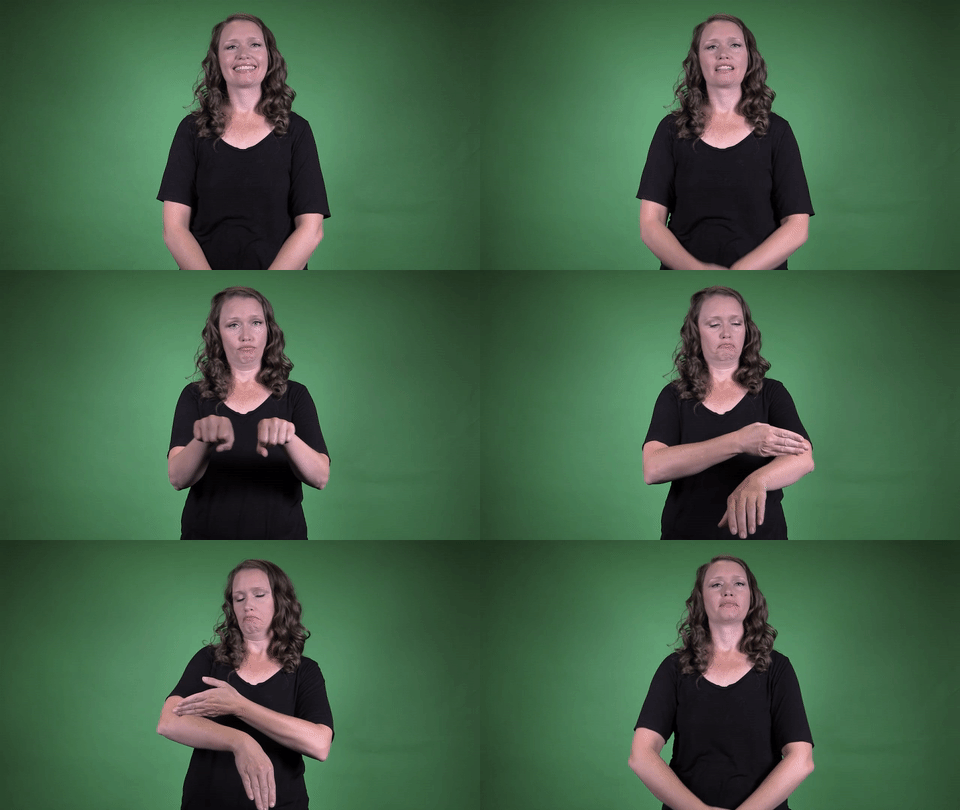
Sign for BOOTS in ASL | 🥾 ASL Dictionary

Definition: A type of footwear.

Sign for BOOTS in ASL

YouTube player

Practice Activities:

To practice the sign for BOOTS in ASL, begin by using a mirror to watch yourself sign. Focus on the correct hand shape and movement, imagining you are indicating the height of boots on each leg. Repeat the sign slowly, then increase speed while maintaining accuracy. Sign it several times in a row, pausing to self-correct any errors.

Incorporate the sign into common clothing vocabulary. Practice pairing the sign for BOOTS in ASL with words like “coat,” “hat,” “scarf,” and “jeans.” This will help reinforce the vocabulary as it’s often used in descriptive contexts. Create short phrases such as “I wear boots in winter” or “She has red boots” and sign them aloud.

Try storytelling exercises that involve changing weather or outdoor settings. For example, create a short narrative about going outside in the snow, including signs like “cold,” “snow,” and “boots.” Another idea is a short skit about shopping for shoes, where the characters try on boots and different kinds of footwear. This helps strengthen situational use and expressive fluency.

Use flashcards with pictures of different kinds of boots, like hiking boots, rain boots, and cowboy boots. Show the card to a partner or yourself, then sign the item and describe it briefly using size, color, or purpose. Questions like “What kind of boots do you wear to work?” can become part of a partner dialogue session.

For fun group practice, play charades with a theme of clothing where players take turns signing items without speaking. Others must guess the sign. Ensure the sign for BOOTS in ASL makes repeated appearances to reinforce visual memory and expressive confidence.

Taking the time to use the sign for BOOTS in ASL in different formats will help improve both receptive and productive skills in real-life communication.

Cultural Context:

In American Sign Language, clothing signs like the sign for BOOTS in ASL carry more than just practical meaning. They reflect how Deaf culture connects with the visual and expressive nature of communication. Signers often use descriptive signs to show details about style, use, or function, which adds depth to simple vocabulary.

The sign for BOOTS in ASL is usually demonstrated with a motion that shows the length or style of the footwear. This kind of signing gives context in real-time, helping others understand whether someone is referring to ankle boots, rain boots, or even work boots. Signers often adapt this sign depending on the discussion, providing flexibility and clarity through visual description.

Clothing signs, including the sign for BOOTS in ASL, also serve as a way to express one’s identity, profession, or lifestyle. For example, boots can suggest outdoor work, fashion choices, or even protection from weather. Within the Deaf community, signs like this help convey both functional and social meanings in conversation.

Deaf culture values accessibility and clarity, and descriptive ASL signs such as the sign for BOOTS in ASL help keep communication quick and effective. When talking about fashion or describing someone’s outfit, signers can use the sign for BOOTS in ASL as part of a larger message that reflects style or context.

This sign is also used when teaching vocabulary in school or language classes. Learning the sign for BOOTS in ASL supports both expressive and receptive skills. Teachers often use real boots or images alongside the sign to help reinforce understanding, making the vocabulary more memorable and connected to real-life experiences.

ASL signs like the sign for BOOTS in ASL are influenced by cultural trends and generational shifts. As new styles of boots become popular, the way signers describe them may evolve too. Some may modify the basic sign slightly to clarify between modern, fashionable designs and more traditional styles.

The Deaf community often embraces creativity and personalization in signs, and footwear is no exception. While the standard sign for BOOTS in ASL is generally understood, regional or age-based variations may exist. These natural differences show how language in the Deaf world reflects both individuality and shared understanding.

In storytelling or visual poetry within Deaf culture, wearable items like boots can carry metaphorical meanings. A character wearing boots might symbolize travel, stubbornness, or even protection, and the sign for BOOTS in ASL helps bring that imagery to life in a rich, visual way.

Social media has also played a part in

Extended Definition:

The sign for boots in ASL is a useful and practical vocabulary word, especially when discussing clothing or preparing for different types of weather. American Sign Language offers a visual and expressive way to describe all kinds of footwear, and boots are no exception. Whether you’re talking about winter gear, construction wear, or fashion, the sign for boots in ASL is one you’ll want to know.

To sign boots in ASL, you generally use both hands to mimic the shape and positioning of boots around your calves. The sign typically involves pointing your index fingers out and tapping them against each side of your lower legs. This motion visually represents where boots would typically reach on your legs, making it easy to remember.

The sign for boots in ASL fits naturally into a conversation about clothing or style. It’s a great term to use when shopping, describing outfits, or planning for a seasonal wardrobe. If you’re teaching kids or beginners ASL related to apparel, adding this sign will help expand their vocabulary quickly.

In classroom settings, educators often introduce the sign for boots in ASL during lessons on weather or jobs where protective clothing is needed. It’s particularly relevant when teaching how to describe snow gear, construction clothing, or firefighter uniforms. Adding visual context with pictures of boots can further enhance understanding while signing.

Boots come in all styles—rain boots, cowboy boots, hiking boots—and the versatility of ASL allows speakers to use the same sign while clarifying the type through additional context. For example, you might sign boots in ASL and then indicate rain or outdoor activities to give more detail. This helps broaden the conversation and makes communication more vibrant.

Using the sign for boots in ASL in everyday life is simple and effective. Whether you’re packing for a trip, choosing your outfit for the day, or getting kids ready for school, knowing this sign helps foster efficient and engaging communication. It also encourages more use of ASL in day-to-day conversations, which supports long-term retention and fluency.

This sign is particularly helpful in Deaf and hard-of-hearing communities where visual cues play a major role in understanding. Adding the sign for boots in ASL to your vocabulary ensures you’re ready to join conversations that center around clothing, fashion, or weather events like snow or rain. It’s one of many clothing-related signs that can form part of a more complete wardrobe discussion.

Parents teaching their children ASL will find that signs like boots are easy and fun for kids to learn. Introducing signs tied to practical, everyday items helps build a

Synonyms: Boots, footwear, shoes, hiking boots, work boots

Educational resources: Find related learning materials in our course bank!

Want more? Check out some of our popular learning activities on the homepage!

Need to look up a sign? Use our highly rated dictionary: https://aslinteractive.com/best-asl-dictionary/

Follow us on tiktok: https://www.tiktok.com/@aslinteractive. More social media links at the bottom of this page!

Long-tail Keywords: what is the sign for boots in ASL, how do you sign boots in ASL, ASL sign for boots

Categories:

tags: Clothing, Language Learning, Activities, Footwear, Describing Appearance

Parameters

*Handshape*:

The handshape used in the sign for BOOTS in ASL involves both hands in a modified “B” handshape. Fingers are extended and together, with thumbs tucked in against the palms.

To produce the sign for BOOTS in ASL, the hands are positioned flat and are moved outward along the sides of the forearms or lower legs, mimicking the placement of footwear. This sign visually represents the height and location of boots on the legs.

*Palm Orientation*:

For the sign for BOOTS in ASL, both hands are typically used. The index fingers are extended while other fingers are tucked in, resembling the shape of boots. The palm orientation is inward, with both palms facing each other. Hands are held in front of the body at about hip level.

The movement emphasizes tapping or drawing a line down the sides of the forearms or lower legs. This positioning helps convey the length and placement of boots, reinforcing the concept in the sign for BOOTS in ASL .

*Location*:

The sign for BOOTS in ASL is produced at about mid-torso level, directly in front of the body. This neutral space allows for clear visibility of the movement, which focuses on the wrists and hands drawing lines indicative of boot outlines.

The location does not require contact with the body, making the sign easy to perform and comprehend. Because of its placement, the sign for BOOTS in ASL is accessible for a wide range of users and suitable for everyday conversation.

*Movement*:

To make the sign for BOOTS in ASL, begin with both hands in index finger shapes (like pointing). Hold them at about waist level, with palms facing inward and fingertips pointing forward. Move the hands downward slightly and apart so that the fingers trace the sides of imaginary boots.

This movement mimics the outline of tall boots, as if indicating their height on your lower legs. The sign for BOOTS in ASL emphasizes footwear that extends above the ankles, clearly differentiating it from shoes.

*Non-Manual Signals*:

When demonstrating the sign for boots in ASL, maintain a neutral facial expression with slight eye focus on the hands to support clarity. A casual, composed demeanor reflects the literal nature of the sign, as it typically depicts the structure of footwear.

Occasionally, slight eyebrow movement may occur to match the tone or context, but avoid excessive facial emotion. This helps ensure the viewer focuses clearly on the hand movements of the sign for boots in ASL .

*Prosody, Dominant/Non-Dominant Hand*:

The sign for BOOTS in ASL uses both hands in an index finger shape. The dominant and non-dominant hands are held in parallel and point downward, mimicking the shape or position of boots. The dominant hand taps or slides against the non-dominant wrist area, often near where boots would be worn.

To perform the sign for BOOTS in ASL, maintain a steady rhythm and spacing between the hands. This prosodic movement helps emphasize the length or presence of boots, making the meaning clear in context .

Tips for Beginners:

The sign for BOOTS in ASL is simple but requires attention to hand placement and movement. To sign it, hold both flat B-hands in front of you and move them down the sides of your legs, mimicking the shape or coverage of a boot. This motion adds context, letting the viewer understand the type of footwear you’re referring to. Practicing in front of a mirror helps align your hand movements and avoid errors.

When learning the sign for BOOTS in ASL, be mindful of your facial expressions and body orientation. Signing too quickly or without the appropriate positioning can make it look like you’re referencing something else entirely. Be sure to keep your hands open, palms facing in, and move them smoothly from the mid-thigh area down toward the knees.

Beginners often confuse the sign for shoes with the sign for BOOTS in ASL. While shoes involve a tapping movement, boots focus on length, and that’s shown by the downward stroke on the legs. Practicing side-by-side comparisons of footwear-related signs can be helpful to build vocabulary distinctions.

It’s also essential to remember that the size or type of boot doesn’t drastically change the sign. Context will help communicate whether you’re referring to rain boots, cowboy boots, or winter boots. You can pair this sign with descriptive classifiers or fingerspelling for clarity when needed.

Try practicing the sign for BOOTS in ASL in everyday situations, like when discussing weather or going shopping. Repetition will help solidify muscle memory and increase your signing fluency. If possible, sign with a partner or record yourself for feedback and improvement.

Lastly, stay consistent with your movements and handshape. The cleaner your sign, the easier it will be for others to understand you. Think of the motion as tracing the height of a boot, and stay relaxed to keep your signing natural and expressive.

Connections to Other topics:

The sign for BOOTS in ASL is closely related to the concept of clothing and accessories. It typically involves a gesture that outlines the shape or length of the boots on one’s lower legs. This connection helps learners link the sign to other signs for clothing items like SOCKS, SHOES, or PANTS, all of which involve placement and spatial awareness.

In ASL, classifiers and descriptive signs often accompany the sign for BOOTS in context-heavy conversations. For example, describing the style of the boots—such as tall, short, or rugged—might involve combining the sign for BOOTS with size or texture classifiers. This is similar to how other clothing signs, like HAT or JACKET, are expanded for more detail.

The sign for BOOTS in ASL can also be used in discussions of weather and work attire. It often appears when talking about winter gear or occupations that require heavy footwear, like construction or farming. In such contexts, learners may see compound sign groupings like WORK-BOOTS or SNOW-BOOTS, using classifier or descriptive signs alongside the main sign.

This sign reinforces the ASL principle of iconicity—where signs visually resemble the object they represent. The gesture mimicking footwear height helps reinforce its meaning and makes it distinct from other footwear signs. Learners who understand this can better differentiate between related signs and interpret the meaning more fluently.

In children’s conversations or in storytelling, the sign for BOOTS in ASL may appear with expressive facial grammar to indicate something like “splashing in puddles” or showing the heaviness of wearing boots. These expressive techniques tie into broader ASL features such as role-shifting, spatial mapping, and classifiers that enrich the language.

Understanding the sign for BOOTS in ASL can make it easier for learners to grasp the patterns of how clothing signs are structured, described, and used interactively in real-life conversations.

Summary:

The sign for BOOTS in ASL is a straightforward depiction of footwear, mimicking the length and shape of boots worn on the lower leg. Typically, both index fingers are used to draw a vertical line along the sides of the lower leg, emphasizing the height of the boots. This visual representation allows the viewer to instantly grasp the concept of extending footwear as opposed to shorter shoes.

To make the sign, place both hands in index finger shape (also known as the “1-handshape”). Bring your hands down in parallel on each side of the lower part of your legs. This is usually done from mid-calf down to the ankle area, depending on how tall the boots are that you want to represent.

The orientation can be adjusted slightly based on the type or style of boots you are describing. For example, cowboy boots, hiking boots, or fashion boots might be followed by descriptive classifiers or images via additional signs. ASL may also combine the general sign for BOOTS with adjectives like “tall,” “black,” or “leather” to give nuance.

Facial expressions play a subtle but important role when signing BOOTS in ASL, especially to convey affection, sarcasm, or disapproval connected with specific looks. A proud, confident facial expression can indicate fashionable boots, while a playful scowl might mean big or awkward-looking ones. These expressions enrich the narrative without additional signs.

The sign for BOOTS in ASL is contextually flexible. It can appear in various sentence structures, including declarative, interrogative, imperative, and negation formats. This grammatical flexibility allows signers to discuss anything from fashion preferences to practical needs like winter or work boots.

ASL allows for expansion and linguistic layering through classifiers after signing BOOTS. For instance, after the base sign, you may use a classifier to show the act of putting on boots, walking in them, or exaggerating their size. This dynamic capacity prevents the language from being rigid, ensuring more natural storytelling.

Culturally, boots can indicate identity groups, especially in American settings. Cowboy boots often suggest a Western rural lifestyle, military boots hint at service affiliation, while sleek designer boots may imply urban fashion sensibilities. The sign for BOOTS in ASL, when used within Deaf communities, can carry these same cultural connotations, giving it a layered interpretation.

Among Deaf fashion influencers or vloggers, the sign for BOOTS in ASL is often accompanied by expressive handshapes and exaggerated facial markers to inject vibrancy. It not only shows how functional footwear is but captures its role in visual self-expression. This further illustrates how ASL constructs personal style through visual storytelling.

The sign modifies well in plural usage. To indicate more than one pair of boots, a simple pluralization marker like repeated motion or added quantifiers may be used. ASL tends not to rely on suffixes for plural forms, so its expressiveness turns toward repetition or numerical incorporation.

In discussion of clothing or packing lists, the sign for BOOTS in ASL typically follows the general item structure: object description followed by color, type, use, or quantity. This keeps the syntax clean and efficient, guiding the viewer visually from the general to the specific. The efficiency mirrors how ASL centers visuals and space in its grammatical design.

The versatility of the sign for BOOTS in ASL also supports discourse in education. Teachers may use it during lessons on weather, clothing, professions, or even during storytelling involving different characters. It becomes a multifunctional term embedded within broader educational goals, especially in early language acquisition.

In storytelling contexts, especially around seasons, the sign for BOOTS in ASL comes to life. Winter stories, rainy-day adventures, and even Halloween costumes often include this sign. It enriches scenes, establishing weather, mood, or character identity quickly and memorably.

ASL classifiers interact meaningfully with the BOOTS sign. For instance, a signer might use a “CL:1” to mimic walking in boots, highlighting weight or awkwardness. This tactile space manipulation transforms static vocabulary into moving, context-rich experience.

Aside from fashion and utility, boots carry metaphorical meaning in English—phrases like “pull yourself up by your bootstraps” or “the boot drops.” While these idioms don’t translate directly, ASL culture is rich in idiomatic expressions too, and the sign for BOOTS in ASL may be replaced by metaphor-specific signs to match the conceptual idea.

In practical usage, this sign is essential when discussing safety gear or occupational wear. Construction workers, soldiers, climbers—all wear boots. ASL vocabulary adapts for these discussions, often incorporating fingerspelling or compound signs (e.g., BOOTS + WORK to indicate work boots).

In linguistics, the sign’s construction demonstrates iconicity—a core principle where form mirrors meaning. The spatial movement and shape of the sign directly resemble the item it represents. This iconic nature makes it intuitively easy to learn, even for non-native

Want more? Check out some of our popular learning activities!

ASL Interactive Resources

ASLInteractive YouTube Channel

Follow us on tiktok: @aslinteractive.com

Follow us on Instagram: aslinteractive

Facebook page: aslinteractive

Facebook group: aslinteractive

LInkedIn: ASL Interactive LLC

Twitter: @ASL_interactive

*Some information on this page is AI-generated. AI can make mistakes. Please check the information.

Sign for BOOTS in ASL

Responses