Sign for BORROW in ASL | 🙇 ASL Dictionary

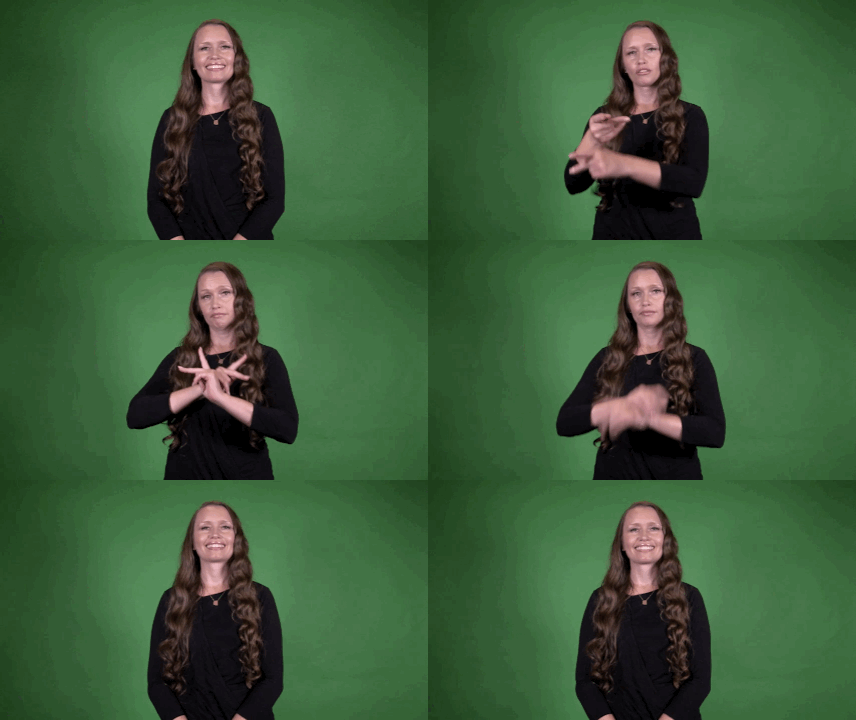
Definition: Borrow in ASL is signed by forming a “K” handshape with both hands, stacking one on top of the other, and moving them slightly towards your body as if taking something temporarily.

Sign for BORROW in ASL

YouTube player

Practice Activities:

To build confidence using the sign for BORROW in ASL, begin with isolated sign practice in front of a mirror. Sign the word slowly, concentrating on correct handshape and movement. Focus on maintaining clarity between signs like LEND and BORROW, which can be confused because of similar structure.

Next, pair the sign with common objects in your environment. Point to items like books, keys, or a phone and then sign BORROW to create associations. This will help you develop fluency when combining the sign with nouns. For example, practice saying phrases like “Can I borrow your book?” or “I need to borrow a pen” in sign language.

Use storytelling prompts to support memory and context-based learning. Tell a short story using the sign for BORROW in ASL, such as a time you borrowed a computer from a friend or when someone borrowed your jacket. As you tell the story, include facial expressions and appropriate non-manual markers to show the intent and mood.

Use partner activities to practice signing dialogues. One person can sign a question using BORROW, and the other can respond with agreement or objection. For instance, practice exchanges like “Can I borrow your car?” followed by, “Sure, bring it back at 5,” or “Sorry, I need it today.”

Watch videos of native ASL users signing BORROW in various contexts. Pause and try to copy the sign exactly. Follow up by recording yourself using the sign in sentences and reviewing for accuracy.

To reinforce fluency, play a game like “Sign Charades” where you act out a situation with BORROW and others guess what is happening. Regular repetition of the sign for BORROW in ASL within interactive and real-life simulations boosts long-term retention and signing confidence.

Cultural Context:

In American Sign Language, understanding cultural context is essential when using the sign for BORROW in ASL. This sign goes beyond a direct translation and carries social meanings rooted in Deaf culture. When someone uses the sign for BORROW in ASL, it’s understood that the item will be returned, and there’s often a shared trust between the signer and the person they are signing with.

In Deaf communities, communication tends to be very straightforward, but also deeply respectful. Using the sign for BORROW in ASL reflects a mutual understanding and an implied agreement. It’s not just about taking something temporarily—there is an expectation of accountability.

Body language and facial expressions are a big part of how meaning is conveyed when signing. The sign for BORROW in ASL is often accompanied by a questioning expression or a nod, depending on the context. These non-manual markers help specify the level of urgency or formality, and they’re important to maintain clarity and respect.

The sign for BORROW in ASL is commonly used in everyday conversation, especially in schools, Deaf events, and other community spaces. Items like pens, books, laptops, or chargers are typical things people may refer to when using this sign. Because interactions in Deaf culture are very community-oriented, borrowing is seen as a temporary, cooperative exchange—often with an assumption of goodwill.

It’s not uncommon for Deaf people to use the sign for BORROW in ASL when asking for help or requesting assistance with something non-material. This might include borrowing someone’s time or asking for support with a task. In contexts like these, the sign takes on deeper social meaning and signals trust within the relationship.

When teaching the sign for BORROW in ASL, educators often emphasize the importance of follow-through. Asking to borrow something and then not returning it can harm relationships within the community. Because the language is so visually rich, the absence of follow-through becomes even more noticeable, reinforcing the value placed on responsibility.

In many situations, the sign for BORROW in ASL can also be modified slightly with movement or expressions to reflect a plural form, such as borrowing multiple items. The cultural context still applies—whether it’s one object or many, the understanding is that what’s borrowed will be returned. This shared value is a foundation in many Deaf interactions.

Technology and digital tools are now part of daily life, so the sign for BORROW in ASL has grown to include more modern requests. For example, someone might ask to borrow a phone charger or headphones using

Extended Definition:

The sign for borrow in ASL uses a movement that mirrors the concept of temporarily taking something with the intention to return it. It is based on the sign for “loan” or “loaning” and involves two “K” handshapes. These hands start upright and move forward together, away from the signer, symbolizing the act of borrowing from someone.

In American Sign Language, directional movements play a role in verbs like borrow. The direction can indicate who is borrowing from whom. For example, if you are borrowing from someone else, the motion goes away from your body. If someone is borrowing from you, the motion goes toward your body.

The context of the conversation is essential when using the sign for borrow in ASL. Facial expressions, body language, and eye gaze help provide clarity, showing whether the action is polite, urgent, casual, or serious. ASL is a visual language, and much of its meaning comes from how a sign is performed rather than just the handshape or movement alone.

The sign for borrow in ASL shows the temporary nature of the action. It differs from signs like “take” or “steal,” which have more permanent or unauthorized meanings. Teaching the difference between borrow and these other signs can help clarify communication and avoid misunderstandings.

When performing the sign for borrow in ASL, it is helpful to consider the setting. Whether you’re in a classroom, at home, or in a professional environment, the details in how the sign is delivered may change slightly to suit the tone. Children and beginners learning ASL often practice this sign because it’s part of everyday social interactions.

Learning the ASL sign for borrow helps users communicate needs, such as borrowing a pen, a book, or even money. This makes it a practical vocabulary word for anyone using signing in daily life. Teachers, interpreters, and students use this sign frequently in different contexts.

As with many ASL verbs, borrow can become more complex when combined with other signs. You might sign borrow with an added time sign to indicate when the item will be returned. This type of grammatical structure is typical in ASL and helps provide fuller meaning without needing extra spoken words.

The sign for borrow in ASL is part of a broader category of verbs called agreement verbs. These are verbs that can show subject and object relationships through movement. It makes communication faster and more intuitive for conversational ASL users.

For those learning ASL or using it professionally, mastering the borrow sign can improve flu

Synonyms: borrow, take on loan, lend temporarily, get on loan, borrow meaning

Educational resources: Find related learning materials in our course bank!

Want more? Check out some of our popular learning activities on the homepage!

Need to look up a sign? Use our highly rated dictionary: https://aslinteractive.com/best-asl-dictionary/

Follow us on tiktok: https://www.tiktok.com/@aslinteractive. More social media links at the bottom of this page!

Long-tail Keywords: what is the sign for borrow in ASL, how do you sign borrow in ASL, borrow in American Sign Language

Categories:

tags: borrow, verbs, everyday activities, language learning, actions

Parameters

*Handshape*:

The handshape for the sign for BORROW in ASL uses both hands in an “H” handshape, with the index and middle fingers extended together and the remaining fingers tucked in. These handshapes are mirrored, representing two people or objects interacting.

To perform the sign for BORROW in ASL, the dominant “H” hand rests on top of the non-dominant “H” hand, and then both move forward together. This motion symbolizes the temporary sharing of an item, key to the meaning of the sign.

*Palm Orientation*:

For the sign for BORROW in ASL, both hands are in the “K” handshape and start in front of the body. The palms face forward, away from the signer, with fingers slightly tilted inward. As the motion proceeds, the hands move forward and slightly upward while maintaining the same palm orientation.

The sign for BORROW in ASL mirrors the sign for LEND but is directed toward the signer rather than away. This consistent palm orientation helps differentiate the direction of action, reinforcing who is borrowing or lending.

*Location*:

The sign for BORROW in ASL is made in the neutral space directly in front of the chest. Both hands use the “K” handshape and are stacked one over the other, palms facing outward. The hands move forward slightly from the chest area.

This location is consistent in most variations of the sign for BORROW in ASL, maintaining accessibility and clarity during communication. It remains between mid-torso and upper chest levels, allowing comfortable signing without strain.

*Movement*:

To produce the sign for BORROW in ASL, start with both hands in an “H” handshape (index and middle fingers extended and together, thumb tucked under). Palms face forward. Place the dominant hand on top of the non-dominant hand so both “H” hands are stacked parallel.

Move both hands forward in a small arc away from the body simultaneously. This movement suggests the concept of temporarily transferring something. The sign for BORROW in ASL distinguishes itself from the sign for LEND mainly through directionality. ⬅️➡️

*Non-Manual Signals*:

When using the sign for BORROW in ASL, the facial expression should match the context of the request or situation. A questioning look with slightly raised eyebrows is common if you’re asking to borrow something . If you’re stating that you borrowed, a neutral or mild nod may accompany the sign. These non-manual signals help convey the tone and intent alongside the sign for BORROW in ASL.

*Prosody, Dominant/Non-Dominant Hand*:

The sign for BORROW in ASL uses both hands in a mirrored, forward movement. The dominant and non-dominant hands form the H handshape and start with fingertips touching, palms facing down. Both hands move together slightly forward in the direction of the recipient, as if offering shared items.

In the sign for BORROW in ASL, the motion resembles handing over or temporarily sharing something. This sign visually conveys the concept of a temporary exchange or lend.

Tips for Beginners:

When learning the sign for BORROW in ASL, pay attention to the handshape and movement. This sign uses both hands in an “H” handshape, starting from your body and moving outward. The dominant hand rests on top of the non-dominant hand, and both move forward together in a slight arc. This movement shows a transfer, indicating something being borrowed.

One great tip is to practice with a mirror to make sure your handshapes are accurate and that the movement looks natural. Many beginners confuse borrow with lend, which uses the same sign but with the opposite direction. For the sign for BORROW in ASL, make sure the movement goes away from you to show you are borrowing from someone else.

Facial expressions are also important in reinforcing meaning. Use a polite or questioning expression if you are asking to borrow something. This supports the tone of the message and can prevent misunderstandings in conversations. Adding proper expression will help convey whether it’s a request or a statement.

A common mistake when learning the sign for BORROW in ASL is using incorrect hand orientations. Keep the “H” handshapes horizontal and make sure they are aligned. Also, don’t forget to move both hands together. Practicing in slow motion can help build coordination and reinforce muscle memory.

Context helps determine meaning, especially since lend and borrow share the same hand motion. Make sure your surrounding signs and expressions match the intent. Using phrases like “me borrow book you” or “can I borrow pen” can give practice in context.

Try signing with a partner or recording yourself. Watching your sign on video can help you catch subtle errors. Consistent, daily practice boosts confidence and helps reinforce how and when to use the sign for BORROW in ASL in real conversations.

Connections to Other topics:

The sign for BORROW in ASL is conceptually linked to signs that involve giving, receiving, or temporary exchange. It uses a directional movement that shows the handshape moving from the person giving to the person borrowing, which mirrors the structure of GIVE and TAKE. This directional quality helps learners understand how certain ASL verbs shift meaning based on movement and orientation.

There is a strong relationship between the sign for BORROW in ASL and the sign for LEND. Both use the same handshape, often a “K” hand on each hand, but the movement direction is reversed to reflect who is giving and who is receiving. This visual and spatial grammar emphasizes ASL’s rich use of classifiers and directional verbs that can represent subject and object roles without separate signs for pronouns.

The concept behind BORROW also connects with signs like HELP, SHARE, or EXCHANGE, which deal with mutual or cooperative actions. Compound expressions arise when using BORROW with time indicators, as in BORROW-YESTERDAY or BORROW-LONG-TIME, informing the context of how long something is being borrowed. These combinations show ASL’s ability to build nuanced meaning using spatial and temporal modifications.

In daily conversation, the sign for BORROW in ASL is often used with facial expressions or classifiers to specify what is being borrowed, like money, books, or tools. For instance, a signer might show the shape of a book after BORROW to indicate the item. This demonstrates how ideas are layered visually in ASL for more precise communication.

Learning the sign for BORROW in ASL can also support a deeper understanding of responsibility and permission in Deaf culture. It emphasizes the importance of clear intent and mutual respect. ASL learners can better grasp this when they explore pragmatic use, like when kids ask to borrow toys or adults discuss borrowing items for work.

Summary:

The sign for BORROW in ASL is elegantly constructed using a compound of the sign for “person” and a directional verb concept. It uses both hands in a shape that mimics the concept of giving and receiving, reflecting the mutual aspect of borrowing something. The movement of the sign shows a shift from the giver to the receiver, typically from the signer toward the other person.

The handshape involves both hands forming the “K” handshape (index and middle fingers extended and together, thumb tucked under). These hands are placed on top of one another and move forward slightly. This motion symbolizes the act of temporarily transferring possession from one person to another.

The directional element in the sign for BORROW in ASL is critical to its grammatical function in a signed sentence. Directional verbs in ASL change movement to point to the subject and object of an action. In this case, the signer modifies the starting and ending location of the sign based on who is borrowing from whom.

This grammatical flexibility allows the sign to be highly expressive without requiring additional signs for the subject or object. For example, signing it from yourself toward someone indicates that you are lending; conversely, signing it from someone toward yourself indicates that you are borrowing.

In ASL linguistics, the sign for BORROW in ASL exemplifies how classifiers and movement create semantic meaning. It’s not just about form—it’s about how that form maps onto the real-world concept of temporary exchange. That connection between form and function is essential in producing intuitive, spatially-organized communication.

This sign also highlights the economy of signing in ASL. Where English might need a sentence like “Can I borrow your pen?”, ASL can communicate the same idea more succinctly through directional usage and non-manual signals (NMS), such as facial expressions that serve to indicate the level of politeness or the urgency.

The cultural values of the Deaf community often place importance on clarity, respect, and directness. Using the sign for BORROW in ASL within social situations often comes with expected reciprocity, just as in many spoken cultures. However, when using this sign in Deaf culture, there is often also an unspoken rule about accountability—what you borrow, you must return.

From a semantic viewpoint, the concept of “borrow” inherently includes the temporariness of possession and an implied return. ASL conveys this subtly through its movement and context rather than explicitly stating it. Body orientation, eye gaze, and non-manual markers help reinforce this temporality when signing.

Often, the sign for BORROW in ASL is juxtaposed with the sign for LEND, which uses the same base movement but initiated from the opposite person. This pairing is an example of how ASL maximizes its use of space and visual-spatial orientation to show nuanced relationships.

The spatial grammar of this sign is particularly noteworthy in conversations involving multiple entities. When a signer refers to several people borrowing or lending items, they can anchor different subjects and objects in different areas of the signing space. This turns the interaction into a form of gestural mapping that tracks who is doing what to whom.

In classroom settings, when teaching the sign for BORROW in ASL, instructors encourage students to understand the sign within narratives. Creating situations where one must borrow something and sequence events highlights the verb’s temporary and transactional nature, reinforcing both vocabulary and syntax.

Related signs such as BUY, TAKE, or STEAL involve similar handshapes or movements but differ in ethical or temporal implications. BUY involves an exchange and permanent change of ownership. TAKE may be neutral or imply force, while STEAL adds an ethical frame of wrongdoing. BORROW, in contrast, implies trust and social responsibility.

Understanding how the sign for BORROW in ASL differs from related signs helps deepen a student’s ability not just to sign fluently, but to reason and communicate clearly. These distinctions often prompt discussions in Deaf studies classes about how society conceptualizes ownership and permissions.

The pedagogical approach to this sign also includes the discussion of cognates and false cognates between spoken English and ASL. For English learners of ASL, BORROW might seem intuitive, but the directionality and NMS components make it a sign that requires practice to master.

In applied linguistics, the sign for BORROW in ASL provides an example of how modality shapes grammatical expression. Because ASL is a visual language, it leverages motion and space to convey meanings that spoken languages might convey through auxiliary verbs or modal constructions.

For example, a raised eyebrow when signing BORROW can turn the phrase into a question—”Can I borrow it?”—without needing any additional sign. This integration between form and facial grammar enriches the expressive potential of the sign and aligns with ASL’s visual-spatial modality.

As more ASL becomes accessible online and in multimedia learning environments, the sign for BORROW in ASL is increasingly included in tutorials that emphasize its directional grammar. It’s a commonly used verb in everyday

Want more? Check out some of our popular learning activities!

ASL Interactive Resources

ASLInteractive YouTube Channel

Follow us on tiktok: @aslinteractive.com

Follow us on Instagram: aslinteractive

Facebook page: aslinteractive

Facebook group: aslinteractive

LInkedIn: ASL Interactive LLC

Twitter: @ASL_interactive

*Some information on this page is AI-generated. AI can make mistakes. Please check the information.

Sign for BORROW in ASL

Responses