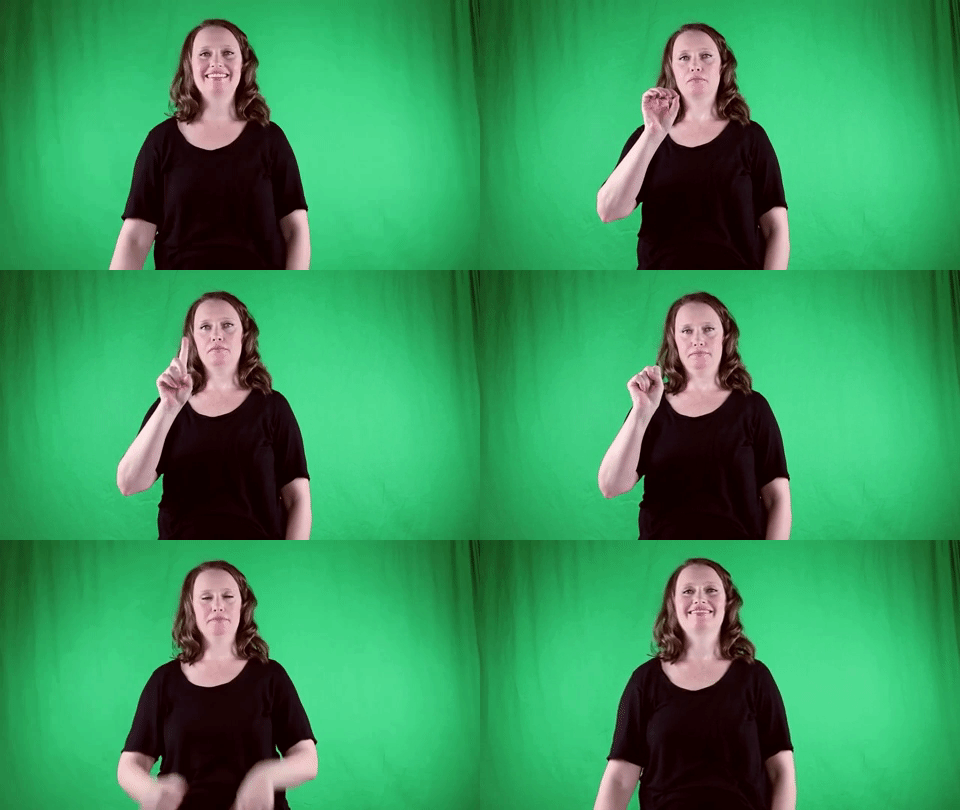
Definition: A donut shop.
Sign for BOSA DONUTS in ASL

Practice Activities:
To begin practicing the sign for BOSA DONUTS in ASL, start by fingerspelling each part of the name clearly and smoothly. Practice the fingerspelling slowly at first: B-O-S-A for the brand name, followed by D-O-N-U-T-S. Repeat the full phrase several times in front of a mirror to monitor your hand shape, orientation, and pace.
Once you are comfortable fingerspelling it in isolation, integrate the sign for BOSA DONUTS in ASL into simple sentences. For example, sign “I LOVE BOSA DONUTS” or “YESTERDAY I WENT TO BOSA DONUTS.” This will help reinforce sentence flow as well as fingerspelling fluency. Try adding signs for flavors like CHOCOLATE, STRAWBERRY, or GLAZED to expand your vocabulary in a fun context.
Use storytelling as a practice tool. Create a short narrative such as, “I woke up, got in my car, and drove to BOSA DONUTS,” combining sequential and location-related signs. This helps build comfort using the business name in more detailed ASL discourse. Make sure to focus on transitions and facial expressions to give your story life.
Partner practice can be fun and effective. One person fingerspells BOSA DONUTS in ASL and gives a clue, while the other has to guess the sentence or the type of donut described. This kind of interactive learning can really help with recall and speed.
Another good idea is to role-play ordering at a donut shop using the sign for BOSA DONUTS in ASL. Practice signing, “HELLO, I WANT TWO DONUTS FROM BOSA DONUTS,” or “WHERE IS BOSA DONUTS?” This activity can prepare you for real-life interactions in ASL involving location and ordering vocabulary in everyday contexts.
Cultural Context:
The sign for BOSA DONUTS in ASL reflects a broader connection between American Sign Language and popular regional culture. As a beloved donut chain primarily based in the southwestern United States, BOSA DONUTS has become a recognizable name in many communities. When people seek the sign for BOSA DONUTS in ASL, they’re often looking for a way to talk about local favorites within the signing community.
Incorporating branded names into ASL is a growing trend, especially with businesses like BOSA DONUTS that have strong local recognition. The sign for BOSA DONUTS in ASL may vary slightly depending on region, signer familiarity, and context. Typically, signs for specific businesses can involve fingerspelling or invented signs that capture an idea associated with the brand.
ASL is a living language that evolves along with culture, and signs for places like BOSA DONUTS are great examples of this evolution. Community members often come up with variations of a sign based on how frequently they interact with or talk about a certain location. When searching for the sign for BOSA DONUTS in ASL, some may rely on fingerspelling BOSA, followed by an existing sign for donuts .
This blending of a unique company name with a common food sign shows how flexible ASL can be. The sign for BOSA DONUTS in ASL is often used in discussions about favorite donut shops, weekend routines, and local businesses. It helps create a sense of shared experience in the Deaf community when talking about everyday places.
Deaf-owned and Deaf-friendly businesses sometimes adopt signs created by the community, which gives the sign more traction and acceptance. If enough people use the same sign for BOSA DONUTS in ASL, it helps it become more widely understood. Some ASL users might sign BOSA as an initialized sign using the “B” handshape, while others may prefer clear fingerspelling for accuracy.
Brand names in ASL are also useful when describing directions, meetups, or events happening at a BOSA DONUTS location. Using the right sign for the place helps build fluency and engagement in social conversations. When videos or content include the sign for BOSA DONUTS in ASL, it not only spreads language awareness but also strengthens connections within the signing community.
For students learning ASL or for interpreters, knowing regional signs like this one adds depth to their vocabulary. The sign for BOSA DONUTS in ASL
Extended Definition:
The sign for BOSA DONUTS in ASL is a proper noun used to represent the donut chain known as Bosa Donuts, popular for its fresh pastries and drinks. Since brand names often don’t have a widely recognized sign, the sign for BOSA DONUTS in ASL typically combines fingerspelling with a visual classifier for “donut.”
To sign BOSA DONUTS, you would first fingerspell B-O-S-A clearly and smoothly. After spelling out the brand name, you transition into the generic sign for “donut,” which involves a motion showing a round shape or mimicking the act of biting into a donut. This combination tells the viewer both who and what is being talked about.
In American Sign Language, it’s common to spell out brand names unless they’ve become widely used enough in the Deaf community to develop unique signs. For now, the most accepted sign for BOSA DONUTS in ASL involves this two-step format: fingerspelling and then signing the object. This approach ensures clarity and accuracy when discussing specific businesses or products.
Some Deaf users might also perform a slight directional movement or facial expression with the donut sign to indicate personal preference or familiarity with Bosa Donuts. These small changes can convey excitement or a recommendation, enhancing how a person shares their experience with a place like Bosa Donuts using ASL. It’s a beautiful example of the expressiveness of sign language.
Visual classifiers after the brand name can also help illustrate what kind of donut is being referred to, especially if someone is talking about a particular item on the menu. You could add a sign for “glazed,” “chocolate,” or even use size and shape indicators to talk about larger or more unique pastries. This keeps the conversation in ASL both fun and informative.
When teaching or learning the sign for BOSA DONUTS in ASL, it’s a great opportunity to discuss how proper nouns and commercial names are treated in sign language. It encourages both cultural understanding and technical signing practice. For ASL students, brands like Bosa Donuts offer familiar reference points that help build vocabulary and signing accuracy.
Always fingerspell slowly enough for the other person to recognize B-O-S-A, especially if it’s the first time they’re hearing about the brand. Speed comes with practice, but clarity should always come first. This is especially true for brand names, which may not be instantly identifiable without spelling.
Whether you’re describing a weekend trip to grab a treat or inviting
Synonyms: Bosa Donuts, Bosa Doughnuts, Bosa’s Donuts, Bosa Doughnut Shop, Bosa Donuts Cafe
Educational resources: Find related learning materials in our course bank!
Want more? Check out some of our popular learning activities on the homepage!
Need to look up a sign? Use our highly rated dictionary: https://aslinteractive.com/best-asl-dictionary/
Follow us on tiktok: https://www.tiktok.com/@aslinteractive. More social media links at the bottom of this page!
Long-tail Keywords: What is the sign for Bosa Donuts in ASL, How do you sign Bosa Donuts in American Sign Language, Bosa Donuts ASL sign
Categories:
tags: Donuts, Food, Snacks, Brands, Locations
Parameters
*Handshape*:
The handshape used for the Sign for BOSA DONUTS in ASL involves fingerspelling each letter of “BOSA DONUTS” using the standard ASL alphabet. This means forming each letter individually with your dominant hand in clear, fluid motions, making sure the palm orientation and finger placement are correct per ASL rules.
During the Sign for BOSA DONUTS in ASL, your fingers should remain firm but relaxed to maintain clarity. Each letter—B, O, S, A, D, O, N, U, T, S—is articulated with smooth transitions, keeping the hand at chest level for easy visibility .
*Palm Orientation*:
For the sign for BOSA DONUTS in ASL, both words are typically fingerspelled. While fingerspelling, the palm orientation stays mostly forward, facing the viewer, to ensure clear visibility of each letter. This is especially important when signing names like BOSA DONUTS, which rely on precise hand positioning and visibility.
During the sign for BOSA DONUTS in ASL, hands remain at a neutral level with the palm angled slightly out or side-facing if in a conversational stance. Adjustments to palm orientation might occur naturally depending on the signer’s positioning, but clarity is always the focus.
*Location*:
The sign for BOSA DONUTS in ASL uses fingerspelling, so the location is primarily in the neutral space just in front of the chest. Both hands stay within a comfortable signing area, keeping movements clear and visible to the viewer.
When fingerspelling the sign for BOSA DONUTS in ASL, maintain steady hand placement to avoid shifting out of frame. The fingers are angled slightly outward, with the dominant hand neatly forming each letter across from the upper torso.
*Movement*:
To produce the sign for BOSA DONUTS in ASL, begin by fingerspelling each letter of “BOSA” using steady, clear movements. The dominant hand forms each letter in sequence—B-O-S-A—while held in front of the upper chest, maintaining a comfortable pace for clarity and accuracy .
Next, sign “DONUTS” by mimicking the motion of twisting a donut on the index finger of your non-dominant hand using an X-handshape. The movement should feel circular and playful, reflecting the shape and fun nature associated with donuts. This full combination captures the Sign for BOSA DONUTS in ASL effectively.
*Non-Manual Signals*:
When signing the Sign for BOSA DONUTS in ASL, maintain a neutral to slightly pleasant facial expression to reflect the casual and friendly context often associated with food or brand names. Eyebrows remain in a relaxed position, and eyes may briefly glance toward each hand during the fingerspelling to ensure clarity.
Depending on the pace, subtle mouthing of the word “Bosa Donuts” can accompany the sign, but it’s not required. Keep your head steady, avoiding excessive movement, which helps maintain focus on the fingerspelled portion of the Sign for BOSA DONUTS in ASL.
*Prosody, Dominant/Non-Dominant Hand*:
To express the sign for BOSA DONUTS in ASL, both hands are used for fingerspelling. The dominant hand fingerspells B-O-S-A, followed by D-O-N-U-T-S. Each letter is clearly articulated using the ASL manual alphabet, and the hand remains at shoulder height, slightly outward near the dominant side, keeping wrist steady and fingers relaxed.
Since BOSA DONUTS is a proper noun, the sign for BOSA DONUTS in ASL relies solely on fingerspelling. Make sure to maintain steady eye contact and natural rhythm while fingerspelling to improve clarity.
Tips for Beginners:
When learning the sign for BOSA DONUTS in ASL, it’s important to understand that proper names of businesses are typically fingerspelled. For practice, break the name into manageable parts—first fingerspell B-O-S-A, then follow with D-O-N-U-T-S. Practice each segment slowly and accurately using the correct handshapes. Keep your fingers relaxed and spaced evenly to avoid cramping and to improve precision.
Consistency in finger movement and orientation is key for clarity. Begin with your dominant hand in signing space, near your shoulder, and keep the movement smooth and readable. It’s a good idea to practice the transitions between the segments so that you’re not pausing awkwardly between BOSA and DONUTS. A common mistake is rushing through the fingerspelling, which can make the sign unclear to your viewer. Instead, aim for clarity over speed.
Facial expression isn’t as vital when fingerspelling names like in the sign for BOSA DONUTS in ASL, but natural facial engagement supports overall communication. To strengthen your receptive skills, watch videos of native signers fingerspelling and try to recognize the name BOSA DONUTS in different speeds and accents. Pair up with a practice partner to finger spell and receive the name for better fluency.
Review fingerspelling basics daily, especially the less commonly used letters like B or S, to speed up recognition and recall. Also, remember that in casual signing environments, some signers may abbreviate or modify repeated names for convenience, but fingerspelling remains the most consistent format for brand names. Keep a mirror nearby as you practice so you can self-correct on angles and spacing.
The sign for BOSA DONUTS in ASL will look more natural over time as fingerspelling becomes more automatic. Don’t get discouraged early on—everyone struggles with speed and legibility at first. Keep practicing short practice sessions throughout the week rather than overloading your fingers in one sitting.
Connections to Other topics:
The sign for BOSA DONUTS in ASL typically uses fingerspelling for the proper noun “Bosa” followed by the sign for “donuts.” This approach aligns with how other business names or branded terms are usually represented in American Sign Language. Proper names that are not commonly established signs in the Deaf community are most often fingerspelled to preserve accuracy and clarity.
The process of combining fingerspelling with a standard sign connects the sign for BOSA DONUTS in ASL to other similar signs that represent food chains or local establishments. For example, signs like STARBUCKS or DUNKIN DONUTS often use a similar structure: fingerspelling the name followed by the generic sign for the product or service offered. This pattern helps reinforce the broader principle of specificity in ASL when referring to unique or brand-based items.
Learning the sign for BOSA DONUTS in ASL can also help users practice transitional techniques between fingerspelling and signing a concept. This is a common feature in ASL when moving from proper nouns to tangible objects or actions. A good example of this transition might be fingerspelling “Bosa” and then seamlessly using the familiar “O” shape in one hand to depict the shape of a donut, a common strategy for showing round foods.
This combination also allows learners to explore classifiers and conceptual accuracy. Since donut signs can resemble other round foods like bagels or cookies, context and handshape become critical, especially when distinguishing BOSA DONUTS in ASL from other food-related signs. Engaging with this variety supports a deeper understanding of sign clarity, nuanced classifiers, and brand differentiation.
Finally, mastering the sign for BOSA DONUTS in ASL offers an opportunity to discuss Deaf-friendly businesses and community-specific references. When signs are derived from local or cultural points of interest, they often serve as conversation points and deepen engagement with Deaf culture and shared spaces.
Summary:
The sign for BOSA DONUTS in ASL begins with the understanding that “BOSA” is a proper noun, referring to a specific brand or franchise of donut shops, and as such, it is typically fingerspelled. This preserves the brand identity and maintains clarity in communication among signers.
To render the sign for BOSA DONUTS in ASL accurately, one would first fingerspell B-O-S-A. The handshapes transition smoothly through the letter sequence using the dominant hand in front of the body, usually at upper chest height.
Following the fingerspelling of BOSA, the word DONUTS can be signed in one of a few acceptable variations depending on regional usage or personal preference. A common way is to show the act of holding and eating a donut using a circular motion of the dominant hand to indicate the shape.
Another recognized version of the sign for DONUTS involves a tapping motion on the side of the mouth, representing powdered sugar or a bite, indicating familiarity and the consumable nature of the food. This sign tends to reflect ways that Deaf culture emphasizes visual and experiential meaning in signs.
The combination of fingerspelling BOSA and following it with the generic sign for DONUTS ensures that the communication is both brand-specific and understandable. It reflects the blending of proper noun adaptation into ASL with food item categorization.
Culturally, the sign for BOSA DONUTS in ASL gives insight into how Deaf communities engage with branding. Fingerspelling is not just a bridge for English terms into ASL but also a tool that allows incorporation of branded entities into everyday conversations.
When using the sign for BOSA DONUTS in ASL, context is vital. The fingerspelled BOSA often requires familiarity among conversational participants, or it can be clarified with accompanying facial expressions or classifiers to show it is a donut shop.
In terms of grammatical placement, BOSA DONUTS typically operates as a proper noun phrase. It can function as the subject or object in a sentence, such as “I GO BOSA DONUTS” or “YOU LIKE BOSA DONUTS?”
Applied linguistics provides additional insights into the sign for BOSA DONUTS in ASL. For instance, the use of loan signs or initialized signs is not applicable here due to the necessity of preserving brand specificity through fingerspelling.
The repetition of the sign for DONUTS after BOSA strengthens the semantic association, especially in casual conversation or descriptive storytelling about food experiences. This categorization approach helps in contextual blending of nouns, places, and actions within ASL syntax.
Visual classifiers may also be used alongside or after the sign for BOSA DONUTS in ASL. These might include miming the act of biting into a donut or showing a shelf of baked goods to reinforce the setting and topic.
Localization of fingerspelling plays a role in how the sign for BOSA DONUTS in ASL is expressed. Accents in fingerspelling can vary by region or age group, contributing to slight changes in rhythm or speed of the hands.
The expressiveness of ASL allows personalization of the sign for BOSA DONUTS. For example, a signer may alter facial expressions while signing it, from smiling to cheek puffing, communicating taste satisfaction or indulgence.
In educational settings, the sign for BOSA DONUTS in ASL might be used to teach fingerspelling fluency, categorization of food signs, or in dialogues about brand culture. It provides an authentic context to apply language learning in thematic units.
The intersection of branding and Deaf culture is evident in fingerspelled loanwords. However, with BOSA DONUTS, there is no universal abbreviated sign or lexicalized format, so fingerspelling BOSA is required to maintain authenticity.
Lexical borrowing in ASL often bypasses typical sign creation when a term does not yield a meaningful visual representation. For BOSA DONUTS, fingerspelling suffices for the brand name, while visual-temporal spatial use reinforces location and selection of signs.
While DONUTS has considered variations across signing communities, the concept of donut — as a circular sweet treat — tends to be universally understood due to its physical and cultural distinctiveness. This helps the sign for BOSA DONUTS in ASL stay consistent in usage.
Content creators and social media influencers who use ASL might fingerspell BOSA in stylized ways for visibility or aesthetic consistency. This adds a performative layer, but standard conversational ASL remains rooted in clear, culturally grounded practice.
Students learning about the sign for BOSA DONUTS in ASL often explore food-related vocabulary together to contextualize nouns. This also extends into how topics like breakfast, cafés, or popular hangouts are discussed within Deaf culture.
Grammar in ASL relies heavily on topic-comment structure, and the sign for BOSA DONUTS in ASL naturally integrates into this. A sentence might begin with the topic
Want more? Check out some of our popular learning activities!
ASL Interactive Resources
ASLInteractive YouTube Channel
Follow us on tiktok: @aslinteractive.com
Follow us on Instagram: aslinteractive
Facebook page: aslinteractive
Facebook group: aslinteractive
LInkedIn: ASL Interactive LLC
Twitter: @ASL_interactive
*Some information on this page is AI-generated. AI can make mistakes. Please check the information.


Responses