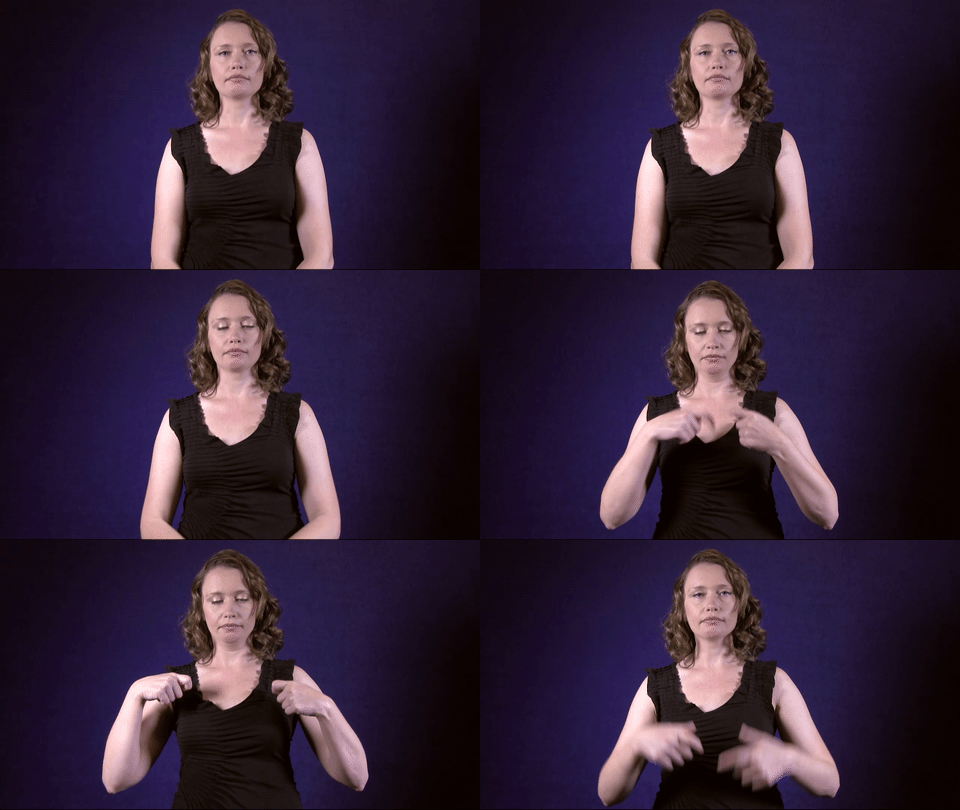
Definition: To bend the upper part of the body forward.
Sign for BOW in ASL

Practice Activities:
To become more comfortable using the sign for BOW in ASL, begin by practicing the sign on its own in front of a mirror. Focus on the body movement and posture, since this sign typically involves a forward bend at the waist, showing respect or stage performance. Repeat the sign multiple times at different speeds while keeping it clear and consistent.
Next, use the sign for BOW in ASL within basic phrases like, “I take a bow,” or “She bowed on stage.” Practice forming full sentences in ASL structure to incorporate the sign naturally. Record yourself signing these phrases and evaluate your facial expressions and accuracy. Facial expression is key for showing the purpose of the bow—respect, performance, or submission.
Create a short story involving characters who bow in different settings. Your story might include a performer bowing after a play, a person bowing to show respect at a ceremony, or someone teaching a child how to bow. Incorporate the sign at appropriate moments as you narrate.
Engage in partner work by taking turns acting out short scenes, like ending a performance or greeting someone formally. Your partner can provide feedback on clarity and movement. Try doing mock performances where each person ends with the sign for BOW in ASL to reinforce the context.
Play a charades-style game where one person signs a scene using the sign for BOW in ASL, and others try to guess the context. This adds fun and variety to practice, while also reinforcing the various meanings this sign might convey.
Lastly, watch videos of native signers performing skits or stories that include the sign and try to mimic their movements and expressions. This will give you a better understanding of how the sign for BOW in ASL is used in fluent conversation.
Cultural Context:
The sign for BOW in ASL can change depending on the meaning and context of the word. In American Sign Language, many English words have several interpretations, and BOW is a perfect example. It can refer to a respectful gesture, a weapon accessory, or even a decorative knot, and each has a different ASL sign.
When referring to the respectful gesture, like bowing after a performance or as a cultural symbol of humility or respect, Deaf culture emphasizes facial expression and body movement. The sign for BOW in ASL in this context typically involves a forward tilt of the upper body, mimicking the motion of a person bowing. This version often conveys formality or acknowledgement.
In the context of a decorative ribbon bow, like those used in gift wrapping or fashion, a different ASL sign is used. This version of the sign for BOW in ASL is more visual and iconic, often performed with handshapes that represent the loops of a tied ribbon. When teaching this concept, Deaf artists and designers may even add stylistic flair to enhance visual clarity.
If BOW refers to the weapon used in archery, yet another sign is employed. The sign for BOW in ASL here mimics the action of pulling back an arrow in a bow. This version carries a strong visual likeness to real-life archery, and is commonly used when storytelling or discussing historical themes in the Deaf community.
Deaf culture holds storytelling and visual metaphors in high regard, so the sign for BOW in ASL may also be elaborated during performances or storytelling for clarity or drama. In established narratives, small variations in this sign can signal different characters or emotional tones. This versatility shows how the sign is more than just a word—it’s a cultural expression.
Understanding the correct sign for BOW in ASL requires deeper cultural awareness. In Deaf classrooms or performance settings, students are encouraged to explore all the variations of the sign based on these different meanings. This not only helps with communication but also fosters respect for the full range of Deaf experience.
When watching performances or attending events, you may witness how the sign for BOW in ASL is used in theatrical contexts. Performers will bow at the end of a show, each demonstrating their sign differently depending on formality, emotion, or character portrayal. The act of bowing has both linguistic and cultural significance for Deaf audiences.
Children in the Deaf community are taught these sign variations at a young age to strengthen expressive language skills.
Extended Definition:
The sign for bow in ASL can change depending on the context in which it’s used. In American Sign Language, signs often reflect the meaning and usage of the word in everyday situations. The sign for bow in ASL could refer to taking a bow after a performance, tying a bow as in a ribbon, or even using a bow for archery. Because of this versatility, it’s important to consider the situation to choose the appropriate sign.
When referring to taking a bow after a performance, like at the end of a play or dance, the sign mimics the actual body movement. You lean forward slightly at the waist, much as a performer would do on stage. This version of the sign for bow in ASL focuses on body movement more than hand configuration. It’s a natural and intuitive sign meant to reflect actual human behavior.
In a different context, if you want to show tying a decorative bow, such as on a gift or in your hair, the sign uses more specific handshapes. The dominant and non-dominant hands make a motion as if tying loops, mimicking the familiar movement of tying shoelaces or ribbon. This form of the sign for bow in ASL captures the shape and action behind creating a bow.
If you’re talking about a weapon, like a bow and arrow, the sign usually shows the drawing motion of stringing an arrow. One hand remains still to form the bow, and the other hand pulls back in a curved motion as if holding the string and arrow. The gesture represents the physical structure and use of a bow, making this sign both visual and functional.
All of these versions of the sign for bow in ASL are context-driven and rely heavily on visual depiction. ASL is a highly expressive language, and classifiers along with body language play a key role in communicating meaning. When signing, facial expressions and additional descriptive signs can add layers of information.
Regional dialects and personal style may also affect the sign you use. Some signs for bow in ASL might differ slightly from one community or age group to another. It’s always useful to double-check signs with native ASL users or local Deaf communities to ensure clarity and cultural relevance.
The sign for bow in ASL also holds significance in storytelling and stage interpreting. In those instances, accurate depiction of the gesture enhances understanding and immersion. Students learning ASL should explore these contextual signs to better understand the depth of the language.
If you’re using ASL in an educational or
Synonyms: bend, curve, arc, arch, flex
Educational resources: Find related learning materials in our course bank!
Want more? Check out some of our popular learning activities on the homepage!
Need to look up a sign? Use our highly rated dictionary: https://aslinteractive.com/best-asl-dictionary/
Follow us on tiktok: https://www.tiktok.com/@aslinteractive. More social media links at the bottom of this page!
Long-tail Keywords: what is the sign for bow in ASL, how to sign bow in American Sign Language, learn ASL sign for bow
Categories:
tags: Actions, Commands, Language Learning, Etiquette, Bowing
Parameters
*Handshape*:
The handshape used in the sign for BOW in ASL typically involves both hands open with flat palms, forming a “B” handshape. The fingers are extended and together, with the thumbs resting alongside the palms.
To perform the sign for BOW in ASL, both hands start near the chest and then move forward and down in a smooth motion, simulating the respectful gesture of bowing. This handshape effectively mirrors the body movement associated with a traditional bow.
*Palm Orientation*:
The palm orientation for the sign for BOW in ASL depends on the context. In the context of a respectful gesture (such as bowing to someone), both hands are generally open with fingers together, starting with palms facing inward toward the chest. As the person bends at the waist, the hands move forward and downward, maintaining an inward-facing orientation.
If referring to a bow like a ribbon, the sign may involve mimicking tying a bow, with the palm orientation changing throughout the motion. In this version of the sign for BOW in ASL, the initial palms may face each other and then rotate slightly depending on the motion of “tying.” Ensure this orientation complements the handshape used to properly convey meaning.
*Location*:
The sign for BOW in ASL is typically produced in the neutral space in front of the body or slightly closer to the upper torso, depending on the context. If referring to a theatrical or respectful bow, the signer leans forward slightly from the waist with hands open near the chest or at the sides, simulating the gesture.
For a bow as in archery, the sign is located in front of the chest or shoulder, mimicking the act of drawing a bowstring. Proper facial expressions and context will help clarify the meaning when signing the sign for BOW in ASL.
*Movement*:
To perform the sign for BOW in ASL, start with both open hands at chest level, palms facing down. Then, bend slightly at the waist while simultaneously moving both hands forward and down in a smooth, graceful arc, mimicking a person taking a bow after a performance.
The movement of the sign for BOW in ASL should flow naturally and show clear respect or acknowledgment, just like a theatrical bow. Keep the motion gentle and deliberate to effectively convey the meaning.
*Non-Manual Signals*:
The non-manual signals for the sign for BOW in ASL depend on the context—whether it refers to bowing as in bending forward or a bow as in an accessory or weapon. For the gesture of bowing, a slight forward tilt of the head and upper body with a soft facial expression mimics respect or gratitude. Maintain eye contact or lower your gaze slightly to enhance authenticity.
When referring to a decorative bow, widen your eyes slightly, smile gently, and nod subtly to reflect something cute or pretty. Facial expressions help reinforce the meaning, so your non-manual behaviors should match the specific version of the sign for BOW in ASL being used.
*Prosody, Dominant/Non-Dominant Hand*:
For the sign for bow in ASL, the dominant hand is typically used to mime the action of bowing. Both hands may be placed flat, with fingers together and palms down, near the upper body. The hands then move forward and slightly downward, accompanied by a slight head and upper body tilt to simulate a bow.
This sign for bow in ASL mimics respectful movement, often used in contexts such as performances or formal greetings. The non-dominant hand usually mirrors the dominant hand’s motion for balance and emphasis.
Tips for Beginners:
When practicing the sign for BOW in ASL, it’s helpful to understand the context in which you’re using the sign. BOW can describe a physical gesture, as in bowing at the waist, or it could refer to an object like a hair bow or a bow for archery. Each has a different sign or may require fingerspelling, so make sure you know which one you’re aiming for before you begin.
For the action of bowing, such as in a performance or a respectful greeting, the sign typically involves bending slightly at the waist with your arms loosely at your sides. Practice this with a fluid motion and without stiffness. Beginners often make the movement too sharp or shallow, which can look unnatural. Try observing native signers for a more realistic pacing and flow.
If the sign for BOW in ASL is referring to an object like a bowtie or a ribbon bow, this will usually involve descriptive classifiers or the use of FS (fingerspelling). In such cases, clarity in letter formation is critical. Keep your hand steady and maintain consistent spacing between letters. Practicing in front of a mirror can help with your accuracy and orientation.
One major tip is to consider facial expressions and body language. These should match the context—whether you’re bowing humbly, proudly, or playfully. ASL relies heavily on these non-manual markers, so avoid a neutral face when you’re signing an action like bowing.
Also, pay close attention to your posture during the sign for BOW in ASL. Over-exaggerating your movement can break the natural rhythm of signing and might confuse the viewer. Keep the motion smooth and proportionate to your body.
Lastly, rehearse the sign in everyday scenarios. Whether you’re acting out a bow during storytelling or fingerspelling B-O-W to describe an object, consistency and repetition will help strengthen your confidence and muscle memory.
Connections to Other topics:
The sign for BOW in ASL connects closely to body movement and gesture-based expressions, making it relevant when discussing signs that involve respect, greeting, or performance. ASL often uses pantomime or culturally specific gestures to represent formal actions, and bowing as a respectful or ceremonial gesture is a prime example. This aligns with signs like THANK-YOU, SALUTE, or CURTSY, which also draw on respectful or formal body motions.
The sign for BOW in ASL can shift in meaning based on context, especially when dealing with performing arts or traditional activities. In stage contexts, it connects to the signs for ACT, THEATER, and PERFORM, often indicating the conclusion of a performance. It may be incorporated into compound signs or interpreted alongside signs like APPLAUSE or ENCORE to reflect the full cultural moment of a bow at curtain call.
Some learners also confuse the sign for BOW in ASL with signs for BEND or LEAN because of the overlap in body movement. Understanding the subtle differences in the motion and context is essential for clarity. Additionally, the sign for BOW can appear as a classifier or part of classifiers when describing someone bowing before royalty or as part of a ritual, linking it to narrative and storytelling elements of ASL.
When discussing ceremonial bowing, such as in martial arts or cultural traditions, the term may be fingerspelled as (FS)BOW, especially to distinguish it from figurative uses. For example, in historical reenactments or religious rituals, the sign for BOW in ASL can be defined clearly by pairing it with signs like KING, SENSEI, or PRAY. Contextual cues play a significant role in choosing between a gestural representation and fingerspelling.
Overall, the sign for BOW in ASL serves as a bridge to many cultural and situational concepts, making it a versatile and expressive part of the language.
Summary:
The sign for BOW in ASL may have several interpretations depending on the context. It can refer to the act of bending at the waist to show respect or acknowledgment, or it may imply an object like a ribbon or bow used in decoration. Each context influences how the signer presents the concept with their hands and body.
When referring to a theatrical or formal bow, such as after a performance, the sign involves a slight forward motion at the waist, mimicking the actual gesture. This sign uses the entire upper body rather than just hand configurations, showing how ASL incorporates iconic movements. The signer typically tilts the head and torso forward in a fluid motion.
For a decorative bow, like one on a gift or in hair, the sign mirrors tying a bow. It is a two-handed movement mimicking the motion of making loops and pulling the ends of a ribbon. This representation helps convey the physical form and action behind the object, an example of ASL’s visual-spatial nature.
To clarify context, ASL users often rely on facial expressions and topic markers. In a conversation about performances, the sign for BOW in ASL is usually assumed to be the respectful gesture. In contrast, discussing fashion or gifts naturally implies the knot-like decorative version.
ASL is a context-rich language, so classifiers can also describe varied bow types. For example, a flat C handshape moving in a loop can act as a classifier to indicate a large ribbon tied in loops. Classifiers in ASL help expand upon nouns and give richer details.
The sign for BOW in ASL, when used in formal contexts like ceremonies or theater, can function alongside signs like APPLAUD or THANK-YOU. This allows a smooth narrative in signed performance environments. It contributes culturally to storytelling and performance-type interactions.
In narratives or plays translated into ASL, the sign for BOW often appears at the end, preserving the theatrical tradition. It connects signed performance with the broader history of performance and respect. This sign serves as a cultural bridge between hearing and Deaf practices.
From a linguistic perspective, the sign for BOW in ASL aligns with other iconic signs, where form follows physical resemblance. The act of bowing lends itself to easily understood representation. Iconicity in this sign reinforces its clarity for both native signers and visual learners.
Variations in how the sign is produced may be seen across different signing regions. Some may include more pronounced torso movement, while others might use minimal head tilting. These variations show natural language evolution and regional expression in ASL.
The grammatical usage of the sign for BOW in ASL includes its role as a verb. For example, “he bowed” would use a directional movement, embodied through the signer’s own bowing. This reinforces how the sign’s meaning is affected by body orientation and facial expression.
As a noun, the sign for a decorative bow is visually different, showing ASL’s flexibility between noun and verb indications. This fluid differentiation depends on movement context, showcasing ASL’s dynamic verb classes. Directionality and repetition can also help distinguish uses.
Deaf culture emphasizes visibility and performance, so gestures like bowing hold deeper meaning. The performative bow is not only respectful but expresses closure, gratitude, or humility. This builds interpersonal norms within the Deaf community, especially in visual expressions.
The bow as a decoration also holds significance in celebratory ASL contexts. At birthdays or ceremonies, the presence of a sign for BOW in ASL enhances shared visual storytelling. It also allows efficient references to symbolic items without fingerspelling.
In educational applications, teaching the sign for BOW in ASL helps children understand symbolic actions. Educators often link the sign to emotional expressions like pride, accomplishment, or humility. This supports socio-emotional development through sign language learning .
Applied linguistics finds value in how signs like BOW reflect gesture-universal concepts. The use of body as meaning-space allows language learners to comprehend abstract ideas. The visual experience reinforces embodied learning and memory retention.
In interpreter training, the sign for BOW in ASL is used as a case study in non-manual and manual blends. Interpreters must transition between different bow meanings based on cues and context. This nurtures advanced interpretation skills and situational accuracy.
The morphology of the BOW sign shows how minimal movement creates complex interpretation. With slight changes, the signer can shift the sign from literal gesture to symbolic role. This supports many nuanced discussions in Deaf theater, education, and celebrations .
There is also a broader connection in comparative sign linguistics. Many signed languages share similar gestures for the theatrical bow, showing overlap in Deaf world cultural norms. This sign unifies visual traditions across borders through mutual iconicity.
Semiotics in sign language often draws from real-world gestures, and the sign for BOW in ASL highlights that beautifully. The gesture derives meaning through form, action, and embodiment. This includes influences from dance, etiquette, and societal honor
Want more? Check out some of our popular learning activities!
ASL Interactive Resources
ASLInteractive YouTube Channel
Follow us on tiktok: @aslinteractive.com
Follow us on Instagram: aslinteractive
Facebook page: aslinteractive
Facebook group: aslinteractive
LInkedIn: ASL Interactive LLC
Twitter: @ASL_interactive
*Some information on this page is AI-generated. AI can make mistakes. Please check the information.


Responses