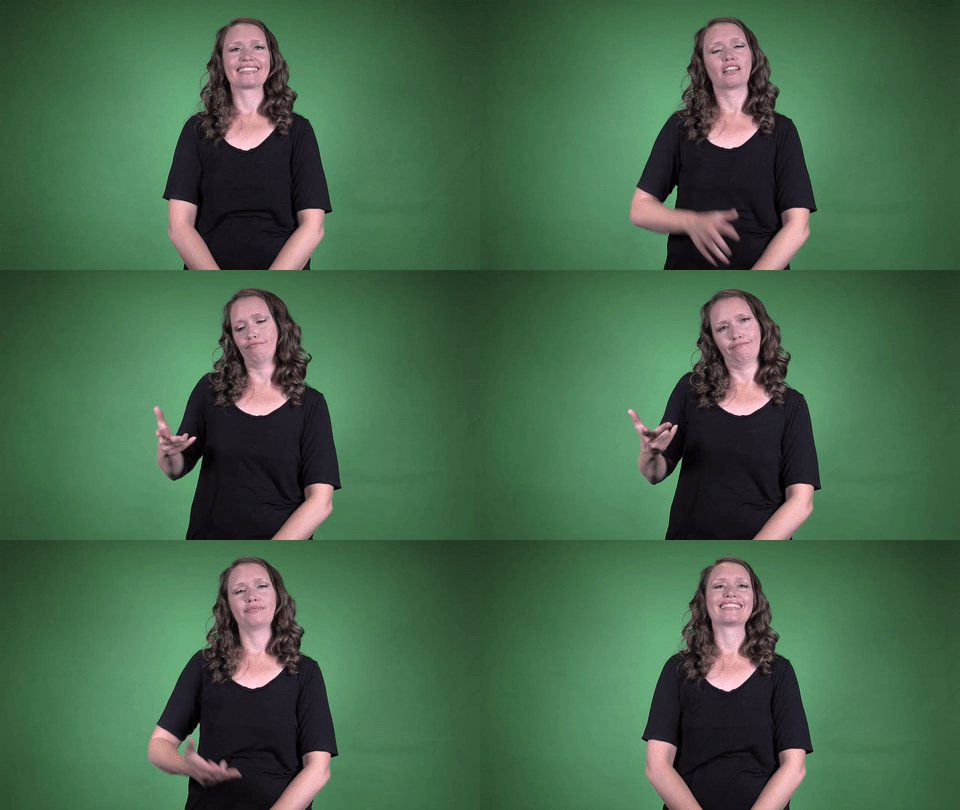
Definition: A game involving rolling a ball to knock down pins.
Sign for BOWLING in ASL

Practice Activities:
Start by practicing the sign for BOWLING in ASL in front of a mirror. Focus on how your dominant hand mimics the shape and rolling motion of a bowling ball as it is released toward pins. Repeat this handshape and movement several times to build muscle memory and precision.
Use the sign for BOWLING in ASL in short phrases like “I like bowling,” “We go bowling on Saturdays,” or “Bowling is fun.” As you sign these full sentences, think about your non-manual markers like facial expressions to show enthusiasm or excitement. Say each sentence aloud first, then sign it, which helps connect the concept to the physical sign.
Create a story involving a trip to the bowling alley. Describe walking in, putting on special shoes, choosing a ball, and knocking down the pins. Sign each step using full sentences, incorporating sequencing signs like “first,” “next,” and “finally.” This activity helps reinforce context and vocabulary beyond the keyword phrase.
Try a partner exercise where one person signs a sentence using the sign for BOWLING in ASL, and the other guesses what’s being described. Switch roles to encourage expressive and receptive practice. This back-and-forth builds confidence and hones comprehension skills.
Watch a video of someone bowling and practice narrating what is happening in ASL. Use the sign for BOWLING along with other descriptive signs like color, size, roll, and knock down. This combines real-world imagery with signing to help embed the vocabulary.
Create a mini dialogue where two friends make plans to go bowling. Sign both sides of the conversation, focusing on clear body shifts and facial grammar to show who is speaking. Rehearsing the sign for BOWLING in ASL within natural conversations makes recall in real-life situations easier and more fluid.
Cultural Context:
Understanding the sign for bowling in ASL goes beyond just learning a motion—it’s about connecting with a popular recreational activity enjoyed by many in the Deaf community. Bowling is often a social and community-centered event, and knowing the sign allows for smoother communication and inclusion during these gatherings.
The sign for bowling in ASL typically mimics the underhand motion of rolling a ball down the lane. This natural gesture reflects how closely ASL mirrors real-life actions, making it intuitive and expressive. When using the sign in conversations, it’s usually accompanied by facial expressions that match the context, like excitement for a strike or disappointment for a miss.
In Deaf culture, bowling has long held a unique place as a popular group activity. Many Deaf bowling leagues and tournaments have formed across the country, creating important spaces where Deaf individuals can socialize, compete, and build community. So, knowing the sign for bowling in ASL can help foster a sense of belonging in these shared experiences.
The sign embodies the visual and kinetic nature of ASL. When people use the sign for bowling in ASL, they’re not just saying a word—they’re enacting a part of the experience. This makes communication richer, helping others in the conversation quickly grasp what’s being talked about.
Bowling alleys have often been gathering spots for Deaf clubs or meet-ups, especially before social media connected the community online. In these environments, signs like the sign for bowling in ASL played a vital role in making sure everyone could enjoy the game and the interaction equally. With one simple sign, entire conversations about strikes, spares, and frame scores come alive.
Learning the sign for bowling in ASL is also helpful in educational settings. Teachers often include sports and recreational vocabulary in ASL lessons to help students practice interactive signs. Since bowling is a common activity, teaching its sign allows learners to apply language to their daily lives outside the classroom.
Parents and interpreters also find this vocabulary essential when supporting Deaf children in group outings or community events. Using the correct sign for bowling in ASL helps children feel more confident and integrated when participating in group activities. It’s a small but meaningful way to support inclusion in both formal and informal social settings.
Even in casual conversations, people often talk about weekend plans, favorite hobbies, or fun competitions. Being able to fluidly use the sign for bowling in ASL enriches these interactions and helps Deaf and hard of hearing individuals be fully engaged. It supports not just linguistic communication, but emotional connection as well.
Extended Definition:
The sign for bowling in ASL is a fun and dynamic motion that reflects the real-world action of the sport. When expressing the concept in American Sign Language, you mimic the hand motion of releasing a bowling ball down a lane. The movement is smooth and curved, similar to an underhand toss, often done with the dominant hand.
This sign conveys the essence of the activity rather than spelling it out letter by letter. The sign for bowling in ASL is typically performed in a single motion, using the dominant hand to mimic the action of rolling a ball forward. It’s often used in casual conversation when discussing sports, weekend plans, or favorite hobbies.
Understanding how to sign bowling in ASL can make sports-related discussions clearer and more engaging in sign language. Whether you’re talking about going bowling with friends or referencing a professional bowling event, using the correct sign helps create an accurate and vivid exchange. Since this sign is concept-based, it’s important to pair it with the appropriate facial expressions and context so the meaning remains clear.
Deaf culture often emphasizes visual and kinetic movement, so signs like bowling that mirror actual activities are favored. This enhances understanding and helps create vivid storytelling moments in conversation. When you use the sign for bowling in ASL, you are adding a visual cue that supports fluent, natural interaction.
It’s important to note that different regions or communities might have slight variations of the sign for bowling. However, the general handshape and motion are fairly consistent across most ASL users. The key idea is to replicate the rolling action, which is instantly recognizable to those familiar with the sport.
This sign can also be incorporated into a broader context, such as “I went bowling last night” or “Do you like bowling?” In such phrases, the sign for bowling in ASL becomes an essential part of the sentence structure. Learning how to fluently use activity-based signs can make ASL communication faster and more expressive.
For children or beginners just starting to learn American Sign Language, using signs that represent common hobbies like bowling is an effective way to build vocabulary. These signs allow learners to connect language to real-life experiences, making communication both functional and enjoyable. Repetition and context are crucial for mastering this sign.
Whether you’re creating a conversation about sports, social outings, or fitness, knowing how to use the sign for bowling in ASL adds variety to your vocabulary. You can include it in games, storytelling, or classroom activities to get more comfortable with both the sign and its usage.
Synonyms: bowling, ten-pin bowling, alley bowling, lane bowling, 10-pin
Educational resources: Find related learning materials in our course bank!
Want more? Check out some of our popular learning activities on the homepage!
Need to look up a sign? Use our highly rated dictionary: https://aslinteractive.com/best-asl-dictionary/
Follow us on tiktok: https://www.tiktok.com/@aslinteractive. More social media links at the bottom of this page!
Long-tail Keywords: what is the sign for bowling in ASL, how do you sign bowling in ASL, ASL sign for bowling
Categories:
tags: bowling ASL sign, how to sign bowling in ASL, American Sign Language bowling, bowling sign language video, learn bowling in ASL
Parameters
*Handshape*:
The handshape for the sign for BOWLING in ASL uses a modified “claw” or open-5 handshape with fingers slightly curved, mimicking the grip used when holding a bowling ball. The dominant hand typically takes this shape while making a forward rolling motion, representing the act of bowling .
When making the sign for BOWLING in ASL, the finger spread and curve replicate how fingers go into the bowling ball holes. This realistic handshape helps visually connect the sign with the actual sport, making it easily understood by native ASL users.
*Palm Orientation*:
The palm orientation for the sign for BOWLING in ASL typically faces inward toward the body. The dominant hand forms a modified “O” handshape, with fingers slightly spread as if holding a bowling ball. As the hand swings forward in a small arc, the palm remains facing the signer.
This orientation mimics the natural motion of releasing a bowling ball. When performing the sign for BOWLING in ASL, keeping the palm inward helps convey the action clearly and accurately.
*Location*:
The location for the sign for BOWLING in ASL is in front of the body at about chest level. The hand is brought forward in a smooth, slightly arcing motion to mimic the release of a bowling ball .
This sign is made in the space directly in front of the torso, aligning with the natural range of movement used when actually bowling. The sign for BOWLING in ASL stays within a comfortable, neutral signing space.
*Movement*:
To show the sign for BOWLING in ASL, you mimic the motion of a bowling ball being thrown. Extend your dominant hand downward with fingers together and slightly curved, palm facing in. Move the arm forward in a gentle underhand arc, as if you’re rolling a bowling ball down the lane.
This natural motion helps others quickly associate the gesture with the sign for BOWLING in ASL. Keep your body relaxed and the movement fluid, not stiff.
*Non-Manual Signals*:
When using the sign for BOWLING in ASL, the facial expression should be relaxed and natural, with a slight smile to show engagement or enjoyment. Since the activity is recreational, your face can show mild excitement or focus, matching the motion of the sign which mimics a bowling action .
To effectively communicate the sign for BOWLING in ASL, your eyes should track the imaginary ball’s path, emphasizing the direction and intention of the motion. Maintain eye contact with your conversation partner before or after executing the sign to ensure connection.
*Prosody, Dominant/Non-Dominant Hand*:
The sign for BOWLING in ASL uses the dominant hand shaped like the number three, palm facing forward, mimicking the motion of releasing a bowling ball. The hand moves forward in a slight arc, similar to the underhand toss seen when bowling.
The non-dominant hand is not involved for most signers. The sign for BOWLING in ASL is often paired with a facial expression that adds context, especially when emphasizing fun, competition, or effort.
Tips for Beginners:
When learning the sign for BOWLING in ASL, it’s important to think about the visual concept of the activity. The sign mimics the motion of a person rolling a bowling ball down the lane. You typically form one hand into the shape of a loose “O” or curved grip, palm facing slightly downward, and then make a forward underhand rolling motion. Try to imagine the actual weight and motion of a bowling ball as you do this sign. This helps convey the meaning more clearly and naturally.
A common issue for beginners is not committing enough to the rolling gesture. A small or stiff movement might not clearly express the idea of bowling and could be confused with another sign. Make sure the motion is fluid and larger than usual if you’re just starting out. Keep your elbow relaxed and put a slight “bounce” into the rolling action to show that it’s an intentional and familiar movement.
Consistency and context are really important when using the sign for BOWLING in ASL. If you’re talking about the sport in general or describing an activity like going bowling with friends, the natural context will help clarify any ambiguity. Supplementing the sign with facial expressions or a brief fingerspelled clarification can help when you’re communicating with someone unfamiliar with your signing style.
Practice signing in front of a mirror to check how visible and accurate your motion is. Sometimes a slight change in angle can make a big difference for clarity. Try watching videos of native signers using the sign and mimic their rhythm and flow. The sign for BOWLING in ASL often looks more correct when it’s part of a full sentence, rather than as an isolated gesture, so practice using it in everyday conversation to gain confidence.
sign for BOWLING in ASL, bowling in ASL, ASL sign for bowling, learn the sign for BOWLING in ASL, how to sign bowling in American Sign Language
Connections to Other topics:
The sign for BOWLING in ASL is closely related to other recreational and sports signs, such as BASEBALL, BASKETBALL, and TENNIS. Each of these signs utilizes distinct handshapes and movements to represent the activity visually. This helps learners recognize patterns in how ASL expresses physical actions by mimicking relevant body motions, contributing to their broader understanding of sports concepts in sign language.
The motion used in the sign for BOWLING reflects the underhand rolling motion typical in the sport, similar to how the sign for ROLL shows something rotating forward. Because of this, students can compare the sign to ROLL or BALL to understand how classifiers and iconic movement can combine to create new signs. For example, the classifier CL:1 can denote a moving object, and when paired with specific directional and rolling motions, it can depict a bowling ball rolling down a lane.
In more complex expressions, the sign for BOWLING in ASL can be included as part of descriptions for social events or group activities. For instance, combining BOWLING with the sign for FRIEND, FAMILY, or FUN makes phrases like “family bowling night” or “went bowling with friends.” This shows how ASL signs are composed together for fuller storytelling or information sharing, reinforcing temporal or relational context.
The sign for BOWLING in ASL also connects with directional verbs and spatial referencing. When describing a bowling game, a signer can use space in front of them to represent the lane, the direction of the ball’s movement, or even the pins. This illustrates how spatial grammar functions in ASL, and how sports signs can strengthen understanding of those spatial features.
Additionally, BOWLING connects directly to signs related to competition and games, such as WIN, LOSE, or SCORE. These associations are important in casual conversation and storytelling when discussing game results or experiences. Understanding the sign for BOWLING in ASL supports a broader vocabulary for discussing sports and leisure, enriching expressive capability.
Summary:
The sign for BOWLING in ASL mimics the action of rolling a bowling ball down a lane. It’s an iconic sign, relying on visual imagery that aligns closely with the real-life experience of the sport. Using a dominant hand in an “S” handshape, the signer mimics a forward underhand rolling motion.
This sign captures the smooth release of the ball, with an added wrist flick to suggest spin if stylistically desired. This experiential representation makes the sign intuitive to native and non-native signers with exposure to the context.
The sign for BOWLING in ASL lives within the category of recreational and athletic activity signs. Much like signs for BASEBALL or BASKETBALL, it relies on mimicking the motion essential to the sport. These kinds of signs are often referred to as iconic signs because they visibly represent the activity itself.
This iconic quality increases comprehension across users, especially when compared with more abstract or arbitrary signs. The easily interpreted motion enhances communication between deaf and hearing individuals in integrated settings, like school athletics or community sports leagues.
The sign is typically made with one hand, which allows for simplicity and fluidity when incorporated into larger sentences. Still, variation exists. Some signers may use additional signs or descriptive classifiers when discussing variations of bowling such as candlepin bowling or five-pin bowling, which can require contextual clarification.
In casual conversation, the sign for BOWLING in ASL appears frequently in dialogues about weekend plans, social outings, and youth activities. It may also be used in conversations involving adaptive sports, where inclusive experiences for deaf and hard-of-hearing individuals are the norm.
When examined through a grammatical lens, this sign functions as both a noun and a verb, depending on placement and movement. A static form might refer to the sport as a noun, while repeated rolling motion may suggest playing or going bowling. This flexibility showcases ASL’s fluidity, where context and movement transform meaning.
The use of facial expressions and body shift can further emphasize the action. For example, leaning slightly forward during the sign can suggest intensity or competitiveness in the game. These nuanced expressive elements enhance the semantic content of the sign.
ASL classifiers can be used to personalize the context around bowling. A classifier to show the ball rolling or pins scattering expands upon the primary sign and roots it in a dynamic description. These classifiers support storytelling in ASL, elevating it beyond vocabulary into vivid narrative.
From a cultural standpoint, bowling holds steady popularity in American social life. By extension, the sign for BOWLING in ASL bridges communication gaps, affirming inclusion for deaf community members in mainstream recreation. In family bowling alleys and youth centers alike, the sign creates equal access to shared experiences.
In Deaf culture, group events like bowling leagues create space for community building. The accessibility of sports-related signs allows deaf individuals to fully participate in conversation, planning, and play. The sign for BOWLING in ASL thus plays a key role in representation and integration.
ASL linguistics shed light on the use of spatial awareness in signs like this one. The rolling motion moves away from the signer’s midpoint, indicating directionality. This spatial orientation situates the activity in physical and imagined space, essential for signed narrative structure.
Applied linguistics explores how signs such as this are taught in classrooms and community programs. In deaf education, sports signs are often learned during unit work on hobbies, physical education, or community engagement. The sign for BOWLING in ASL makes frequent appearances due to its regular relevance in life and media.
Language acquisition studies show that children learn iconic signs more quickly. This is likely due to the congruence between form and real-world action. As such, the sign for BOWLING in ASL serves as an excellent introduction to sports vocabulary in early signing environments.
In storytelling within ASL, the theme of bowling may show up in anecdotes, jokes or life lessons. The sign itself becomes part of a broader semiotic system, serving as both linguistic representation and cultural touchstone. It offers multiple layers of meaning in both casual and formal signed narratives.
ASL poetry and creative works also sometimes incorporate signs related to recreational activities. The rhythmic rolling motion of the sign for BOWLING in ASL offers aesthetic possibilities. The repetition, tempo, and symmetry of the movement mirror poetic meter or visual rhythm in performances.
In conversations about accessibility, sports like bowling are often highlighted for their alignment with deaf inclusion. The highly visual and physical nature of bowling makes it easier for deaf players to participate fully. The sign itself is a component in affirming meaning and shared identity in these spaces.
Comparatively, some signs for other sports are less transparent in their formation. Sports like GOLF or LACROSSE may incorporate signs that require additional explanation or fingerspelling. The sign for BOWLING in ASL stands out for its mimetic simplicity and immediate cultural intelligibility.
Variations exist in regional ASL dialects, though the general rolling
Want more? Check out some of our popular learning activities!
ASL Interactive Resources
ASLInteractive YouTube Channel
Follow us on tiktok: @aslinteractive.com
Follow us on Instagram: aslinteractive
Facebook page: aslinteractive
Facebook group: aslinteractive
LInkedIn: ASL Interactive LLC
Twitter: @ASL_interactive
*Some information on this page is AI-generated. AI can make mistakes. Please check the information.


Responses