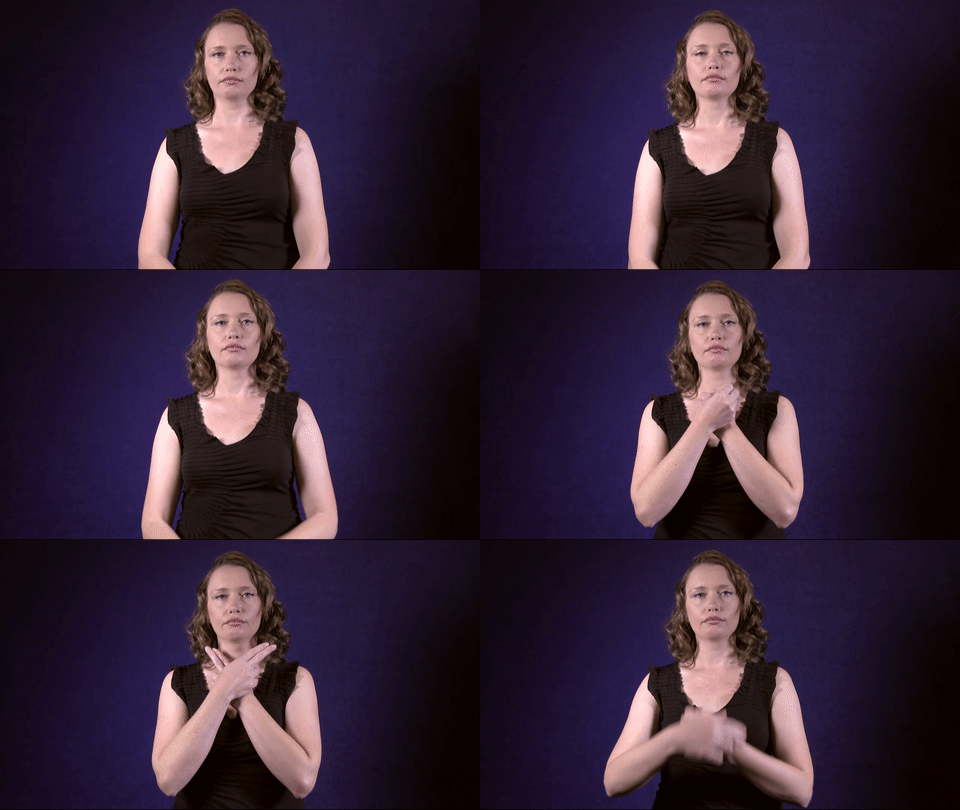
Sign for BOWTIE in ASL | 👔 ASL Dictionary

Definition: A small piece of fabric tied in a bow shape.

Sign for BOWTIE in ASL

YouTube player

Practice Activities:

Begin practicing the sign for BOWTIE in ASL by repeating it in front of a mirror. Focus on your handshape and the movement near the collar area to mimic putting on a bowtie. Try doing the sign slowly at first, then gradually increase your speed while maintaining accuracy. Record yourself and compare your performance with that of a fluent signer.

Next, practice the sign for BOWTIE in ASL by using it in isolated phrases such as fancy bowtie, red bowtie, or wearing a bowtie. These word combinations will help you become more comfortable with using the sign in descriptive contexts. You can create a list of adjectives like shiny, polka-dotted, or silk to pair with the noun and sign them together.

Create sentences using the sign for BOWTIE in ASL, such as he wore a bowtie to the party or my grandfather always wears a bowtie. Say the sentence out loud, then sign it fluently while maintaining proper facial expressions. Focus on your transitions between signs and keep your signing pace consistent.

Try a storytelling activity where a character gets ready for a big event and chooses to wear a bowtie. Include other signs for clothing, emotions, and events to create a fuller story. This will give more context for using the sign for BOWTIE in ASL within a narrative format.

Work with a partner to practice asking and answering questions. One person can sign what color is your bowtie or where did you buy your bowtie, and the other responds using the target sign and supporting vocabulary. Use illustrations of people in bowties to help form descriptive sentences and spark conversation using the sign.

To reinforce your memory, label a mirror or dresser area where you usually get dressed with the word BOWTIE and sign it every time you see it. This builds muscle memory and visual association.

Cultural Context:

The sign for bowtie in ASL reflects both a cultural and stylistic accessory often associated with formal events, unique fashion, and expressions of individual identity. In Deaf culture, bowties can convey personal expression just like in hearing communities, and signing for specific clothing items helps create richer descriptions during conversations.

When using the sign for bowtie in ASL, it’s helpful to understand the cultural importance of appearances in Deaf conversations. Describing what someone is wearing, especially something as distinct as a bowtie, plays a big role in identification and storytelling. Sharing visual details like clothing helps set the scene or clarify who someone is referencing.

Bowties have long stood out as more than just formal wear. Whether in fashion or events like weddings, performances, or celebrations, a bowtie often indicates a special or expressive choice. In ASL, visual accuracy is crucial, so the sign for bowtie helps communicate not just what someone is wearing but also something about their personality or status in a moment.

The sign for bowtie in ASL often mirrors the object’s shape or placement. This visual aspect of American Sign Language connects well to its cultural value, emphasizing direct representation. This kind of visual-spatial communication is central to Deaf experience, making fashion-related signs particularly meaningful.

In some traditions, such as prom, graduations, or formal dinners, bowties may also have cultural significance. Recognizing these shared cultural milestones is important when learning signs like the sign for bowtie in ASL. These signs don’t exist in isolation; they’re used in contexts full of emotion, pride, and social connection.

Deaf community events, like Deaf proms or banquets, may also feature formal attire where bowties are common. Knowing the sign for bowtie in ASL enables smoother communication and helps learners become culturally competent. Understanding when and where such signs are used contributes to an even deeper knowledge of Deaf norms.

The sign for bowtie in ASL also supports access for Deaf professionals or performers who dress in formalwear for meetings, interviews, or onstage events. Describing accessories like a bowtie helps others visualize and connect more personally in conversations. It also promotes full inclusion in professional settings where fashion is often a subtle form of self-expression.

Students of ASL often come across signs related to clothing while expanding their vocabulary for everyday situations. The sign for bowtie in ASL is a great way to explore how personal style and description come together in natural conversation. While some may see a bowtie as a

Extended Definition:

The sign for bowtie in ASL captures the visual form of the accessory while also reflecting how it is typically worn. To produce the sign, both hands are often used to mimic the action of tying a bow at the neck, similar to tying a shoelace. This movement symbolically represents the shape and position of a bowtie around the collar area.

In American Sign Language, context plays an important role. The sign for bowtie in ASL may share movements or elements with signs for other neckwear, like necktie or scarf. The key is how the hands move and where the sign is made near the body, typically centered at the front of the neck .

If someone is wearing a bowtie, the ASL sign can be modified to emphasize real-life use or even describe the size or pattern. For example, adding facial expressions or using classifiers can help describe whether the bowtie is large, colorful, or patterned with spots or stripes . Visual descriptions in ASL add dimension and detail that spoken language may not capture as quickly.

When teaching or learning the sign for bowtie in ASL, it helps to associate it with the idea of formal attire or dressing up. Bowties are often worn at weddings, dances, or other fancy events, and that connection can make the sign easier to remember. Associating signs with cultural moments is a useful language acquisition technique.

The sign may vary slightly depending on region, signer preference, or the level of formality being described. Some signers may prefer a simple gesture near the neck, while others might include a tying motion with a twist of the fingers. Both versions are understood, and context will usually make the intention clear.

Some children learning ASL may associate the sign for bowtie with familiar characters from TV or books who wear one. Using beloved characters is a fun and effective way to reinforce vocabulary. Teaching bowtie this way helps make language acquisition engaging for young learners.

Understanding the sign for bowtie in ASL also opens the door to learning other related clothing signs. Words like suit, jacket, or suspenders often appear together, especially in discussions about formal wear. Building related vocabulary helps learners express more complete ideas during conversations.

In Deaf culture, attention to detail in visual language expression is important. When describing someone wearing a bowtie, using the correct handshape, movement, and placement helps paint a fuller picture. The sign for bowtie in ASL is one small part of that visual storytelling.

You

Synonyms: cravat, necktie, ribbon tie, formal tie, tuxedo tie

Educational resources: Find related learning materials in our course bank!

Want more? Check out some of our popular learning activities on the homepage!

Need to look up a sign? Use our highly rated dictionary: https://aslinteractive.com/best-asl-dictionary/

Follow us on tiktok: https://www.tiktok.com/@aslinteractive. More social media links at the bottom of this page!

Long-tail Keywords: what is the sign for bowtie in ASL, how do you sign bowtie in American Sign Language, ASL sign for bowtie

Categories:

tags: Clothing, Fashion Accessories, Attire, Formal Wear, Language Learning

Parameters

*Handshape*:

The handshape used in the sign for BOWTIE in ASL generally begins with both hands forming the “F” handshape—thumb and index fingers touching to make a circle, with the other fingers extended upward. The hands are placed near the center of the neck, mirroring the shape and location of a bowtie .

This representation mimics the knot and flared ends of a bowtie, helping to visualize the concept clearly. When teaching the sign for BOWTIE in ASL, it’s important to emphasize that the precise “F” handshape makes the symbol easily recognizable.

*Palm Orientation*:

For the sign for BOWTIE in ASL, the palm orientation typically starts with both hands in S-handshapes, oriented inward toward the chest. The knuckles face each other, and the fingers are curled in, simulating the knot at the center of a bowtie.

As the movement continues, the hands may shift slightly outward to mimic the bow’s shape on either side. Consistent inward-facing palms help convey the tied structure common in a real bowtie. The sign for BOWTIE in ASL captures the visual form of this accessory with clarity.

*Location*:

The sign for BOWTIE in ASL is located at the upper chest area, right below the neck. Both hands come together in this area to depict the shape and position of a bowtie.

This location mirrors where an actual bowtie is worn, helping to visually convey the concept. The close proximity to the neck and upper chest is essential in making the sign for BOWTIE in ASL easily recognizable.

*Movement*:

To show the sign for BOWTIE in ASL, start with both hands in a flat “O” shape positioned at the base of the neck, mimicking where a bowtie would sit. Then, move the hands slightly outward and to the sides while maintaining the “O” shape, as if adjusting or fluffing a bowtie .

The motion reflects the symmetrical shape of a bowtie. This makes the sign for BOWTIE in ASL iconic and easy to remember.

*Non-Manual Signals*:

When using the sign for BOWTIE in ASL, adopt a pleasant or neutral facial expression to complement the formal accessory being referenced. Slight raised eyebrows can indicate a descriptive or identifying context, such as when explaining what someone is wearing.

A small smile or relaxed lips can enhance the elegance associated with a bowtie. Using appropriate non-manual markers helps emphasize clarity and keeps the sign for BOWTIE in ASL visually descriptive and contextually accurate.

*Prosody, Dominant/Non-Dominant Hand*:

The sign for BOWTIE in ASL uses both hands to mimic the shape of a bowtie at the neck. Start with both hands in flat “O” shapes, positioned near the collarbone area. The fingertips of each hand touch the sides of the neck, then move slightly outward to suggest the tied ends of a bowtie.

In the sign for BOWTIE in ASL, the dominant and non-dominant hands perform mirrored movements, giving balance and symmetry to the gesture. This symmetrical prosody visually reflects the shape and placement of an actual bowtie, enhancing clarity and visual impact in conversation.

Tips for Beginners:

When learning the sign for BOWTIE in ASL, it’s essential to start with understanding where the sign is typically placed. Since a bowtie is worn at the neck, the location of the sign is right under your chin. Touch your thumbs and index fingers together to mimic a small bow shape, and place it at the base of your throat to indicate where the bowtie sits. This position is vital because location helps convey meaning clearly in ASL.

Practice maintaining a symmetrical handshape for the bow, with your fingers forming a clear and compact loop. Exaggerating this shape too much can confuse it with other clothing-related signs. Keep your movements subtle and deliberate. Accuracy is more important than speed, especially when learning the sign for BOWTIE in ASL for the first time.

Facial expressions matter, even with simple signs. Although this is a noun, adding a light smile or a neutral expression can help keep your tone friendly and appropriate in context. Avoid stiff or robotic motions. ASL favors natural fluidity, so be sure to relax your hands before and after producing the sign.

One common beginner mistake is placing the handshape too low or too far to the side, which may make the sign unclear. Use a mirror or video to check your positioning. The hand placement should be consistent and centered along the neckline. Repetition drills can help you build muscle memory for proper placement.

If you’re unsure whether you’re using the correct sign, don’t hesitate to fingerspell the word. Fingerspelling is accepted and understood, especially in specific or fashion-related terms. Slowly work toward using the sign for BOWTIE in ASL fluidly, but rely on fingerspelling when necessary until you feel more confident. Developing clarity takes time, so be patient and practice consistently.

sign for BOWTIE in ASL, ASL sign for BOWTIE, how to sign BOWTIE in American Sign Language, BOWTIE ASL sign

Connections to Other topics:

The sign for BOWTIE in ASL connects closely with the broader category of clothing-related signs. Just like signs for SHIRT, JACKET, or TIE, the motion and location of the sign for BOWTIE help convey the type and position of the accessory. Signs that indicate articles of clothing often include movements near the area where the item is typically worn, such as the neck or torso.

Additionally, the sign for BOWTIE in ASL shares conceptual connections with signs that describe formality, style, or events. It may appear in contexts alongside signs like FANCY, WEDDING, or PARTY, indicating its use in describing attire for special occasions. The sign can be incorporated into larger expressions such as WEAR BOWTIE PARTY or YOU LOOK NICE BOWTIE, showing how it functions within descriptive or narrative phrases.

Learners can draw parallels between the handshape and movement of the sign for BOWTIE in ASL and similar directional or symmetrical signs. For example, signs like GLASSES or COLLAR also involve the area around the neck or face, requiring a focus on spatial precision. These comparisons help build spatial awareness and consistency in signing placement.

The sign for BOWTIE in ASL may also be useful when learning about classifiers or visual descriptions. Describing a person wearing a bowtie can make use of classifiers to explain clothing in visual detail. This skill is essential for storytelling, especially when portraying characters or emphasizing unique aspects of appearance.

In storytelling, the sign for BOWTIE in ASL can help define character traits. A character described as wearing a bowtie might be portrayed as formal, meticulous, or stylish. Such use highlights how clothing signs, including this one, contribute to richer, more expressive narratives in ASL.

Summary:

The sign for BOWTIE in ASL is iconic and highly visual, often representing the actual shape and placement of a bowtie on the neck. It is typically produced by forming both hands into flat Os or modified Os and placing them at the neck area, then twisting or expanding slightly to mimic the bowtie’s form. This motion captures the symmetrical and tied appearance of a bowtie.

This sign is influenced by the visual structure of a bowtie, helping to align with ASL’s tendency toward representing concepts in a gestural and image-based format. ASL heavily relies on depicting spatial elements, and the bowtie’s location on the body makes it perfect for location-based representation. The movement and handshape align with the symmetrical form and iconic imagery of a traditional bowtie.

Culturally, bowties may be associated with formal attire, weddings, black-tie events, or even intellectual or eccentric personas. In ASL, signing something like the word BOWTIE brings in these connotations, depending on the context and surrounding classifiers. This contributes to how the sign for BOWTIE in ASL can help convey nuanced ideas of fashion, status, occasion, or personality.

When someone references the sign for BOWTIE in ASL, the context often guides whether one is talking about a person wearing it, an item of clothing, or a themed event. For example, describing someone attending a fancy party might involve the sign for BOWTIE along with signs like DRESS-UP, PARTY, or FANCY. The accompanying facial expressions enhance or tone down the formality.

ASL grammar supports modifying signs to show additional meaning using non-manual markers like facial expressions and body orientation. When expressing that someone is proudly wearing a bowtie or feeling uncomfortable in one, the sign for BOWTIE in ASL can be changed by exaggerating size or motion while using matching expressions. This layering enriches the sign’s communicative depth and supports full syntactic constructions in ASL.

Linguistically speaking, the sign for BOWTIE in ASL is an example of an iconic sign that naturally overlaps with its visual referent and is easily interpretable by viewers. This is in contrast with arbitrary signs, which don’t resemble their meaning. Bowtie’s clear correlation with its shape makes it a strong candidate for both comprehension and teaching new signers.

In structured ASL storytelling or narratives, the sign for BOWTIE in ASL can be effectively used to establish a character or setting. One may sign MOUSE + WEAR + BOWTIE, suggesting a character like a cartoon personality or children’s story figure. This shows how visual language encourages creative expression and character building through clothing features.

There are cases where users fingerspell the word BOWTIE, especially when discussing a brand name or a distinctive kind of bowtie — like a novelty or patterned version. However, the standard sign remains the preferred method in most casual or narrative usage. Variations may occur between communities and among Deaf professionals in fashion contexts.

ASL allows for incorporated classifiers to describe the bowtie more richly after the initial sign. For instance, a signer might follow the sign for BOWTIE in ASL with a size-dependent classifier to show that it is oversized or child-sized. These features add dimensionality and specificity to the visual description.

The sign for BOWTIE in ASL also lends itself to compound usage within more complex ideas, like someone looking stylish or preparing for a gala. Combining the sign for BOWTIE with signs like SHARP or DRESS-UP makes the meaning more complete. This reflects how ASL phrases function dynamically rather than through isolated words.

Deaf fashion influencers and stylists, particularly on social media platforms like Instagram or TikTok, sometimes use or stylize the sign for BOWTIE in ASL as part of Deaf Gain — using Deaf culture as a lens to view identity and culture. Emphasizing visual signs of personal style reinforces how ASL reflects cultural aesthetics and individuality.

The placement of the sign at the neck also aligns with other clothing-related signs, such as NECKTIE or SCARF, helping learners place new vocabulary into spatial categories. This enhances memory and cognitive links. These signs cluster around the body part they represent, making them easier to access and distinguish.

From a sociolinguistic standpoint, the sign for BOWTIE in ASL may differ slightly depending on region or age group. While most variations maintain the same core handshape and location, some communities may favor a two-handed motion, while others use a one-handed simplified sign. These microdialects enrich the tapestry of ASL and highlight its living nature.

The sign for BOWTIE in ASL also underscores the language’s spatial grammar. You are not simply naming a thing, but actively placing it on the body, giving it location and context through space and motion. This aligns with ASL

Want more? Check out some of our popular learning activities!

ASL Interactive Resources

ASLInteractive YouTube Channel

Follow us on tiktok: @aslinteractive.com

Follow us on Instagram: aslinteractive

Facebook page: aslinteractive

Facebook group: aslinteractive

LInkedIn: ASL Interactive LLC

Twitter: @ASL_interactive

*Some information on this page is AI-generated. AI can make mistakes. Please check the information.

Sign for BOWTIE in ASL

Responses