Sign for BRICK in ASL | 🧱 ASL Dictionary

Definition: A small rectangular block.

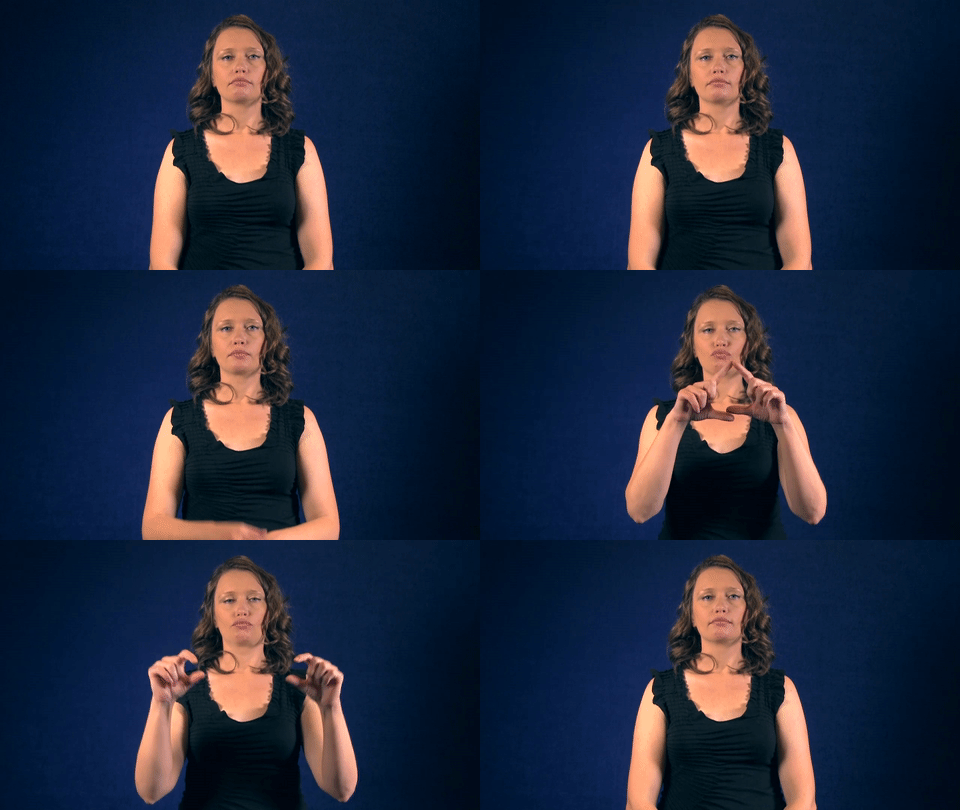
Sign for BRICK in ASL

YouTube player

Practice Activities:

To begin practicing the sign for BRICK in ASL, start by isolating the sign. Stand in front of a mirror and practice forming the sign slowly and clearly, repeating it several times to build muscle memory. Focus on the handshape, palm orientation, and movement. It can help to say the English word “brick” silently as you sign for reinforcement. Try signing it five times in a row without breaking focus.

Next, use the sign in short, simple phrases. Sign sentences like “The wall is made of brick” or “I saw a red brick.” Record yourself and review your signing to check for accuracy. You can also try signing common adjectives with the sign, such as “heavy brick,” “broken brick,” or “brick wall,” to build fluency in combining signs.

Create short storytelling prompts that include the sign for BRICK in ASL. For example, describe a scene where a worker builds a house using bricks or a story where someone finds an old brick in the garden. Incorporate color and texture vocabulary to strengthen descriptive language ability.

In partner activities, take turns creating visual scenes that include bricks. One person describes an image using ASL, and the other draws it or finds a matching picture. Then switch roles. For example, a user could sign “three bricks stacked on the sidewalk” and their partner would try to recreate the scene.

Another collaborative activity is “ASL charades.” One person signs a situation involving bricks, like building a barbecue pit or stumbling over a brick, and the other guesses what’s being signed using full sentences. This helps improve expressive and receptive skills while reinforcing the sign for BRICK in ASL in a fun way.

Maintain variety in your practice to stay engaged and keep growing your confidence in using the sign naturally.

Cultural Context:

The sign for BRICK in ASL holds both a literal and metaphorical cultural context within the Deaf community. As with many signs in American Sign Language, the sign for BRICK is not only used to describe physical materials but also plays a role in expressions and storytelling. Understanding the cultural meaning behind the sign for BRICK in ASL adds depth to its use and can help learners better connect with native signers.

In daily conversation, the sign for BRICK in ASL is most often used to describe building materials, construction work, or architecture. However, its usage can extend beyond that, especially in storytelling, where it symbolizes strength, foundation, obstacles, or permanence. Just as in English, where the word brick might imply something heavy or solid, the sign for BRICK in ASL can carry that same feeling depending on context.

Storytelling is a vibrant and essential part of Deaf culture. When a storyteller uses the sign for BRICK in ASL, it might be used to show the building of a strong foundation, whether in a relationship, a community, or an idea. Similarly, the sign can represent a hurdle that must be overcome, especially when combined with expressive facial grammar and other classifiers.

Within ASL poetry and visual vernacular, the sign for BRICK in ASL can also symbolize the rough edges of society or a barrier someone faces. This non-verbal language often relies on physical expressions and visual metaphors, where something like a brick can take on deeper emotional meaning. Because the community values visual learning and expression, the use of such imagery resonates strongly.

Some Deaf people also describe their experiences of education and communication access using the sign for BRICK in ASL. For example, hitting a brick wall might be portrayed through intense facial expressions and repetition of the sign, showing persistent struggle or frustration. These metaphors are powerful and relatable within ASL discourse.

The sign for BRICK in ASL can also appear in discussions about Deaf history. For instance, when referencing the building of Deaf institutions or the foundation of Deaf culture, the sign becomes symbolic. It represents stability, growth, and resilience, much like bricks do in physical buildings.

Understanding the sign for BRICK in ASL means more than just memorizing handshapes. It involves appreciating how language reflects culture and values. In this case, the notion of building something strong and lasting comes through in both literal and symbolic uses of this sign.

Whether used to describe a house made of bricks or a lesson in perseverance

Extended Definition:

The sign for brick in ASL is a visually descriptive sign that mimics the shape and layout of bricks in a wall. This makes it intuitive and easy to remember for signers of all levels. When learning American Sign Language, understanding how to associate visual meaning with signs helps reinforce vocabulary.

To make the sign for brick in ASL, use both hands to represent the rows or structure of bricks. Typically, the hands are held flat with fingers extended, and they tap together in a motion that looks like stacking or arranging bricks. This sign effectively communicates the concept by drawing on the visual structure of an object made from bricks.

In conversation, the sign for brick in ASL can be used to describe building materials, construction, or even metaphorical uses like building a strong foundation. It’s useful in discussions about architecture, home improvement, or describing objects made out of bricks, like walls or pathways. Knowing how to correctly sign brick adds depth to your vocabulary, especially when discussing physical materials.

This sign falls under the broader category of ASL vocabulary relating to construction and home design. When paired with other related signs like wall, cement, or house, the sign for brick in ASL becomes part of a larger set of useful terms. This is ideal for both conversational use and educational settings where describing environments is important.

The sign for brick in ASL may vary slightly across regions or signing communities, but the general meaning remains consistent. Always consider context when using vocabulary that refers to specific materials, as the nuance can change slightly depending on the sentence. Watching native deaf signers or using ASL videos can help you master the rhythm and positioning.

Teachers, interpreters, and ASL learners frequently encounter this sign when engaging with topics about buildings or materials. For example, in classrooms teaching construction trades or even during storytelling where characters encounter a brick wall, knowing this sign becomes relevant. It supports visual literacy and expressive signing, which are key to fluent communication.

Using signs like the sign for brick in ASL helps reinforce your understanding of how ASL uses shape and function to build meaning. American Sign Language often relies on visual representations rather than abstract symbols, and this particular sign highlights that beautifully. It’s a useful reminder of how ASL adapts language to fit the real world.

Including the sign for brick in ASL in everyday vocabulary also helps broaden your expressive capacity. Whether you’re detailing how something was built or describing a physical setting made of bricks, this sign will serve you well. Pairing it with facial

Synonyms: block, slab, stone, tile, hunk

Educational resources: Find related learning materials in our course bank!

Want more? Check out some of our popular learning activities on the homepage!

Need to look up a sign? Use our highly rated dictionary: https://aslinteractive.com/best-asl-dictionary/

Follow us on tiktok: https://www.tiktok.com/@aslinteractive. More social media links at the bottom of this page!

Long-tail Keywords: what is the sign for brick in ASL, how do you sign brick in ASL, ASL sign for brick

Categories:

tags: Objects, Building Materials, Construction, Housing, Architecture

Parameters

*Handshape*:

The handshape for the sign for BRICK in ASL uses both hands in a flat “B” handshape , with fingers pressed together and thumbs tucked alongside the palms. The hands are held in front of the body, slightly apart, and then move toward each other as if representing a rectangular shape.

This movement and handshape reflect the size and shape of a typical brick. The sign for BRICK in ASL visually conveys the solid and rectangular nature of real bricks.

*Palm Orientation*:

For the sign for BRICK in ASL, both hands are typically in a flat “B” handshape. The palms face inward toward the body, parallel to each other and the ground.

During the sign for BRICK in ASL, the hands may mimic the motion or layout of stacked bricks. The consistent palm orientation creates a visual representation of a flat, solid surface, emphasizing the structure associated with bricks.

*Location*:

The location for the sign for BRICK in ASL takes place in the neutral space in front of the body, around chest level. Both hands are typically used and held slightly apart, forming a flat shape to represent the rectangular shape of a brick.

This location allows for clear visualization and mimics the physical attributes of a brick. Using neutral space helps maintain clarity and visibility when signing the sign for BRICK in ASL .

*Movement*:

To produce the sign for BRICK in ASL, start with both hands in a flat B-handshape, palms facing down and fingers pointing forward. Move your dominant hand above the non-dominant hand as if stacking a brick on top of another. Repeat the motion slightly to mimic multiple bricks being laid. This movement represents the layered, rectangular pattern of bricks and effectively conveys the concept within the sign for BRICK in ASL.

*Non-Manual Signals*:

When demonstrating the sign for brick in ASL, maintain a neutral to focused facial expression to match the solid and sturdy nature of a brick. Avoid exaggerated emotion, as the concept of a brick is literal and doesn’t carry emotional weight unless context requires it.

Your eyebrows should stay neutral, and the mouth can remain closed or slightly pursed, reinforcing the physicality of the sign for brick in ASL . Keep your body posture upright to emphasize the structural nature of a brick.

*Prosody, Dominant/Non-Dominant Hand*:

The sign for BRICK in ASL uses both hands to resemble the shape and stacking of bricks. The non-dominant hand remains flat and steady, palm facing in, while the dominant hand, also flat, moves away and then slightly up, mimicking the layering of bricks .

This motion is repeated in short shifts to suggest multiple brick layers. The sign for BRICK in ASL clearly conveys the concept of construction through spatial representation.

Tips for Beginners:

When learning the sign for BRICK in ASL, it’s helpful to understand that this sign typically mimics the shape or placement of bricks. Use both flat B-handshapes and hold your hands out in front of you, palms facing each other horizontally, then bring them together to align like bricks in a wall. Keep your movements clean and your handshape consistent so the meaning stays clear.

Beginners often struggle with the spatial aspect, so take time to practice this sign in front of a mirror. Make sure your hands are stacked evenly and facing each other accurately to match the concept of a brick formation. Practicing slowly at first helps you internalize the motion before increasing your speed.

A common pitfall with the sign for BRICK in ASL is turning the hands incorrectly, which can confuse the message or make the sign resemble others related to building or construction. Ensure you’re not rotating your palms toward your chest or away from each other. Keep your motions tight and deliberate for clarity.

Watching fluent signers demonstrate the sign for BRICK in ASL can provide helpful visual reinforcement. Videos or live practice with others will strengthen your confidence and accuracy. Don’t be afraid to replay clips or ask for feedback from a more experienced signer.

It’s also essential to understand the context where the sign is used. For example, if you’re discussing construction materials or describing a house, be sure to use signs for surrounding vocabulary that support the context of BRICK. This helps your message flow naturally in conversation.

Lastly, repetition is key. The more you use the sign for BRICK in ASL within meaningful sentences or storytelling, the easier it becomes to remember and produce correctly. Practice makes perfect—just like laying bricks!

Connections to Other topics:

The sign for BRICK in ASL connects to various construction and architectural terms, making it a foundational concept in vocabulary related to building. It shares similarities with the sign for BUILD, often using a motion that mimics stacking or layering, which is visually aligned with how bricks are laid. This visual and conceptual connection helps learners understand physical layout and structure through sign language.

In compound signs, the sign for BRICK can be a component in phrases like BRICK WALL or BRICK HOUSE. These compound signs allow signers to specify the type of structure being described, integrating directional and locative elements to further clarify meaning. For example, in BRICK WALL, the concept of a wall’s vertical layout may be added after establishing the brick layering motion, enriching the spatial detail.

The sign for BRICK in ASL also connects to the semantic field of materials like CEMENT, CONCRETE, and STONE. These material signs often incorporate tactile or surface-indicating motions, allowing learners to discriminate between textures and uses. Understanding the different signs for building materials helps contextualize the sign for BRICK within broader conversations about construction or home design.

Educational themes also intersect with this sign. When discussing topics like historical buildings, engineering, or community infrastructure, the sign for BRICK may appear alongside signs for SCHOOL, BUILDING, or CITY. These conceptual groupings help learners understand roles and structures in society and how they are physically represented in ASL.

The iconic nature of the sign for BRICK aids in memory retention, especially for visual learners. It bolsters comprehension by aligning hand motion with real-world interactions, such as stacking or placing units. This embodiment enhances communicative clarity and fosters deeper associations between physical experiences and signed language.

Summary:

The sign for BRICK in ASL mimics the appearance and solidity of a physical brick through a very visual and iconic hand movement. Both hands are generally held in a flat “B” handshape, facing each other horizontally, then moved together as if to represent the edges of a rectangular brick .

This visual representation resonates strongly with how the Deaf community often builds meaning—through physical representation and iconicity. In the case of the sign for BRICK in ASL, the concept of strength and structure is key in the metaphorical alignment of the word.

The sign not only shows the rectangular shape of a literal brick, but also metaphorically invokes ideas of foundation, durability, and building. These underlying associations often creep into ASL storytelling and poetic forms.

ASL poetry and narratives love such rich physical symbols. Bricks can represent emotional fortitude, the individual steps in personal growth, or the foundation of community and language in Deaf culture .

Linguistically, the sign for BRICK in ASL is iconic in nature and stems from the concept of high visual-motor mapping. This means the handshape and movement closely resemble the concept they’re expressing, aiding memory and cognition.

The movement often includes a placement action—hands may bounce slightly together or edge towards one another to simulate setting a brick into place. This can map directly to constructing, layering, or organizing, which are critical cytoplasm-style semantic fields in ASL.

From a grammatical standpoint, signs like BRICK function as nouns. Depending on context, the sign can be spatially modified to show quantity, arrangement, or even abstraction (like a mental block or “brick wall” of emotion).

In ASL syntax, it can follow typical noun-verb ordering, often paired with verbs like BUILD, STACK, or ARRANGE. You might see something like [WALL – BRICK – BUILD] in English gloss, showing a vertical iconic logic.

Beyond its standalone meaning, the sign for BRICK in ASL can combine with other concept signs to create compound ideas. For instance, HOUSE BRICK would indicate material style, and FOUNDATION BRICK would extend metaphorical resonance.

Context determines whether the sign leans literal or abstract. For example, in discussions about architecture or construction, the meaning is literal. In a psychological or poetic narrative, it can symbolize emotional barriers or resilience.

There’s a rich convergence between gesture and meaning in this sign—an illustrative example of embodiment in sign language linguistics. The body acts out the concept, compressing image and semantic content into a split-second visual unit.

ASL leans heavily into spatial logic and visual placement. For BRICK, the signer may refer back to previous spaces in signing space to show arrangement—like vertical stacking for a wall or horizontal layers for a path.

The sign for BRICK in ASL also plays a part in wider Discourses of DeafSpace and Deaf architecture. Discussions about inclusive design may involve literal and idiomatic uses of the sign, bridging physical and cultural architecture ️.

In this sense, BRICK becomes a symbol of agency. As a building block, it suggests construction, not only of physical spaces, but also of linguistic and narrative structures within ASL.

Related signs include BLOCK, STONE, and WALL. Each has its unique handshape and motion, but all exist within the same physical and conceptual domain—shaped by form, density, and arrangement.

There’s also an overlap semantically with the fingerspelled (FS) C-E-M-E-N-T or (FS) G-R-O-U-T, depending on context. But these tend to be more specific and technical, whereas BRICK can be both basic and metaphorically layered.

Culturally, in Deaf folklore or metaphoric storytelling, a single BRICK might symbolize a memory or musician’s moment encoded into the “walls” of Deaf experience. Signs like these carry narrative resonance far beyond denotative meaning.

ASL learners often grapple with iconicity—believing it is easier to learn because signs look like their meaning. But signs like BRICK can teach us how specificity and context guide clarity. The same shape and motion can mean wildly different things with a shift in environment.

In cognitive linguistics, this showcases “construction grammar”—where the meaning isn’t just in the root word or gesture, but in its emergent structure during use. BRICK gains its full meaning when placed beside other building concepts in a sentence.

In ASL literature and film, the sign for BRICK in ASL may even be stylized. A signer might exaggerate the size or weight in a poetic performance, enhancing emotional tone or thematic weight.

For younger learners, especially in Deaf education, BRICK plays well with tactile and visual teaching tools. Real bricks may be used along with signing to create physical-to-visual-to-linguistic learning loops .

This also connects with Vygotskyan frameworks in applied lingu

Want more? Check out some of our popular learning activities!

ASL Interactive Resources

ASLInteractive YouTube Channel

Follow us on tiktok: @aslinteractive.com

Follow us on Instagram: aslinteractive

Facebook page: aslinteractive

Facebook group: aslinteractive

LInkedIn: ASL Interactive LLC

Twitter: @ASL_interactive

*Some information on this page is AI-generated. AI can make mistakes. Please check the information.

Sign for BRICK in ASL

Responses