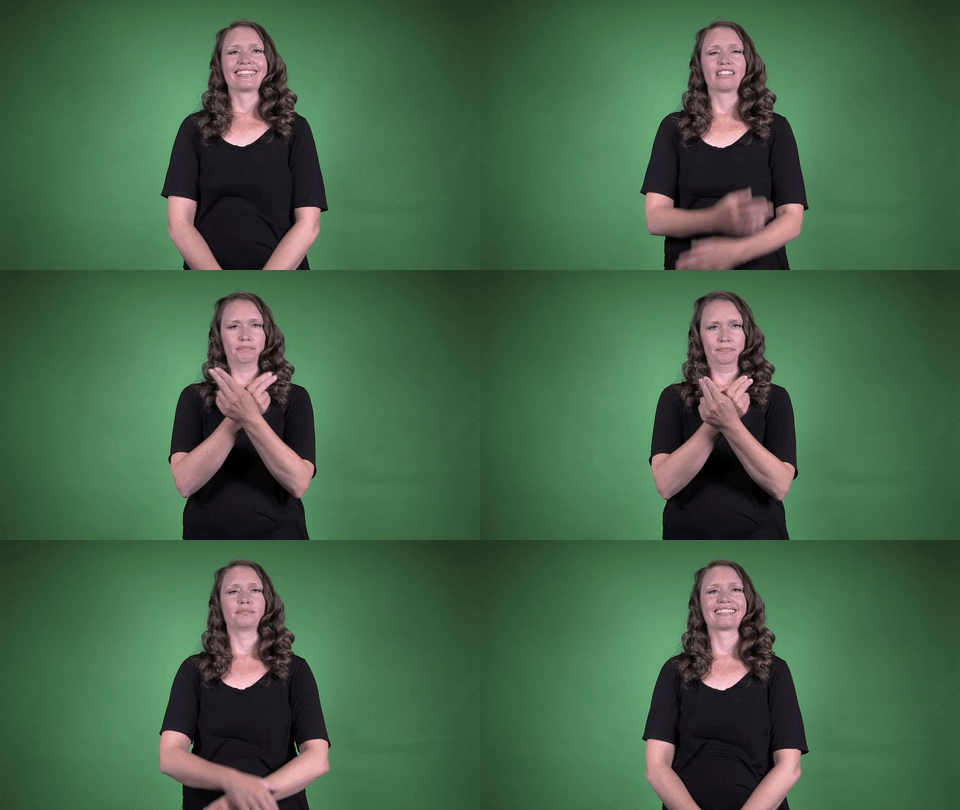
Definition: A small mammal with long ears and a fluffy tail.
Sign for BUNNY in ASL

Practice Activities:
Start by practicing the sign for BUNNY in ASL in front of a mirror. Pay close attention to your handshape and movement. Try signing it slowly at first and gradually increase your speed as you gain confidence. Repeat the sign ten times in a row to build muscle memory.
Next, use the sign with simple phrases like “I see a bunny” or “That bunny is cute.” Practice these phrases several times, changing emphasis and facial expression to reflect different emotions such as surprise, excitement, or curiosity. You can also describe the color or size of the bunny using additional signs, like white bunny, big bunny, or soft bunny.
Try storytelling by including the sign for BUNNY in a short narrative. For example, create a story about a bunny hopping through a garden, looking for a carrot. Sign each part slowly and clearly, using classifiers and role-shifting to show the bunny’s actions or where it goes.
Use animal-themed picture flashcards and sign the correct animal when shown a bunny. This not only reinforces your recognition of the sign for BUNNY in ASL but also helps you distinguish it from signs for other animals like dog, cat, or horse.
Work in pairs and take turns signing a sentence with the target word while your partner guesses what you signed. They can try repeating it back or building additional sentences using the same sign. This encourages active usage and improves recall.
During holidays like Easter, practice using themed signs in context. Talk about finding a bunny, the bunny hiding eggs, or receiving a bunny stuffed animal as a gift. Seasonal themes make learning more fun and memorable.
End your practice session by watching a short children’s story or song with the sign for BUNNY in ASL and signing along. Mimicking rhythm and movement in a musical context helps with fluency and sign timing.
Cultural Context:
The sign for BUNNY in ASL is more than just a cute gesture—it reflects how American Sign Language captures playful and endearing aspects of life. This sign is often one of the early vocabulary words taught to children learning ASL, as it’s both fun and easy to remember. The sign itself mimics the bunny’s ears, making it visually engaging and appropriate for storytelling or educational settings.
In the Deaf community, the sign for BUNNY in ASL is commonly used around holidays like Easter, during springtime, or in conversations involving pets and animals. It’s a staple sign in seasonal storytelling and is often included in children’s stories, poems, and songs translated into ASL. The whimsical nature of the bunny makes it a favorite among educators and parents teaching basic animal signs.
The sign for BUNNY in ASL is part of a larger tradition of using descriptive and visually representative signs in ASL. ASL relies heavily on visual-spatial elements, and the sign for BUNNY creatively mirrors a bunny’s physical features. This makes it easier for learners to associate the handshape and motion with the actual animal, reinforcing memory and comprehension in both Deaf and hearing students.
You’ll encounter the sign for BUNNY in ASL in early childhood education programs, Deaf preschool environments, and even baby sign language classes. By incorporating familiar and friendly animals like the bunny into early vocabulary, children build a joyful connection to the language. Because bunnies are so widely recognized and loved, the sign for BUNNY in ASL also becomes a bridge between cultures and communities, helping both Deaf and hearing children engage with language through fun characters.
In many visual ASL poems and performances, the bunny often represents innocence, agility, and speed. These symbolic interpretations add richness to the sign for BUNNY in ASL, showing how signs can carry cultural and emotional meaning beyond their literal use. Even in visual storytelling and ASL literature, the bunny appears as a charming and recurring character.
Because bunnies are associated with feasts, folklore, and fairy tales in many cultures, the sign for BUNNY in ASL helps connect Deaf culture to those wider traditions. Whether it’s part of celebrating the Easter Bunny or reading a picture book with bunny protagonists, the expression of this sign ties language and culture together. This connection helps ASL users feel included in festive cultural moments where the bunny plays a central role.
Teaching the sign for BUNNY in ASL
Extended Definition:
The sign for bunny in ASL is a fun and expressive sign that’s widely used, especially by children and in early education. This sign captures the playful nature of a bunny and is often used during springtime, Easter activities, and teaching animal names in American Sign Language. Parents, teachers, and kids enjoy using it when learning or talking about animals in everyday conversations.
To sign bunny in ASL, you use both hands in the handshape for the letter U. The tips of your fingers start near your head, with palms facing back. Then “wiggle” the fingers like bunny ears. This motion helps learners associate the sign directly with a bunny’s most recognizable feature: its ears. It’s a simple, visual, and memorable way to connect language with imagery.
The sign for bunny in ASL is also frequently used in storytelling, especially in children’s books and songs. Since it’s so visual, it’s easy for young learners to remember and enjoy repeating. This helps build engagement and makes sign language a fun part of daily routines. Bunny signs often come up when signing about pets, wild animals, or during playtime.
Animal signs like bunny often serve as important vocabulary builders in beginner ASL lessons. Teachers and interpreters use these animal signs to help learners build sentence structure, ask questions, and share stories. The word bunny links to phrases like “I saw a bunny,” “The bunny is hopping,” or “Do you see a bunny?” which gives learners multiple chances to use and reinforce the sign.
The popularity of the sign for bunny in ASL spikes during holidays like Easter, when bunnies become part of crafts, songs, and story times. Content creators and influencers may also use this sign in holiday-themed videos, helping spread ASL awareness. Integrating this sign with themed content supports inclusive communication while inviting more people to learn basic ASL.
The sign for bunny in ASL is commonly confused with rabbit, and in fact, both signs are often the same or very similar within different communities. Sometimes, minor regional differences may appear, especially between bunny and rabbit signs, but they are understood interchangeably. This shared usage supports more flexible, natural conversations in ASL.
Learners who want to expand their vocabulary beyond the sign for bunny in ASL may explore related signs such as animals, hop, or fur to build more complete sentences. Using descriptive signs along with bunny helps learners improve fluency and express more complex ideas. For example, signing
Synonyms: rabbit, hare, cotton-tail, coney, leveret
Educational resources: Find related learning materials in our course bank!
Want more? Check out some of our popular learning activities on the homepage!
Need to look up a sign? Use our highly rated dictionary: https://aslinteractive.com/best-asl-dictionary/
Follow us on tiktok: https://www.tiktok.com/@aslinteractive. More social media links at the bottom of this page!
Long-tail Keywords: what is the sign for bunny in ASL, how to sign bunny in american sign language, how do you sign bunny in ASL
Categories:
tags: Animals, Pets, Zoo animals, Bugs, Farm animals
Parameters
*Handshape*:
The handshape for the sign for BUNNY in ASL involves both hands forming the bent “H” handshape . This means the index and middle fingers are extended and bent, while the remaining fingers are tucked into the palm. The thumbs may touch or cross behind the bent fingers.
To perform the sign for BUNNY in ASL, place the bent “H” hands at the sides of your head, mimicking bunny ears . Wiggle the bent fingers quickly to represent the movement of a bunny’s ears, making the sign playful and visually iconic.
*Palm Orientation*:
In the sign for BUNNY in ASL, both hands form the bent “U” handshape with fingers extended and together, resembling bunny ears. The palms face backward, away from the signer, with fingers pointing upward near the sides of the head.
As the movement begins, the bent fingers wiggle slightly, mimicking a bunny’s ear movement. The sign for BUNNY in ASL uses primarily backward-facing palm orientation to create a clear animal representation .
*Location*:
The sign for BUNNY in ASL is typically made near the upper sides of the head. Your hands are positioned close to the sides of your head, just above shoulder level, with your index and middle fingers extended and bent like bunny ears. This specific location helps mimic the appearance of rabbit ears, adding clarity to the sign.
Maintaining the position near the head emphasizes the animal nature of the sign for BUNNY in ASL . By keeping the movement and handshape in this area, the sign becomes visually descriptive and easily recognizable.
*Movement*:
To perform the sign for BUNNY in ASL, place both hands near the sides of your head with index and middle fingers extended upward like bunny ears and the rest of the fingers folded down. Wiggle the extended fingers a few times to simulate twitching ears . The motion is small and bouncy, capturing the playful energy of a bunny.
The sign for BUNNY in ASL uses both hands simultaneously and involves gentle, repeated finger movement. Keep the hands stationary near the head as the fingers wiggle. This sign is often used with a cheerful facial expression to match the cute nature of a bunny.
*Non-Manual Signals*:
When performing the sign for BUNNY in ASL, a playful and cheerful facial expression enhances the meaning. Raising your eyebrows slightly and widening your eyes can convey the lively and cute demeanor typically associated with a bunny .
A light smile or an amused look pairs well with the hand movements. The sign for BUNNY in ASL is more effective when your non-manual signals reflect the fun, animated nature of the animal.
*Prosody, Dominant/Non-Dominant Hand*:
The sign for BUNNY in ASL uses both hands with the dominant and non-dominant hands in a bent “H” handshape. Place the hands at the sides or back of the head with palms facing backward. Wiggle the extended fingers to mimic bunny ears twitching . Both hands move in unison to complete the sign for BUNNY in ASL.
This sign captures the playful essence of a bunny through ear-like finger movement. It’s commonly used with facial expressions to add excitement or cuteness, especially when teaching children the sign for BUNNY in ASL.
Tips for Beginners:
When learning the sign for BUNNY in ASL, focus on maintaining clear and deliberate hand movements. This sign uses both hands to mimic bunny ears by extending the index and middle fingers and placing them behind the head, moving them as if they are floppy ears. Beginners should be careful to keep their fingers together and avoid fanning them apart, as that can confuse the sign with others.
Hand placement is key for the sign for BUNNY in ASL to be easily understood. Make sure your hands are directly behind your head and not sticking out to the sides too much. The wiggling ear motion should be small and controlled; too much movement could distract from the intended meaning.
Facial expressions really help emphasize the playful nature of the sign for BUNNY in ASL. A soft smile or a bright look can make your signing come across as more natural and friendly. These visual expressions add clarity and emotional tone to your sign.
Practice in front of a mirror to watch how your fingers move and where your hands are placed. Repeating the motion helps build muscle memory, which is essential for smoother and faster communication. Observing your own signing can also help you spot unclear or inconsistent movements.
Avoid overcomplicating the sign by adding unnecessary movements or changing finger positions. Stick to the basic structure and focus on accuracy before trying to speed up. You can master the sign for BUNNY in ASL more effectively by watching native signers through videos or live interaction.
Lastly, don’t be afraid to ask for feedback from deaf individuals or experienced signers. Learning from someone fluent in the language can greatly boost your confidence and accuracy. Keep practicing until the sign feels natural and clear every time you use it.
Connections to Other topics:
The sign for BUNNY in ASL connects closely to signs related to animals, especially small creatures like RABBIT, SQUIRREL, or MOUSE. These signs often share similar features such as using both hands and employing quick, repetitive movements to convey small size or rapid motion. These connections can help learners create a mental category of animal-related signs, enhancing memory retention and recognition.
In many cases, the sign for BUNNY in ASL is used interchangeably with the sign for RABBIT, as both depict the iconic handshape representing bunny ears. The context usually determines which meaning is intended. For example, in children’s ASL stories, such as “The Bunny Hop,” the playful movement helps emphasize the character and action, grounding the sign in visual language storytelling.
This sign also appears in compound signs when discussing holidays like EASTER BUNNY or seasonal references such as SPRING BUNNY. In these cases, signs like EASTER and SPRING are combined sequentially with the sign for BUNNY in ASL, creating a fluid expression understood within the cultural context. These combinations showcase how signs can evolve and blend to reflect larger concepts or traditions.
Parents and educators commonly use the sign for BUNNY in ASL when teaching young children animal names or incorporating it into nursery rhymes like “Little Bunny Foo Foo.” The sign becomes a useful teaching tool because of its visual mimicry and its ability to mirror the playfulness of childhood language learning.
There’s also value in connecting this sign with facial expressions and classifiers in storytelling. For instance, when acting out a bunny hopping across a field, signers may use classifiers to show movement while maintaining the handshape of the bunny ears. This ability to blend spatial and descriptive features helps enhance narrative skills and fosters deeper fluency in ASL.
Summary:
The sign for BUNNY in ASL is playful and charming, much like the animal it represents. This sign is particularly popular with children and is often used in storytelling, early education, and festive contexts like Easter .
To produce the sign for BUNNY in ASL, both hands are used. The hands form the letter H handshape, and the tips of the index and middle fingers wiggle, imitating bunny ears.
The H handshape is a foundational shape in ASL and is also seen in other signs, revealing how the language builds on core components. In this sign, the location is near the side of the head, often behind or near the temples to resemble where a bunny’s ears might sit.
The movement is light and repetitive. The fingers bend and straighten a few times to give the visual impression of the wiggly ears of a rabbit in motion.
Facial expressions often accompany this sign, especially when communicating with children. A soft smile or a wide-eyed expression enhances the sign’s meaning and emotional tone.
The sign for BUNNY in ASL also reflects cultural associations with the animal. Bunnies often symbolize innocence, nature, and new life, especially during spring festivals like Easter.
In ASL storytelling and poetry, the sign appears frequently. Stories involving animals often use signs like this one to bring lifelike animations to characters, helping Deaf children connect with narratives through visual language.
The sign requires bilateral hand use and symmetry. This helps develop coordination in young learners and becomes a sensory-rich learning experience when combined with movement and facial expression.
Unlike fingerspelling, the sign for BUNNY in ASL is more iconic. It visually mimics the concept it represents—a central quality of many animal signs, which helps with easy comprehension.
From a linguistic perspective, the sign is an example of classifier thinking. Even though it’s not a classifier sign itself, it shows how signers think visually and metaphorically when representing concrete nouns.
Applied linguistics reveals that signs like these help Deaf children learn about animal taxonomy and ecological connections. Teachers may use the sign for BUNNY in ASL along with related signs like CARROT, GRASS, or HOP to create thematic learning units.
Syntax in ASL allows flexibility with signs like BUNNY. It could be the subject or object of a sentence depending on the context and sentence construction.
For instance, in an ASL narrative, BUNNY might be the main character, hopping through various settings. Verb agreements such as HOP or RUN are then directed spatially to describe the bunny’s actions.
The sign for BUNNY in ASL can be easily adapted to plural forms. Repeating the movement or changing the spatial location can show multiple bunnies visually.
Parents and educators often use this sign in songs and rhymes. Because it’s easy to remember and perform, it’s among the first animal signs many children pick up.
In a cultural context, bunnies are often seen in children’s media. In ASL translations of such content, the sign for BUNNY in ASL plays a crucial role in conveying engagement and character identity.
When used consistently with young signers, the sign supports conceptual development around pets, wild animals, and the cycle of life in nature.
In some cases, the sign may be modified. Some people produce a simplified version using just one hand, especially when signing quickly or narrating to a group.
This variation is also useful for individuals with limited mobility or one-handed dexterity. Such adaptations highlight the flexibility and accessibility of ASL.
Deaf art often includes dynamic signs like the one for BUNNY. These signs bring color and personality into performance ASL, including poetry slams and theatrical portrayals.
In dramatizations, signers can elaborate the sign, combining it with pantomime. For instance, adding body movements like crouching and miming hopping deepens the engagement.
The sign also serves social functions among children. It’s used in games, pretend play, and role plays, enhancing the use of ASL in peer interactions and spontaneous expression .
In DeafGain theory, where deafness is viewed as a cultural and cognitive resource, signs like BUNNY show how the visual modality of language enriches learning creativity.
The sign for BUNNY in ASL supports multisensory engagement. Children see, feel, and sometimes mirror the movement, engaging kinesthetic and visual memory.
Linguistically, BUNNY belongs to the category of animal signs that are aesthetically driven. These take shapes and movements that echo the physical traits of animals.
The finger movement mimics actual bunny ear twitching. This iconography makes the sign intuitive and accessible even for young learners or non-native signers.
There is also frequent integration of this sign with classifiers. For example, after signing BUNNY, a signer might use the bent-V classifier to show hopping or movement directionally.
The classifier system in ASL allows the narrative to flow, as
Want more? Check out some of our popular learning activities!
ASL Interactive Resources
ASLInteractive YouTube Channel
Follow us on tiktok: @aslinteractive.com
Follow us on Instagram: aslinteractive
Facebook page: aslinteractive
Facebook group: aslinteractive
LInkedIn: ASL Interactive LLC
Twitter: @ASL_interactive
*Some information on this page is AI-generated. AI can make mistakes. Please check the information.


Responses