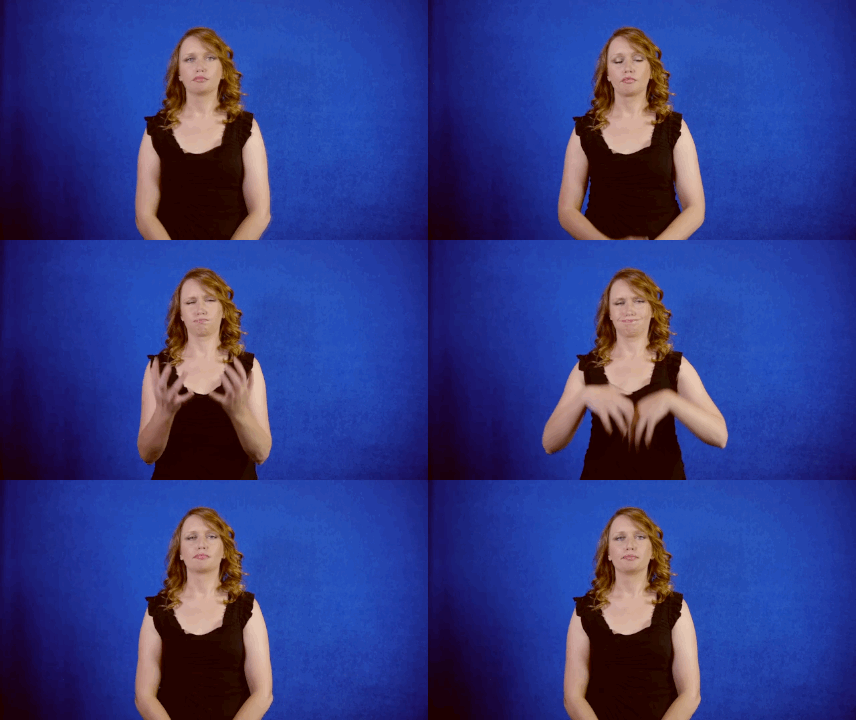
Sign for BURN DOWN in ASL | ❤️‍🔥 ASL Dictionary

Definition: To destroy by fire.

Sign for BURN DOWN in ASL 

YouTube player

Practice Activities:

To become more fluent with the sign for BURN DOWN in ASL, start by practicing the sign in isolation. Use a mirror to check your handshape, movement, and facial expression. Repeat the sign multiple times while maintaining a consistent pace and accuracy. Use both dominant and non-dominant roles to show what is burning and what is being destroyed.

Next, put the sign into short phrases. Practice with sentences like, “The house burn down,” “Old barn burn down last night,” or “Forest burn down after fire.” This helps incorporate the sign into everyday communication. Focus on using appropriate facial grammar, especially if marking time or emotion.

Try storytelling prompts that include the sign for BURN DOWN in ASL. For example, describe a storm that caused a lightning strike, leading to a large building burning down. Incorporate other signs like FIRE, DESTROY, and EMERGENCY to build your storytelling fluency. Visual descriptions and classifiers (like flat hands to show structures) will make your story more vivid and clear.

Work with a practice partner. One partner can sign out a short situation where something is burning down, and the other responds or retells the situation using the same sign. You can also challenge each other with improvisational prompts—for example, imagining a scene and figuring out how to describe what burned down and what caused it.

Video-record yourself signing sentences using the sign for BURN DOWN in ASL. Watch the replay to analyze your clarity and accuracy. This helps catch small errors and improves self-assessment. You may also use flashcards with images of buildings or environments and describe what is happening using the sign. Adding dramatic facial expressions improves the emotional tone of the sign and reinforces understanding.

Cultural Context:

The sign for BURN DOWN in ASL carries powerful cultural and emotional implications. In Deaf culture, visual language provides a rich way to express destruction, loss, and rebirth, all of which may be associated with this concept. Whether it’s a house, a building, or a symbolic representation of something ending, the sign for BURN DOWN in ASL captures more than just the literal meaning.

ASL relies on facial expression and body movement to add emotional nuance. When signing BURN DOWN in ASL, users often incorporate intense facial expressions and directional motion to convey the scale of damage. This aligns with how deeply storytelling in ASL is visual and expressive, offering more than just a translation—it’s a lived experience.

Because Deaf communities often experience communication barriers during emergencies, context is important. Learning the sign for BURN DOWN in ASL becomes more than vocabulary—it’s part of safety and awareness. During natural disasters or fire safety drills, knowing how to sign this clearly can be critical in getting help or sharing urgent information fast.

In storytelling and art, the concept of burning down also holds metaphorical weight in ASL. Whether used in poetry, jokes, or dramatic narratives, the sign for BURN DOWN in ASL might represent transformation, the end of an era, or a turning point. In visual Vernacular and ASL poetry, it’s not uncommon to see this sign used as part of larger themes around change or loss.

In educational settings or Deaf history discussions, the sign for BURN DOWN in ASL might come up when talking about events such as school closures or historical buildings damaged by fire. These discussions evoke strong emotions and are tied closely to collective memory. Having an accurate and expressive sign helps ensure these stories are passed down within the community.

The sign for BURN DOWN in ASL changes slightly depending on what is burning. You might see variations in classifier use to indicate the size of the structure or the direction the fire spreads. This flexibility allows for clear storytelling that aligns with the visuals of the event being discussed.

In social media conversations, especially in Deaf TikTok or YouTube videos, signing BURN DOWN can take on trending or even humorous meanings, elevated by ASL’s rich expressions. Just like in spoken English, Deaf users may play with culturally significant signs in creative ways. This adds layers of modern relevance to the core meaning of the sign for BURN DOWN in ASL.

Whether it’s used literally in emergency contexts or metaphorically in storytelling, the sign for BURN

Extended Definition:

The sign for burn down in ASL is a powerful visual representation that captures the complete destruction of a structure by fire. This phrase is typically used when a building or home has been entirely consumed and destroyed by flames. The sign involves using handshapes and motion to mimic the spreading and eventual downfall of fire.

In American Sign Language, the sign for burn down combines the concept of fire with the idea of collapse or total destruction. It includes directional and space-based elements to show how the fire spreads and leads to a building burning down. The signer will generally begin with a fire sign and follow it with a motion that indicates the structure collapsing or being consumed.

Context is very important when using the sign for burn down in ASL. It’s often used in storytelling or news-related interpretations to describe major fire incidents or disasters. The way the sign is produced can also reflect the emotional weight or seriousness of the situation being described.

There are a few variations of the sign depending on the region or the preference of the ASL user. Some signers may use a classifier to represent the building and show it being overtaken by flames. Others will use more abstract movements to convey the full scenario of something burning down completely.

Facial expressions also play a crucial role when using the sign for burn down in ASL. These expressions help convey the intensity, severity, or emotional reaction to the event being described. For example, a shocked or saddened facial expression might accompany the sign when explaining a tragic house fire.

The sign for burn down in ASL is not the same as the sign for simply burn. While burn can refer to heat or flames in a general sense, burn down adds the meaning of destruction and total loss. This makes the sign especially useful in more detailed or specific conversations.

Many ASL signers will use space in a meaningful way while signing burn down. They may set up the location of a building in signing space and then show fire engulfing and destroying that space. This makes the communication more visual and clear to those watching.

If you’re learning the sign for burn down in ASL, it’s important to study both the individual components and how they are combined. Practice with real-life examples, such as fire-related news stories, can help with memorization and fluency. Watching native signers use the phrase in context also helps reinforce understanding.

The phrase is commonly used in discussions about natural disasters, fire safety, emergency response, or historical events where buildings were lost due to fire. Its precise use

Synonyms: burn, blaze, destroy by fire, incinerate, reduce to ashes

Educational resources: Find related learning materials in our course bank!

Want more? Check out some of our popular learning activities on the homepage!

Need to look up a sign? Use our highly rated dictionary: https://aslinteractive.com/best-asl-dictionary/

Follow us on tiktok: https://www.tiktok.com/@aslinteractive. More social media links at the bottom of this page!

Long-tail Keywords: what is the sign for burn down in asl, how do you sign burn down in american sign language, burn down in asl

Categories:

tags: Commands, Actions, Verbs, Everyday Activities, Safety

Parameters

*Handshape*:

The handshape for the sign for BURN DOWN in ASL typically begins with open “5” handshapes, palms facing down, representing flames spreading across an area. The fingers wiggle downward in a wavy motion, mimicking the way fire spreads and consumes something below it.

This sign for BURN DOWN in ASL may also use flat hands to show a structure collapsing, visually representing destruction by fire. The movement and handshape work together to express the concept clearly.

*Palm Orientation*:

In the sign for BURN DOWN in ASL, the dominant hand usually starts with the palm facing downward while the non-dominant hand may represent a surface or area with the palm also facing down. As the movement mimics fire spreading or an area being consumed, the dominant hand wiggles downward with fingers fluttering, palm gradually rotating to face downward throughout the motion.

This dynamic palm orientation helps convey a realistic visualization of destruction. The sign for BURN DOWN in ASL captures the downward movement of flames consuming a space, aided by changing palm angles for dramatic effect.

*Location*:

The sign for BURN DOWN in ASL is produced in the neutral space in front of the body, roughly between chest and stomach height. The motion typically begins with a flame-like movement upwards or flickering fingers to represent fire, followed by a downward sweeping motion of the hands to indicate destruction or collapse.

When signing the phrase, both parts are executed clearly in this central signing space for visibility. The location helps convey the literal and metaphorical aspects of the sign for BURN DOWN in ASL effectively to the viewer.

*Movement*:

Start with your dominant hand in a flat “5” shape, palm facing down, above your non-dominant hand which also forms a flat “5” palm-up. Wiggle the fingers of your dominant hand as you slowly move it downward toward the other hand, mimicking flames descending and engulfing something below. This motion in the sign for burn down in ASL visually represents fire consuming a structure from top to bottom.

Emphasizing destruction by fire, the sign for burn down in ASL may be followed by an explosion-like gesture or a sudden sharp lowering of the top hand to reinforce the idea of collapse. The handshape and movement here clearly convey the concept of something being entirely consumed by flames. ️

*Non-Manual Signals*:

Facial expressions play a crucial role in the sign for BURN DOWN in ASL. Typically, the eyes widen and brows may furrow slightly to convey intensity or severity, reflecting the destructive nature of something burning completely. The mouth may also form a slight moue or tight line to give a sense of something being consumed by fire .

The non-manual signals emphasize the finality that the sign for BURN DOWN in ASL communicates. A sharp head nod downward can add a sense of collapse or total destruction, enhancing the sign’s overall visual impact. These expressions support the motion and meaning behind the concept, making it clear and emotionally accurate.

*Prosody, Dominant/Non-Dominant Hand*:

The sign for BURN DOWN in ASL uses both hands. The non-dominant hand stays flat, palm down, representing a surface or ground. The dominant hand starts with wiggling fingers underneath the non-dominant hand, then moves upward and away, simulating flames rising and destruction spreading.

This movement captures the concept of fire consuming a structure. The sign for BURN DOWN in ASL visually conveys the idea of a building or area being entirely destroyed by fire.

Tips for Beginners:

When learning the sign for BURN DOWN in ASL, beginners should keep in mind that this concept is usually conveyed using a combination of classifiers, directional movements, and contextual facial expressions. You’re not just signing a single word; you’re demonstrating an action or event. This makes it especially important to understand what classifiers are and how they represent buildings, fire, and destruction.

A common technique involves establishing a building or object with a classifier like flat hands or bent “B” hands, then transitioning into a movement that shows flames overtaking it, accompanied by a downward movement to show it collapsing or being reduced to rubble. Practice this in front of a mirror to make sure the handshapes are clean and that your movements show the progression of burning and collapsing. Precision matters—the hand movements must clearly separate the fire’s action from the physical collapse to convey the full meaning of the sign for BURN DOWN in ASL.

Facial expressions play a crucial role here. Showing urgency, shock, or seriousness with your brows or mouth will help clarify that you’re not just talking about a simple burn but about complete destruction. Beginners often forget facial grammar, which makes their signing feel flat or unclear. So, exaggerate slightly at first to get used to incorporating your face into the language.

Another pitfall is rushing through the movement. Take your time to show each stage of the event—building, fire starting, fire consuming, and finally destruction. The pace helps your audience follow your story. Remember, ASL is a visual language and the sign for BURN DOWN in ASL is a perfect example of how it uses spatial storytelling. Practice with a friend or teacher to ensure you’re using the right classifiers and expressions for full impact.

Sign for BURN DOWN in ASL, burn down in sign language, asl sign for building destroys by fire

Connections to Other topics:

The sign for BURN DOWN in ASL is conceptually tied to other destruction-related verbs like COLLAPSE, DESTROY, and FIRE. It often incorporates elements of the sign for FIRE—typically using fluttering fingers to represent flames—and modifies them to indicate complete destruction, usually by moving the sign downward and opening the hands to show spreading or engulfing. This makes the sign visually and conceptually similar to ACTION-BASED signs that show process and result in one motion.

This sign also connects to natural disaster vocabulary in ASL, such as FLOOD, EARTHQUAKE, and HURRICANE. These signs frequently share visual storytelling elements that spatially locate events and show changes to structures or environments. The sign for BURN DOWN in ASL uses similar space and motion techniques to show a structure being overtaken and destroyed by flame, especially in narratives about wildfires or urban disasters.

The sign can form part of compound phrases such as HOUSE BURN DOWN or FOREST BURN DOWN. These compounds combine the idea of a place or object with the resulting fire-driven destruction, emphasizing the totality of the damage. The structure here mirrors how ASL often uses topic-comment structure—showing the object first, then what happens to it.

Because the sign for BURN DOWN in ASL often includes physical storytelling, it links well to classifier use. Classifiers like CL:3 (vehicle) or CL:rectangle (building shape) can be placed in space, followed by the FIRE/BURN motion overtaking them. This provides context-rich expressions that deepen clarity and understanding in explanations or storytelling.

In teaching or learning the sign for BURN DOWN in ASL, it’s helpful to compare it to verbs of change like BREAK, EXPLODE, or DISAPPEAR. They all share a focus on transformation or end state, even if the mechanisms differ. These comparisons enrich vocabulary and help learners predict how new or related signs are formed.

Summary:

The sign for BURN DOWN in ASL involves a combination of conceptual layering that blends the idea of destruction by fire with physical motion. To sign it, you often begin with the sign for fire, which uses fluttering fingers on both hands that move upward to represent flames. Then you transition to a downward gesture or a flattening motion to show collapse or destruction.

This blend of visual metaphors captures both fire’s presence and its eventual effect—reduction to ashes. The downward collapsing motion clearly communicates that the structure or object has been consumed and no longer stands. It’s a powerful visual metaphor that maps closely to the full impact of uncontrolled fire.

The sign for BURN DOWN in ASL is highly expressive and rich in context. When done with expressive facial features, it emphasizes the gravity or intensity of the loss. You might furrow your eyebrows, look down slightly, or mimic emotional distress for added depth.

Grammatically, the sign for BURN DOWN in ASL functions as a complete verb phrase. It combines the action (burn) with the result (down), which means it’s often used as a compound predicate in ASL syntax. You wouldn’t typically need extra auxiliaries with it, as ASL prefers compact expressions that encapsulate full meanings.

The cultural significance of the sign for BURN DOWN in ASL can link to narratives of tragedy or major events. ASL users may use it when recounting stories involving fires, whether personal or historical. Such signs carry emotional weight, particularly within Deaf communities where storytelling plays a major role in cultural transmission.

Contextual understanding makes a big difference when using the sign for BURN DOWN in ASL. For example, if you’re referring to a literal house fire, you would localize the sign towards a classifier representing a house. For metaphorical uses—like an institution burning down figuratively—you’d adjust your expression accordingly.

ASL often allows for spatial storytelling, so if multiple buildings burn down in a story narrative, you might position them differently in the signing space. This enables the signer to move from one to another as if they’re illustrating a top-down view of the scene. The sign for BURN DOWN in ASL invites this level of visual storytelling.

Related signs include variations like fire, destroy, collapse, and explode. Each has overlapping semantic fields and can be combined or sequentially signed depending on clarity and context. Using these with the sign for BURN DOWN in ASL allows a nuanced and vivid description of events.

There’s an organic quality to how ASL signs evolve, and the sign for BURN DOWN in ASL demonstrates lexical blending. This blending process, in linguistics, shows how signs adapt new meanings by combining existing handshapes. It reflects the economy and efficiency inherent in signed languages.

From an applied linguistics perspective, the sign for BURN DOWN in ASL incorporates both physical articulation and emotive expressiveness. Fluid control of handshapes and directional movement is key to signing it accurately. Misplacing the direction or failing to show spatial effects could alter the meaning.

The sign aligns with ASL’s visual and classifier-rich nature. If you use classifiers properly, you can show the burning of a tall building versus a small cottage. The shape, size, and orientation classifiers work seamlessly with the sign for BURN DOWN in ASL to paint a robust mental image.

This sign exemplifies ASL’s ability to collapse temporal sequence into visual space. A signer can show ignition, expansion of fire, and eventual collapse all in seconds. The sign for BURN DOWN in ASL is not static—it evolves with each narrative depending on detail and visual scope.

There are regional differences and idiolects when it comes to the exact way this compound sign is formed. Some signers may use more dragging downward motion, while others emphasize the explosion or loss. The core idea, however, remains—the irreversible damage caused by fire.

When paired in narratives, the sign for BURN DOWN in ASL is often followed by signs indicating loss, fear, or emergency. This helps ground the audience emotionally and connects the movement of hands to the perceived weight of the incident. Signers may include facial shifts to show horror or disbelief.

Facial grammar plays a critical role in modulating the intensity of the sign. A neutral face might suggest a controlled burn, whereas a shocked or grieving expression intensifies the signer’s intent. These visual cues are embedded into the grammar of ASL, especially with emotive verbs.

The sign for BURN DOWN in ASL is useful in educational and social justice storytelling. It can be used to speak about unjust events, such as historical injustices like the burning of cultural symbols or towns. It adds weight and agency to the tone of such discussions when signed powerfully.

In Deaf poetry and sign language theater, the sign for BURN DOWN in ASL frequently appears in metaphorical contexts. It could represent emotional destruction, the collapse of old systems, or transformation after chaos. Artistic

Want more? Check out some of our popular learning activities!

ASL Interactive Resources

ASLInteractive YouTube Channel

Follow us on tiktok: @aslinteractive.com

Follow us on Instagram: aslinteractive

Facebook page: aslinteractive

Facebook group: aslinteractive

LInkedIn: ASL Interactive LLC

Twitter: @ASL_interactive

*Some information on this page is AI-generated. AI can make mistakes. Please check the information.

sign for BURN DOWN in ASL

Responses