Sign for BUSHY EYEBROWS in ASL | 🥸 ASL Dictionary

Definition: Eyebrows that are thick and bushy.

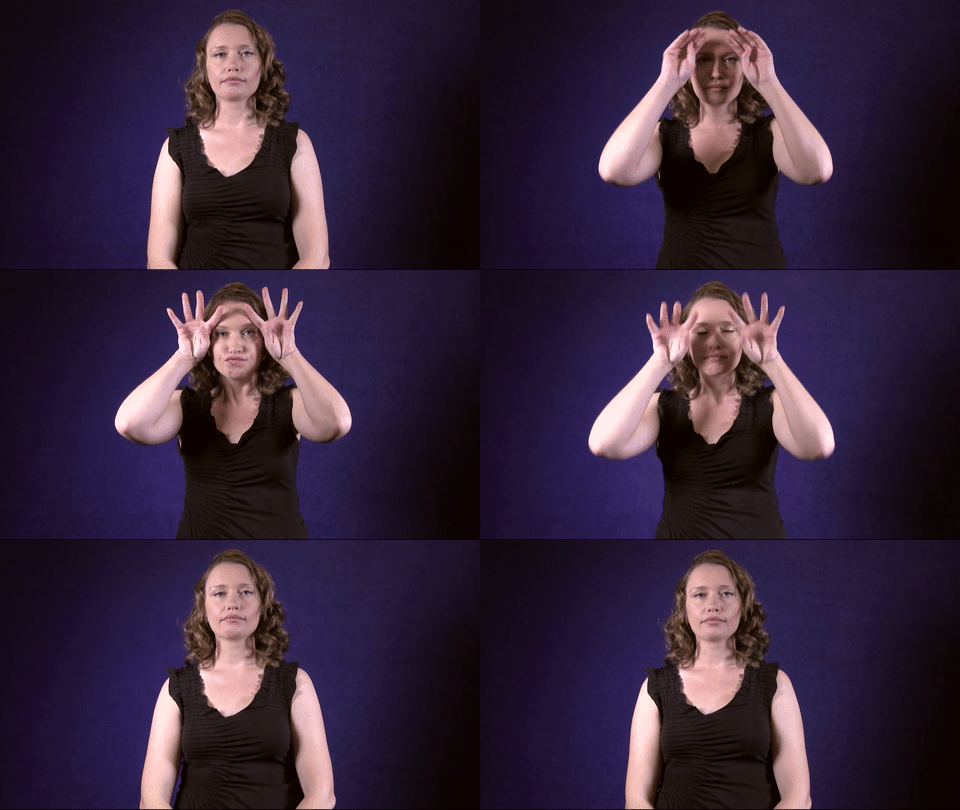
Sign for BUSHY EYEBROWS in ASL

YouTube player

Practice Activities:

To practice the sign for BUSHY EYEBROWS in ASL, begin by standing in front of a mirror and practicing the sign in isolation. Focus on the handshape, movement, and facial expression that naturally mimics the thick, prominent quality of bushy eyebrows. Repeat this sign several times while watching your face to make sure the visual meaning is clear and intentional.

Move into practicing the sign for BUSHY EYEBROWS in ASL with descriptive phrases. Try combining it with different facial features, such as “man with bushy eyebrows,” “woman with long hair and bushy eyebrows,” or “bushy eyebrows, big nose.” Think about how facial expressions enhance the meaning. This sign depends a lot on exaggeration and clarity through visual description, so facial expressions are key to effective communication.

Develop fluency by incorporating the sign for BUSHY EYEBROWS in ASL into full sentences. Examples include: “My uncle has bushy eyebrows and wears glasses” or “I saw a cartoon character with huge bushy eyebrows.” You can write these sentences down first and then sign them while focusing on clear transitions and fluid movements.

Try a storytelling activity where you describe a character. Include vivid details that utilize the sign for BUSHY EYEBROWS in ASL, such as a detective with bushy eyebrows who always looks surprised or a wizard with wild hair and thick brows. This strengthens your narrative skills and helps with visual storytelling.

Partner practice is also helpful. Describe people you know or characters from movies using the sign for BUSHY EYEBROWS in ASL. Then, ask your partner to guess who you’re describing. This makes the practice interactive and builds receptive as well as expressive skills.

End each practice session with a self-recording. Watch yourself to verify clarity and expression when using the sign for BUSHY EYEBROWS in ASL, and adjust as needed.

Cultural Context:

In American Sign Language, facial expressions carry just as much meaning as the hand signs themselves. When learning the sign for bushy eyebrows in ASL, it’s important to recognize how specific features like eyebrow shape or facial hair are communicated visually. Bushy eyebrows are a noticeable and expressive feature that can influence the overall meaning of a facial description in ASL.

Deaf culture emphasizes visual communication, so describing physical traits like bushy eyebrows involves not just hand movements, but also mimicking the exaggerated appearance through facial expressions. The sign for bushy eyebrows in ASL showcases how the Deaf community represents descriptive features with clarity and precision. This type of description adds depth to storytelling and everyday visuals in ASL conversations.

Physical characteristics such as hair type, facial structure, or prominent features are commonly shared in personal stories or when identifying someone. The sign for bushy eyebrows in ASL is a great example of how adaptable and visual the language is. This descriptive sign connects with a long-standing tradition in Deaf culture of vividly portraying people and events.

Using ASL to describe someone’s looks can be rich and expressive, relying on both iconic gestures and creative movement. The sign for bushy eyebrows in ASL captures this perfectly by blending gesture with dramatized facial displays. In a visual language, details like these help provide precise and relatable descriptions.

In Deaf storytelling, bushy eyebrows can become part of a character’s identity, often humorously emphasized to leave a lasting image. The sign for bushy eyebrows in ASL allows signers to present those vivid physical features that make a story enjoyable or memorable. It’s more than a label—it contributes to the visual texture of the language.

Often in ASL, signs for descriptive features vary slightly depending on the region or personal signing style. However, the sign for bushy eyebrows in ASL is commonly understood due to its iconic nature—it mirrors the shape and size of the eyebrows visibly and clearly. This standardization helps keep signed communication accessible and effective.

In daily Deaf social life, signs for physical characteristics like bushy eyebrows are used playfully, especially among friends and family. The sign for bushy eyebrows in ASL is typically accompanied by expressive eye and brow movement that mimics the shape, reinforcing the sign’s meaning. This kind of visual emphasis is a big part of how ASL brings personality into descriptions.

Understanding the sign for bushy eyebrows in ASL also gives insight into how much ASL values detail. Whether used in a classroom, a conversation, or storytelling

Extended Definition:

The sign for bushy eyebrows in ASL is a descriptive gesture that illustrates the fullness and texture of thick eyebrows. American Sign Language uses visual cues to represent details like shape, size, and distinct facial features, making signs like this both expressive and easy to understand.

When signing bushy eyebrows in ASL, you typically start by outlining the shape and fluffiness above the eyes using both hands. Your fingers may move in a rounded motion, capturing the bushy appearance through exaggerated movement just above the brow line. This form of description allows others to visualize the unique characteristic of the eyebrows without the need for extra explanation.

In ASL, describing physical features accurately is essential for identification or storytelling. The sign for bushy eyebrows in ASL often appears in conversations when describing someone’s face, especially in detail-rich narratives. Children’s stories, personal anecdotes, and character descriptions use this kind of sign to add clarity and personality to descriptions.

Because ASL is a visual and spatial language, the sign adapts naturally to show the concept of thickness and fluffiness. The movement and facial expressions help express how bushy the eyebrows are, whether they are slightly thicker than average or dramatically overgrown. Adding a facial expression of slight surprise or animated eyes can further enhance the meaning during signing.

Learning the sign for bushy eyebrows in ASL increases your vocabulary related to physical traits and improves your ability to describe people clearly. This can be especially helpful in settings like classrooms, video calls, or interactions where visuals are part of the communication.

Many ASL users, including Deaf and hearing signers, often use descriptive signs like this in everyday interactions. Whether you’re explaining your own features or talking about someone else, the sign for bushy eyebrows in ASL gives others a visual reference point they can immediately understand.

This sign is an example of how ASL integrates visual storytelling with anatomy to form a single, expressive motion. Signed descriptions become vivid illustrations, and using the correct sign connects concepts with portrayals much faster than spoken language might.

It’s also common to see this sign used in casual conversations, especially when describing someone’s appearance to a friend. For example, if someone is trying to point out a person across the room and they remember them having thick, noticeable eyebrows, using the sign for bushy eyebrows in ASL helps paint an immediate picture.

Being able to recognize and use this sign not only improves your ASL fluency but also strengthens how naturally you can describe people.

Synonyms: thick eyebrows, full eyebrows, dense eyebrows, heavy eyebrows, prominent eyebrows

Educational resources: Find related learning materials in our course bank!

Want more? Check out some of our popular learning activities on the homepage!

Need to look up a sign? Use our highly rated dictionary: https://aslinteractive.com/best-asl-dictionary/

Follow us on tiktok: https://www.tiktok.com/@aslinteractive. More social media links at the bottom of this page!

Long-tail Keywords: what is the ASL sign for bushy eyebrows, how to sign bushy eyebrows in ASL, how do you say bushy eyebrows in American Sign Language

Categories:

tags: appearance, facial features, describing people, emotions, expressions

Parameters

*Handshape*:

The handshape for the sign for BUSHY EYEBROWS in ASL involves spreading the fingers of both hands apart, using open “5” handshapes. The fingers are slightly curved and held near the brow area, palms facing downward.

This expressive handshape helps depict the fullness and thickness of bushy eyebrows. The motion often follows the natural line of the eyebrows. It’s a descriptive and visual element crucial to accurately signing the sign for BUSHY EYEBROWS in ASL.

*Palm Orientation*:

The palm orientation in the sign for BUSHY EYEBROWS in ASL involves both hands with palms facing downward toward the face. Fingers are spread slightly apart and curved to suggest the shape and volume of bushy eyebrows.

As you perform the sign for BUSHY EYEBROWS in ASL, the palms stay facing the face throughout, moving from the center outward along the brow line. This palm direction helps emphasize the thickness and area of the eyebrows ️.

*Location*:

The location for the sign for BUSHY EYEBROWS in ASL is primarily around the upper face, just above the eyes. Both hands typically begin near the forehead, indicating the brow line where eyebrows naturally grow.

Facial expressions are crucial in conveying the concept. This sign stays in the vicinity of the face to emphasize the thickness or prominence of the eyebrows, helping to visually reinforce the idea behind the sign for BUSHY EYEBROWS in ASL.

*Movement*:

To show the sign for BUSHY EYEBROWS in ASL, start with both hands in loose claw shapes near the brow line. With palms facing downward, move the hands outward and slightly upward in short, wavy motions to mimic the thickness and texture of bushy eyebrows .

The movement emphasizes exaggeration, capturing the fluffiness or density of the brows. Facial expression is important—raise your own eyebrows to enhance the concept conveyed by the sign for BUSHY EYEBROWS in ASL.

*Non-Manual Signals*:

For the sign for BUSHY EYEBROWS in ASL, raise the eyebrows slightly while puffing your cheeks to convey thickness or fullness. The eyes should widen slightly, and the head may tilt forward to show emphasis or curiosity. These non-manual signals help emphasize the concept of exaggerated or prominent eyebrows, enhancing clarity when demonstrating the sign for BUSHY EYEBROWS in ASL. Maintain expressive facial features to support the visual nature of the concept.

*Prosody, Dominant/Non-Dominant Hand*:

The sign for BUSHY EYEBROWS in ASL uses both hands to trace the shape of thick, prominent eyebrows above the eyes. The dominant and non-dominant hands are typically in bent “L” handshapes or clawed “5” handshapes, starting above each eyebrow and moving outward while mimicking the fullness of bushy eyebrows. ️

This expressive sign relies on simultaneous hand movement and facial expression, particularly a furrowed brow or raised eyebrows to match meaning. The sign for BUSHY EYEBROWS in ASL visually conveys texture and shape, making it clear and iconic.

Tips for Beginners:

When learning the sign for BUSHY EYEBROWS in ASL, pay close attention to facial expressions along with hand movements. In ASL, describing features like bushy eyebrows often depends on clear non-manual markers, such as eye and brow motions paired with illustrative hand shapes around the eyebrow area.

One helpful tip is to use C- or curved-open handshapes near your eyebrows to mimic the shape and texture of bushy eyebrows. You can slightly wiggle your fingers or move your hands outward to suggest thickness and bushiness. This kind of descriptive classifier helps illustrate the concept clearly and visually.

Practice in front of a mirror to make sure your sign doesn’t look too similar to other facial description signs. It’s easy to blur movements or placement, especially when facial features fall close together in the signing space. The sign for BUSHY EYEBROWS in ASL heavily relies on spatial accuracy near your forehead.

Don’t forget facial grammar! Raise your eyebrows slightly or furrow them depending on the context—whether you’re admiring, questioning, or describing neutrally makes a difference. ASL is a visual language, and eyebrows themselves often play a grammatical role, so balancing expression and description is key.

New signers sometimes forget hand placement and make the motion too high or too far from the face. Keep your movements anchored close to the brow line to maintain clarity. In storytelling or conversation, using the sign for BUSHY EYEBROWS in ASL clearly can help paint a vivid picture.

As you develop fluency, pay attention to native signers and how they adjust the size, speed, or intensity of this sign depending on who or what they’re describing. Repetition and mimicry are powerful learning tools . Take your time and incorporate it into descriptive exercises to reinforce understanding and natural use.

Connections to Other topics:

The sign for BUSHY EYEBROWS in ASL connects to a broader set of signs used to describe physical characteristics and facial features. This cluster includes signs like EYEBROWS, BIG, SMALL, HAIR, and descriptive modifiers such as THICK or THIN. Understanding how adjectives work in ASL is vital, as many signs rely on spatial or movement variations to convey meaning instead of separate lexical items.

Descriptive signs like the sign for BUSHY EYEBROWS in ASL also tie into classifiers and depiction strategies, often used when talking about people’s appearances. Classifiers may amplify the meaning of bushiness, using handshape and movement to show spread or density. These strategies are also common when describing animals or even objects with similar textures or features, such as a dog with shaggy fur or a costume with feathers.

The formation of compound signs and the layering of meaning is also key here. For example, the sign for BUSHY EYEBROWS in ASL could be formed by modifying EYEBROWS with a classifier or an exaggerated motion to indicate fullness. This pattern is similar to how signs like LONG-HAIR or BIG-NOSE are created, combining a core feature with a size descriptor to build a full mental picture.

Facial expressions in ASL also enhance meaning, especially for descriptive signs. When using the sign for BUSHY EYEBROWS in ASL, specific non-manual markers like raised brows or widened eyes may emphasize the exaggerated fullness and draw attention to the area being described. These markers are fundamental in the wider context of visual language, impacting clarity and tone.

Finally, signs for body and face descriptions are often used in storytelling or introductions. Being able to describe someone with the sign for BUSHY EYEBROWS in ASL is useful when recounting a memory, clarifying identity, or painting a vivid picture in narratives or casual conversations ‍ ️.

Summary:

The sign for BUSHY EYEBROWS in ASL visually represents the texture and size of eyebrows that are full and prominent. It typically involves using both hands in clawed 5-handshapes, starting above each eye and fluffing outward in a wide motion to suggest the thickness and spread of the eyebrows. This expressive sign draws on iconicity — the idea that the sign looks like what it represents.

This sign is highly visual and mimetic, reflecting the descriptive nature of ASL when referring to physical features. It allows the signer to immediately establish a visual reference without needing supplemental explanation. The clarity of this depiction aids both comprehension and storytelling.

Eyebrows in ASL are significant because they play a core grammatical role in the language. They are used for marking grammar such as yes/no questions or WH-questions, which involve manipulating the position and movement of the brows. When discussing someone with bushy eyebrows, there is a fascinating intersection between grammatical brows and descriptive brows.

The sign for BUSHY EYEBROWS in ASL must take care not to interfere with grammatical expressions. For example, if a question is being asked while signing, the signer may isolate the description or use facial layering to ensure clarity. Facial grammar is an essential part of ASL syntax, so balancing expressiveness with grammatical accuracy is key.

In terms of culture, bushy eyebrows may carry connotations related to age, ethnic identity, or personality. ASL allows nuance in describing these features, and classifiers or additional context can be added to expand the meaning. The sign often forms part of narratives, jokes, or descriptions that align with Deaf humor and visual storytelling customs.

When used within a conversation, the sign for BUSHY EYEBROWS in ASL can act as a noun modifier, often accompanying a referent’s indexical sign. For instance, one might describe a friend or a client by pointing and adding the descriptive sign. This allows dynamic identification of individuals in a story, making communication smoother and more accessible.

Related signs include EYEBROWS, HAIRY, and CLASSIFIER-C descriptions involving hair texture or grooming. Combining these elements builds richer descriptions of a person’s face or head. It can also express style preferences, such as in beauty or fashion contexts.

Linguistically, this sign illustrates how ASL uses spatial referencing and iconicity to represent physical descriptions. Unlike English, which depends on adjectives lined up linearly, ASL can convey multiple visual features in simultaneous layering. This incorporates handshape, movement, non-manual markers, and facial orientation.

Applied linguistics features prominently here when observing how Deaf individuals recall or identify people based on standout traits. Bushy eyebrows might be a salient feature someone uses to describe a character or stranger. This strategy aligns with how visual languages prioritize perceptual salience over arbitrary descriptors.

In learning ASL, mastering the sign for BUSHY EYEBROWS involves visual sensitivity and mimicry. Students are encouraged to mirror facial structures and movements accurately. ASL curricula often include exercises where learners describe images or people using visual traits like these.

The sign also opens the door to discussions about naturalness in sign production. Smooth transitions, use of facial space, and rhythm influence the legibility of the measurement expressed in the width and thickness of the eyebrows. Creating consistent sizing in the air reflects linguistic discipline, similar to modulating vocal pitch or speed in spoken languages.

Understanding this sign also contributes to discussions about ASL phonology. While often thought of in terms of how hands shape syllables, ASL phonology also includes non-manual signals. The eyebrow shape and accompanying facial expressions may work as a phonological unit in this context.

From a storytelling angle, describing someone with bushy eyebrows can enhance the visual richness of a narrative. It creates mental imagery that is especially useful in mediums like Deaf theater or ASL poetry, where visual language thrives. The sign helps construct vivid, relatable characters.

Usage of the sign for BUSHY EYEBROWS in ASL can also reflect attitudes. When paired with eye rolls, shoulder movements, or exaggerated gestures, it can suggest admiration, surprise, or even judgment. This polysemous use adds emotional flavor without needing words.

Interestingly, the sign can be stylistically altered for comedic effect. In some situations, signers exaggerate the width or fluffiness, much like cartoonists draw bold features. Humor in Deaf culture often revolves around visual distortion, making this a fertile area for performance.

Interpreters need to be mindful when translating these ideas from English to ASL. Literal translation isn’t always successful, especially for idioms or metaphors involving eyebrows. Clear understanding of cross-modal equivalents helps preserve the intent and sense of the original expression.

For those using ASL in clinical, educational, or social work contexts, accurately conveying someone’s distinguishing facial traits is often needed. The sign for BUSHY EYEBROWS in ASL ensures inclusive and respectful description of individuals. It also prevents confusion in environments where

Want more? Check out some of our popular learning activities!

ASL Interactive Resources

ASLInteractive YouTube Channel

Follow us on tiktok: @aslinteractive.com

Follow us on Instagram: aslinteractive

Facebook page: aslinteractive

Facebook group: aslinteractive

LInkedIn: ASL Interactive LLC

Twitter: @ASL_interactive

*Some information on this page is AI-generated. AI can make mistakes. Please check the information.

Sign for BUSHY EYEBROWS in ASL

Responses