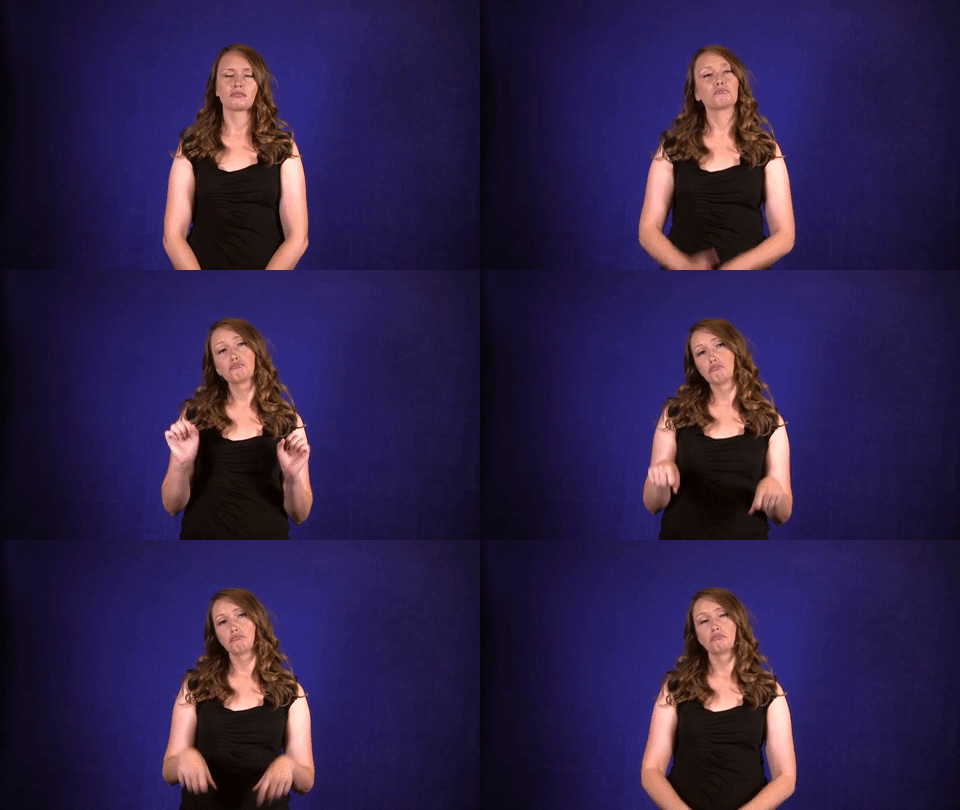
Definition: To be able to.
Sign for CAN ABLE in ASL

Practice Activities:
Begin by practicing the sign for CAN ABLE in ASL in front of a mirror. Focus on the handshape, palm orientation, and movement, making sure your gesture appears strong and affirmative. Repeat the sign multiple times slowly and then at conversational speed to build muscle memory.
Next, try using the sign for CAN ABLE in ASL in isolation by associating it with everyday verbs. Sign combinations like CAN GO, CAN EAT, CAN HELP using expressive determination in your facial expression to match the sign’s assertive meaning. This helps emphasize the sign’s affirmation of ability or permission.
Create practice sentences using the sign for CAN ABLE in ASL, such as I CAN DRIVE, SHE CAN COOK, or WE CAN SIGN. Practice both making and understanding these sentences with a study partner if possible. Switch roles where one person signs a sentence, and the other translates it into spoken English to reinforce comprehension.
Consider storytelling activities where you describe a character’s abilities using the sign repeatedly. For example, tell a short story about a superhero who CAN FLY, CAN RUN FAST, and CAN SAVE PEOPLE. This encourages the use of the sign in creative and engaging contexts while building fluency with surrounding vocabulary.
Use flashcards with various action verbs. After choosing a card, try forming a sentence using the sign for CAN ABLE in ASL with that verb. For instance, draw the card TEACH and sign I CAN TEACH or YOU CAN TEACH, adding emotion and clarity.
Practice conversations with a partner where you ask and answer ability-based questions. Ask things like CAN YOU SWIM? or CAN THEY DRIVE?, responding using the correct affirmative or negative signs. This keeps your understanding of context strong and prepares you for real-life conversations using the sign for CAN ABLE in ASL.
Cultural Context:
In American Sign Language, the sign for CAN ABLE in ASL represents the concepts of ability, capability, and permission. This sign is commonly used in everyday conversation and has a strong place in Deaf culture, where visual language reflects not just grammar but also cultural values and norms.
The sign for CAN ABLE in ASL often appears when someone is discussing possible actions or confirming that someone has the power or permission to do something. It is equally important when talking about personal empowerment or validating another person’s abilities in a respectful, direct manner.
In Deaf communities, communication is often rooted in clarity and mutual understanding. The sign for CAN ABLE in ASL helps express those values. It allows users to communicate affirmation, capacity, and confidence quickly and clearly in a visual format.
This sign plays a crucial role in educational settings. Deaf students often need to express or hear encouragement in terms that foster confidence. When teachers and peers use the sign for CAN ABLE in ASL, it promotes a positive learning environment and supports skill-building.
The cultural context also connects to how members of the Deaf community encourage independence. Signing CAN ABLE aligns with a worldview that emphasizes what individuals can do instead of what they cannot. It supports empowerment and self-advocacy.
Because ASL is not a direct translation of English but a fully developed language with its own grammar, the sign for CAN ABLE in ASL may not always align directly with English word order. Understanding the broader cultural meaning behind signs like CAN ABLE is important for respectful and accurate communication.
Often, this sign is part of affirmations shared within the community. For example, during motivational talks or peer encouragement, the sign for CAN ABLE in ASL is frequently used to uplift others. It carries both linguistic and emotional weight.
The use of visual emphasis in facial expressions adds depth to the meaning. In Deaf culture, facial expressions are just as important as hand signs. When using the sign for CAN ABLE in ASL, the signer’s face might show certainty, support, or reassurance, adding rich cultural nuance.
In storytelling and performance art, which are large parts of Deaf cultural expression, the sign for CAN ABLE in ASL helps depict a character’s journey or the challenges they overcome. These performances are more than entertainment; they are a way to share values and experiences central to Deaf identity.
The visibility and repetition of signs like CAN ABLE contribute to language fluency. New learners of ASL are encouraged to practice this sign as
Extended Definition:
The sign for CAN ABLE in ASL represents the concept of being capable, permitted, or physically able to do something. This sign is often used in everyday conversations to express ability or permission. In American Sign Language, the sign for CAN ABLE can change slightly depending on the context or intensity of the meaning.
To sign CAN ABLE in ASL, you typically use both hands in the “S” handshape. The hands start near the chest and then move downward slightly, creating a firm, definitive motion. This emphasizes certainty and assurance, reflecting the meaning of capability or permission.
This sign is commonly used in phrases like “I can help,” “You can go,” or “She is able to do that.” The emphasis is on the idea that something is possible or allowed. It’s also interchangeable with contexts involving strength or skill, as in when someone has the ability to perform a physical or mental task.
The sign for CAN ABLE in ASL does not require facial expressions to change its core meaning, but facial expressions can add additional clarity. For instance, nodding while signing CAN ABLE can reinforce the positivity or certainty of the statement. Shaking the head while signing it may convey irony or doubt, depending on the rest of the sentence.
It’s important to note that the sign for CAN ABLE in ASL is distinct from similar signs like MAY, which also implies permission but with a softer or more formal tone. CAN ABLE is more direct and confident. Understanding this difference can help learners improve both expressive and receptive skills in casual and formal ASL communication.
Children and beginners often learn this sign early in their ASL journey because it’s used frequently and pairs with a large number of vocabulary words. Mastering the sign for CAN ABLE in ASL opens up more versatile conversation possibilities, especially when talking about capabilities or rules. It empowers the signer to express potential or consent clearly.
In more advanced contexts, the sign for CAN ABLE in ASL may appear in conditional statements or rhetorical questions. For example, a signer may ask “Can you believe that?” by combining a questioning facial expression with the sign. This adaptability makes it one of the foundational verbs in conversational American Sign Language.
As you continue exploring ASL vocabulary, recognizing the consistency of handshapes and movements used in the sign for CAN ABLE in ASL will help reinforce both memory and fluency. Remember to watch how native signers use it across various sentences to catch the subtle nuances. Videos and
Synonyms: can, capable, able, competent, proficient
Educational resources: Find related learning materials in our course bank!
Want more? Check out some of our popular learning activities on the homepage!
Need to look up a sign? Use our highly rated dictionary: https://aslinteractive.com/best-asl-dictionary/
Follow us on tiktok: https://www.tiktok.com/@aslinteractive. More social media links at the bottom of this page!
Long-tail Keywords: what is the sign for Can able in ASL, how to sign Can able in American Sign Language, how do you sign Can able in ASL
Categories:
tags: Abilities, Verbs, Language Learning, Commands, Everyday Activities
Parameters
*Handshape*:
The handshape for the Sign for CAN ABLE in ASL uses two A-handshapes, where each hand forms a fist with the thumbs resting alongside the index fingers. Both hands start in front of the body at chest level.
In the Sign for CAN ABLE in ASL, the fists are moved downward simultaneously in a firm, confident motion. This sign conveys the idea of possibility or ability through both the handshape and movement.
*Palm Orientation*:
For the sign for CAN ABLE in ASL, both hands are formed into the letter “S” handshape and positioned shoulder-width apart. The palms are oriented downward, facing toward the floor. When performing the sign, the movement involves simultaneously dropping both fists slightly downward in a firm and confident motion. This palm orientation enhances the assertive and affirmative meaning of the sign for CAN ABLE in ASL .
*Location*:
The sign for CAN ABLE in ASL is made at the lower chest area, just a few inches in front of the body. Both A-hands start shoulder-width apart and then move downward slightly in a firm, confident motion. This movement reflects the meaning of the sign for CAN ABLE in ASL, showing physical capability or permission.
The location is neutral and centered, keeping the sign within the lower torso area. This placement allows full visibility and ease of motion, which aligns with the concept conveyed by the sign for CAN ABLE in ASL.
*Movement*:
Begin with both S-handshapes, palms facing down, held about shoulder-width apart at shoulder level. In the sign for CAN ABLE in ASL, move both hands downward simultaneously in a short, firm motion to about chest level, ending with a slight bounce to show certainty or emphasis.
The movement is strong and deliberate, conveying a sense of ability or permission. The sign for CAN ABLE in ASL should be performed with confidence and clarity to reflect the concept effectively.
*Non-Manual Signals*:
When using the sign for CAN ABLE in ASL, the facial expression remains neutral but confident, showing certainty and assurance. There is no exaggerated eye movement or head tilt, just a firm nod that aligns with the affirmative nature of the sign.
The sign for CAN ABLE in ASL relies heavily on a strong, deliberate motion, so the non-manual signals should support that intent with a clear, purposeful demeanor. Avoid furrowed brows or any indication of doubt to maintain accuracy.
*Prosody, Dominant/Non-Dominant Hand*:
The sign for CAN ABLE in ASL uses both hands in the dominant and non-dominant roles. Both hands form the letter “S” shape and are held shoulder-width apart in front of the body. They start slightly elevated and then move downward at the same time in a firm and confident motion, showing assertiveness and capability.
The dominant and non-dominant hands remain parallel throughout the sign for CAN ABLE in ASL, emphasizing agreement and balance. The movement is smooth but deliberate, conveying the meaning of ability or possibility with clarity.
Tips for Beginners:
When learning the sign for CAN ABLE in ASL, focus on the movement and handshape, as these are what differentiate it from other similar signs. Both hands should form the letter “S” handshape and move downward in unison from chest level. Keep your hands firm and your movement confident—this is a key part of showing capability or permission in ASL.
New signers might confuse the sign for CAN ABLE in ASL with signs like “possible” or even “okay,” especially when they aren’t paying attention to the firmness of the movement. Make sure your “S” hands don’t bounce or move too far apart. The movement is short, deliberate, and simultaneous—avoid jerky or overly exaggerated gestures.
Practice the sign in a mirror to become aware of symmetry and pace. Inconsistent motion can make the intended meaning unclear. The hands should drop with slight tension to show definitiveness, which communicates the affirmative tone of CAN ABLE clearly.
Also, try incorporating facial expressions. A neutral or confident face helps reinforce the message, while a hesitant or unsure look could alter the tone, especially in conversational settings. Native signers often use both hand and face to complete meaning, so don’t overlook this aspect.
If you are fingerspelling the word “can” for clarification or emphasis in a sentence, remember that fingerspelling and the sign for CAN ABLE in ASL have different purposes. Use the sign when expressing ability and only resort to fingerspelling when contextually necessary or for emphasis.
As you’re mastering the sign for CAN ABLE in ASL, don’t rush. Slow down, ensure clarity, and build muscle memory through repetition. Watching native signers or video demonstrations can also help lock in accuracy and flow. Real-time feedback from instructors or peers makes a big difference too.
Connections to Other topics:
The sign for CAN ABLE in ASL is foundational and closely tied to modality in sign language — expressing what is possible, allowed, or achievable. This sign falls under the broader category of modal verbs in ASL, alongside MUST, SHOULD, and WILL. These modal signs often come at the end of a statement for grammatical accuracy, highlighting how ASL syntax differs from English structure.
The sign for CAN ABLE in ASL connects with multiple concepts related to ability, possibility, and permission. It’s frequently combined with other signs to form compound or idiomatic expressions, such as YOU CAN GO, or I CAN’T SEE. The negation of CAN ABLE, using CAN’T, introduces learners to the role of facial expression and movement in transforming meaning, which is crucial in accurate ASL grammar.
Learning the sign for CAN ABLE in ASL also helps reinforce the concept of affirmation vs. negation. For example, pairing CAN ABLE with NOT produces a contrast meaning, essential when asking clarifying questions or setting expectations. This makes it integral to everyday conversation, job interviews, or school contexts where one must express capability or lack thereof.
This sign often appears in combination with directional or context-dependent verbs, enriching learner understanding of classifiers and verb inflection. Phrases like CAN HELP or CAN CALL demonstrate how to convey ability and intent together. This functional blending encourages fluidity and natural communication.
Additionally, the concept underlying the sign for CAN ABLE in ASL serves as a linguistic bridge to expressing confidence and willingness. It aligns with signs for TRY, READY, and POSSIBLE, which all signal levels of willingness or competence. By exploring these relationships, learners build a stronger sense of expressive freedom in sign language. ✨
Summary:
The sign for CAN ABLE in ASL is widely used in everyday conversations and holds a foundational role in ASL grammar. It typically conveys ability, permission, or possibility depending on context. This makes it highly versatile and essential for fluency.
To produce the sign, both hands are formed into the letter “S” handshapes, palms facing downward. The hands are placed near chest level and then moved down slightly in a deliberate, firm motion. This shows affirmation and capability.
The motion must be smooth and assertive, without being rushed. The energy behind the sign helps express certainty and confidence, traits inherently linked to the concept of ability. The firmness of the movement subtly reinforces a sense of control or strength.
One of the key aspects of the sign for CAN ABLE in ASL is its use in affirmative statements. When used alone, it often means “I can” or “able to.” Negative versions require the NOT sign or a modified facial expression to signal inability.
Facial grammar plays a crucial role when signing CAN ABLE in ASL. Raised eyebrows and nodding can emphasize agreement or willingness. A slight frown or headshake helps indicate the opposite when used with NOT or CAN’T.
The sign connects to broader ASL grammar concepts like modality. Modals in ASL function differently from English ones and are often placed before the main verb. CAN ABLE functions as a modal, taking a position that changes the tone and meaning of the sentence.
In some contexts, signers may layer the sign for CAN ABLE in ASL with other verbs. For example, pairing it with the sign for GO creates the meaning “can go.” The verb follows the modal for grammatical cohesion in ASL syntax.
The concept of ability or permission within Deaf culture also underscores agency. The sign for CAN ABLE in ASL often implies self-sufficiency or empowerment. It resonates strongly with values of independence and Deaf pride.
Linguistically, the sign for CAN ABLE in ASL demonstrates how ASL uses non-manual signals in conjunction with manual signs. This interaction is essential to understanding ASL as a visual-spatial language. Non-manual markers like head nods provide nuance.
Applied linguistics uses this sign in educational settings, where teaching modality enhances ASL students’ comprehension. Understanding how to use CAN ABLE in diverse sentence structures supports second language acquisition principles. Its regular use reflects real-world interactions.
In comparative linguistics, CAN ABLE in ASL is parallel to modal verbs in English and other spoken languages. However, ASL shows modality visually rather than through auxiliary verb changes. This highlights how modalities adapt differently across modalities of communication.
The sign also ties into discussions about capability versus permission. For example, “can” in English may mean “allowed to” rather than “capable of.” Therefore, the cultural and contextual interpretation of CAN ABLE in ASL must be clear through facial expressions and environment.
The gesture can shift subtly based on regional dialects within the Deaf community. Some may add slight movements or changes in intensity to reflect local signing conventions. Dialectical variation in signing shows the living, changing nature of ASL.
The sign does not require fingerspelling, which supports its use in fluent, flowing conversation. Its simple handshape makes it accessible for new learners. The ease of formation is one reason why novices learn this early in ASL education.
Teaching the sign for CAN ABLE in ASL often serves as an entry point into deeper grammar. Students learn that modality affects sentence structure and requires unique facial components. This scaffolds later learning of other modal signs like SHOULD or MUST.
In sentence construction, CAN ABLE precedes the action it modifies. This sequencing differs from English but aligns with ASL norms. For example, CAN + EAT means “can eat” with the flair of visual affirmation through facial cues.
When someone asks a question using the sign for CAN ABLE in ASL, they often raise the eyebrows and tilt the head slightly. This converts the phrase into a yes/no question. Such questions assume brevity in response, mimicking how modality functions in English.
Videos, emoji prompts, and ASL glossing are useful tools for teaching the sign. They help illustrate both semantic meaning and linguistic structure. The integration of emoji like can represent strength or capability when learning signs in digital spaces.
Canonical teaching sequences recommend introducing the sign early in instruction. Its high frequency makes it a practical benchmark for comprehension and production. Teachers often pair it with actions like RUN, READ, or GO to encourage phrase building.
When combined with other signs conveying limits, CAN ABLE becomes part of a larger narrative. For example, CAN’T + SEE may refer to a visual impairment. In such contexts, the sign goes beyond grammar to convey identity and lived experience.
Artists and poets in the Deaf community often play with the sign for CAN ABLE in ASL to explore themes of empowerment. Incorporating the sign into visual storytelling
Want more? Check out some of our popular learning activities!
ASL Interactive Resources
ASLInteractive YouTube Channel
Follow us on tiktok: @aslinteractive.com
Follow us on Instagram: aslinteractive
Facebook page: aslinteractive
Facebook group: aslinteractive
LInkedIn: ASL Interactive LLC
Twitter: @ASL_interactive
*Some information on this page is AI-generated. AI can make mistakes. Please check the information.


Responses