Sign for CANCELING in ASL | ❌ ASL Dictionary

Definition: The act of deciding that an event will not happen.

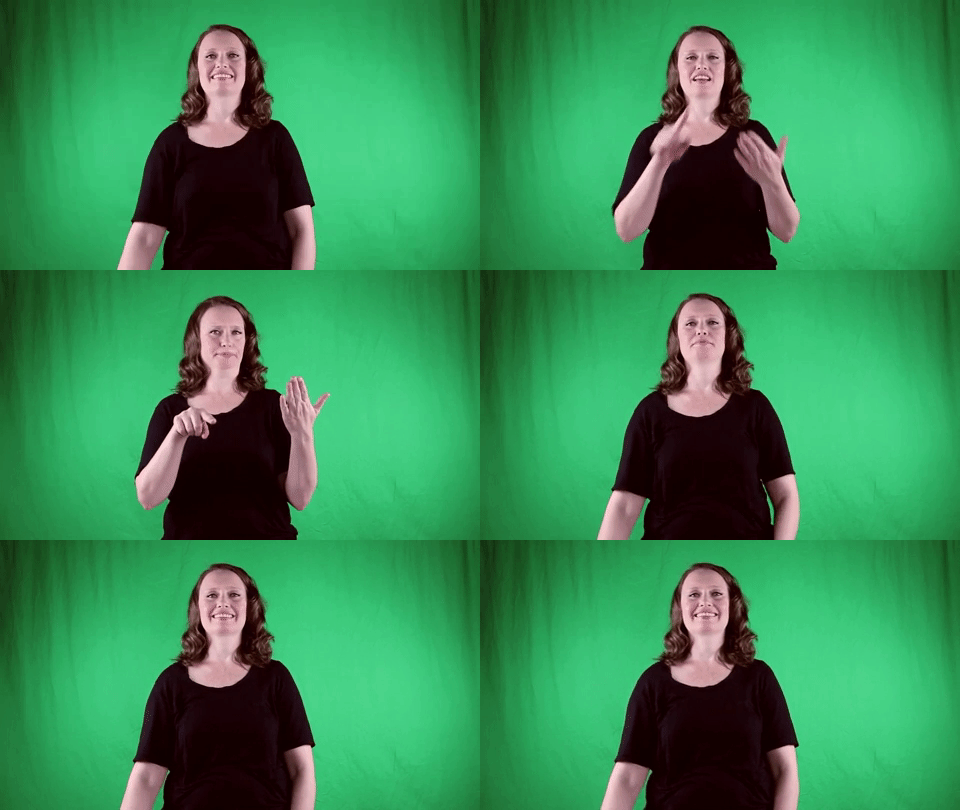
Sign for CANCELING in ASL 

YouTube player

Practice Activities:

To build fluency with the sign for CANCELING in ASL, begin by practicing the sign in isolation. Use a mirror or video yourself signing to correct hand placement, movement, and facial expression. Repeat the sign slowly, increasing speed as accuracy improves. Try signing it with different non-manual signals that could show disappointment, frustration, or relief, depending on context.

Create flashcards with scenarios to practice. For example, one card might say “doctor appointment,” and you would sign “I cancel doctor appointment.” Try 10 different flashcards and focus on correct sign order. This helps reinforce how the sign for canceling in ASL fits into full sentence structures.

Write or record example sentences and sign them. Try phrases like “I’m canceling my trip,” “He canceled the meeting,” or “They are canceling school today.” Pay attention to verb shifts and how to incorporate pronouns and time indicators. Adding role shifts can further reinforce expressive signing skills.

Practice with a partner by taking turns canceling events. One person names the event, and the other responds with an appropriate cancellation sentence using the sign for canceling in ASL. For example, one partner signs “Wedding on Saturday,” and the other signs, “Sorry, I’m canceling the wedding.”

Use storytelling prompts to increase complexity. Tell a short story about planning a vacation and having to cancel it due to unexpected weather. Incorporate emotions and additional descriptive signs. This engages vocabulary expansion and encourages fluid signing with the sign for canceling in ASL naturally present in context.

To build receptive skills, have a partner sign short scenarios involving cancellations. Write down what you see, then check for comprehension. Switch roles regularly to practice both expressive and receptive abilities. Use emojis in labeling or storytelling activities to make practice more engaging and visually supportive.

Cultural Context:

In the Deaf community, understanding the sign for canceling in ASL is essential for everyday communication. Whether it’s canceling a meeting, a plan, or an event, the ability to express the concept clearly impacts interactions and mutual understanding. American Sign Language is deeply rooted in visual expression, and the sign for canceling in ASL carries cultural nuances that reflect how the Deaf community views commitment and follow-through.

The sign for canceling in ASL may be used in both casual and formal contexts. For example, canceling a date or canceling a medical appointment both require clear communication. Within Deaf culture, being direct and transparent is highly valued, so using the correct sign for canceling helps avoid confusion and ensures respect between signers.

This sign often conveys more than just the act of stopping or removing an event—it can also show consideration for others’ time. In ASL, non-manual markers like facial expressions also play a key role when using the sign for canceling. The context, tone, and intention behind the cancelation are commonly illustrated through body language, adding depth to the visual message.

In a classroom or work environment, knowing the sign for canceling in ASL can help avoid misunderstandings. Deaf professionals and students often use this sign to reschedule appointments or notify others of changes in plans. It’s a fundamental sign in organizational settings and demonstrates awareness of scheduling and responsibility.

Socially, the need to convey cancelation is common in group chats, meetups, or events. When communicating these changes in ASL, the sign for canceling is accompanied by visual cues to soften the message or express regret. This sensitivity to emotional tone is a key feature of Deaf etiquette and shows that cultural norms extend beyond just vocabulary.

Technology also plays a role in spreading and reinforcing signs like the sign for canceling in ASL. With the rise of video calls and vlogs, Deaf creators frequently demonstrate signs in action, making signs such as canceling more visible and understood among wider audiences. It also helps hearing signers or interpreters use the appropriate visual language in mixed settings.

The act of cancelation also ties into broader values in Deaf culture around time and commitment. Canceling without notice can be seen as disrespectful, so mastering the sign for canceling in ASL and using it properly shows cultural competence. Understanding this helps both native and new signers communicate with greater empathy.

In family communication, especially in Deaf-parent households, children learn the sign for canceling in ASL early

Extended Definition:

The sign for canceling in ASL is used when expressing the idea of stopping an event, rejecting a commitment, or reversing a previous decision. It often comes up in everyday conversations when plans change or when an agreement is no longer valid. In American Sign Language, context plays a major role, so the expression and tone will help clarify whether it’s a formal cancellation or a casual one.

To make the sign for canceling in ASL, one common version involves drawing a small X on the palm of your non-dominant hand with the index finger of your dominant hand. This motion mimics the idea of erasing or invalidating something. It’s a visual way to indicate that something is being crossed out, similar to how you’d cancel something on paper ✖️.

Facial expressions are crucial when signing canceling in ASL. You might show frustration, disappointment, or even relief, depending on the situation. Like all ASL signs, emotion and body language give extra meaning and make the sign clear.

The sign for canceling in ASL can also be adapted based on context. For example, if you’re talking about canceling a subscription, appointment, or trip, additional signs might be used before or after to give clarity. You might sign “doctor” before canceling to show you canceled a doctor’s appointment.

ASL learners often confuse the sign for canceling with other signs such as delete, remove, or mistake. While these may appear similar, each has a separate meaning. Practicing the difference will help ensure you are communicating your intended message.

Native signers may also incorporate regional variations for canceling in ASL. Some communities may use slightly different handshapes or motions, but the meaning stays the same. If you’re unsure, observing and asking are great ways to confirm you’re using the most natural sign for the area.

Understanding the sign for canceling in ASL helps in many real-life situations. Whether you’re making or breaking social plans, dealing with schedule changes, or handling responsibilities, this sign comes in handy. It’s not only practical, it’s frequently used day-to-day.

In expressive conversations where plans suddenly change, this ASL sign quickly tells the other person that something will no longer happen. It’s direct and efficient, making it useful at work, school, and at home. And since ASL is a visual language, your facial cues provide key information while signing.

It’s also common to see the sign for canceling in ASL in educational or instructional settings when teachers need

Synonyms: voiding, rescinding, nullifying, revoking, aborting

Educational resources: Find related learning materials in our course bank!

Want more? Check out some of our popular learning activities on the homepage!

Need to look up a sign? Use our highly rated dictionary: https://aslinteractive.com/best-asl-dictionary/

Follow us on tiktok: https://www.tiktok.com/@aslinteractive. More social media links at the bottom of this page!

Long-tail Keywords: what is the sign for canceling in asl, how do you sign canceling in american sign language, canceling in asl

Categories:

tags: ASL sign for canceling, how to sign canceling in ASL, canceling meaning in American Sign Language, canceling ASL sign demonstration, American Sign Language dictionary canceling

Parameters

*Handshape*:

The handshape for the sign for CANCELING in ASL uses the dominant hand in a pointed index finger, resembling the number one handshape ☝️. The non-dominant hand is held flat, palm up, acting like a writing surface.

In the sign for CANCELING in ASL, the index finger moves across the palm as if drawing an “X,” symbolizing something being marked out or canceled. This motion reinforces the concept of removing or voiding something.

*Palm Orientation*:

The palm orientation for the sign for CANCELING in ASL typically involves the dominant hand in a pointing handshape, with the index finger extended. The palm faces downward as it makes a quick motion across the non-dominant open palm, which is held steady and facing upward.

This crossing movement symbolizes “erasing” or canceling something out. The specific palm orientation emphasizes the action of removing or invalidating, aligning with the meaning behind the sign for CANCELING in ASL. ️❌

*Location*:

The sign for canceling in ASL is typically produced in the neutral space directly in front of the signer’s torso. The dominant hand uses an index finger to “draw” an X over the palm of the non-dominant flat hand, symbolizing erasing or negating something. This motion happens at chest level and slightly away from the body.

Most of the movement occurs within arm’s reach, maintaining eye contact and visibility for clarity. The sign for canceling in ASL should be clearly visible to the viewer and centered in front of the body for optimal understanding.

*Movement*:

To produce the sign for CANCELING in ASL, begin with your non-dominant hand open and palm facing up, held horizontally in front of you. Use the index finger of your dominant hand, shaped like a “1,” to draw a short X-shape or slash motion onto the open palm.

This action mimics the idea of erasing or crossing something out. The motion should be brief and deliberate, symbolizing an action being canceled or removed. The sign for CANCELING in ASL may vary slightly depending on region or context, but this slashing movement is widely recognized.

*Non-Manual Signals*:

Facial expression for the sign for canceling in ASL typically includes a look of mild frustration or disapproval, matching the act of negating or stopping something. The eyebrows may be slightly furrowed and the mouth might form a slight downward curve or tight line . This non-manual signal supports the meaning of withdrawing or invalidating an event or action.

To clearly convey the sign for canceling in ASL, head movement may also include a small shake or emphasis on the sign hand, aligning with the idea of deletion or refusal. Maintain eye contact with your signing partner to reinforce the action being taken.

*Prosody, Dominant/Non-Dominant Hand*:

The sign for canceling in ASL uses the dominant hand in a straight index finger (like a writing tool) to draw an “X” shape on the open palm of the non-dominant hand. The non-dominant hand remains steady, palm facing up.

This motion mimics the act of crossing something out. The sign for canceling in ASL reflects the concept of deletion, rejection, or withdrawal, clearly expressing the meaning through this quick, deliberate X-mark gesture. ️✖️

Tips for Beginners:

When learning the sign for CANCELING in ASL, it’s important to focus on clarity and control in your hand movements. The sign typically involves tracing an “X” on the palm of your non-dominant hand using the index finger of your dominant hand. Practicing this movement slowly at first helps build muscle memory and precision, which is crucial to accuracy.

A common mistake beginners make is rushing through the movement, which can make the meaning unclear. Be sure to keep your non-dominant hand steady and flat, with fingers extended naturally. Try not to curl the fingers or reposition the hand awkwardly—it should be relaxed but firm for a consistent signing base.

Another tip for mastering the sign for CANCELING in ASL is to maintain proper facing toward your conversation partner. Like many directional signs in ASL, this one benefits from visual clarity. Make sure your dominant index finger distinctly draws the “X” shape without intersecting the palm too quickly or too lightly; the motion should be intentional but smooth.

Practicing in front of a mirror or recording yourself can be helpful. These tools let you review the angle, movement, and clarity of your attempt. You might notice subtleties such as whether the “X” touches the palm at the correct points or if your hand is trailing off the sign prematurely.

Also, remember that expression plays a role. While not as emotion-driven as some signs, slight facial emphasis communicates finality or frustration, depending on how CANCELING is used in context. Use this to your advantage when shaping conversations.

Finally, expose yourself to native or fluent signers using the sign for CANCELING in ASL in different contexts. Videos, language exchange, and ASL practice groups can offer real-life views on timing, speed, and cultural uses of the sign, helping you make it part of your natural signing vocabulary.

Connections to Other topics:

The sign for CANCELING in ASL is closely related to concepts of rejection, change, and reversal. It typically uses a motion that mimics erasing or crossing something out, which ties it to other signs like DELETE, ERASE, and FORGET. The visual nature of the sign helps reinforce its meaning, emphasizing that something planned or written before is being removed or altered.

This sign can be used in various contexts, such as canceling plans, appointments, or classes. It’s frequently paired with time-specific signs like TOMORROW, SCHEDULE, or MEETING, to clarify what is being canceled and when. For example, the phrase CANCELING CLASS TOMORROW would utilize these signs in a sequence that conveys a clear and grammatically correct message in ASL structure.

The sign for CANCELING in ASL also aligns semantically with negative modifiers, such as NOT, DON’T-WANT, and REFUSE. This connection helps learners understand how ASL conveys disapproval or withdrawal of prior intent. It’s important to observe how facial expressions and physical emphasis can intensify the meaning, making the sign adaptable to different emotional contexts.

In compound constructions, the sign can form part of larger expressions like CANCELING TRIP or CANCELING RESERVATION. These phrases help learners understand how ASL constructs meaning with clarity and economy by using classifiers and topic-comment structure. The directional aspect of the sign may also change slightly depending on the subject and object in the sentence.

Additionally, the sign for CANCELING in ASL intersects with signs used in professional and social environments. Knowing this sign is useful in interpreting situations relating to scheduling, customer service, and even emergency announcements. It’s especially crucial for students and working professionals who frequently navigate changes in plans or commitments.

Summary:

The sign for CANCELING in ASL typically uses the index finger to represent writing or marking something out, followed by a sharp movement that resembles striking a mark through an item. The dominant hand, using the index finger, mimics the action of drawing an X on the palm of the non-dominant flat hand. This movement visually represents the idea of canceling—removing or negating something previously agreed upon or scheduled.

Facial expressions in the sign for CANCELING in ASL add emotional context to the message. A slight frown or look of concern can indicate disappointment or urgency, whereas a neutral expression might imply a simple schedule change. It’s one of those signs where the expression enhances clarity.

The sign for CANCELING in ASL highlights ASL’s spatial and visual communication genius. Rather than focusing on abstract symbols, ASL embodies meaning through gestures that are metaphorical and iconic. This sign in particular bridges the conceptual with the visual by drawing out the idea of a cross-out or negation clearly.

Grammatically, the sign for CANCELING in ASL typically follows subject-verb-object structure depending on context. For instance, “meeting cancel” or “class cancel” would communicate “the meeting is canceled” or “the class was canceled.” Time indicators like “tomorrow” or “next week” may be used at the beginning for clarity and temporal placement.

The act of cancellation varies by setting, so contextual understanding is essential for accurate usage of the sign. For example, in casual conversation, it might refer to personal or social plans. In more formal or institutional parts of discourse, such as business or academics, it may relate to appointments, obligations, or deadlines.

The sign for CANCELING in ASL points toward broader themes in Deaf culture related to agency and planning. Within tight-knit Deaf communities, timeliness and commitment are valued. When something is canceled, the clarity of communication and timeliness of notice speaks volumes about respect and consideration.

There are related ASL signs that often appear together with the sign for CANCELING in ASL. For example, “POSTPONE,” “RESCHEDULE,” and “CHANGE” often surface in discussions about calendar management. These signs allow users to offer alternatives or solutions when canceling is not definitive.

The visual metaphor underpinning the sign for CANCELING in ASL is also relevant to American culture at large. Crossing something out, scratching a line through a commitment, or striking out plans all reinforce the idea tied into the sign’s construction. This familiarity adds an intuitive quality for new learners studying the sign.

The act of erasure in the sign for CANCELING in ASL can also convey abstract meanings, like disregard or elimination, depending on context. For instance, canceling a debt or canceling behavior can pull in other signs as modifiers, but CANCELING still serves as a conceptual anchor.

In contemporary conversation, especially online, the idea of being “canceled” as part of cancel culture has influenced how people discuss accountability and controversial actions. While the sign for CANCELING in ASL keeps its traditional form, ASL users might fingerspell or sign additional context to align with current discourse.

The sign for CANCELING in ASL sometimes appears with modifications in regional dialects or among different age groups. Some signers use the “X” marking more precisely, while others adapt the motion based on setting or flow. It highlights the linguistic richness and variability present in community ASL usage.

Applied linguistics insights reveal that the sign for CANCELING in ASL serves as a vivid example of how action-based signs can anchor abstract or time-based ideas. Rather than being solely temporal, cancellation in ASL pulls from the physical act of removing or denying. This makes for a highly effective communicative gesture.

Pedagogically, teaching the sign for CANCELING in ASL can offer students a bridge into understanding how ASL uses metaphor and visual-spatial reasoning. Students can explore parallels between the visual representation of negation and language function. It doubles as both a vocabulary lesson and a cognitive skill builder.

Cursed by its own timing demands, the sign for CANCELING in ASL often emerges during periods of high coordination, like group meetups or organizational dialogs. Its usefulness in group settings underscores ASL’s sociolinguistic orientation. The language thrives on clarity and mutual respect.

Even though the sign for CANCELING in ASL deals with negation or deletion, it’s ultimately about care. Canceling might signal inconvenience, but properly conveying it with this sign demonstrates transparency and responsibility. It strengthens interpersonal bonds within communities.

In literary contexts, the sign for CANCELING in ASL might take on dramatic qualities. Paired with facial tension or enhanced gesture, it can symbolize a severing or irrevocable decision. This makes it powerful in ASL storytelling and performance, evoking visual drama.

Deaf poets and ASL performers often play with the symbolism in the sign for CANCELING in ASL. In a narrative arc, canceling something

Want more? Check out some of our popular learning activities!

ASL Interactive Resources

ASLInteractive YouTube Channel

Follow us on tiktok: @aslinteractive.com

Follow us on Instagram: aslinteractive

Facebook page: aslinteractive

Facebook group: aslinteractive

LInkedIn: ASL Interactive LLC

Twitter: @ASL_interactive

*Some information on this page is AI-generated. AI can make mistakes. Please check the information.

Sign for CANCELING in ASL

Responses