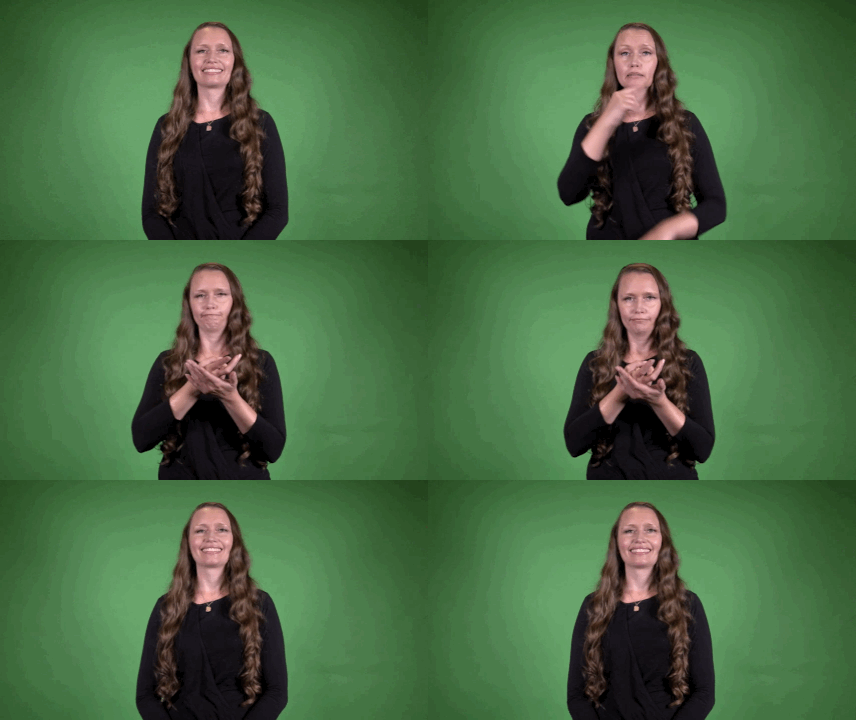
Sign for CAN’T SLEEP in ASL | 🥱 ASL Dictionary

Definition: Unable to sleep.

Sign for CAN’T SLEEP in ASL

YouTube player

Practice Activities:

A great way to build fluency with the sign for CAN’T SLEEP in ASL is to start with isolated practice. Stand in front of a mirror and practice producing both parts of the compound sign clearly: first signing SLEEP, then immediately following it with the sign for CAN’T. Focus on maintaining a neutral facial expression with SLEEP and a frustrated or annoyed expression with CAN’T to match the meaning accurately.

Next, try using the sign for CAN’T SLEEP in ASL in short phrases or full sentences. Say something like “I can’t sleep because I’m stressed” or “My baby can’t sleep at night.” Signing full sentences helps internalize the structure and improves your ASL grammar and fluency. Record yourself and check for fluid transitions and clear facial grammar.

Storytelling is another great tool. Use the sign for CAN’T SLEEP in ASL to tell a short narrative about a difficult night. Include signs for reasons like NOISE, BUSY THOUGHTS, or BAD DREAMS. This helps learners build connections with meaningful context and fosters recall during real conversation.

Work with a partner to create dialogues or conduct mock conversations. One partner can describe a bad night with phrases like “Last night, I can’t sleep” and the other can respond with empathy or advice using signs like TRY MEDITATE or WHAT WRONG. Partner work encourages spontaneous usage and reveals areas for improvement.

For receptive practice, watch videos or ask a partner to sign sentences that include the sign for CAN’T SLEEP in ASL. Raise your hand or clap whenever you recognize the sign and try to repeat it back correctly.

Wrap up your session by signing a quick summary of a time when you couldn’t sleep and share with the group or record it for review. This reinforces vocabulary and builds confidence in expressing real-life experiences.

Cultural Context:

The sign for can’t sleep in ASL is often used in late-night conversations or social media posts where someone wants to share their insomnia struggles. In Deaf culture, expressing emotions clearly and honestly is an important part of communication, and the phrase can’t sleep in ASL gives users a concise way to visually share their late-night experiences. Whether someone is dealing with stress or overthinking, this sign allows them to express their state directly.

Visual storytelling is a powerful part of ASL. Using the sign for can’t sleep in ASL makes communication more expressive and immediate. Instead of simply saying they are tired, Deaf signers can show frustration, restlessness, or exhaustion all within one smooth gesture. This adds depth to the message and helps others relate on a more personal level.

In everyday Deaf community life, the sign for can’t sleep in ASL may come up during group chats, text-based ASL vlogs, or casual conversations about someone’s day. For instance, someone might describe how they tossed and turned last night, using this sign to emphasize just how little rest they had. It’s as much about the feeling as the action, connecting people through shared experience.

The ability to clearly show emotions through sign language is one of the features that make ASL unique. The sign for can’t sleep in ASL carries emotion in its movement and facial expressions. This is not just about stating a fact—it’s about conveying a mood or current state of mind. Deaf and hard-of-hearing individuals often rely on this kind of expressive storytelling.

This sign also shows up in educational and healthcare settings. A Deaf student might tell a teacher they couldn’t focus because they couldn’t sleep. A patient might use the sign for can’t sleep in ASL to explain symptoms to a signing doctor or interpreter. It’s functional language that’s useful across many real-life scenarios.

Social media users in the Deaf community often use signs like can’t sleep in ASL to create relatable, humorous, or heartfelt video posts. As visual platforms like TikTok and Instagram continue to grow, ASL signs become key elements in reaching broader audiences. Hashtags and captions often include this phrase to attract views and connect with others going through the same.

The sign for can’t sleep in ASL reflects a shared human experience, translated through the lens of visual language. It’s a universal feeling made accessible through expressive hand shapes, eye contact, and body language. This connection deepens communication for the Deaf community and helps ASL learners better understand not just vocabulary, but emotional depth.

Understanding

Extended Definition:

The sign for can’t sleep in ASL is a useful expression that conveys when someone is experiencing insomnia or difficulty sleeping. This phrase is commonly used in both casual and formal conversations to describe sleepless nights or restlessness.

In American Sign Language, phrases like this are not translated word-for-word from English. Instead, they are signed using a combination of signs that convey the overall meaning. Knowing the sign for can’t sleep in ASL helps communicate clearly with Deaf and hard-of-hearing individuals in everyday situations, especially when discussing health or emotional well-being.

To sign can’t sleep in ASL, you use the sign for “sleep” followed by a motion that indicates negation or inability. The sign for “sleep” typically involves the hand moving over the face in a downward motion as if pulling down a sleep mask. Then, to indicate “can’t,” one might use a strong downward motion that resembles a finger striking another, symbolizing negation or something not possible.

Many people learn the sign for can’t sleep in ASL when talking to others about common problems such as anxiety, stress, or excitement that keeps them awake. This sign is often used when sharing personal experiences, asking questions about someone else’s night, or describing a bad sleep schedule.

Understanding how to use the sign for can’t sleep in ASL properly involves more than just hand movements. Facial expression and body language add important context in ASL. For example, showing a tired or frustrated face helps express the emotion behind the words, making the message clearer and more relatable.

Children and adults learning ASL benefit from mastering expressions like the sign for can’t sleep in ASL early on. It builds conversational skills and makes it easier to talk about matters related to daily routines, health, and emotional states. It also helps to develop an intuitive sense of how ASL conveys abstract concepts.

Many ASL learners find it helpful to use videos or practice in front of a mirror to refine their signing. Seeing the sign for can’t sleep in ASL demonstrated by native users makes it easier to pick up on the nuances. The sign is often repeated in lessons focused on discussing schedules, sleep habits, mental health, or feelings of restlessness.

Adding this sign to your ASL vocabulary strengthens your ability to engage in deeper, more meaningful conversations. The sign for can’t sleep in ASL can be part of telling stories, expressing discomfort, or even conversations at bedtime. Whether you’re talking with friends, family, classmates, or coworkers, this phrase is a powerful way to

Synonyms: unable to sleep, sleepless, insomnia, restless, wakeful

Educational resources: Find related learning materials in our course bank!

Want more? Check out some of our popular learning activities on the homepage!

Need to look up a sign? Use our highly rated dictionary: https://aslinteractive.com/best-asl-dictionary/

Follow us on tiktok: https://www.tiktok.com/@aslinteractive. More social media links at the bottom of this page!

Long-tail Keywords: what is the sign for can’t sleep in asl, how do you sign can’t sleep in asl, asl sign for can’t sleep

Categories:

tags: Negation, Everyday activities, Emotions, Time, Verbs

Parameters

*Handshape*:

The handshape for the sign for CAN’T SLEEP in ASL uses two different configurations. For the “can’t” part, the dominant hand is in an extended index finger handshape, while the non-dominant hand also shows an index finger. The dominant hand strikes downward on the non-dominant finger to imply negation. ️

For the “sleep” portion, the dominant hand starts open near the face and closes to a flat O handshape near the chin while moving down, representing the eyes closing. This combination of movements and handshapes expresses the concept of the sign for CAN’T SLEEP in ASL accurately.

*Palm Orientation*:

In the sign for CAN’T SLEEP in ASL, the palm orientation varies slightly between the two parts of the sign. For “can’t,” the dominant index finger points downward with the palm facing inward, striking the non-dominant index finger which is held horizontally, palm down.

For “sleep,” the dominant hand starts open in front of the face, palm facing in, and closes into a flat O shape while moving downward. This combination accurately conveys the meaning of the sign for CAN’T SLEEP in ASL.

*Location*:

The sign for CAN’T SLEEP in ASL takes place in the neutral space in front of the signer, about chest to lower face level. The dominant hand typically mimics the common motion for the sign SLEEP near the face, and then transitions into a gesture showing negation or impossibility.

To fully express the concept of CAN’T SLEEP, facial expressions such as frustration or tiredness are crucial. This helps enhance clarity and reinforces the meaning of the sign for CAN’T SLEEP in ASL for natural, expressive communication.

*Movement*:

The sign for CAN’T SLEEP in ASL combines elements from both “can’t” and “sleep.” Start by signing “sleep” with your dominant hand starting open over your face, then drawing it downward to a closed “O” shape near the chin. Immediately follow with the sign for “can’t” by holding both index fingers out, palm down, then striking the dominant index finger downward onto the non-dominant one with a quick tap.

The transition between sleep and can’t should be smooth, expressing the negation without pausing. Facial expressions are important—show frustration or tiredness to convey inability. Repeating this motion naturally reinforces the meaning of the sign for CAN’T SLEEP in ASL .

*Non-Manual Signals*:

To express the sign for CAN’T SLEEP in ASL, the signer typically uses a frustrated, tired, or annoyed facial expression to convey the inability to rest. Eyebrows may be slightly furrowed, with squinted eyes or a sighing motion to enhance the severity or discomfort of the action.

The non-manual signals that accompany the sign for CAN’T SLEEP in ASL should indicate mental restlessness or irritation. A subtle head shake or shift in posture can help reinforce the idea of disruption or struggle with sleep.

*Prosody, Dominant/Non-Dominant Hand*:

The sign for CAN’T SLEEP in ASL combines the signs for “can’t” and “sleep,” using both hands for clarity and emphasis. The dominant hand forms a flat “B” shape for “sleep,” moving down the face like closing a curtain, while transitioning into the sign for “can’t,” where the dominant index finger strikes the stationary non-dominant index finger in a downward motion.

This prosody often emphasizes frustration or restlessness. To express that you really can’t sleep, facial expressions like furrowed brows or a tired look can enhance the meaning. The sign for CAN’T SLEEP in ASL uses both manual components and non-manual signals to fully convey sleeplessness. ❌

Tips for Beginners:

When learning the sign for CAN’T SLEEP in ASL, one of the most important tips is to break it down into two signs: first sign CAN’T, then sign SLEEP. The sign for CAN’T involves extending both index fingers and tapping the dominant hand’s index finger down on the non-dominant one in a sharp downward motion, symbolizing a negation. The sign for SLEEP uses one flat hand moving down over the face while closing the eyes slightly, with the hand forming into a flat “O” shape near the chin.

Practice these signs separately before combining them smoothly. Using the correct facial expression is essential—look frustrated or tired to convey that you are expressing the inability to sleep. Facial grammar in ASL carries critical meaning, especially with negation or emotional expressions like in the sign for CAN’T SLEEP in ASL.

Be attentive to speed and handshape. Some beginners rush through the transition or use handshapes that appear too relaxed, which can reduce clarity. Use a mirror or video yourself to monitor your form and adjust as needed. Over-exaggerating the signs during early practice may help solidify motion and form.

Another useful technique is watching fluent signers use the phrase in context, especially in storytelling scenarios. Repetition and exposure help reinforce how the sign for CAN’T SLEEP in ASL is used naturally in conversation. Try using it in a routine sentence like “Last night, I CAN’T SLEEP,” to build fluency.

Always remember that ASL is a visual language, so the clarity of motion and facial cues strengthens communication. Even a simple phrase like the sign for CAN’T SLEEP in ASL can be more effective and expressive when signed with intention and proper technique. Stay patient with your learning process and practice daily in front of a friend, instructor, or camera.

Connections to Other topics:

The sign for CAN’T SLEEP in ASL connects to several foundational ASL grammar and syntax patterns. It involves negation and time-related concepts, which are vital building blocks in conversational signing. This sign typically combines the sign for SLEEP with the negation sign for CAN’T, showing how compound signs are formed through combining ideas visually.

Understanding the sign for CAN’T SLEEP in ASL helps learners grasp how to express conditions, emotions, or states of being. It can lead into related signs like INSOMNIA, RESTLESS, or AWAKE, which all build vocabulary around the broader context of sleep and wakefulness. These related signs offer ways to express more nuanced struggles with sleep or restfulness.

The concept of negation in ASL is crucial, and the sign for CAN’T is used broadly in many phrases outside of sleep. By mastering how to pair verbs like SLEEP with CAN’T, learners can adapt the structure to other signs such as CAN’T EAT, CAN’T GO, or CAN’T THINK, strengthening verb and negation fluency. This empowers users to create a wide range of expressive sentences.

Temporal aspects also play a role in forming related expressions. You might combine the sign with gestures for NIGHT or ALL-NIGHT to clarify meaning, such as CAN’T SLEEP ALL NIGHT. This enhances sentence depth and builds on ASL’s visual grammar.

Facial expressions are another layer deeply connected to the sign for CAN’T SLEEP in ASL. Non-manual markers like frustrated or tired facial expressions enhance the meaning, reflecting the emotional strain of sleep difficulty. These nuances teach learners how emotion influences meaning in ASL.

Storytelling and daily conversation heavily rely on signs like the sign for CAN’T SLEEP in ASL to describe common experiences. Signing about health, stress, or parenting often includes this expression. It links naturally to narratives where sleep is disrupted, making it a practical sign for real-world use.

Summary:

The sign for CAN’T SLEEP in ASL is a compound idea combining negation with the concept of sleep. This nuanced phrase involves both facial expression and specific hand movement to convey the meaning clearly and accurately. Like many ASL signs, the delivery is just as important as the handshape.

To form the sign, start with the sign for SLEEP. The dominant hand is held open, fingers extended and touching. The hand starts in front of the forehead and closes gently as it moves downward to the chin area, fingers coming together as if pulling down a curtain of sleep. Facial expression is usually relaxed when signing SLEEP on its own.

However, when combining it with CAN’T, the context and expression shift. The sign for CAN’T involves both index fingers. Place the non-dominant hand palm down with the index pointing forward. The dominant hand’s index comes down sharply and taps the other index finger downward, showing negation. The motion is quick and deliberate.

To sign CAN’T SLEEP, begin with the sign for SLEEP, but shift the facial expression to show frustration or stress—eyebrows furrowed, mouth slightly turned down. Then, immediately follow with the sign for CAN’T. The combination of these two signs, along with the emotional expression, effectively conveys not being able to sleep.

Facial expression is essential in this sign. Without emotion, it can appear as a basic, neutral phrase. A tired or aggravated look strengthens the impact and helps contextualize the situation. In storytelling or conversation, these non-manual markers add depth.

The sign for CAN’T SLEEP in ASL reflects more than a physical condition—it’s also emotional and situational. In Deaf culture, expressing how one feels emotionally or physically is often more vivid through signs like this. ASL allows for the incorporation of emotional state in a natural way.

ASL syntax often places the time or topic before the verb. So someone might sign “LAST NIGHT” or “ALL NIGHT” before signing CAN’T SLEEP to create a full sentence. Facial expressions again serve as punctuation within the flow of the sentence.

As a negated verb construction, CAN’T SLEEP employs standard ASL structure for negation. Rather than signing NOT separately, the sign for CAN’T acts as a clear standalone negation. This shortens and simplifies the message.

Variations exist depending on region and context. Some signers prefer to use mouth morphemes like “mmm” or “cha” to accompany the sign, indicating length of time or emotional stress. These nuances help personalize the message without adding more signs.

The keyword phrase sign for CAN’T SLEEP in ASL connects to daily experience. Whether due to stress, noise, anxiety, or health, communicating insomnia or restlessness is a fundamental human need, and ASL approaches it with natural fluidity.

This sign sits at the intersection of health vocabulary and emotional expression. It’s commonly used in narratives about one’s day, health discussions with a doctor, or even jokes with friends. Its use weaves through everyday dialogue with ease.

From a linguistic perspective, the sign for CAN’T SLEEP in ASL exemplifies the language’s efficiency through compounding. It shows how ASL often pairs key signs together to form complete thoughts, using movement, expression, and space.

The verb SLEEP can be modified with directional movement or facial expression to convey “dozing off” or “deep sleep.” But when matched with CAN’T, the tone changes. It becomes about frustration, discomfort, or emotional overload.

Applied linguistics in ASL interprets signs like this as performative acts. They are not just descriptions but representations of emotional states. Signing CAN’T SLEEP effectively performs the fatigue or restlessness being described.

Interpreters often see CAN’T SLEEP in ASL used in mental health settings. Clients or patients may sign it to express ongoing difficulty, bonding emotional suffering with physical consequence. It’s a common phrase in therapy sessions and support groups.

Experiencing insomnia or sleep disruption is complex, and the sign for CAN’T SLEEP in ASL contributes to fuller self-expression. Unlike English, which may depend on abstract phrases, ASL packages meaning and emotion together fluently.

The cultural significance also appears in ASL poetry and visual storytelling. A signed poem might use CAN’T SLEEP to represent deeper struggles—grief, fear, excitement, haunting memories. The sign thus gains poetic versatility.

In stories told by Deaf elders or performers, CAN’T SLEEP is sometimes exaggerated ly to invite humor. Tossing, turning, and wild facial expressions turn the mundane complaint into a visual comedy sketch. ASL has rich comedic styles.

In ASL literature, the phrase can also stand metaphorically. A sleeping body may represent complacency or ignorance, while someone who CAN’T SLEEP may be presented as alert, aware, or burdened with truth. Artistic performances sometimes use it symbolically.

This sign links thematically with others like DREAM

Want more? Check out some of our popular learning activities!

ASL Interactive Resources

ASLInteractive YouTube Channel

Follow us on tiktok: @aslinteractive.com

Follow us on Instagram: aslinteractive

Facebook page: aslinteractive

Facebook group: aslinteractive

LInkedIn: ASL Interactive LLC

Twitter: @ASL_interactive

*Some information on this page is AI-generated. AI can make mistakes. Please check the information.

Sign for CAN'T SLEEP in ASL
Sign for CAN’T SLEEP in ASL

Responses