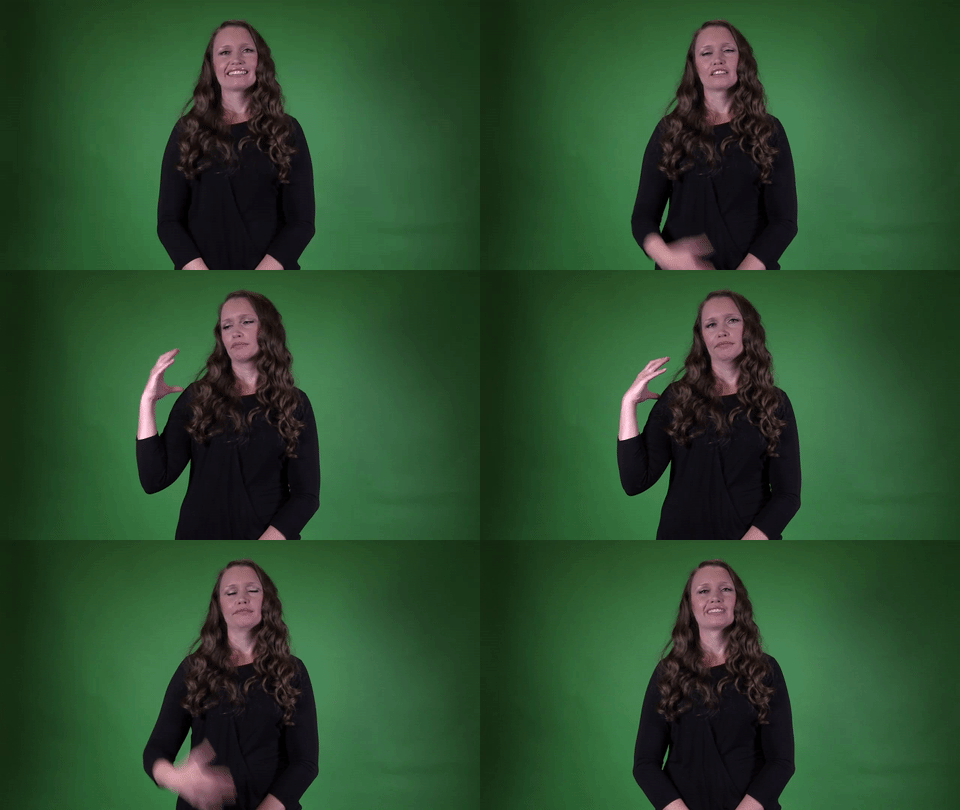
Definition: The city that serves as the seat of government.
Sign for CAPITAL in ASL

Practice Activities:
Start by practicing the sign for CAPITAL in ASL in isolation. Use a mirror to check your hand placement and movement, making sure it’s smooth and consistent each time. Try signing it slowly at first, then at a conversational speed. Repetition builds muscle memory, so aim to sign it at least ten times in a row without mistakes.
Once you are comfortable, use the sign in short phrases like “capital city” or “state capital.” Focus on smoothly integrating the sign for CAPITAL in ASL with related vocabulary such as “state,” “country,” and “government.” You can practice simple questions and answers using the sign, such as “What is the U.S. capital?” with the response, “Washington, D.C.”
Work with a partner and quiz each other on common capital cities using fingerspelling when necessary for less familiar names. You can turn this into a game by taking turns naming a country and having the other person sign the capital. Include the proper facial expressions to show confidence or curiosity depending on the context.
Try a storytelling activity where you describe a road trip to a capital city. Include sequence signs like “first,” “then,” and “finally” to explain your journey. Use signs for travel-related concepts like “drive,” “hotel,” and “museum” alongside the sign for CAPITAL in ASL.
Record yourself signing about visiting a capital to review fluency and accuracy. This is helpful for identifying areas needing improvement. You can also watch videos of fluent signers using the word in context to recognize how native signers incorporate it into sentences naturally.
Finally, try describing a map to a classmate or tutor, locating different capital cities and states. This encourages spatial awareness and helps solidify your understanding of how to properly use the sign for CAPITAL in ASL within conversation and description.
Cultural Context:
The sign for capital in ASL can carry different meanings depending on cultural and contextual use. In American Sign Language, users understand that the word “capital” can refer to money, a city of political importance, or even the concept of uppercase letters. Deaf culture values precision and clarity in communication, so the sign for capital in ASL will be used differently based on context.
When discussing finances, the sign for capital in ASL usually refers to economic resources or a large amount of money. Within the Deaf community, financial literacy is just as important as language access. Interpreters and ASL users often emphasize the importance of financial terms in everyday conversation. The ability to clearly sign capital in ASL helps with budgeting, investments, and understanding news reports about the economy.
If capital is being used in a political or geographical sense, as in a capital city, the sign for capital in ASL changes slightly in presentation. Deaf students learning about government or geography will see this variation while studying Washington, D.C. or state capitals. This demonstrates how flexible and dynamic ASL is, adapting signs to meet real-life situations. Knowing the sign for capital in ASL helps Deaf individuals engage in civic conversations and school topics more fluently.
In an academic or writing context, capital can refer to uppercase letters. The sign for capital in ASL is often used in classrooms or educational videos to reinforce grammar and spelling standards. When Deaf children are learning to write in English, teachers and interpreters often teach the difference between lowercase and uppercase letters, using the sign for capital in ASL.
Culturally, Deaf communication often relies on visual precision, which means signs must be accurate and appropriate for context. The sign for capital in ASL is a great example of how meaning shifts depending on where and how it is used. Whether it’s about money , a location , or writing , the sign communicates specific ideas. Being aware of these variations strengthens understanding and communication within the Deaf community and with ASL learners.
In social settings, signing capital in ASL may come up in conversations about jobs, relocation, education, or even politics. Using the correct handshape and movement ensures the message is received clearly. ASL users take pride in visual language skills, and knowing when and how to use the sign for capital in ASL shows respect for Deaf culture and language norms.
Sign language is never just translation—it includes cultural values and social relevance. The sign for capital in ASL is
Extended Definition:
The sign for CAPITAL in ASL can be used in different contexts depending on whether you’re discussing money, a government center, or something significant or important. American Sign Language adapts to these meanings with different signs depending on the usage. Understanding the right sign for CAPITAL in ASL starts with recognizing the context of the conversation.
For the financial meaning, such as capital in terms of money or investments, the sign commonly used is the sign for MONEY followed by gestures that reinforce the idea of large sums or funds. This might include gestures indicating stacks or an accumulation. Some people also pair the MONEY sign with signs like INVEST or FUND to clarify the meaning.
When referring to a capital city, such as the capital of a state or country, the sign often combines CITY or GOVERNMENT with a location-specific context. To convey this idea clearly, a signer might gesture a map layout while signing the name of the city along with GOVERNMENT or HEADQUARTERS. This helps pinpoint the place as a central or governance-related location rather than a financial term.
The concept of something being capital in the sense of “important” or “major” usually involves signs like MAIN or IMPORTANT. These signs stress significance without connecting specifically to money or place. Context again plays a key role because ASL is highly contextual and visual.
To express the sign for CAPITAL in ASL in a complete and grammatically correct way, a signer often introduces the topic first. They may use facial expressions and body language to match the intended meaning. Whether it’s financial, geographic, or metaphorical, ASL signers rely on visual clarity to convey their message.
Regional variations can influence the exact sign for CAPITAL in ASL. Some sign language users may develop their own common signs depending on their experiences or local trends. Still, the overall format often remains similar, linking the core meanings with proper classifiers and topic indicators.
In ASL, forming compound ideas is key to accurately signing terms like CAPITAL. Since there is no one-size-fits-all sign for this word, users often combine multiple signs in a sequence. This technique allows them to reflect the layered meanings of the term.
Beginners learning the sign for CAPITAL in ASL should focus on understanding the subject matter they’re discussing. Is it about money, a capital city, or an idea of importance? Knowing that helps select the most accurate sign. Practice with native signers or watch real-world examples to see how it’s typically used.
Using the sign for CAPITAL in ASL within more complex discussions,
Synonyms: wealth, assets, funds, resources, finances
Educational resources: Find related learning materials in our course bank!
Want more? Check out some of our popular learning activities on the homepage!
Need to look up a sign? Use our highly rated dictionary: https://aslinteractive.com/best-asl-dictionary/
Follow us on tiktok: https://www.tiktok.com/@aslinteractive. More social media links at the bottom of this page!
Long-tail Keywords: what is the sign for capital in asl, how do you sign capital in american sign language, asl sign for capital
Categories:
tags: Capitals, Cities, Language Learning, Education, Geography
Parameters
*Handshape*:
The dominant hand uses a bent “L” handshape, with the thumb and index finger slightly curved to form a loose angle. The base of the hand taps the back of the non-dominant fist, which remains stationary and upright. This positioning helps infuse the sign for CAPITAL in ASL with a structural or architectural feel.
This handshape supports the idea of prominence or importance, much like a capital city or uppercase letter. The motion and contact emphasize the concept of leadership or hierarchy, crucial in conveying the full meaning behind the sign for CAPITAL in ASL.
*Palm Orientation*:
For the sign for CAPITAL in ASL, the palm orientation typically begins with both hands in a neutral position, facing each other or slightly angled outward. As the dominant hand moves upward to indicate prominence or importance, the palm may face down or slightly inward depending on the variation.
This movement helps emphasize the concept behind the sign for CAPITAL in ASL, often expressing a city’s main status or financial meaning. The palm adjusts naturally to maintain fluidity through the sign’s motion.
*Location*:
The sign for CAPITAL in ASL is typically produced in the neutral space slightly in front of the upper torso. The dominant hand moves near the shoulder area or may shift slightly toward the center of the chest depending on the variation used. This location helps emphasize the elevated or important status implied by the word capital.
When using the sign for CAPITAL in ASL, it’s essential to maintain clear spacing between the hand and the upper body. This ensures good visibility and distinguishes it from other similar signs that also occur in the upper torso region.
*Movement*:
To produce the sign for CAPITAL in ASL, form a flat non-dominant hand, palm down, in front of your body. With your dominant hand in a modified “C” shape, bring it up and tap the top back area of the fingers on the non-dominant hand. This mimics the idea of a top or main location.
The sign for CAPITAL in ASL emphasizes the concept of a main or central point, like a capital city. The movement is deliberate and focused, suggesting prominence or importance. ️
*Non-Manual Signals*:
When producing the sign for CAPITAL in ASL, the facial expression usually remains neutral to slightly assertive, especially when emphasizing importance or distinction, such as a capital city or capital letters. Slightly raised eyebrows can be used to convey focus or emphasis depending on context.
Context influences the non-manual signals during the sign for CAPITAL in ASL. If discussing capital in a financial or political sense, a confident head nod or firm mouth posture may help convey seriousness or significance. ️
*Prosody, Dominant/Non-Dominant Hand*:
In the sign for CAPITAL in ASL, the dominant hand typically uses a bent “L” handshape while the non-dominant hand is held flat, palm facing down. The dominant hand strikes the top of the non-dominant hand lightly, as if indicating the top or uppermost part.
This sign reflects the concept of a main or central place, aligning with the meaning of “capital.” The sign for CAPITAL in ASL is straightforward and clear, often used in geographic or governmental contexts ️.
Tips for Beginners:
When learning the sign for CAPITAL in ASL, begin by mastering the concept behind the sign. It usually refers to a capital city or a seat of government, so understanding the context will help you remember when and how to use it. The location, movement, and orientation of your hands are key to ensuring your sign is accurate and understood.
A common approach to the sign for CAPITAL in ASL is to start with the dominant hand forming the letter “C” handshape. This hand may move in an upward and slightly forward motion toward the top of the non-dominant hand, which can be in a flat or modified base shape. This gesture mimics the idea of a main or leading location, giving a visual representation of importance or hierarchy.
Pay close attention to the placement of your non-dominant hand. If it’s not stable or properly shaped, the sign for CAPITAL in ASL may become unclear. Practicing in front of a mirror can help ensure you are consistent with orientation and movement. Try recording yourself to analyze how you’re forming the handshapes and adjusting your posture accordingly.
Avoid confusing CAPITAL with other contextually similar signs like “country” or “state.” The unique handshape and motion for CAPITAL differentiate it, so making that distinct is vital for clear communication. Consult with fluent signers or instructors to confirm you’re using the correct motions.
Finger dexterity and wrist control also play a role in presenting a clean sign. Warm up your fingers and hands before extended ASL practice to avoid stiffness or fatigue. Remember, the sign for CAPITAL in ASL should look fluid and confident—don’t rush it, and keep practicing steadily to gain confidence over time.
sign for capital in asl, capital city in sign language, how to sign national capital in ASL, ASL sign for capital building, American Sign Language sign for capital
Connections to Other topics:
The sign for CAPITAL in ASL often connects to financial concepts and government-related terminology. In economic contexts, it may be paired with signs like MONEY, INVEST, or SAVE to expand on ideas such as capital investment or venture capital . In these cases, the sign for CAPITAL serves as the base, with classifiers and facial expressions enriching the meaning depending on the sentence.
The sign for CAPITAL in ASL can also relate to geographical or political discourse. When discussing a country’s capital city, such as Washington D.C., the sign may be compounded with the sign for CITY or even fingerspelled alongside the proper noun. This helps distinguish between capital as a location and capital as a financial asset.
Linguistically, CAPITAL shares similarities in movement and handshape with signs such as HEAD, IMPORTANT, or LEADER. These connections support the conceptual link between a capital city being the “head” or central hub of a country, making it easier for learners to remember. It also ties into leadership, as capitals often signify seats of government or authority.
You might see modified versions of the sign for CAPITAL when translating terms like CAPITAL GAIN, CAPITAL LETTER, or CAPITAL PUNISHMENT, each depending on context. For example, CAPITAL LETTER would typically use the sign for LETTER combined with a description or mouthing gesture to indicate uppercase. This shows how flexible the sign can be when adapted to various domains like grammar or criminal justice ⚖️.
Understanding the sign for CAPITAL in ASL opens pathways to more advanced topics such as business, finance, politics, and linguistics. It serves as a useful foundation to explore compound phrases and specialized vocabulary. For students, this level of connection enhances fluency and helps integrate the sign across numerous instructional and conversational settings.
Summary:
The sign for CAPITAL in ASL typically uses a sign that reflects the concept of a “capital city” or a central, important place. To form the sign, you begin with the dominant hand in a modified “C” handshape. The fingertips of this “C” hand come down and tap the back of the non-dominant hand, which is held palm-down in a flat “B” shape.
This sign is iconic in that it mimics the idea of something being seated at the top or most important spot, like a capital city on a government map. You might compare it to placing a marker or a flag at the most influential point. The visual metaphor aligns closely with how “capital” functions culturally and linguistically.
Meaning can shift depending on context. If you’re referring to “capital” in the sense of an economic base or financial capital, the sign might shift to incorporate money-related signs instead. This demonstrates one of the beauties of ASL—the language’s flexibility and contextual adaptability.
When emphasizing “capital” in terms of government, the sign for CAPITAL in ASL can be used in conjunction with the sign for CITY or GOVERNMENT to specify. This magnetism between signs helps build context quickly. Native signers often connect these seamlessly to form nuanced expressions.
There’s also a historical dimension to the sign for CAPITAL in ASL. Signed languages evolve, and this sign has seen shifts over time in both form and usage. Especially in Deaf communities engaged deeply in political dialogue, nuanced variations may emerge.
In grammatical usage, the placement and movement of the sign for CAPITAL in ASL can determine its role in a sentence. Its directionality, speed, and facial expressions signal whether it’s functioning as a main concept, a background detail, or a connecting idea. ASL grammar often leans heavily on these visual-modulation techniques.
The sign falls into the classifier-style family of ASL in terms of linguistic structure. It uses handshape and space cleverly to denote importance and geographic centrality. It’s an example of how ASL employs iconicity in structure—signs often look like what they mean.
In terms of linguistic roots, the sign for CAPITAL in ASL mirrors the same semantic foundation as the spoken English term. It’s rooted in the idea of central importance—be that geographic, political, or financial. This direct semantic mapping is rare in signed language and worth noting.
From an applied linguistics lens, the sign is an access point to larger conversations about geography, politics, and cultural organization within Deaf education. Teaching this sign paves the way for engaging students in learning about countries, states, and capitals with visual gestural grounding. Educators often build entire lesson structures around such geography-oriented signs.
The cultural meaning of the sign for CAPITAL in ASL is not only tied to governmental concepts but also to power and influence. Just as a capital city holds the reins of policy and rulership, the sign itself can symbolize dominance or primacy in a metaphorical sense. Deaf creators and artists have occasionally played with this metaphor in sign poetry and signed storytelling.
In visual narratives, particularly those in ASL storytelling, placement on the signing space becomes pivotal. The sign for CAPITAL in ASL is often spatially elevated during its production—placed higher in the air—to match its conceptual hierarchy in a visual-spatial narrative. This visual elevation aligns with the notion of power being “up top.”
ASL literature, especially folktales and modern narratives, also uses the sign for CAPITAL in ASL when describing journeys, cities, and allegorical power centers. These uses go beyond denotation; they involve connotation and performance artistry. As such, the sign carries layers of meaning in these expressive formats.
In comparative linguistics, the sign for CAPITAL in ASL has parallels in other signed languages, like BSL or LSF, although the sign forms may look quite different. Many cultures conceptualize “capital” as the central place of governance, but the expression in each sign language varies linguistically with unique handshapes and movements.
Learning the sign for CAPITAL in ASL opens up avenues for richer language use. Once acquired, the sign makes it easier for learners to follow signed news reports, describe maps, and navigate conversations about governance. It’s an empowering linguistic asset for bilingual ASL-English speakers.
There’s also a sociolinguistic frame to be considered. Geopolitical terms like CAPITAL often appear more frequently in politically active Deaf communities. As such, fluency in such signs is directly linked to civic participation and awareness among signers.
In terms of related signs, there’s CITY, TOWN, COUNTRY, GOVERNMENT, and LEADER, which often appear in proximity to CAPITAL in conversations. These associated signs build around overlapping semantic fields. Understanding these connections deepens one’s fluency and expressive range in ASL.
Notably, ASL interpreters often need to differentiate between multiple meanings of “capital”—capital letters, capital punishment, capital as in
Want more? Check out some of our popular learning activities!
ASL Interactive Resources
ASLInteractive YouTube Channel
Follow us on tiktok: @aslinteractive.com
Follow us on Instagram: aslinteractive
Facebook page: aslinteractive
Facebook group: aslinteractive
LInkedIn: ASL Interactive LLC
Twitter: @ASL_interactive
*Some information on this page is AI-generated. AI can make mistakes. Please check the information.


Responses