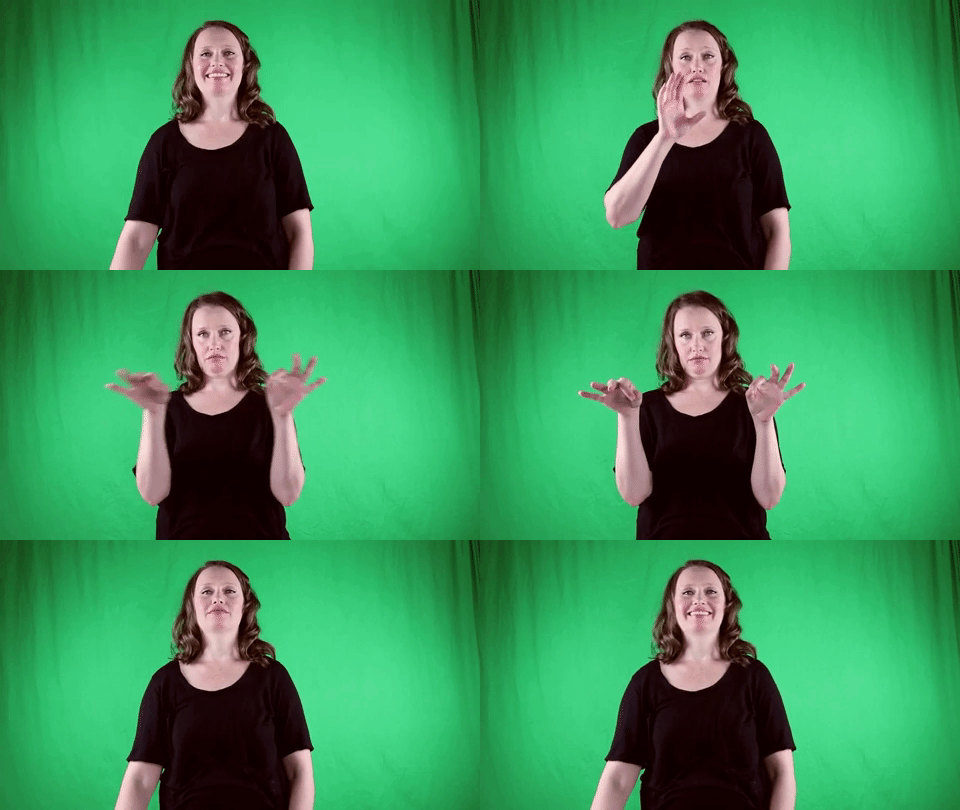
Definition: Text displayed to provide information or translation.
Sign for CAPTIONS in ASL

Practice Activities:
To practice the sign for CAPTIONS in ASL, begin by isolating the sign and repeating it in front of a mirror. Focus on handshape, movement, and facial expressions each time. Practice slowly at first, then increase your speed while maintaining accuracy.
Next, incorporate the sign for CAPTIONS in ASL into simple phrases such as I read captions or TV with captions helps. Say the sentence in English first, then sign it in ASL, ending with the correct sign. Try recording yourself to self-check clarity and fluency.
Use storytelling to create small narratives involving watching TV, streaming videos, or movies. An example prompt could be: Tell a short story about your favorite movie and why you use captions. Include the sign naturally when you mention the word captions.
Practice with a partner by playing role-switching games where one person asks a question and the other responds using the sign for CAPTIONS in ASL. Example: Why do you like captions? Your partner would respond using ASL, incorporating the keyword sign meaningfully.
Use activities such as watching a short video clip with the sound off, then sign what you think was said and incorporate the concept of captions. This helps reinforce context and the importance of the sign in accessibility communication.
Create flashcards with different media-related vocabulary terms and include the sign for CAPTIONS in ASL among them. Test yourself daily to recall the sign quickly when shown the prompt.
Additionally, reflect on real-life applications, such as talking to someone about media access or explaining why you prefer captions while watching content. Practicing describing this experience in ASL makes the sign feel more purposeful and helps build fluidity. Regular exposure to real-world examples will strengthen your signing skills and help you remember the sign long-term.
Cultural Context:
Understanding the sign for captions in ASL is essential in promoting accessibility and inclusivity within the Deaf and Hard of Hearing communities. Captions make spoken language visible, turning audio into readable text so everyone can enjoy and understand content equally. In the Deaf community, captions are not just a tool—they are a vital bridge to communication in media, education, and everyday interactions.
The sign for captions in ASL helps empower Deaf individuals by providing access to real-time or pre-recorded dialogue in videos, movies, and live events. It supports full participation by creating opportunities for comprehension and connection. When captions are displayed, they offer independence and an equitable way to experience content that might otherwise be exclusionary.
Culturally, the sign for captions in ASL represents more than just a word. It reflects a movement toward visibility and respect for Deaf culture and language. The consistent use of this sign in conversations places emphasis on the importance of text-based accessibility within Deaf spaces. It signals a shared understanding of how crucial visual communication is in a sound-focused world.
Within the Deaf community, having accurate captions signifies respect. When videos feature real-time captions or closed captioning, content creators and educators demonstrate a commitment to accessibility. The sign for captions in ASL is often used in advocacy, education outreach, and conversations about media accessibility.
In schools and universities where Deaf students learn alongside hearing peers, the availability of captions can change outcomes. It helps students better understand complex topics and supports academic success. The sign for captions in ASL often appears in educational discussions, as students learn to advocate for their rights and access needs.
Social media and digital content have become huge areas where captions play an important role. More creators are using captions on platforms like YouTube, TikTok, and Instagram, making their content accessible to the Deaf and Hard of Hearing. The sign for captions in ASL is often included in content developed by and for the Deaf community to celebrate access and inclusivity.
In live settings such as conferences, panel discussions, or performances, real-time captioning allows Deaf attendees to participate fully. The use of the sign for captions in ASL during these events signals the importance of equal access. Interpreters, accessibility staff, and Deaf individuals often refer to captioning options using this specific sign as part of planning and participation.
The adoption of captions benefits not only Deaf individuals but also second-language learners, those in noisy environments, and anyone who prefers visual learning. The sign for captions in ASL opens up discussions about universal
Extended Definition:
The sign for captions in ASL refers to the visual text that represents spoken dialogue, sound effects, and other audio information on-screen. This sign is particularly useful in conversations about media accessibility, including TV shows, movies, news programs, and video content.
To sign captions in ASL, you generally use your hands to mimic the idea of words appearing on a screen. This is often done by forming both hands into flat B-handshapes and moving them horizontally beneath your chin or face level, simulating the way captions appear under the visual content. The specific motion and expression may vary slightly based on the signer’s region or personal style.
The sign for captions in ASL may sometimes be used in combination with other signs like video, television, or subtitles to provide full context during a conversation. It’s important to note that while captions and subtitles are sometimes used interchangeably in English, they have distinct signs in ASL. Captions usually imply additional audio cues like sound effects or speaker IDs, while subtitles often only convey the spoken text.
Understanding the sign for captions in ASL empowers Deaf and hard-of-hearing individuals to discuss media accessibility more clearly and advocate for inclusivity. It also supports interpreters, educators, and ASL learners in accurately conveying the importance of captioning in various digital and broadcast settings. With more content being shared online daily, the need for accessible viewing and the appropriate use of the sign for captions in ASL keeps growing.
In educational environments, the sign for captions in ASL is vital when discussing accommodations or advocating for classroom media to be accessible. Teachers and support staff benefit from knowing the sign so they can effectively meet the needs of Deaf students.
Social media platforms, streaming services, and online learning tools are increasingly incorporating accurate captioning, making the sign for captions in ASL more relevant for those who rely on visual information. Using this sign effectively during conversations or presentations helps emphasize the importance of access in the digital world.
It’s also worth noting that technology has influenced how people use the sign for captions in ASL. As auto-caption features and live transcription become common, users are developing smoother methods to incorporate this sign into real-time discussions about technology, media quality, and accessibility settings.
For ASL learners, practicing the sign for captions in ASL builds strong vocabulary connected to modern communication. It links directly to contemporary topics, helping signers stay current and connected to everyday experiences that affect the Deaf community.
The sign for captions in AS
Synonyms: Subtitles, Closed Captions, Text Overlays, Transcripts, Subtitle Text
Educational resources: Find related learning materials in our course bank!
Want more? Check out some of our popular learning activities on the homepage!
Need to look up a sign? Use our highly rated dictionary: https://aslinteractive.com/best-asl-dictionary/
Follow us on tiktok: https://www.tiktok.com/@aslinteractive. More social media links at the bottom of this page!
Long-tail Keywords: what is the sign for captions in ASL, how do you sign captions in American Sign Language, ASL sign for captions
Categories:
tags: Clothing, Commands, Classroom Picture, Language Learning, Wh-words
Parameters
*Handshape*:
The handshape used in the sign for captions in ASL typically features both hands in a relaxed “B” handshape, with palms facing inward. The fingers are held together and extended, while the thumbs rest alongside the fingers. This configuration is essential to represent the motion of text scrolling or appearing on a screen.
When performing the sign for captions in ASL, the hands move in a coordinated, side-to-side motion to symbolize lines of text. The “B” handshape supports the visual metaphor of written captions commonly found on screens or videos.
*Palm Orientation*:
The palm orientation for the sign for CAPTIONS in ASL typically involves both hands in a “C” handshape, facing each other with palms angled slightly inward. The movement mimics the appearance of lines of text or captions appearing on a screen. Hands may move slightly outward or alternate in movement to represent the flowing of captions. This expressive orientation helps reinforce the concept conveyed in the sign for CAPTIONS in ASL .
*Location*:
The sign for captions in ASL is typically produced at the lower front of the body, near the upper chest or slightly below shoulder level. Both hands move side to side as if outlining the text on a screen, suggesting the location of written information or subtitles.
This placement connects naturally to the concept of on-screen text, helping reinforce the meaning of the sign for captions in ASL. By keeping the movement at this central visual area, it aligns with where captions usually appear on video content .
*Movement*:
The sign for captions in ASL involves forming both hands into flat “C” handshapes. Start with the hands held in front of the body, palms facing upward, and move them horizontally outward while wiggling the fingers slightly to mimic the movement of text appearing on a screen.
The motion resembles words scrolling or appearing in a line, similar to how real captions are displayed. The sign for captions in ASL effectively captures how subtitles function visually. ️
*Non-Manual Signals*:
When using the sign for CAPTIONS in ASL, the facial expression should show slight concentration or clarity, emphasizing distinction or separation of visual elements. Slight eyebrow movement or a neutral mouth gesture helps maintain focus on the idea of readable or displayed text.
The non-manual signals for the sign for CAPTIONS in ASL support the concept of visibility and comprehension, often used when referring to video accessibility. Eye gaze may shift slightly down or forward to mimic viewing a captioned screen .
*Prosody, Dominant/Non-Dominant Hand*:
The sign for CAPTIONS in ASL uses both hands. The dominant hand and non-dominant hand are in flat “L” handshapes, palms facing each other. Start with both hands in front of the chest, then move them horizontally outward, as if showing a line of text. This movement visually represents captions appearing across the screen, similar to subtitles.
This symmetrical two-handed sign mimics the layout of text, helping convey meaning clearly. When signing the sign for CAPTIONS in ASL, facial expression should remain neutral unless emphasizing tone. ️ ️
Tips for Beginners:
When learning the sign for CAPTIONS in ASL, it’s helpful to first understand that this concept is often expressed through clear finger movements that mimic the format of text appearing on a screen. Begin by using both hands in a modified “G” handshape and mimic a typing or scrolling motion from left to right at chest level. Think of how captions run across the bottom of a screen — that’s the visual you’re trying to communicate.
For beginners, one major tip is to focus on the direction and rhythm of the motion. Smooth hand movement is essential to communicate the idea of flowing text. Jerky or imprecise movements might confuse your message. Practice in front of a mirror or video yourself to ensure your gestures are aligned and symmetrical on both sides.
A common pitfall is forgetting facial expressions. Don’t just rely on your hands when signing the sign for CAPTIONS in ASL. Using an engaged facial expression that reflects attention or information being fed visually reinforces the clarity of your sign. Think about your context — whether you’re referencing closed captions on a TV or captioning for accessibility during a presentation — and adjust your expression accordingly.
Another tip is to take your time mastering this sign, especially because it includes a concept more than a literal translation. Since signs like this one represent abstract ideas, practicing in various real-life settings — like while watching shows with captions or discussing accessibility — helps reinforce learning.
Beginners should also avoid substituting this with fingerspelling unless absolutely necessary. While fingerspelling CAPTIONS in place of the true sign for CAPTIONS in ASL is acceptable if the sign is unfamiliar, building your vocabulary consistently is better for long-term fluency. Using proper placement and repetition in practice will help the motion feel natural and allow you to sign more confidently in conversations.
sign for CAPTIONS in ASL, captions ASL sign, how to sign captions in American Sign Language, ASL sign for video captions, American Sign Language sign CAPTIONS
Connections to Other topics:
The sign for CAPTIONS in ASL connects closely with concepts like communication access, media, and inclusion. It’s conceptually related to signs for SUBTITLES, CLOSED-CAPTIONED, and INTERPRET. These signs all revolve around making spoken or auditory information visually accessible, often to Deaf or hard-of-hearing individuals.
In discussions about technology and accessibility, the sign for CAPTIONS in ASL is often used alongside signs for TELEVISION, MOVIE, or VIDEO. The sign may also appear together with TOUCHSCREEN and STREAM to express captions on digital devices. These combinations help learners understand how layered ideas can be expressed in ASL by combining visual concepts and topic-specific signs.
In educational contexts, this sign is frequently seen in conversations about inclusive learning, alongside visuals like POWERPOINT, LECTURE, and NOTE-TAKING. Students and interpreters may combine the sign for CAPTIONS in ASL with signs that convey learning or viewing experiences, like UNDERSTAND, WATCH, or EXPLAIN. These compound uses highlight how captions support comprehension and access.
The sign for CAPTIONS in ASL can also tie in with cultural discussions. It aligns with terms like DEAF RIGHTS, ADVOCATE, and EQUALITY, as captions are considered a fundamental accommodation. Understanding the connection between access and linguistic equity gives learners a broader view of how ASL interfaces with social justice topics.
In media and entertainment settings, the sign for CAPTIONS in ASL may be used with LIVE or RECORDED content, such as LIVE STREAM or NEWS BROADCAST. These combinations help learners grasp context-specific vocabulary where captions are common. It reinforces the idea that ASL is dynamic and capable of expressing modern technological terms.
Finally, when discussing accessibility tools like CART or transcripts, the sign for CAPTIONS in ASL becomes even more relevant. It teaches not only vocabulary but also the social significance of visual language supports. Understanding its usage in these contexts strengthens expressive skills and cultural awareness.
Summary:
The sign for CAPTIONS in ASL is generally demonstrated using the concept of subtitles or words appearing on a screen. It is often shown by holding flat hands parallel to one another in front of the body and moving them as if outlining rows of text. This visual mimics how captions are displayed during television shows, videos, or movies.
Sometimes the sign combines the concept of writing and screen with a flicking or typing-like motion of the fingers. In context, the sign can also reflect the idea of words being presented alongside visual content. The sign is iconic and metaphorical, not literal, representing text that appears at the bottom of a video screen.
The sign for CAPTIONS in ASL reflects broader inclusion values. It connects to the Deaf community’s fight for access to media in accessible formats. Captions ensure Deaf individuals receive the same information as hearing viewers.
The cultural significance of captions is immense in the Deaf world. It symbolizes equal access, linguistic justice, and representation in mainstream media. The lack of captions historically excluded Deaf individuals from important civic, educational, and entertainment content.
The keyword phrase sign for CAPTIONS in ASL is frequently tied to media literacy and accessibility discourse. It plays an important role in discussions around the Americans with Disabilities Act (ADA) and its standards for communication access. The implementation of captions in public and private media settings remains a major gain for the ASL-using community.
Grammatically, the sign for CAPTIONS in ASL functions as a noun but can also be incorporated into complex ASL sentence structures. For example, users will sign THINK CAPTIONS IMPORTANT or VIDEO, NEED CAPTIONS. The sign fits seamlessly into topic-comment structures common in ASL grammar.
Modern usage includes variations depending on context—TV shows, YouTube videos, or real-time captioning services. Signers may include contextual classifiers or modifications to indicate the type of captions being discussed. Spatial referencing can help convey caption locations on a screen.
When discussing live versus closed captions, users may distinguish these with additional fingerspelling or modifier signs. FS-CLOSED may be added before the sign for CAPTIONS to indicate the type. This reflects the language’s adaptive nature in handling new concepts.
The phrase sign for CAPTIONS in ASL also interacts with signs for MOVIE, SCREEN, VIDEO, and READ. These associated signs help construct a fuller narrative around screen-based communication. Using these in combination enriches clarity and context in ASL storytelling.
Linguists studying the sign for CAPTIONS in ASL often examine its iconographic basis. Iconicity is a key principle in ASL and other signed languages. For CAPTIONS, the visual cue of rows of text simulates the actual format of captions in visual media.
Researchers in applied linguistics also explore how this sign supports language development. Deaf children seeing CAPTIONS learn linguistic patterns and vocabulary across spoken and signed languages. Captions can serve as a bridge in bilingual education programs involving ASL and English.
The sign for CAPTIONS in ASL also aligns with broader efforts in multimodal communication. Professionals in Deaf Education, interpreting, and accessibility advocacy use the sign regularly. It becomes a tool to both advocate for and implement inclusive practices.
Historically, before the increasing availability of captions, Deaf individuals had to rely on interpreters or friends. This created a reliance on secondhand interpretations. With the rise of captions, autonomy and self-guided comprehension became possible.
Technological advances such as AI-generated captions have spurred new discussions in the Deaf community. The reliability and accuracy of such captions are frequently debated. The sign for CAPTIONS in ASL is at the center of these conversations about digital inclusivity.
In educational settings, the sign for CAPTIONS in ASL is part of curriculum discussions. Deaf students often depend on captions in mainstream classrooms with video content. Teachers and interpreters must understand the sign’s relevance and represent its importance accurately.
In Deaf culture, the concept behind the sign is layered with emotion. Many individuals remember the first time they saw language rendered in captions, feeling seen and included. The sign doesn’t only convey a word, but a lived experience.
The sign intersects with advocacy work led by organizations like the National Association of the Deaf. These advocates push for universal captioning policies. The sign for CAPTIONS in ASL becomes a rallying symbol in such campaigns.
The evolution of the sign reflects changes in technology and society. Originally the concept might not have existed widely, but with increased exposure to media, the necessity shaped the language. ASL adapts to real-world needs simply and beautifully.
Some regional variation exists in the performance of the sign, as seen across different ASL communities. While many Deaf people use the standard representation, localized and generational differences may arise. This variety is an expression of ASL’s richness and flexibility.
Some signers choose to fingerspell CAPTIONS when referring to legal, formal, or industry-specific concepts.
Want more? Check out some of our popular learning activities!
ASL Interactive Resources
ASLInteractive YouTube Channel
Follow us on tiktok: @aslinteractive.com
Follow us on Instagram: aslinteractive
Facebook page: aslinteractive
Facebook group: aslinteractive
LInkedIn: ASL Interactive LLC
Twitter: @ASL_interactive
*Some information on this page is AI-generated. AI can make mistakes. Please check the information.


Responses