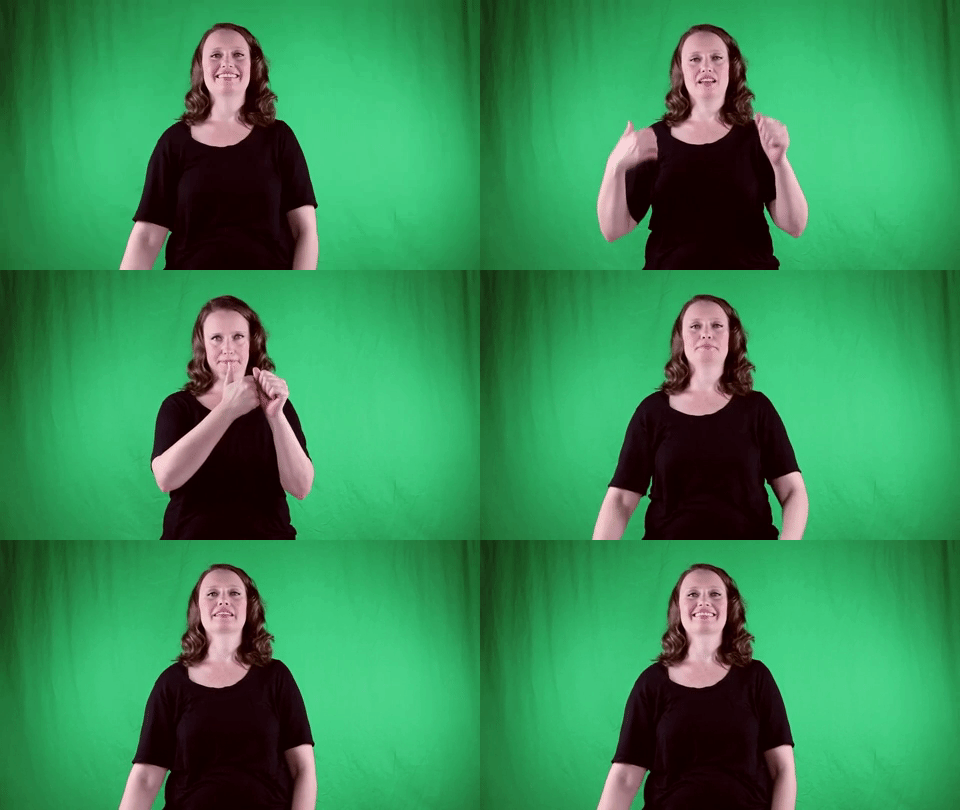
Definition: To make up for lost time.
Sign for CATCH-UP in ASL

Practice Activities:
To begin practicing the sign for CATCH-UP in ASL, start by isolating the motion. The dominant hand, shaped like a thumbs-up, starts behind the non-dominant thumbs-up hand and moves quickly forward to overtake it. Repeat this motion slowly at first, then gradually increase your speed to gain fluency. Practice in front of a mirror to monitor handshape and movement.
Next, integrate the sign into simple sentences. Try phrases like “I need to catch up,” “You catch up,” and “We caught up yesterday.” Sign each sentence several times, focusing on fluid transitions between signs. Record yourself and compare the timing and movement with video examples from reliable ASL resources.
Use storytelling prompts to place the sign for CATCH-UP in ASL within a conversational context. For example, create a story about being sick for a week and returning to class. Where in the story would you use the sign? Another prompt could be someone falling behind during a group hike and needing to catch up with friends. Think visually and try to describe the scene using full body language in addition to signs.
Do role-play exercises with a partner where one person plays a teacher checking on students and the other explains how they are catching up after missing lessons. Switch roles to reinforce vocabulary and improve comprehension. For self-practice, watch a short video in ASL and describe how someone had to catch up in the storyline, then incorporate the sign accordingly.
In spontaneous signing drills, ask a partner or tutor to give you random prompts like work, school, or sports. Respond appropriately using the sign for CATCH-UP in ASL with correct grammar and facial expressions. Vary your sentence structure to increase flexibility and control over the sign’s usage in real-life conversations.
Cultural Context:
In Deaf culture, the concept of catching up is more than just a quick chat. The sign for CATCH-UP in ASL is often used when reconnecting with someone after a period of time. It reflects the community’s strong emphasis on relationships, storytelling, and shared experiences.
The sign for CATCH-UP in ASL isn’t just used socially—it appears in everyday conversations at school, work, or community events. In classroom settings, catching up with missed lessons or homework is commonly expressed with this sign. It’s both practical and expressive, fitting neatly into both formal and casual settings.
For Deaf individuals, social interaction holds a powerful place in daily life. When Deaf friends reunite after not seeing each other for a while, they often engage in long conversations to reconnect. This is when the sign for CATCH-UP in ASL is frequently used, showing the desire to update one another and maintain strong bonds.
ASL is deeply tied to the lived experiences of the Deaf community, and concepts like catching up take on richer meanings. It’s about more than information—it’s about connection, empathy, and community. Using the sign for CATCH-UP in ASL can express excitement and interest in someone’s life, even the small details.
The visual nature of ASL adds emotion and clarity to this kind of expression. Facial expressions play a key role in enhancing how the sign for CATCH-UP in ASL is perceived. Whether it’s enthusiasm, surprise, or curiosity, these emotions are built right into the sign through facial grammar.
At Deaf social gatherings, such as Deaf coffee chats, meetups, and events, people often use the sign for CATCH-UP in ASL as a way to initiate conversations. It’s a casual, friendly way of saying there’s something to talk about or update. It opens the door to bonding and reinforcing community ties .
Work environments among Deaf professionals also involve the use of the sign for CATCH-UP in ASL. From teamwork meetings to peer discussions, it’s used to indicate someone needs to get up to speed. This helps maintain clarity and ensures everyone is on the same page, reinforcing communication values in the Deaf world.
Deaf culture places high value on face-to-face interaction. Reconnecting in person offers a depth that digital conversations can’t always reach. The sign for CATCH-UP in ASL is particularly valuable here, creating space for emotional sharing and mutual support.
Learning the sign for CATCH-UP in ASL is a bridge into cultural understanding. It’s
Extended Definition:
The sign for catch-up in ASL can have different meanings depending on the context. In general conversation, it might mean catching up on missed information, reconnecting with someone, or gaining ground in a competitive situation. American Sign Language adapts to these meanings with subtle changes in facial expressions or body movement to convey the correct intent.
To express the sign for catch-up in ASL when referring to catching up with a person, like reconnecting after time apart, one might use a gesture that combines meet and chat signs. This might involve both hands coming forward in a meeting position followed by gestures that suggest ongoing conversation. Facial expressions often include excitement or warmth to show the reunion.
When referring to catching up on work or tasks, the sign for catch-up in ASL might involve a motion that shows progressing forward quickly or making up for lost time. This could be represented by a forward sweeping motion, suggesting speed and urgency. The meaning becomes clear through the signer’s facial expression and context clues in the conversation.
Another use of the sign for catch-up in ASL appears in situations where someone is behind in schoolwork or a project and needs to get back on track. The movement becomes more brisk and purposeful, stressing responsibility and effort. It’s important to note that the rhythmic pacing of the sign may change to reflect how much needs to be made up.
In group settings, the sign for catch-up in ASL can also be used playfully or cheerfully, especially when it means hearing about personal news or stories. In this context, it’s common to see informal body language and smiles, making the interaction friendly and lighthearted. The charm of ASL lies in its ability to adapt the same sign into multiple moods and meanings based on delivery.
When learning ASL, understanding how one sign can have multiple uses is key. The sign for catch-up in ASL is an excellent example of this flexibility. Learners should focus as much on facial cues and tone as they do on the hand movements themselves.
Teachers often encourage students to observe native signers using the sign for catch-up in ASL to better understand how it fits into real-world communication. Video clips, social interactions, and classroom instruction all help reinforce the different ways the sign can be adapted. Mimicking natural pace and emotions will help the sign feel more fluent and genuine.
In every version of the sign for catch-up in ASL, the conversation context is critical. Without words, ASL relies on a mixture of hand shapes, motion,
Synonyms: update, progress, gain ground, overtake, close the gap
Educational resources: Find related learning materials in our course bank!
Want more? Check out some of our popular learning activities on the homepage!
Need to look up a sign? Use our highly rated dictionary: https://aslinteractive.com/best-asl-dictionary/
Follow us on tiktok: https://www.tiktok.com/@aslinteractive. More social media links at the bottom of this page!
Long-tail Keywords: what is the sign for catch-up in asl, how do you sign catch-up in american sign language, asl sign for catching up
Categories:
tags: Catch-up, Conversations, Social interactions, Everyday activities, Actions
Parameters
*Handshape*:
The handshape for the sign for CATCH-UP in ASL begins with both hands in an “A” handshape, where the fingers are curled into the palm and the thumbs are extended outward. This formation is central to conveying the concept visually. To show movement and connection, the dominant “A” hand starts slightly behind the non-dominant hand and then quickly moves forward to align with it.
In the sign for CATCH-UP in ASL, the quick motion of the dominant hand catching up to the other hand reflects the concept of progressing or coming even. This use of the “A” handshape effectively represents advancement or gaining ground in a context that aligns with the meaning. The straightforward shape supports clarity and visibility .
*Palm Orientation*:
The palm orientation for the sign for CATCH-UP in ASL typically involves both hands starting in a horizontal position with palms facing each other or downward, depending on the regional variation. The dominant hand brushes or flicks past the non-dominant hand in a movement that suggests following or joining quickly.
In the sign for CATCH-UP in ASL, the dominant hand’s palm may shift slightly upward during the motion to emphasize the idea of advancing to the same level or pace. This directional movement helps visually convey the concept behind the sign.
*Location*:
The sign for CATCH-UP in ASL is located in the neutral signing space in front of the torso. Both hands typically start near the chest or shoulder height, allowing for comfortable and clear movement. Since the sign involves a motion of one hand catching up to the other, maintaining it in the space directly in front of the body ensures visibility and clarity.
Using this central position helps to emphasize the action of advancement or progress embodied in the sign for CATCH-UP in ASL. This placement also allows the signer to maintain natural posture while conveying the concept effectively.
*Movement*:
Start with both hands in A-hands near your chest, thumbs pointing upward. With a quick forward flicking motion, move both thumbs forward in unison as if indicating acceleration or advancement, like catching up to someone. The hands should stay in close proximity throughout the movement.
The sign for CATCH-UP in ASL uses a dynamic and repeated forward flick to emphasize the idea of advancement or progress. This movement reflects the concept of someone needing to match the pace of others.
*Non-Manual Signals*:
When using the sign for CATCH-UP in ASL, facial expressions play a critical role in conveying the urgency or intensity of the action. Raise your eyebrows slightly to indicate a question or eagerness, and maintain focused eye contact to enhance clarity. A slight forward head tilt can show enthusiasm or the need to reconnect quickly.
This personalized non-manual cue helps contextualize the sign for CATCH-UP in ASL, especially in friendly or inquisitive conversations.
*Prosody, Dominant/Non-Dominant Hand*:
The dominant hand in the sign for CATCH-UP in ASL forms an “A” handshape and moves quickly forward from behind the stationary non-dominant “A” hand. The non-dominant hand stays in place, palm facing sideways, while the dominant hand passes it in a slight arc forward, mimicking an action of overtaking or catching up.
Speed and energy are important in the sign for CATCH-UP in ASL as it conveys a sense of urgency. Facial expression can add intensity, showing that the subject is hurrying to catch up or stay on pace.
Tips for Beginners:
When learning the sign for CATCH-UP in ASL, it’s important to first observe how native signers use it in real conversations. This sign involves a motion that resembles one hand catching up to the other midair, and it often symbolizes bridging a gap in time, progress, or social situations. Practice slowly at first, focusing on hand shape and direction to ensure clarity.
One common pitfall for beginners is making the sign too stiff or robotic. The sign for CATCH-UP in ASL is dynamic and should have a natural flow. To prevent misunderstandings, make sure your dominant hand smoothly overtakes your non-dominant hand, not just aligning them but clearly moving ahead of it.
Another helpful tip is to keep your body language and facial expressions consistent with the meaning of the phrase. For instance, raising your eyebrows can convey a sense of urgency or excitement, aligning visually with the idea of catching up. Facial grammar is a critical part of ASL, and it adds depth to your signs.
It’s essential to understand the context in which this sign is used. The sign for CATCH-UP in ASL might be used in social settings like reconnecting with a friend, or in academic environments when talking about making up work. Knowing these contexts will help you use the sign more appropriately and naturally.
Consistency is key in practice sessions. Try recording yourself or practicing with a mirror to assess your movements. You can also watch videos from skilled signers to mimic timing and fluidity.
Don’t hesitate to ask for feedback from more experienced ASL users. They can point out subtle inaccuracies you might not notice. Mastering the sign for CATCH-UP in ASL takes time, but with patience and regular practice, your fluency will improve.
Connections to Other topics:
The sign for CATCH-UP in ASL often connects with the concepts of progress, time, and conversation. This sign typically mimics a movement where one hand “catches up” to the other, symbolizing overtaking or reaching the same level, which ties into broader ideas of alignment and pace. It is often used in conversational contexts to describe updating someone on news, stories, or missed events ️.
A useful connection is with the sign for UPDATE, which also relies on the passage or exchange of information. The motion and concept behind the sign for CATCH-UP in ASL can be easily extended to compound ideas like CATCH-UP ON WORK, which might pair CATCH-UP with signs such as WORK, HOMEWORK, or RESPONSIBILITY to express the specific context in fluent discourse. These compound signs help illustrate how ASL can flexibly adapt to communicate layered meanings.
In terms of time-related vocabulary, this sign connects to phrases like BEHIND or LATE, as it implies making up for lost progress or missed engagement. Learners often encounter the sign for CATCH-UP in dialogues that involve time management, deadlines, or reconnecting with someone after a long absence. This overlap reinforces how signs are often grouped by conceptual relevance rather than isolated definitions ⏰.
The sign can also relate to signs for SOCIALIZATION or GROUP TALK, where CATCH-UP is framed as sharing experiences or reconnecting emotionally. For example, someone might use this sign before explaining what’s happened since the last meeting, tying the idea of catching up not just to tasks, but to personal relationships and emotional sharing .
The sign for CATCH-UP in ASL is a gateway to understanding how ASL manages temporal shifts, social cues, and progress narratives. It helps learners identify how abstract ideas can be handled expressively and how context informs sign choice and delivery.
Summary:
The sign for CATCH-UP in ASL conveys the idea of getting back on track or regaining alignment with someone or something. It is used both literally and idiomatically. The meaning often depends on the conversational context and the speed or intensity of the movement.
To produce the sign for CATCH-UP in ASL, start with two flat hands in the “A” handshape—thumbs extended out, fingers curled in. One hand stays in place while the other “catches up” by moving forward and aligning with the stationary hand. The moving hand typically starts from slightly behind and quickly slides forward.
The motion itself is brisk, suggesting a sudden or active movement to align or synchronize. It’s important that the non-dominant hand remains steady while the dominant hand does the catching up. Some users slightly elevate the dominant hand at the end to visually reinforce the idea of progress.
This sign visually represents the idiom of bridging a gap—be it time, knowledge, or pace. The energy of the motion lends emotional nuance. A slower version might be used to indicate a gradual catch-up, while a quick snap indicates urgency or excitement.
Grammatically, the sign for CATCH-UP in ASL functions as a verb and easily integrates into full ASL sentences. It can be used in past, present, or future contexts without changing the sign itself. Time indicators—such as YESTERDAY or TOMORROW—anchor the specific tense.
The linguistic structure of this sign offers insight into how ASL uses space and movement to encapsulate abstract ideas. The physical distance between hands acts as metaphorical distance in time or understanding. The catching-up hand closes that gap, mirroring the conceptual alignment occurring in conversation.
Context is crucial when using the sign for CATCH-UP in ASL. For example, it might refer to needing to catch up on schoolwork, reconnecting with a friend, or matching someone’s physical pace. ASL speakers rely heavily on facial expressions to provide these contextual clues.
Facial expressions connected with this sign vary depending on meaning. A cheerful face implies a social reconnection. Frustrated or determined expressions might emphasize catching up on responsibilities or obligations.
This sign often appears in conversations about education, deadlines, relationships, and syncopated activities like running or teamwork. Its dynamic quality allows it to reflect urgency, emotional tone, and relational context through changes in force and speed.
In terms of cultural significance, the sign for CATCH-UP in ASL parallels the highly social nature of the Deaf community. Community members often prioritize interpersonal connection, so catching up carries weight beyond mere information sharing. It can signal reaffirmation of shared space and identity.
The sign also pairs with additional clarifiers, like SCHOOL or WORK, depending on the object of catching up. For example, one might sign SCHOOL and then CATCH-UP to indicate schoolwork. This modular usage is common in ASL’s visual grammar.
The sign can also be used metaphorically in introspective discussions, like catching up with life, finding oneself, or processing emotions. In artistic contexts such as poetry or storytelling, this sign helps articulate personal growth and retrospection.
From an applied linguistics perspective, the sign for CATCH-UP in ASL provides a robust example of iconicity. The body mirrors the abstract concept of synchronization. Users intuitively understand the spatial and temporal metaphor happening across the palm space.
The sign embodies space grammar, which allows ASL to communicate relative position and movement. It uses the signing space in front of the body to show progression over time. That visual-spatial affordance offers learning advantages to visual learners.
Researchers studying sign language acquisition often examine signs like CATCH-UP because of their metaphorical clarity and consistent structure. Children and new learners tend to grasp such signs easily due to their illustrative movement and logic-based construction.
There are related signs to the sign for CATCH-UP in ASL, such as FINISH or NOT-YET. These signs may be used in overlapping contexts as clarifiers or follow-ups. For instance, one might sign NOT-YET then CATCH-UP to show something undone but progressing.
Another useful related sign is UPDATE, which uses a repetitive circular motion to imply refreshing or catching up with information. While they differ lexically and semantically, UPDATE and CATCH-UP sometimes converge in meaning, especially in tech or media-related conversations.
In some regional variations, the sign for CATCH-UP in ASL might be expressed slightly differently. Some dialects favor a double-movement version for emphasis, while others maintain a minimalist single slide. Regional signing contributes to the sign’s variability.
In casual Deaf settings, the sign is often a conversation starter. Friends or relatives use it playfully before engaging in lengthy dialogues. It naturally leads to storytelling, which is a central practice in Deaf culture and community bonding.
The frequency of this sign in daily conversation highlights its practical relevance. Given the collaborative and community-oriented nature of Deaf life, staying “in sync
Want more? Check out some of our popular learning activities!
ASL Interactive Resources
ASLInteractive YouTube Channel
Follow us on tiktok: @aslinteractive.com
Follow us on Instagram: aslinteractive
Facebook page: aslinteractive
Facebook group: aslinteractive
LInkedIn: ASL Interactive LLC
Twitter: @ASL_interactive
*Some information on this page is AI-generated. AI can make mistakes. Please check the information.


Responses