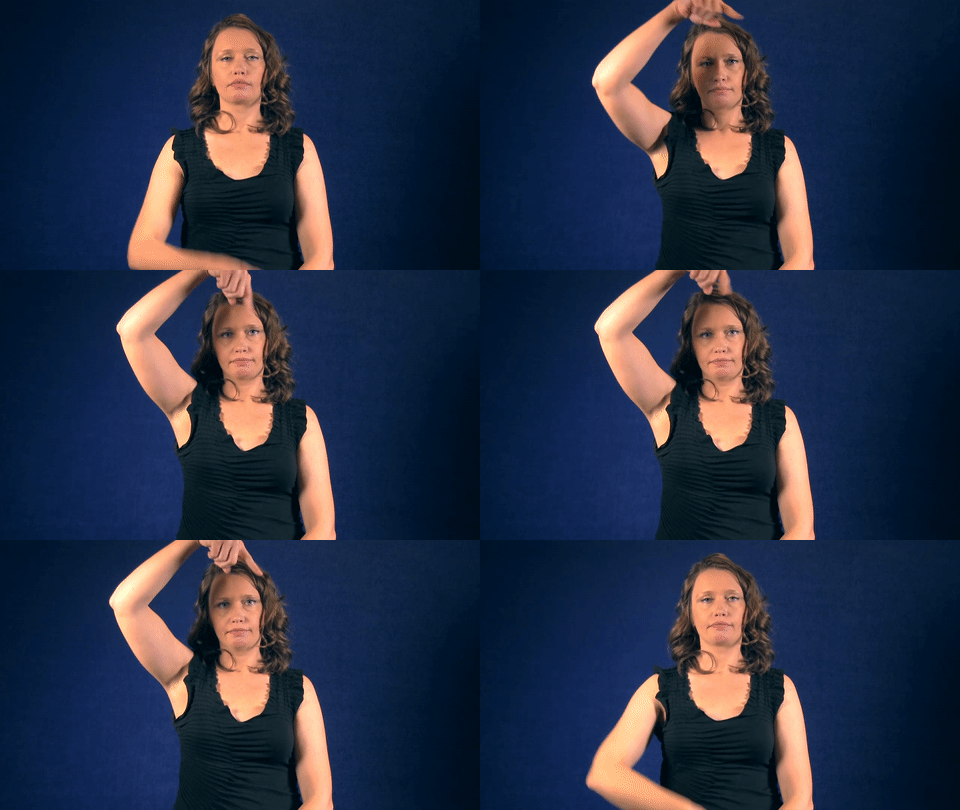
Definition: A fan mounted on the ceiling.
Sign for CEILING FAN in ASL

Practice Activities:
To practice the sign for CEILING FAN in ASL, start by practicing the sign in isolation in front of a mirror. Sign it repeatedly, checking your handshape and motion. This helps build muscle memory and ensures accuracy in production. Record yourself and compare your sign to reference videos to refine your technique.
Next, use the sign in context by creating short phrases such as “The ceiling fan is on,” “I installed a ceiling fan,” or “Do you like using a ceiling fan in summer?” Practicing sentences like these helps internalize how the sign fits naturally within broader communication.
Try storytelling exercises where the ceiling fan plays a role. For example, describe a hot day when you had to sit beneath the ceiling fan to cool off . Include other signs related to home, weather, and comfort to enrich your storytelling experience. Connect the sign for CEILING FAN in ASL with descriptive adjectives like “fast,” “slow,” “broken,” or “new” to illustrate a fuller scenario.
Use flashcards with images of a room, and when you see a ceiling fan, sign the appropriate phrase or sentence. Associating visual context with the sign reinforces memory. This technique is especially helpful for visual learners.
In a partner activity, describe your living room to a peer using only signs. Mention objects like a ceiling fan, couch, television, or lamp. Your partner guesses what you’re signing based on your description, then switches roles. This interactive style encourages receptive and expressive skills.
Narrate a day using ceiling fan references, e.g., waking up and turning on the fan, or cleaning it. The more the sign for CEILING FAN in ASL is used in everyday context, the easier it becomes to remember and use fluidly in conversation.
Cultural Context:
In American Sign Language (ASL), everyday household items have their own visual representations rooted deeply in Deaf culture and daily life. The sign for ceiling fan in ASL is a vital part of that visual vocabulary, especially when describing environments and home settings in conversations. This sign is not only practical but also reflects how ASL quickly adapts to commonly referenced objects.
The Deaf community relies on visual cues to communicate information in both casual and formal settings. Because ceiling fans are widespread in homes, schools, and workplaces, the sign for ceiling fan in ASL is frequently taught in basic vocabulary lessons. Its consistent presence in daily dialogue indicates how visual language develops alongside modern technology and architecture.
When using the sign for ceiling fan in ASL, it’s common to show the spinning motion of fan blades and indicate that the fan is overhead. This visualization helps clarify meaning using only hands and space. ASL uses spatial referencing to match the real-world position of objects, so this sign naturally aligns with how a ceiling fan looks and operates.
Cultural context matters because ASL is not just about hand movements—it’s about depicting whole concepts visually. The sign for ceiling fan in ASL helps Deaf individuals quickly identify the object and communicate its use, such as cooling a room or affecting air circulation. In group conversations or when giving directions inside a house, knowing this sign ensures smooth and accurate communication.
In Deaf homes, where visual accessibility is prioritized, ceiling fans may have built-in lights, and flashing indicators are commonly used instead of sound. The sign for ceiling fan in ASL can be combined with other signs to indicate the light feature or its function. This layered information reflects the richness of ASL and its flexibility in describing real-life experiences.
Educators and interpreters often incorporate everyday items like ceiling fans into lessons to make sure learners can navigate home or apartment conversations. As students learn how to sign different room features, the sign for ceiling fan in ASL becomes essential. Visual cues tied to this sign help children and adults build a comprehensive vocabulary for describing their environments.
For Deaf children growing up with ASL as their first language, signs like the one for ceiling fan are introduced early, along with other household terms like lights, windows, and furniture. This supports language development and fosters strong communication within the home. The sign for ceiling fan in ASL may even vary slightly depending on the region or preference, reflecting the diversity within the community.
Understanding objects in your surroundings enriches your ability to connect with others. The sign
Extended Definition:
The sign for ceiling fan in ASL is a useful and commonly needed sign when talking about household appliances or describing a room. This sign can be especially helpful in conversations about home improvement, interior design, or comfort during warmer seasons. Learning how to express appliances like a ceiling fan improves daily communication in American Sign Language.
To express the sign for ceiling fan in ASL, you typically start with the sign for ceiling, which positions one hand above your head in a flat gesture to represent the ceiling. Then you follow it with the motion for fan, mimicking the rotating motion of the blades. Together, these elements form the complete concept of a ceiling fan.
People often use the sign for ceiling fan in ASL when describing the layout of a room or explaining the need for air circulation. It’s also helpful when discussing different types of fans, like standing fans or table fans, to distinguish between ceiling-mounted ones. Understanding these distinctions helps create clearer, more specific conversations.
In certain regional dialects or household contexts, some slight variations exist in the sign for ceiling fan in ASL. However, the rotating motion of the fan blades remains a core element of the sign. These small differences often depend on how different communities portray everyday objects.
Because ceiling fans are a standard fixture in many homes and public places, the sign for ceiling fan in ASL is a practical addition to your vocabulary. Students, parents, and interpreters frequently encounter this term while describing a home environment or even during school lessons on household items. Practicing this sign makes it easier to discuss temperatures, comfort, and utilities in ASL.
If you’re exploring home fixtures or teaching someone how to describe different spaces in ASL, the sign for ceiling fan in ASL allows conversation that’s fluid and descriptive. It can also be useful during emergencies if explaining the location of appliances to someone with limited hearing. Clear communication about environmental factors like fans also supports safety.
For those engaged in home tours, renovation work, or even maintenance services, the sign for ceiling fan in ASL can make professional exchanges much more accessible. Visual learners and those new to ASL benefit greatly from connecting physical objects in the home to their signs. As people spend more time at home with smart devices and updated fixtures, knowing these terms becomes increasingly valuable.
Including vocabulary like the sign for ceiling fan in ASL in your daily usage helps build familiarity with household and environmental expressions. It’s also key for storytelling, journaling about your day, or signing the weather and climate-related conversations
Synonyms: overhead fan, hanging fan, roof fan, suspended fan, air circulation fan
Educational resources: Find related learning materials in our course bank!
Want more? Check out some of our popular learning activities on the homepage!
Need to look up a sign? Use our highly rated dictionary: https://aslinteractive.com/best-asl-dictionary/
Follow us on tiktok: https://www.tiktok.com/@aslinteractive. More social media links at the bottom of this page!
Long-tail Keywords: what is the sign for ceiling fan in ASL, how do you sign ceiling fan in ASL, ASL sign for ceiling fan
Categories:
tags: Objects, Housing, Describing Residence, Everyday Activities, Facilities and Other Locations/Needs
Parameters
*Handshape*:
The handshape used in the sign for CEILING FAN in ASL typically starts with a flat hand, palm facing downward to represent the ceiling. This is usually done above the head to show spatial location. Following that, the hands transition to an open 5 handshape with slight wiggling motion to mimic the rotation of a fan.
To clearly express the sign for CEILING FAN in ASL, both hands maintain relaxed fingers during the motion, emphasizing the fan’s blades turning. Using the correct handshape is crucial for clarity and meaning in this compound sign.
*Palm Orientation*:
For the sign for ceiling fan in ASL, the palm orientation begins with both hands open and facing downward, parallel to the ground. This simulates the flat surface of the ceiling. As the dominant hand moves in a small circular motion underneath the non-dominant hand, the palm remains palm-down throughout the action, mimicking the rotation of a fan blade.
When signing the concept, the palm of the hand that represents the fan stays toward the ground to capture how a ceiling fan looks from below. Consistency in palm orientation ensures clarity in the sign for ceiling fan in ASL .
*Location*:
The sign for ceiling fan in ASL is typically produced in the neutral space just above the head, representing where a ceiling fan is generally located. The dominant hand mimics the rotating motion of a fan, with the hand positioned palm-down and moving in small horizontal circular motions above the head.
This placement visually matches the real-world position of a ceiling fan. Using this height helps clearly differentiate the sign for ceiling fan in ASL from other fan-related signs.
*Movement*:
To show the sign for ceiling fan in ASL, start by signing ceiling. Raise your dominant hand above your head, palm facing down, and move it in a flat arc to indicate the ceiling. This motion should appear as if you’re tracing the underside of the ceiling overhead.
Next, transition to the sign for fan by placing both hands in front of your face with palms open and facing inward, then wiggle your fingers slightly while making small, alternating circular wrist motions. This mimics the spinning blades of a fan. The combined motions clearly convey the concept in the sign for ceiling fan in ASL .
*Non-Manual Signals*:
When signing the sign for ceiling fan in ASL, keep a neutral or slightly curious facial expression to convey the descriptive nature of the object. Raise your eyebrows slightly if you’re identifying or pointing out a ceiling fan in a space.
Your gaze should follow the hand movement upwards as if indicating the location of the ceiling. Maintain a calm, observational demeanor to align with the visual-spatial context of the sign for ceiling fan in ASL .
*Prosody, Dominant/Non-Dominant Hand*:
The sign for ceiling fan in ASL involves both hands. The dominant hand mimics a small spinning motion above the head with an open palm facing down, representing the fan blades, while the non-dominant hand may remain neutral or support the visualization underneath near forehead level to indicate the ceiling. ⬆️
To clearly convey the sign for ceiling fan in ASL, maintain consistent circular movement with the dominant hand to represent fan rotation. Proper spatial placement above the head helps emphasize that it’s a ceiling-mounted fan, reinforcing the environmental context of the sign.
Tips for Beginners:
When learning the sign for CEILING FAN in ASL, it’s important to first understand that it combines the concepts of “ceiling” and “fan.” Beginners should start by practicing each component separately. For “ceiling,” place your dominant hand flat, palm down, and mime tapping a horizontal surface above your head. For “fan,” turn your dominant hand into a flat open palm and mimic the rotating motion a fan would make, circling slightly at the wrist near your chin or chest.
One tip for mastering the sign for CEILING FAN in ASL is maintaining clear hand shapes and consistent motion. A common issue learners face is getting too fluid or imprecise with the circular motion for “fan,” which can confuse the meaning. Keep your wrist flexible but controlled, and don’t over-exaggerate the motion. Your hand should not go too far away from your face.
Facial expressions aren’t as important for this particular sign but be sure not to look distracted while signing. Eye contact remains vital, even when your sign involves motion near or above your head. Use your eyes to support your signs, especially since ceiling-level signs can be higher and sometimes more difficult to see.
Avoid mixing up “ceiling” with “roof” as they can appear similar in early phases of learning. Consistent practice in front of a mirror can help you evaluate not only hand shapes and movement but also positioning in space. Watching native signers demonstrate the sign for CEILING FAN in ASL can provide context that makes learning more intuitive.
Practicing in practical settings can be useful too. If you’re in a room with a fan on the ceiling, try signing the concept aloud in ASL to solidify the connection. Remember, repetition and real-world usage are key to becoming comfortable with any new sign, especially compound signs like the sign for CEILING FAN in ASL.
Connections to Other topics:
The sign for CEILING FAN in ASL connects with a range of vocabulary related to home, household appliances, air movement, and environmental conditions. Learners studying furniture or interior spaces in ASL often come across this sign while discussing rooms, types of equipment, or ways to stay cool, especially in warmer climates. It shares connections with signs for “ROOM,” “LIVING ROOM,” “CEILING,” and “FAN” individually.
The structure of the sign for CEILING FAN in ASL is often a compound, combining the sign for “CEILING” followed by a motion representing the rotation of a fan. This compound nature allows learners to break it down into separate, foundational signs before mastering the complete phrase. Studying this sign reinforces how ASL can express specificity through compounding and motion rather than relying on adjectives and additional descriptors.
Additionally, this sign is useful when building out descriptions or narratives in ASL, such as setting up context in a story or describing a scene. For example, someone might use the sign for CEILING FAN in ASL when explaining how they sat under a fan on a hot day. This usage naturally connects the sign to climate-related vocabulary, such as “HOT,” “SWEAT,” “SUMMER,” or “BREEZE.”
It also reinforces spatial awareness, as signing “CEILING” typically involves an upward reference, guiding learners toward more fluent use of directional space. Because many appliances in ASL rely on mimetic gestures, the fan’s spinning motion can also connect with signs like “HELICOPTER” or “SPIN,” further emphasizing classifier usage and movement-based concepts.
The sign for CEILING FAN in ASL, while seemingly specific, serves as an excellent example of how descriptive gestures and realism in motion play essential roles in the language. It enriches communication about home settings and cross-links with vocabulary for design, comfort, and even mechanical systems.
Summary:
The sign for CEILING FAN in ASL is composed of two concepts: “ceiling” and “fan.” These are typically expressed in sequence rather than a single compound sign. The sign begins by indicating the concept of “ceiling” followed by mimicking the action or appearance of a “fan.”
To sign “ceiling,” the dominant hand is usually held flat, palm facing down, and moves outward above the head, suggesting the overhead structure of a ceiling. The hand is generally held parallel to the actual ceiling. This gesture clearly portrays the spatial orientation of ceilings in the physical world.
To indicate “fan,” the dominant hand may be placed against the palm of the non-dominant hand and quickly wiggled or rotated to suggest a spinning motion. Another version involves the dominant hand slightly opened and twisting at the wrist, imitating the spinning blades of a fan. Both versions portray the kinetic energy of a ceiling fan.
Together, the sign for CEILING FAN in ASL communicates both location and function. The ceiling is first established as a reference point, followed by the simulation of movement, linking the imagery to a fan. The composite sign geometrically and symbolically conveys the visual representation of a ceiling fan.
ASL relies heavily on spatial references and classifiers. In the sign for CEILING FAN in ASL, the indication of the ceiling acts as a spatial anchor. The subsequent fan motion utilizes a classifier-like depicter, showing how the ASL grammar uses iconic representation.
Culturally, ceiling fans are prevalent in many American homes, especially in warmer climates. The familiarity of the object helps users recognize the sign intuitively. Since a ceiling fan is a common household fixture, its depiction in ASL uses visible and universal features.
The individual components—ceiling and fan—can also be signed independently for different contexts. By combining them, signers convey specificity. This compositional aspect of ASL demonstrates the language’s flexibility and modular structure.
Classifiers in ASL allow for further descriptive layers. A signer can expand on the basic sign for CEILING FAN in ASL by incorporating classifiers to describe size, speed, or noise. These added layers make communication detailed and dynamic.
Grammatically, the sign for CEILING FAN in ASL aligns with the Subject-Verb-Object structure common in ASL declaratives. A sentence might first establish the ceiling fan as the topic, followed by commentary or action. This structure is intuitive for native users and learners of ASL.
Ceiling fans are sometimes used in weather discussions, especially in context of cooling or ventilation. The sign can appear in discussions about air circulation or home settings where temperature regulation is discussed. These thematic discussions further solidify the usage of the sign.
In ASL discourse, setting location in signing space is crucial. Establishing where the ceiling fan is can help anchor further comments. For example, discussions can involve describing the fan’s speed or whether it is on.
The sign for CEILING FAN in ASL visually represents the mechanical aspect of the device. The rotating motion of written English adjectives like “whirling” or “spinning” is brought to life through wrist motion. That kinetic mimicry is core to many classifiers across ASL.
Applied linguistics reveals how signs like this serve both linguistic and cognitive functions. The act of showing motion allows for deeper memory encoding. Gesture paired with visual imagery helps learners and fluent users alike retain meaning.
For learners, the sign for CEILING FAN in ASL demonstrates rich phonological layering. Handshape, location, and movement all interact fluidly. This makes it a valuable teaching example for showcasing iconicicity and visual grammar in ASL.
The concept also reveals the efficiency of ASL in representing complex nouns by merging signs. There’s no need for derivational affixes or complex morphology. Such straightforward combination preserves fluidity in conversational flow.
Teachers of ASL often use signs like this one in thematic units related to the home, climate, or household routines. Visual learners especially benefit from the concrete elements of its representation. The physical presence of a ceiling fan makes it ideal for modeling.
ASL poetry and storytelling may include signs like CEILING FAN, especially in atmospheric or home-environment narratives. The presence of spinning elements or sound in stories can be portrayed through this sign. Its movement adds a visual sonic layer to storytelling.
The rotating motion used in the sign is similar to signs for helicopter or windmill, creating thematic linkages. This borrowing of motion reinforces how ASL builds new signs from familiar visual patterns. Such semantic links deepen aesthetic and cognitive resonance.
From a semiotic lens, the sign for CEILING FAN in ASL is a strong example of iconicity. The form of the sign closely resembles the appearance or function of the referent. Unlike arbitrary symbols, this direct resemblance fosters intuitive learning.
In Deaf Culture, the home environment—and its representation in ASL—carries deep significance. Discussions often include detailed depictions of familiar spaces, and
Want more? Check out some of our popular learning activities!
ASL Interactive Resources
ASLInteractive YouTube Channel
Follow us on tiktok: @aslinteractive.com
Follow us on Instagram: aslinteractive
Facebook page: aslinteractive
Facebook group: aslinteractive
LInkedIn: ASL Interactive LLC
Twitter: @ASL_interactive
*Some information on this page is AI-generated. AI can make mistakes. Please check the information.


Responses