Sign for CEMETERY in ASL | 👻 ASL Dictionary

Definition: A burial ground.

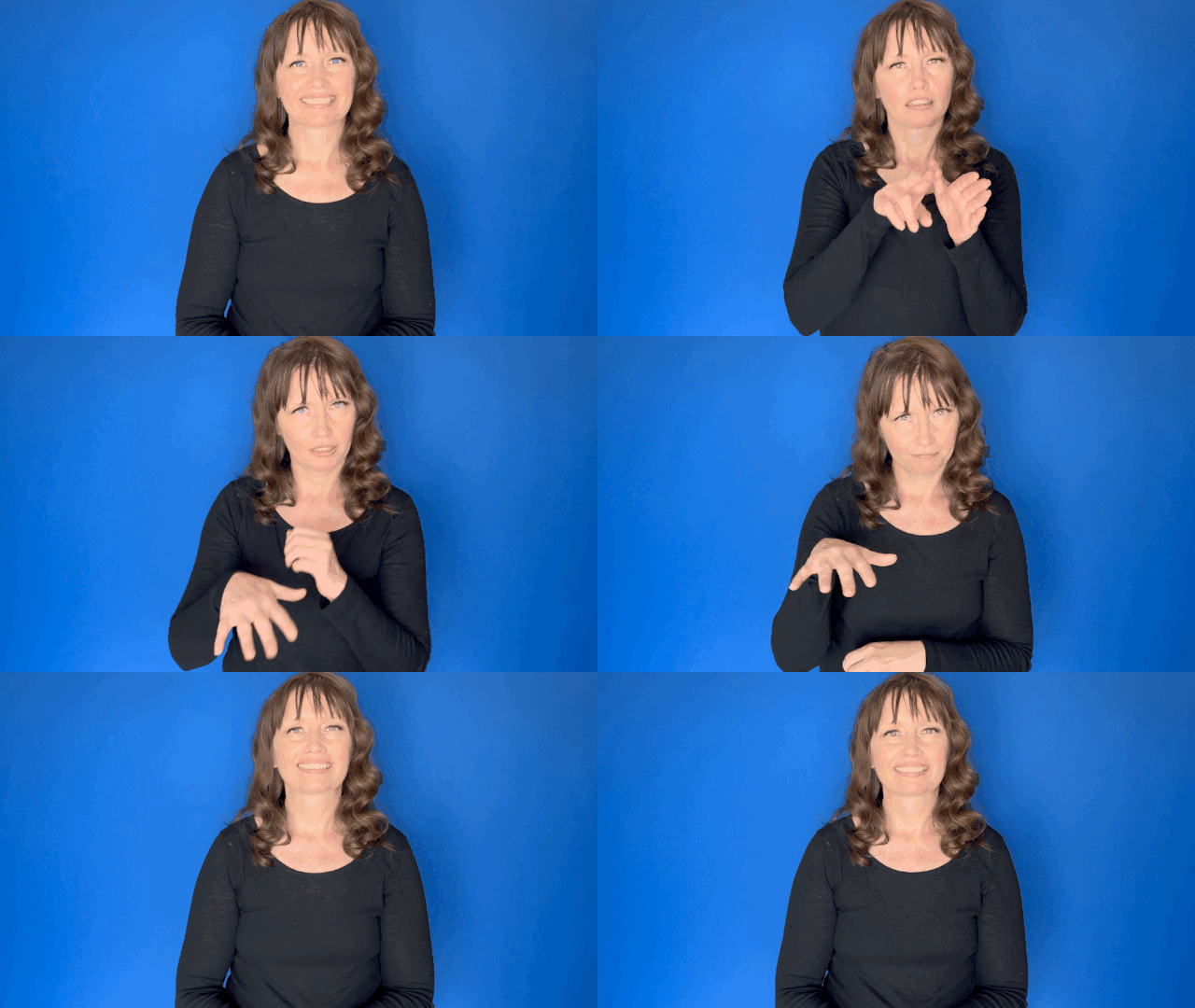
Sign for CEMETERY in ASL

YouTube player

Practice Activities:

Begin by practicing the sign for cemetery in ASL on its own. Use a mirror to watch your handshape, movement, and facial expression. Repeat the sign multiple times slowly, then increase your speed while keeping clarity.

Create a flashcard with the sign on one side and the English word on the other. Test yourself or have a friend quiz you. Then sign it while walking around your home to reinforce the motion with natural movement.

Practice incorporating the sign for cemetery in ASL into short phrases such as “I visited the cemetery” or “That cemetery is very old.” Say the sentence aloud, then repeat it silently while signing. Practice both expressive (signing) and receptive (watching and understanding) forms by watching others sign phrases using this term.

Try storytelling prompts that include a reference to a cemetery. You could sign a story about visiting ancestors on Memorial Day or discovering an old cemetery during a walk in the woods. Use related signs such as grave, quiet, respect, flower, and visit to build narrative flow.

Pair up with a partner to play a guessing game. One person signs a sentence about a cemetery scenario, and the other guesses what is happening. Example: “I put flowers near her grave in the cemetery.” Create a list of similar sentences to take turns practicing.

Use online videos to watch how different signers use the sign for cemetery in ASL in real contexts. Pause and copy their signing, paying attention to fluidity and use in full sentences.

Lastly, create a sentence of the day using this sign and practice it morning and evening. This keeps the sign fresh in your memory and helps you build confidence using it regularly in ASL communication.

Cultural Context:

Understanding the sign for cemetery in ASL involves more than just learning hand movements. It reflects how Deaf culture interprets and expresses ideas about death, memory, and honoring the past. In American Sign Language, signs often carry emotional and cultural weight, especially when tied to places of mourning and remembrance.

The sign for cemetery in ASL captures the grounded and serene nature of such places. Cemeteries are commonly associated with respect, legacy, and quiet reflection in many cultures, including within the Deaf community. When using ASL to discuss a cemetery, tone and facial expression matter just as much as handshape and movement.

Within Deaf culture, the sign for cemetery in ASL may be used during storytelling, family discussions, or even educational settings when talking about history, heritage, or community members who have passed. ASL is a visual and expressive language, allowing the user to convey reverence and solemnity through nuanced motion. When paired with facial expressions and body language, the sign creates a respectful and meaningful exchange.

American Sign Language promotes awareness and inclusion in all parts of life, including topics like grief and remembrance. The cemetery plays a significant role in many family traditions, including the Deaf community, where gatherings may happen at the gravesite, often honoring loved ones with stories or quiet moments. Using the correct sign for cemetery in ASL during these times ensures communication stays clear, respectful, and connected to shared cultural values.

Children learning ASL might encounter the sign for cemetery during holidays like Memorial Day or Day of the Dead, when visits to graves are more common. Teachers and caregivers who understand the cultural significance of the cemetery can use the sign thoughtfully, reinforcing language growth while also supporting emotional development. In doing so, they are fostering more than just vocabulary—they are also building empathy and understanding.

In storytelling within Deaf culture, cemeteries appear as backdrops to historical events, personal anecdotes, or even ghost tales. Using the sign for cemetery in ASL helps set the tone and scene, adding visual imagery that enhances the story. The sign may vary slightly based on region or age group, but the deep respect remains constant throughout versions.

The cemetery is not only a location but also a symbol of peace, tradition, and the continuity of family stories. Signing the word cemetery in ASL can deepen conversations about genealogy and history within Deaf families and communities. It keeps memories alive using expressive language that bridges generations.

When filming ASL content or creating Deaf-accessible material, using culturally appropriate signs like the sign for

Extended Definition:

The sign for cemetery in ASL is a meaningful and respectful way to refer to a burial place or final resting ground. In American Sign Language, this concept is typically expressed by combining signs that convey the idea of a graveyard, often with a motion that suggests the rows or layout of graves. Regional variations may exist, but most Deaf signers will understand the standard form taught in ASL classes and used in Deaf communities.

When learning the sign for cemetery in ASL, it’s important to understand its context within cultural and personal conversations. The sign often appears in discussions about history, remembrance, or when giving directions related to grave sites. Knowing how to sign this term respectfully is valuable, especially during sensitive or emotional conversations.

ASL incorporates visual-spatial elements, so when signing the concept of cemetery, facial expressions and body posture help convey the seriousness or emotional significance of the topic. People may use the sign in stories about loved ones, heritage, or during discussions around holidays like Memorial Day or Día de los Muertos. This makes the sign for cemetery in ASL both functional and culturally important.

Some people may confuse this sign with similar ones like death or funeral, but there are slight handshape and movement differences that distinguish them. In practice, signing cemetery also allows for more elaborate descriptions, like signing a specific location—such as a city or well-known cemetery—before using the main cemetery sign. This makes communication precise and effective.

When teaching or learning the sign for cemetery in ASL, it’s a good idea to practice in complete sentences rather than in isolation. For example, you might sign phrases like visit cemetery or family cemetery to gain confidence in real-life usage. This helps improve fluency and understanding of how the sign fits within broader ASL grammar.

Another helpful tip is to watch videos or interact with native signers using this sign in context. This exposure can show subtle variations or regional accents in signing styles. The sign for cemetery in ASL is often used in storytelling, especially in narratives about life, death, and legacy.

Children learning ASL may also be introduced to this sign during lessons about community places or history. In classroom settings, the sign for cemetery in ASL may be paired with signs like ancestors, spirits, or flowers to help paint a vivid picture. Teachers often use real-world themes to make language learning more relatable and memorable.

The evolution of signs can vary over time, and the sign for cemetery in ASL may shift slightly as regional dialects influence sign usage.

Synonyms: graveyard, burial ground, memorial park, burial site, churchyard

Educational resources: Find related learning materials in our course bank!

Want more? Check out some of our popular learning activities on the homepage!

Need to look up a sign? Use our highly rated dictionary: https://aslinteractive.com/best-asl-dictionary/

Follow us on tiktok: https://www.tiktok.com/@aslinteractive. More social media links at the bottom of this page!

Long-tail Keywords: what is the sign for cemetery in asl, how do you sign cemetery in asl, asl sign for cemetery

Categories:

tags: ASL sign for cemetery, how to sign cemetery in ASL, cemetery meaning in ASL, American Sign Language cemetery, cemetery signs in ASL

Parameters

*Handshape*:

The handshape used in the sign for CEMETERY in ASL typically involves both hands using the B-handshape, where the fingers are extended and together with the thumbs flat alongside the palms. Both hands are held upright, typically near the body at chest level.

In the sign for CEMETERY in ASL, the hands move simultaneously in a brief upward motion, representing headstones or grave markers. This handshape helps convey the concept visually and supports the clear representation of a resting place.

*Palm Orientation*:

The palm orientation for the sign for CEMETERY in ASL typically features both hands in a flat “B” handshape, with palms facing forward or slightly inward toward each other. The hands are usually placed side by side, then moved slightly forward in a short arc to represent gravestones or memorial markers.

In the sign for CEMETERY in ASL, the palms remain relatively vertical to simulate the appearance of headstones standing upright. This orientation helps convey the visual imagery associated with a cemetery.

*Location*:

The location for the sign for CEMETERY in ASL typically takes place in the neutral space directly in front of the torso. Both hands are used and move outward from a central point located near the chest area. This spatial orientation reflects the idea of a designated, solemn space.

During the sign for CEMETERY in ASL, hands remain at mid-torso level, ensuring visibility and clarity. This central location supports the symmetrical movement and helps convey the concept effectively.

*Movement*:

To produce the sign for cemetery in ASL, both hands form the letter “B” handshape, with palms facing toward your body. Starting around mid-torso, move both hands upward and then outward in a slight arc, suggesting gravestones or headstones lined in a cemetery.

The sign for cemetery in ASL uses a smooth, controlled motion that emphasizes structure and solemnity. The movement mimics an upright placement commonly seen in burial grounds.

*Non-Manual Signals*:

The non-manual signals for the sign for CEMETERY in ASL often include a neutral or slightly somber facial expression to convey respect or seriousness, reflecting the solemn context of a cemetery. Eyebrows are typically relaxed, and eye gaze is directed forward or toward the space where the sign is being placed.

This sign often requires a calm demeanor without exaggerated expressions. When using the sign for CEMETERY in ASL in storytelling or conversation, a soft, respectful tone through body posture and face enhances clarity and cultural accuracy.

*Prosody, Dominant/Non-Dominant Hand*:

The sign for CEMETERY in ASL typically uses both hands. The dominant and non-dominant hands are shaped in flat B handshapes, held upright and parallel to each other, moving downward in a slight arc to represent headstones. Sometimes an additional sign for “place” is added underneath using both hands in palm-down flat shapes that move outward.

The movement symbolizes gravestones and the location they occupy. The sign for CEMETERY in ASL is commonly used in narratives about history, culture, or family heritage .

Tips for Beginners:

When learning the sign for CEMETERY in ASL, it helps to first understand the conceptual nature of this sign. Rather than representing just a physical location, the sign reflects the idea of a burial ground or graveyard, so it’s important to bring an appropriate tone and facial expression when signing. Being respectful is part of mastering this sign, especially when using it in conversations around grief, loss, or remembrance.

A common way to express the sign for CEMETERY in ASL is by combining the signs for GRAVE or BURY with a classifier or depiction of a structured area, like rows or grounds. Make sure you’re using both hands if the sign includes a depiction of space, and keep your eye contact and facial grammar attentive and calm. A solemn or neutral facial expression is often most appropriate for this type of vocabulary.

Beginners often rush through the movement or reduce the sign to a simple gesture, which may confuse the message. Unlike signs for more everyday ideas, the sign for CEMETERY in ASL has contextual weight and can require extra clarity. Practice slowly and in front of a mirror to track both your handshapes and your facial expression.

Another tip is to watch fluent signers using the term in conversation. Seeing how the sign for CEMETERY in ASL fits within a larger discussion helps you get a feel for rhythm, placement, and emotion. Try signing while standing or walking around, simulating conversations about different places.

Repetition and context are key to building fluency with signs that show complex ideas. Don’t hesitate to ask a Deaf mentor or instructor if your sign is accurate and culturally appropriate. With time, you’ll refine the movement and clarity so that your ASL communication becomes more confident and expressive.

sign for CEMETERY in ASL, american sign language cemetery, cemetery ASL sign

Connections to Other topics:

The sign for CEMETERY in ASL connects closely with broader topics such as death, mourning, and spirituality. It can frequently appear in conversations about grief, history, or cultural practices surrounding burials. This sign may be used alongside signs like DEAD, DIE, or FUNERAL, which helps expand narrative context for events involving loss or remembrance.

In storytelling or interpretation settings, the sign for CEMETERY in ASL may be paired with TIME, YEAR, or OLD to refer to historical graveyards or ancestral places. When describing locations, it might appear in compound expressions such as GRAVE+CEMETERY or FAMILY+CEMETERY. These combinations allow signers to express detailed concepts without relying solely on fingerspelling or long explanations.

The visual and spatial qualities of the sign also link it to geographic features or locations. For example, it might be grouped with signs for CHURCH, TOWN, or MOUNTAIN when describing where a cemetery is located. These connections are useful in ASL narratives that involve describing travel, history, or cultural landmarks.

The sign for CEMETERY in ASL may also serve in discussions about rituals or traditions, where it can be associated with REMEMBER, MEMORIAL, or BURY. In educational or religious contexts, it plays a role in explaining customs or beliefs associated with the afterlife or honoring the dead. This supports language development in themed discussions like Halloween, Día de los Muertos, or genealogy.

Learners can benefit by relating the sign for CEMETERY in ASL to signs involving family lineage, such as ANCESTOR or GENERATION. These conceptual links enrich vocabulary and deepen understanding of how ASL expresses abstract ideas through physical space and classifier use. By exploring how meaning is built through sign order and proximity, learners become more adept at constructing nuanced, culturally rich expressions.

Summary:

The sign for CEMETERY in ASL often conveys not only a physical location but also a sense of respect and cultural awareness. It visually references the idea of burial and memorial through symbolic handshapes and movement. The sign has more than just a literal meaning—it brings to light societal traditions around mourning and remembrance.

To produce the sign for CEMETERY in ASL, both flat hands (B-hands) are used. Place them palm down and move them forward in a rolling or stepping motion as if indicating gravestones lined in a row. This movement resembles walking through rows in a cemetery or observing its layout.

This sign may also be accompanied by a somber facial expression when used in storytelling or conversation. Facial grammar in ASL is essential in giving the sign emotional context. A neutral or sorrowful gaze emphasizes respect or acknowledgment of death.

The sign for CEMETERY in ASL also holds cultural significance within the Deaf community. Deaf individuals recognize funeral practices and ancestral respect as an integral part of life stories. Whether the cemetery referenced is a family plot, a military burial ground, or a famous site, the same sign can be adapted based on context.

In terms of grammatical usage, the sign functions as a noun and often appears alongside signs for DEATH, FUNERAL, or REMEMBER. In sentences, it typically follows time indicators to locate events in temporal order—for instance, LAST YEAR VISIT CEMETERY FATHER DIED. Temporal and topical structure are key features of ASL syntax.

Related signs include GRAVE, HEADSTONE, and BURIAL, each offering nuance. The sign for GRAVE may involve a depiction of a plot or hole in the ground, while HEADSTONE focuses more on the vertical monument. BURIAL uses a cupped hand sinking below the palm, evoking interment.

The sign for CEMETERY in ASL can also carry metaphorical weight in Deaf storytelling and narratives. It may symbolize memory, heritage, or closure. Often in visual vernacular performances, this sign appears in transition sequences, emphasizing life cycles or connections between generations.

Linguistically, this sign leverages spatial mapping and iconicity. By mimicking gravestone rows, the sign leverages visual-spatial modality unique to sign languages. It highlights ASL’s ability to convey complex sociocultural concepts economically.

From an applied linguistics perspective, learners acquiring the sign for CEMETERY in ASL may benefit from understanding its visual metaphor. The arrangement of hands suggests much more than a place—it conveys tradition, order, and permanence. Teaching this sign can open discussion about how culture and location shape language signs.

Semantically, the sign sits in the conceptual field of death, memory, and ritual. When analyzing ASL lexicon clusters, signs like CEMETERY are often grouped with BURY, MOURN, and SPIRIT. This mental mapping illustrates how ASL users organize conceptual domains nonlinearly and visually.

Body orientation while signing CEMETERY also matters. When used within spatial narratives, signers may point or shift body position to indicate a specific cemetery’s physical location. This spatial referencing allows for integrated storytelling that spoken language might achieve through prepositions or locatives.

Many community events tied to historical remembrance include the sign for CEMETERY in ASL. Memorial Day, Veterans Day, and family remembrance ceremonies all may involve this sign, particularly in interpreter settings. Its use supports broader social participation for Deaf individuals in communal and reflective moments.

Some Deaf culture poetry incorporates themes of loss and remembrance, using the sign for CEMETERY in ASL as a visual anchor. This highlights ASL’s potential as a literary medium. The sign helps convey emotional depth, from grief to reverence.

The lexicalization process around signs related to death often involves a blend of iconic and abstract elements. The cemetery sign’s iconicity is preserved while minor regional variations may change movement intensity or palm orientation. Nevertheless, the sign remains mostly uniform across dialects.

In cross-cultural comparisons with other signed languages, the equivalent for CEMETERY may differ significantly. Some use more metaphorical or religious-based signs. ASL’s version remains relatively secular, focusing on the physical aspect of the location over spiritual connotations.

For heritage language learners, especially those from Deaf families, the sign for CEMETERY in ASL resonates with intergenerational memory. They may link the sign to specific locations or people within family narratives. This adds a layer of personal depth not captured in formal instruction.

Glossing systems used to transcribe or teach the sign in educational settings may use the all-caps CEMETERY to indicate its standardized form. However, instructors often remind students of expressive nuances. The sign is not produced in isolation but within a visual and cultural framework.

Digital platforms now capture the sign for CEMETERY in ASL with high-quality animation or video. These tools help new signers understand subtle spatial and kinetic aspects.

Want more? Check out some of our popular learning activities!

ASL Interactive Resources

ASLInteractive YouTube Channel

Follow us on tiktok: @aslinteractive.com

Follow us on Instagram: aslinteractive

Facebook page: aslinteractive

Facebook group: aslinteractive

LInkedIn: ASL Interactive LLC

Twitter: @ASL_interactive

*Some information on this page is AI-generated. AI can make mistakes. Please check the information.

Sign for CEMETERY in ASL

Responses