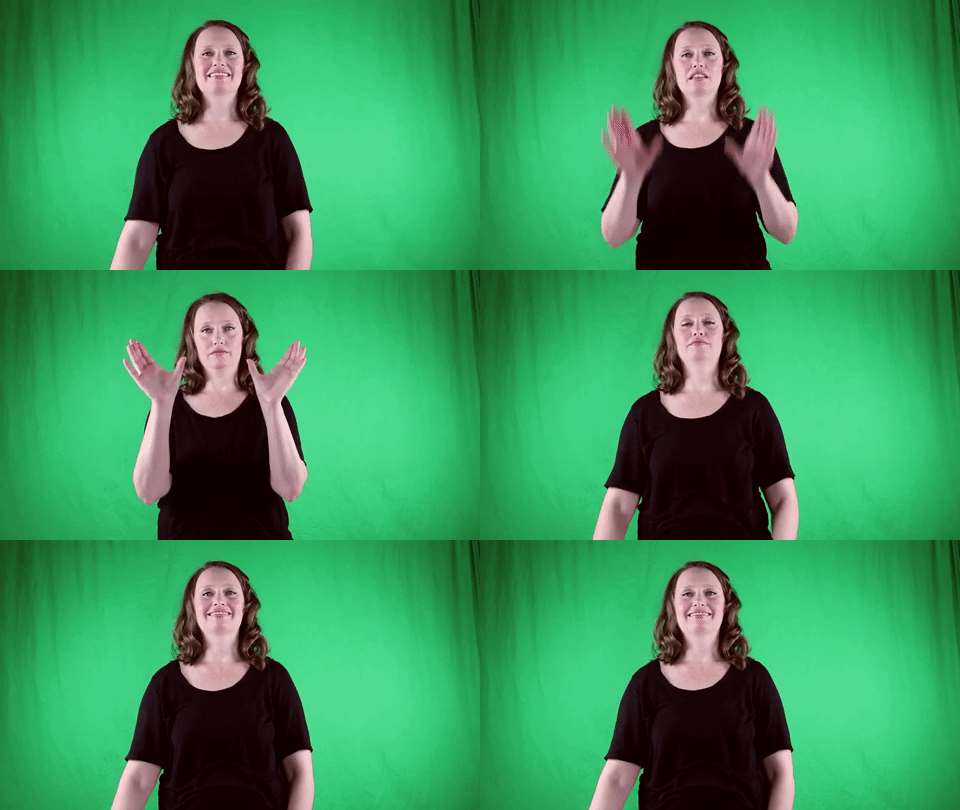
Definition: A document certifying something.
Sign for CERTIFICATE in ASL

Practice Activities:
To effectively learn the sign for CERTIFICATE in ASL, start by practicing the sign in isolation. Stand in front of a mirror and repeat the sign multiple times while focusing on proper handshape, palm orientation, and movement. This helps reinforce muscle memory and ensures clarity in your signing.
Once comfortable using the sign alone, try incorporating it into short phrases. Examples include “I have a certificate” or “She received a certificate yesterday.” Signing these repeatedly will build fluency and confidence. Add facial expressions to indicate pride, excitement, or formality, depending on the context.
Try storytelling to deepen your understanding of the sign for CERTIFICATE in ASL. Create a short story about receiving a certificate of achievement after completing a course. Include details like where you were, who gave it to you, and how you felt. This context-rich activity makes it easier to recall and use the sign naturally.
Work with a partner or in a study group. One person can act out or describe a scenario like attending a graduation or completing a training, and the other person signs the response using relevant phrases that include the sign for CERTIFICATE in ASL. This interaction helps solidify meaning and promotes vocabulary expansion.
Digital flashcards are also helpful. Pair the sign for CERTIFICATE in ASL with related terms like diploma, award, degree, and recognition. Mix the cards and test your ability to distinguish and sign each accurately under timed conditions.
Use video responses for self-assessment. Record yourself using the sign in sentences and monologues, then analyze hand movements, speed, and clarity. This reflection process allows for correction and growth. Try explaining what a certificate is and how it’s used in different settings in ASL without voice support.
Cultural Context:
In Deaf culture, formal recognition through documentation holds significance, especially when it comes to academic or professional achievements. The sign for certificate in ASL represents more than just a piece of paper—it acknowledges effort, skill, and accomplishment in the Deaf community.
The concept of certification in Deaf history has been closely tied to gaining equal access and inclusion in education and employment. Obtaining a certificate means pathways to opportunities that were once less accessible for many Deaf individuals.
When learning or teaching ASL, it’s common to reference educational milestones using specific signs. Knowing the sign for certificate in ASL helps users talk about diplomas, awards, and credentials with clarity in both social and formal settings.
You might see the sign used during graduation ceremonies, job interviews, or community events where achievement is celebrated. Understanding the correct use of the sign for certificate in ASL ensures respectful and accurate communication.
The sign for certificate in ASL is essential in vocational training and adult education. When Deaf individuals complete training programs, discussing credentials often includes using this sign to validate their expertise .
Deaf-owned businesses also use this term to promote their certified services. Whether someone is a certified interpreter, technician, or chef, they use the sign for certificate in ASL to express their qualifications proudly.
In many ASL classes, students are eager to learn how to express their progress properly. As they complete various levels, they often receive a certificate, and signing about it becomes part of their vocabulary practice.
This concept is also practical in legal or medical contexts, where certificates might be required for compliance. Knowing how to use and recognize the sign for certificate in ASL ensures smoother interactions in such settings.
Deaf professionals often need to show continuing education to keep certifications current. The sign for certificate in ASL appears frequently in workplace settings, HR meetings, and training sessions.
The cultural value of achievement is strong within the Deaf community, and this sign is part of that expression. It reinforces identity, pride, and the progress made through advocacy and education over the decades.
Online learning platforms that offer ASL courses often provide printable certificates. Discussing these in ASL among peers makes the sign for certificate in ASL even more relevant in today’s digital learning spaces.
Parents of Deaf children also use the sign when celebrating their child’s success in school or therapy programs. This boosts the child’s sense of pride and introduces useful ASL vocabulary early in life .
By using the correct sign in social media posts or videos, Deaf content creators share their
Extended Definition:
The sign for certificate in ASL represents an official document or recognition of achievement. Whether it’s a school diploma, professional training verification, or special award, this sign conveys the idea of something formally granted. Many people use the sign for certificate in ASL when discussing accomplishments, milestones, or official credentials.
In American Sign Language, signs often reflect the concept they represent, and the sign for certificate in ASL can vary slightly depending on context. Some may use the sign that resembles “paper” or “document” followed by confirmation or official recognition. The concept behind the motion reflects formality and something tangible, making it easy to associate with real-world certificates.
When learning the sign for certificate in ASL, it’s important to consider context. For example, in educational settings, this sign might reference a graduation certificate or course completion document. In work settings, the same sign can be used for a job-related certification or a professional license.
Many learners ask how the sign for certificate in ASL differs from similar signs such as degree, diploma, or license. The key is in the way signs are combined. While the base sign may be similar, ASL users often use additional classifiers or context-specific signs to clarify their meaning.
When used in a sentence, the sign for certificate in ASL often appears alongside signs like complete, receive, or earn. It’s commonly paired with time-related words such as today, recently, or before to show when the certificate was awarded. That makes it a useful sign in daily conversations where achievements are shared.
The sign for certificate in ASL is also helpful in situations like job interviews, school orientation sessions, and personal success stories. When talking about awards, achievements, or program completions, knowing this sign allows for clear communication and recognition. It also adds depth to your ASL vocabulary when trying to be specific.
Variations in the sign for certificate in ASL may exist across regions or style preferences. While the meaning remains the same, some signers may add emphasis or alter the motion slightly. Watching native signers and practicing the sign regularly helps maintain accuracy and fluency.
Deaf professionals, students, and educators frequently use the sign for certificate in ASL during presentations and discussions. It’s a common sign in graduation ceremonies, award presentations, and other formal events. Even in casual stories or conversations, this sign comes up whenever accomplishments are the focus.
Including the sign for certificate in ASL in your daily practice helps reinforce your ability to communicate effectively in both formal and informal
Synonyms: document, diploma, license, certification, credential
Educational resources: Find related learning materials in our course bank!
Want more? Check out some of our popular learning activities on the homepage!
Need to look up a sign? Use our highly rated dictionary: https://aslinteractive.com/best-asl-dictionary/
Follow us on tiktok: https://www.tiktok.com/@aslinteractive. More social media links at the bottom of this page!
Long-tail Keywords: What is the sign for Certificate in ASL?, How do you sign Certificate in ASL?, Certificate in American Sign Language
Categories:
tags: Certificates, Graduation, Occasions, Achievements, Education
Parameters
*Handshape*:
The handshape for the sign for CERTIFICATE in ASL uses both hands in a modified “F” handshape . The thumbs and index fingers form small circles, while the remaining fingers stay extended and relaxed.
In the sign for CERTIFICATE in ASL, the hands begin apart and then come together near the chest or mid-body, as if showing a seal or emblem on a document. The “F” handshape helps visually represent the concept of an official paper or credential.
*Palm Orientation*:
The palm orientation for the sign for CERTIFICATE in ASL starts with both hands in the “F” handshape, held in front of the body. The palms face each other horizontally, as if gripping an imaginary certificate between the thumbs and index fingers.
During the sign, the hands may move slightly apart or stay in place to emphasize the shape and edge of a flat object. This palm orientation helps visually represent the concept behind the sign for CERTIFICATE in ASL .
*Location*:
The sign for CERTIFICATE in ASL is typically made in the neutral space in front of the torso. Both hands are used in a modified “F” handshape, with the index finger and thumb forming a circle. These hands are held in front of the chest area and often touch or come close together.
The location is crucial to differentiate the sign for CERTIFICATE in ASL from similar signs like diploma or license. Keeping the hands at chest level helps convey the formal and official nature of a certificate.
*Movement*:
To produce the sign for certificate in ASL, start by forming both hands into the “F” handshape, with fingers and thumbs making small circles. Position each hand so the tips of the fingers and thumbs touch, creating two small circles facing each other.
Move both hands simultaneously toward the center of your chest, almost as though you’re attaching a badge or holding something flat like a document. This action mimics the idea of presenting or awarding a certificate. The sign for certificate in ASL may slightly vary, but the central movement conveys the concept of an official document or recognition.
*Non-Manual Signals*:
Non-manual signals for the sign for CERTIFICATE in ASL typically include a neutral or slightly serious facial expression, indicating formality or importance. The eyebrows may be slightly raised to show that the item being discussed has official or documented significance.
When using the sign for CERTIFICATE in ASL, the signer might maintain steady eye contact and a composed expression to emphasize credibility and authenticity . There is generally no exaggerated facial movement, keeping the focus on the sign and its context.
*Prosody, Dominant/Non-Dominant Hand*:
The sign for certificate in ASL uses both hands. The dominant hand forms an ‘F’ handshape, as does the non-dominant hand. Both hands touch at the thumbs and index fingers, creating a circular shape, then move slightly forward and apart, as if displaying a document.
In the sign for certificate in ASL, both hands work symmetrically to illustrate the concept of a formal document or award. This movement helps visually convey the official nature of a certificate .
Tips for Beginners:
When learning the sign for CERTIFICATE in ASL, it’s important to focus on the correct handshape and orientation. This sign uses “F” handshapes on both hands, mimicking the look of a formal seal or special document. Start by placing your dominant and non-dominant hands in the “F” formation and bring the tips together near chest level, then move them slightly apart as if presenting a certificate.
Beginners often confuse the sign for CERTIFICATE in ASL with signs like DIPLOMA or LICENSE, which have similar movements but differ in subtle ways. Make sure your “F” handshapes are properly formed with the thumb and index finger touching and the rest of the fingers extended and relaxed. This small detail helps differentiate it from other formal-document signs. Practice in front of a mirror to refine these handshapes.
Facial expression can emphasize context, especially if you’re distinguishing between receiving or awarding a certificate. A slight expression of pride or formality helps set this apart in a narrative or conversation. Adding signing fluency with transitions such as GET, EARN, or FINISH can also help make your signing feel more natural when using the sign for CERTIFICATE in ASL.
One common pitfall is inconsistent spacing or misaligned hand positions. Both hands should mirror each other in shape and move together in sync. Avoid signing too quickly — clarity is more important than speed, especially during your early practice.
In authentic conversations, use the sign for CERTIFICATE in ASL with supporting signs like HONOR, CLASS, or TRAIN when describing achievements or credentials. Repetition also helps ingrain the motion and muscle memory. Finally, watching native signers use this sign in context can help you internalize the rhythm and cultural usage. Apps, videos, or Deaf community events are great places to practice and observe.
Connections to Other topics:
The sign for CERTIFICATE in ASL connects closely with other formal, official documents in ASL such as DIPLOMA, LICENSE, and DEGREE. These signs share similar handshape configurations and movements that convey the idea of a recognized, verified document. Understanding the broader category of official documentation can help learners identify patterns in how ASL expresses certification and validation.
In many contexts, the sign for CERTIFICATE in ASL can be used in compound phrases such as WORK CERTIFICATE, BIRTH CERTIFICATE, or MARRIAGE CERTIFICATE. These compound signs typically incorporate the base sign with a preceding sign that specifies the type of certificate, helping to clarify meaning. For example, a WORK CERTIFICATE might combine WORK with the sign for CERTIFICATE to refer to documentation proving employment or job training completion.
The sign also relates to the concept of validation or acknowledgment, connecting it to signs like APPROVE, PASS, or VALID. These associations help create a more nuanced understanding of the ways ASL expresses approval and qualification. This is useful for interpreting contexts where certification implies eligibility or official status.
Learners will benefit from being able to distinguish the sign for CERTIFICATE in ASL from similar document-related signs, especially in professional or educational settings. In conversations about school achievements, job credentials, or legal documents, knowing when and how to use this sign accurately is essential. The ability to modify or expand the sign into more detailed compounds also enriches expressive options.
Additionally, this sign can appear in storytelling or narratives, especially when discussing achievements, graduation, or immigration. It supports broader themes in ASL, such as accomplishment and legality, and commonly appears in discussions about life events, which makes acquiring this sign particularly relevant for both academic and everyday contexts.
Summary:
The sign for CERTIFICATE in ASL typically mimics the visual concept of a document or official paper being held and presented. The dominant and non-dominant hands form flat “F” handshapes, which touch at the tips of the thumb and index fingers, resembling a seal or finish on a formal document.
To execute the sign, both hands in the “F” handshape meet at chest level, with tips touching, then move slightly apart horizontally, mimicking the action of presenting a certificate. The movement is subtle yet clearly conveys the idea of an accredited or sanctioned document. Facial expression can be neutral or slightly affirming, depending on context.
This semantic choice connects to the conceptual visualization of a certificate as a legalized, formal document that is often ornate or carries significance. In Deaf culture, visual metaphors are essential, so the sign for CERTIFICATE in ASL leans into recognizable shapes and gestures associated with documents.
The sign for CERTIFICATE in ASL aligns closely with signs for DIPLOMA or AWARD in both form and meaning. Context and accompanying signs provide the difference. A sign referring to a graduation or employment setting would usually help distinguish which version or intent is being conveyed.
To clearly communicate the idea of a certificate being professional, you might pair the sign for CERTIFICATE in ASL with signs like JOB, SCHOOL, COMPLETE, or LICENSE. Combining signs adds grammatical clarity and narrative flow, mimicking the clauses or modifiers used in English or other spoken/written language structures.
While the sign for CERTIFICATE in ASL is direct, fingerspelling the word C-E-R-T-I-F-I-C-A-T-E is also acceptable in formal or precise contexts. This is often done when clarifying official documentation or when the sign might be ambiguous due to overlapping semantics with DIPLOMA or LICENSE.
Deaf professionals in education, government agencies, or human resources frequently use the sign for CERTIFICATE in ASL when discussing trainings, authorizations, or professional achievements. It carries strong connotations of formality, preparation, and validation of a skill or standard.
In ASL grammar, depending on how the sign is used, it can be both a noun and a concept marker. ASL does not use affixes or tense articles as in English, so temporal or contextual cues and sentence position give the sign its specific meaning within discourse.
The visual nature of the sign marks its place within iconicity in ASL. Rather than being arbitrary, the movement and shape of the hands have a metaphorical or pictorial basis which enhances understanding. This is one of ASL’s strengths—transparently symbolizing object-based meanings for quick cultural integration.
The form of the sign for CERTIFICATE in ASL is easy to remember because of the memorable “F” handshape pairing, which creates a visual seal or handshake. Just as a certificate often includes a special seal or emblem, this sign visually represents that concept.
ASL linguists often note how layered conceptual blends appear in compound signs like CERTIFICATE. Though simple to execute, it pulls from visual symbolism, cross-linguistic cultural norms, and contextual necessity to land precisely in communication.
From a pedagogical standpoint, the sign is often taught early in life-skills or employment-oriented ASL classes. Students see the practical utility in discussing certificates for jobs, classes, CPR training, vaccinations, or eligibility.
Due to its clear and formal associations, the sign for CERTIFICATE in ASL is often used to emphasize legitimacy. For instance, when describing whether a training program is valid or accepted by employers, this sign may be produced with sharp, deliberate clarity.
Culturally, certificates are interpreted as symbols of hard work and credibility. The Deaf community takes immense pride in educational or vocational achievements, and so the physical representation of those accomplishments deserves accurate, respectful signing.
In academic discussions about visual grammar, the sign for CERTIFICATE in ASL reinforces spatial and risk-based memory cues. This is because its geometry—a horizontal movement from a center point—builds recognition through physical rhythm.
Emotionally, the sign may invoke joy during achievements or solemnity during work qualifications. For example, in graduation ceremonies or award presentations, the sign for CERTIFICATE in ASL becomes a visual bookmark for moments of success.
Translations of ASL into English often prompt questions about what kind of certificate is being referenced. That’s why modifiers or classifiers matter in extended discourse. The sign alone may not sufficiently distinguish between a BIRTH certificate and a COMPLETION certificate.
Classifiers in ASL, such as those indicating type or layout of documents, may supplement the sign for CERTIFICATE to supply detail. For example, a rectangular shape classifier indicates paper form, while contextual signs clarify purpose or origin.
In an applied linguistics view, this sign encapsulates ASL’s morpho-syntactic strengths: minimal movement, a tight spatial arc, and high iconic load. This blends well with theories on visual processing advantages among Deaf communities.
Interestingly, lexical borrowing from English influences
Want more? Check out some of our popular learning activities!
ASL Interactive Resources
ASLInteractive YouTube Channel
Follow us on tiktok: @aslinteractive.com
Follow us on Instagram: aslinteractive
Facebook page: aslinteractive
Facebook group: aslinteractive
LInkedIn: ASL Interactive LLC
Twitter: @ASL_interactive
*Some information on this page is AI-generated. AI can make mistakes. Please check the information.


Responses