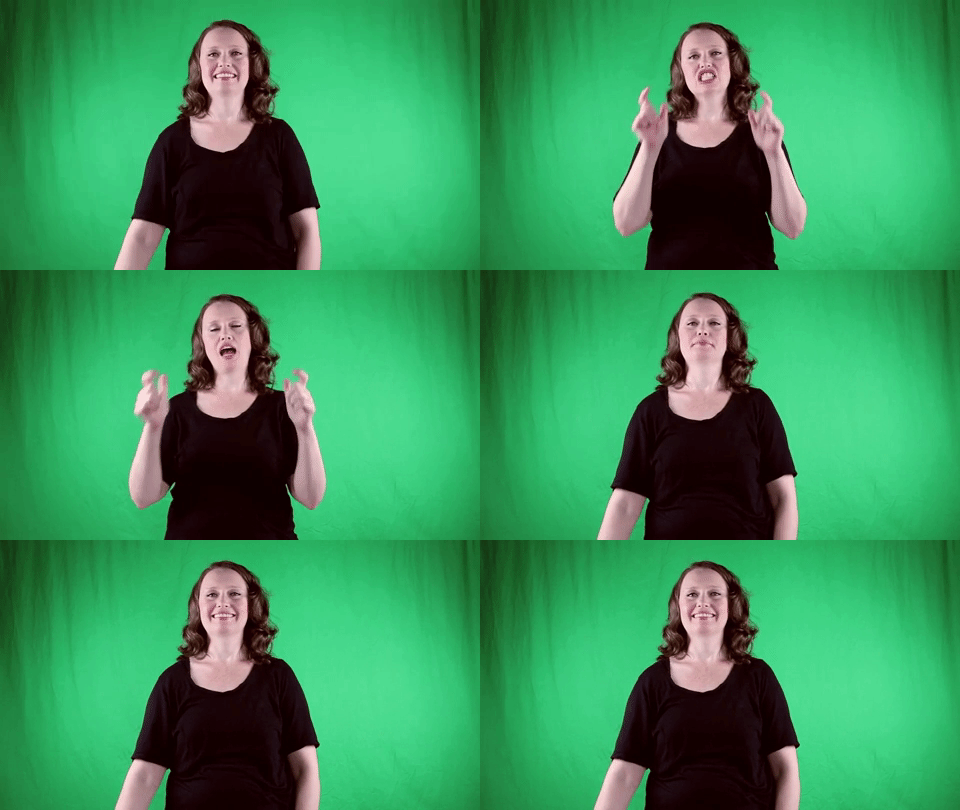
Definition: An expression of excitement.
Sign for CHA in ASL

Practice Activities:
To practice the sign for CHA in ASL, start by signing it in front of a mirror to observe your facial expressions and hand movements. Remember that CHA uses a specific non-manual signal: eyes wide, mouth shaped as if saying “cha,” and hands spaced far apart to show something very large. Repeat the sign several times while focusing on keeping your expression exaggerated—this is an essential part of conveying the meaning.
Use the sign in isolation, then gradually add context. For example, practice signing “big house,” “huge pizza,” or “gigantic mountain,” pairing each noun with the sign for CHA in ASL. The visual emphasis combined with the descriptive size helps reinforce the meaning behind the sign. Vocalizing or exaggerating silently the mouth shape of “cha” while signing can support facial awareness.
Create a short list of items that could vary in size, such as dog, sandwich, truck, or book. Sign each item using size classifiers and apply the sign for CHA in ASL where appropriate to imply something enormous. Compare with other size descriptors like “mm” for small and “oo” for very thin to understand how CHA fits within the size-importance spectrum in ASL grammar.
With a partner, describe imaginary objects or creatures using size-related signs. One person uses the sign for CHA in ASL to describe a massive version of an item, and the other guesses what it is. This helps build expressive vocabulary while reinforcing the facial grammar.
Try storytelling activities using ASL, where the theme is something growing larger or expanding. Tell a story about a tiny seed that grows into a CHA-sized tree, using expressive classifiers as the object gets bigger. This practice highlights how to naturally integrate the sign into narratives for better fluency.
Cultural Context:
The sign for CHA in ASL carries a strong cultural meaning within the Deaf community. This expression goes beyond basic vocabulary and ties into the way Deaf individuals describe something that is extremely large, exaggerated, or intense. The sign reflects a visual and dramatic communication style that is central to ASL storytelling and conversation.
When using the sign for CHA in ASL, facial expression plays a key role. The mouth movement and widened eyes emphasize the intensity or size of what’s being described. This iconic sign is often used with exaggerated gestures and is rooted in ASL’s rich tradition of visual storytelling .
The reason this sign is important isn’t just its meaning but how it encapsulates ASL’s natural expression style. In Deaf culture, the sign for CHA in ASL is not just a hand movement—it’s a blend of signs, facial grammar, and emotion. This type of expressive sign allows conversations in ASL to be deeply engaging and visual.
The sign for CHA in ASL is typically used when someone wants to stress how big, tall, or intense something is. It could describe anything from a large object to a strong personality trait, like someone’s over-the-top energy. This sign functions like an exclamation mark in a sentence, adding emotion and emphasis.
In Deaf performance art like poetry and storytelling, the sign for CHA in ASL shows up frequently. It’s one of many ASL classifiers and expressions that breathes life into narratives. Through this sign, Deaf individuals share experiences in a vibrant way that solely relies on visual cues .
The uniqueness of the sign for CHA in ASL lies in its cultural value. It showcases how ASL uses size and shape to describe objects or feelings, instead of relying on words alone. It also underlines how important body language and facial expressions are when signing in ASL.
Using the sign for CHA in ASL correctly is key to fluency and cultural respect. Learners often focus only on words, but signs like this teach them that emotion, size, and non-manual signals are equally important. It reinforces that ASL is a language full of nuance and depth.
In ASL classes, the sign for CHA in ASL helps new signers appreciate the visual nature of the language. It becomes clear that learning ASL isn’t just about vocabulary—it’s about thinking in pictures and expressing feelings through movement. This visual grammar is a cornerstone of Deaf communication .
The expression shown in the sign for CHA in ASL parallels the dramatic flair found
Extended Definition:
The sign for CHA in ASL is a commonly used classifier expression in American Sign Language. It’s not just a sign for a specific word, but more of a modifier or descriptor that helps create vivid visual imagery. Often used to describe something extremely large in size, volume, or intensity, it brings drama and emphasis to a sentence.
In ASL, classifiers like the sign for CHA are used to show shapes, sizes, or types of actions. The sign for CHA in ASL generally involves puffing the cheeks, making a big mouth shape, and using exaggerated movements. This sign is often paired with descriptive signs to enhance the overall message.
You’ll typically see the sign for CHA in ASL when someone is describing something massive, such as a giant stack of books, a huge sandwich, or an extremely tall person ♂️. It works alongside other signs, but the facial expression and body language are just as important. That’s what makes ASL so unique—non-manual markers like these add layers of meaning.
Using the sign for CHA in ASL helps differentiate between moderate, large, and extremely large items. For example, a person may use it when explaining the size of a large animal or when talking about a loud noise that fills an entire stadium. Viewers immediately understand the meaning due to the exaggerated and vivid nature of the sign.
Facial expressions are a crucial part of making the sign for CHA in ASL effective. Without them, the meaning might be lost or only partially understood. This sign depends on intense expression to be fully clear, making it a perfect example of how ASL uses the whole body to communicate.
In storytelling, the sign for CHA in ASL adds drama and excitement. It’s common in ASL narratives to exaggerate details to keep the audience engaged, and this sign plays a big role in that. Many deaf children and adults use this sign when describing their experiences in visually engaging ways.
You won’t typically find the sign for CHA in ASL used in formal or technical settings. It’s more common in casual, everyday conversation or storytelling. Still, it’s an essential part of learning ASL fluency, especially in understanding informal or native-level signing.
Students learning ASL will often be introduced to this sign early on because of its expressive and fun nature. It gives learners a chance to explore facial expressions and spatial awareness. Practicing the sign for CHA in ASL alongside other classifiers enhances natural signing ability.
When searching for
Synonyms: CHA, cha ASL, cha American Sign Language, ASL cha, cha sign
Educational resources: Find related learning materials in our course bank!
Want more? Check out some of our popular learning activities on the homepage!
Need to look up a sign? Use our highly rated dictionary: https://aslinteractive.com/best-asl-dictionary/
Follow us on tiktok: https://www.tiktok.com/@aslinteractive. More social media links at the bottom of this page!
Long-tail Keywords: what is the ASL sign for Cha, how to sign Cha in ASL, Cha in American Sign Language
Categories:
tags: Languages, Language Learning, Basic Grammar, Classifiers, Everyday Activities
Parameters
*Handshape*:
The handshape for the Sign for CHA in ASL typically features both hands using a “claw” or curved-five handshape, with fingers spread and slightly bent. The hands are placed in front of the body and pulled apart in an exaggerated motion to suggest something unusually large or wide.
In the Sign for CHA in ASL, this handshape helps convey emphasis or exaggeration, often paired with an expressive facial expression like widened eyes or a puffed-out mouth. This combination enhances clarity and impact, especially when describing something immense.
*Palm Orientation*:
The palm orientation for the sign for CHA in ASL begins with the dominant hand held open with fingers spread, palm facing forward. As you express the sign, the palm remains outward, emphasizing the larger-than-usual size referenced by CHA.
In the sign for CHA in ASL, the open hand moves slightly to visually represent size, and the orientation plays a key role in conveying that exaggerated dimension. This sign is often accompanied by a facial expression showing emphasis, adding to the meaning.
*Location*:
The sign for CHA in ASL is located in the neutral space slightly in front of the body, around chest to upper torso level. The hands move outward to emphasize bigness, and the facial expression plays a key role with widened eyes and an exaggerated mouth, sometimes mouthing “cha” while signing.
When performing the sign for CHA in ASL, maintain the movement in front of your chest while keeping your body relaxed. This location helps visually reinforce the concept of largeness or exaggeration, often used with classifiers to describe something very big or impressive.
*Movement*:
The sign for CHA in ASL uses a modified “cha” facial expression to emphasize something large or exaggerated. Begin with both hands in bent L-handshapes, palms facing each other near the front of the chest. Move the hands apart horizontally while expanding your mouth into a “cha” shape to show emphasis.
To effectively sign the sign for CHA in ASL, be sure to combine the movement with exaggerated facial expressions. This helps communicate the intensity or exaggerated size being described.
*Non-Manual Signals*:
The non-manual signals for the sign for CHA in ASL include exaggerated facial expressions to convey something very large or extreme in size. Open eyes, raised eyebrows, and a slightly open mouth are commonly used to intensify the meaning.
To accurately portray the sign for CHA in ASL, the signer may also lean slightly forward with a dramatic head movement. These facial cues are essential in emphasizing the larger-than-normal concept being communicated.
*Prosody, Dominant/Non-Dominant Hand*:
The sign for CHA in ASL uses dominant and non-dominant hands to show exaggerated size or intensity. Both hands are open and spread apart with palms facing each other, moving outward to emphasize something very large or extreme. Facial expression is key—eyes widen, and mouth forms the word “CHA” to enhance the meaning. This prosody supports the descriptive nature of the sign for CHA in ASL .
The sign for CHA in ASL relies heavily on non-manual markers. The dominant and non-dominant hands remain parallel, emphasizing the significance of size or emphasis. It’s common in storytelling and classifiers, bringing dramatic flair to the signing space using full body movement and expression.
Tips for Beginners:
Mastering the sign for CHA in ASL can be a fun and expressive way to show size and exaggeration in conversation. CHA is a non-manual marker rather than a traditional hand sign. That means it relies heavily on facial expression, mouth shape, and body posture rather than a specific hand movement. Begin by practicing in front of a mirror to get comfortable with showing a wide mouth, as if saying “cha,” while raising your eyebrows and moving your hands slightly apart to show something is large or exaggerated.
A common mistake when learning the sign for CHA in ASL is focusing too much on the hands and forgetting the importance of facial grammar. Remember that your facial expressions are just as crucial as your hand movements. Keep your eyes wide, mouth open in a “cha” shape, and add a bit of head tilt or body lean to match the context of what you’re trying to communicate. This enhances the visual impact and matches native ASL use.
If you’re describing something big, like a large animal or an enormous dish of food, the sign for CHA in ASL adds that extra descriptive detail. Think of it as a dramatic punctuation—energetic and expressive. Over time, observe how fluent signers use CHA in storytelling or everyday conversations, and try to mirror those techniques.
Don’t be afraid to exaggerate a little; it’s part of what makes the sign for CHA in ASL so effective. Use real-life examples and act them out. Chat with others in the Deaf community and ask for feedback on your facial expressions and intensity. Consistent practice, especially with body and facial fluidity, will help you incorporate the sign naturally into more animated or expressive signing.
Connections to Other topics:
The sign for CHA in ASL is an example of a descriptive non-manual marker (NMM), often used to emphasize size, intensity, or exaggeration. It typically involves a facial expression showing teeth, widened eyes, and the mouth shaped as if saying “cha,” sometimes accompanied with a large gesture to indicate something enormous. This non-manual signal is commonly paired with signs about size or exaggeration, such as “BIG,” “TALL,” or “HUGE,” to convey emphasis.
This expression connects closely with ASL classifiers, especially when describing large objects, animals, or features of a location. For example, when explaining a massive cliff or a tall person, a signer might include the sign for CHA in ASL in combination with a classifier like CL:1 (for a tall object). It adds a narrative quality, giving more depth and meaning in spatial and descriptive storytelling.
The sign for CHA in ASL is also related to a spectrum of exaggerated or intensified concepts. Its opposites include “OO” (small or tiny) and “MMM” (moderate or average), creating a visual scale for adjectives. These signs help learners understand comparative size or emotion, contributing to more expressive communication in ASL narratives or casual conversation.
In storytelling and storytelling-focused lessons, learners often practice the sign for CHA in ASL when emphasizing big actions or dramatic scenes. It becomes essential in anecdotes involving large animals, big mistakes, or over-the-top experiences, helping to engage audiences and support the visual-gestural nature of ASL. Such expressive non-manual tools underline the three-dimensional nature of signing.
Additionally, compound concepts in ASL like “VERY-BIG” or “SUPER-TALL” incorporate this expression to give added emotional and visual weight. The sign for CHA in ASL thus becomes a powerful expressive anchor, allowing advanced signers to fine-tune intensity and narrative tone in conversation.
Summary:
The sign for CHA in ASL is a dynamic, non-manual sign that conveys something unusually large or exaggerated in size. It is most recognizable for its combination of facial expression, mouth movement, and widened gestures that visually amplify a concept. This marker is one of many size and intensity adverbials in ASL that communicate degrees of magnitude without the use of extra lexicon.
To sign CHA, the mouth forms the sound “cha,” as if emphasizing a burst or impact, while the eyes open wide and the hands often reflect widened parameters. Depending on context, the hands may not always be used, but the exaggerated facial expression is crucial. This mouth morpheme is categorized as a non-manual marker, which plays a grammatical role in ASL.
The sign for CHA in ASL is often inserted mid-sentence or mid-sign when describing a large object or explaining a situation that is extreme in size or intensity. For example, when narrating about a big dog, a storyteller might widen their hands while signing DOG and use the CHA mouth morpheme to show the dog’s amazing size. This produces a highly visual and expressive sentence that enhances understanding beyond linear words.
Non-manual markers like the sign for CHA in ASL are essential components of native signing fluency. They function almost like tone and inflection in spoken languages. Without proper use, signed messages lack the visual richness and fine degrees of meaning that characterize natural ASL.
Linguistically, the sign for CHA in ASL is part of what is known as a size and shape specifier system, sometimes referred to as SASS classifiers. However, while SASS classifiers use handshape functions to show size, the CHA morpheme is non-manual and intensifies those classifiers or signs. The dual use results in layered meaning.
In applied linguistics, studying the sign for CHA in ASL reveals how cognitive and visual-spatial strategies drive meaning in signed languages. The emphasis on visual storytelling challenges traditional linguistic models built around linear speech. In ASL, grammar can exist on the face and body simultaneously with the hands.
When teaching ASL, the sign for CHA is often emphasized early to show how non-manual grammatical components create nuance. Students are taught to treat the face and mouth as part of their signing space. The unspoken rule in ASL that “your whole body signs” is never truer than when incorporating mouth morphemes like CHA.
ASL mouth morphemes are significant because they establish contrast and specificity in larger narrative or descriptive frameworks. In comparison, the sign for OOO expresses something very small, as in a tiny puppy or minuscule amount. These two opposite expressions, CHA and OOO, balance the visual spectrum of describing scale in ASL.
The sign for CHA in ASL also reflects cultural storytelling practices. In Deaf culture, strong use of facial grammar, especially extreme forms like CHA, shows fluency and engagement. Skilled narrators often exaggerate CHA expressions during visual vernacular performances or casual conversations to elicit humor or emotional reactions.
Within broader Deaf cultural expressions, the sign for CHA in ASL aligns closely with dramatic and expressive patterns. Humor and hyperbole are staple ingredients in Deaf storytelling, and CHA captures that stylistically. It’s not just for literal size—it can suggest emotional scale, exaggerated emotion, or imaginative situations.
The sign for CHA in ASL is often used in tandem with classifiers, particularly ones paired with body movement. For instance, describing a large fish might involve a horizontal movement of the hand and a CHA facial expression to show the impressive size. The mouth movement alone instantly intensifies the meaning.
In terms of syntax, the sign for CHA in ASL is not an isolated lexical item but a feature added within another sign. It functions like an adverb to modify the signed concept and cannot stand alone as an independent sign. This trait is common in non-manual adverbials in signed languages.
Among the related signs, the closest comparisons to the sign for CHA in ASL include the signs for TH, OO, and MM, each of which signal different degrees of intensity or dimension. TH often associates with carelessness or contempt, while OO indicates very small, and MM is used for moderate or regular size. Each has its place in the grammatical system of ASL.
In film and media representations of ASL, performers sometimes incorporate exaggerated forms of the sign for CHA in ASL to visually capture the audience’s imagination. Intensified facial expressions paired with powerful classifier use can communicate without subtitles. It highlights ASL’s visual depth beyond English translation.
From a cognitive-linguistic perspective, the brain processes the sign for CHA in ASL in a multimodal way, integrating visual-spatial awareness with facial muscle movement interpretation. This simultaneous processing of sign and expression makes ASL unique among many languages.
In classroom discourse, instructors often model the sign for CHA in ASL as part of a sequence of size-based descriptions. For example, comparisons
Want more? Check out some of our popular learning activities!
ASL Interactive Resources
ASLInteractive YouTube Channel
Follow us on tiktok: @aslinteractive.com
Follow us on Instagram: aslinteractive
Facebook page: aslinteractive
Facebook group: aslinteractive
LInkedIn: ASL Interactive LLC
Twitter: @ASL_interactive
*Some information on this page is AI-generated. AI can make mistakes. Please check the information.


Responses