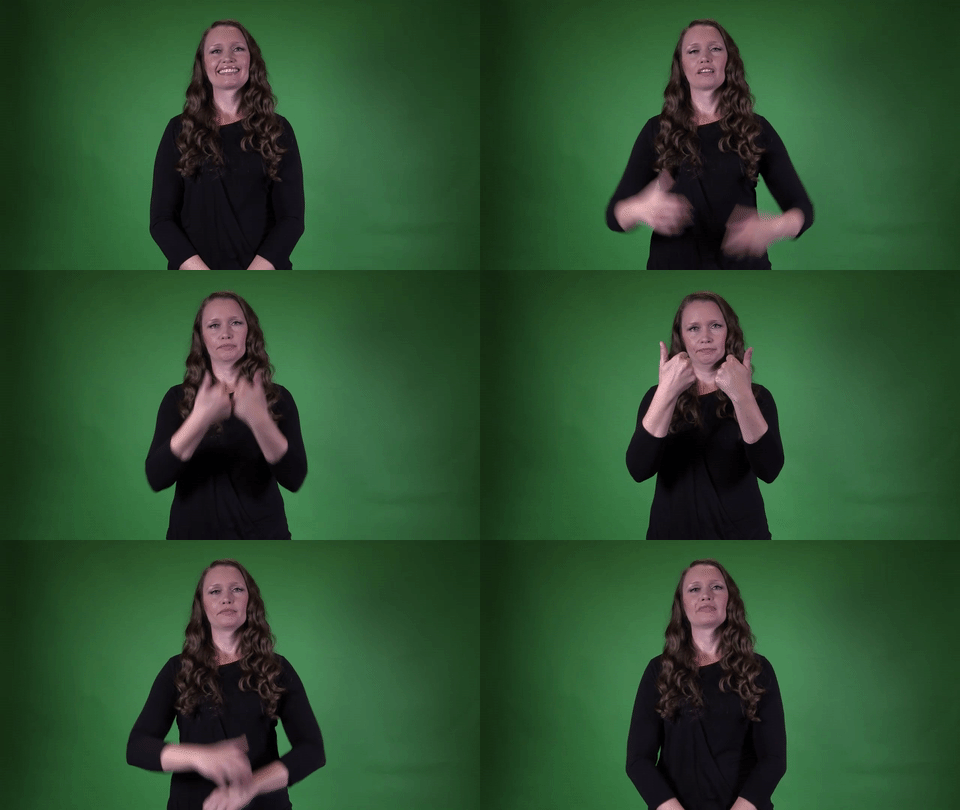
Definition: A test of one’s abilities.
Sign for CHALLENGE in ASL

Practice Activities:
Start by practicing the sign for CHALLENGE in ASL in isolation. Stand in front of a mirror and repeat the sign slowly and clearly, focusing on correct handshape, palm orientation, and movement. Do the sign five times in a row, then switch to doing it with facial expressions that show determination or difficulty, since facial grammar is important when expressing concepts like challenge.
Next, use the sign within simple phrases. Pair it with signs like FACE, BIG, or LIFE to create short practice phrases such as FACE CHALLENGE, BIG CHALLENGE, or LIFE CHALLENGE. These combinations help build fluency by reinforcing how the sign for CHALLENGE in ASL fits into various sentences.
Try making your own sentences that include situations when someone might face a challenge. Some examples: I CHALLENGE YOU. WORK CHALLENGE HARD. SHE ENJOY CHALLENGE. Sign each sentence slowly, then sign it faster to build fluency. Record yourself and review the video, checking for accuracy in movement and expression.
For storytelling practice, create a short ASL story about a personal or fictional challenge. It could be about climbing a mountain, passing a hard test, or learning how to swim. Use the sign for CHALLENGE in ASL at least twice in your story, along with appropriate facial expressions and body language to convey the struggle and success.
Use partner activities to sign dialogues that include challenges. For example, one person can express facing a challenge, while the other responds with support or advice. Examples include: I CHALLENGE RUN MARATHON. FRIEND SAY, YOU CAN DO IT. This helps with conversation flow and practical usage.
Also try interactive games like charades where one person signs situations and others guess the challenge, reinforcing understanding through play.
Cultural Context:
In Deaf culture, the sign for CHALLENGE in ASL carries deep meaning that goes beyond its literal translation. Signing CHALLENGE in ASL not only represents taking on a difficult task but also reflects the resilience and strength within the Deaf community. It is often used to express determination and the drive to overcome obstacles, both in personal growth and in societal advocacy.
The sign for CHALLENGE in ASL is commonly seen in discussions about accessibility, education, and identity. For Deaf individuals, facing a challenge can mean confronting barriers in communication, employment, or inclusion. Using the ASL sign shows a sense of empowerment and unity, reinforcing the community’s commitment to rising above inequality and making their voices seen and heard.
In daily Deaf interactions, signing CHALLENGE in ASL can reflect both internal and external difficulties. It might appear in a classroom when talking about learning something new, or in social settings to describe life events that require courage. This sign captures the cultural value placed on perseverance and self-advocacy within the community.
ASL is a visual language full of cultural nuance. The sign for CHALLENGE in ASL is an example of how Deaf people add emotional and contextual layers to their communication. Depending on facial expressions or intensity of the sign, CHALLENGE can indicate a variety of tones, from a friendly competition to a serious life struggle.
Deaf athletes and performers also frequently use the sign for CHALLENGE in ASL to share their experiences. Competing or performing in environments designed for hearing individuals often presents unique challenges. This sign serves as a proud acknowledgment of the effort and success achieved in the face of such adversity.
Within Deaf storytelling, the sign for CHALLENGE in ASL is often used in personal narratives or community stories. These stories don’t just entertain—they pass down cultural values and highlight important historical experiences. By signing CHALLENGE, Deaf storytellers emphasize themes like persistence, bravery, and solidarity.
The sign for CHALLENGE in ASL also emerges in Deaf activism and advocacy. Whether discussing systemic issues or fighting for policy changes, Deaf leaders use this sign to express the uphill battle for rights and recognition. It becomes a visual statement of strength in the face of structural challenges.
Parents in Deaf families may use the sign for CHALLENGE in ASL when teaching children about important life lessons. It becomes a communicative tool to encourage problem-solving and emotional strength. This builds a foundation of cultural pride and self confidence from an early age.
Social media has
Extended Definition:
The sign for challenge in ASL is a dynamic and visual representation that captures the essence of facing obstacles or engaging in a competitive task. In American Sign Language, this sign involves both hands in a forward-facing position, moving toward each other in a forceful motion — symbolizing two opposing forces meeting.
When signing challenge in ASL, the motion itself conveys a sense of confrontation or difficulty, which is central to the meaning of the word. Whether you’re talking about a physical contest, a mental puzzle, or a life struggle, this sign is used to portray those moments where effort and determination are needed.
Understanding the context is important when using the sign for challenge in ASL. The meaning can shift slightly depending on whether you’re discussing a personal barrier, a competitive game, or a goal to achieve. ASL relies heavily on facial expressions and body language, so emphasizing the sign with your expression can help make the meaning clear.
You may also see the sign for challenge used in motivational conversations, especially when encouraging someone to overcome a difficulty. In the Deaf community, “challenge” is often associated with growth, learning, and persistence, making the sign both common and meaningful in everyday communication.
The sign fits naturally when discussing school assignments, workplace goals, athletic competition, or personal achievements. For instance, if a student is talking about a hard test, they might use the sign for challenge in ASL to show how difficult or complicated it felt.
This sign is frequently seen in educational and self-help videos in ASL that focus on goal-setting, motivation, and development. It resonates well with audiences because it mixes physical motion with a strong emotional impression. That’s why many ASL storytellers and educators use it to capture attention and convey important life lessons.
The sign for challenge in ASL is not just literal — it also symbolizes the drive to overcome. Whether you’re facing an internal battle or an external test, this sign can help you express both the stress and the strength that go hand-in-hand with tackling difficult tasks.
In informal settings, Deaf children and adults might use the sign when talking about games or fun dares among friends. Its meaning remains strong, and it always points to something that requires extra effort or courage to complete.
When practicing the sign for challenge in ASL, make sure to use clear handshapes and deliberate motion. Since many ASL signs can look similar, it’s important to get comfortable with how this particular sign uses space and movement to indicate tension or opposition.
The beauty
Synonyms: test, trial, obstacle, difficulty, hurdle
Educational resources: Find related learning materials in our course bank!
Want more? Check out some of our popular learning activities on the homepage!
Need to look up a sign? Use our highly rated dictionary: https://aslinteractive.com/best-asl-dictionary/
Follow us on tiktok: https://www.tiktok.com/@aslinteractive. More social media links at the bottom of this page!
Long-tail Keywords: what is the sign for challenge in ASL, how do you sign challenge in ASL, ASL sign for challenge
Categories:
tags: Challenge, Verbs, Activities, Major decisions, Commands
Parameters
*Handshape*:
The handshape for the sign for CHALLENGE in ASL uses two “A” hands. Both hands are formed into fists with thumbs extended, resembling the letter “A” in ASL. The hands start near the center of the body, palms facing each other.
During the movement, the fists move slightly forward and apart in a strong, deliberate motion . This gesture emphasizes confrontation or a test of skill, fitting the meaning of the sign for CHALLENGE in ASL.
*Palm Orientation*:
For the sign for CHALLENGE in ASL, both hands are in “A” handshapes with palms facing each other. The palms are angled slightly inward, so the thumbs point upward and the fingers point backward toward the signer. As the hands move forward in a pushing motion, the palms maintain this inward-facing orientation.
In the sign for CHALLENGE in ASL, the palm orientation remains steady during the motion, reinforcing the sense of pressure or confrontation. This palm direction helps symbolize the idea of opposition or two forces coming together.
*Location*:
The sign for CHALLENGE in ASL takes place in the neutral space in front of the torso, just below the chest area. Both hands are used and begin at shoulder width before moving inward in a firm and intentional motion toward each other.
Most movements in the sign for CHALLENGE in ASL remain forward-facing and away from the body, emphasizing confrontation or resistance. This location supports the meaning of facing a test or difficulty directly.
*Movement*:
To produce the sign for CHALLENGE in ASL, begin with both hands in the “A” handshape. Position them near the chest, with the knuckles facing each other and pinky sides touching lightly.
Push both hands outward and slightly upward in a quick, forceful motion, separating them while maintaining the “A” handshape. This movement illustrates rising to meet an obstacle, which conveys the meaning behind the sign for CHALLENGE in ASL.
*Non-Manual Signals*:
Facial expression plays a key role in the sign for challenge in ASL. Eyebrows are often slightly furrowed, and the mouth may be tight or slightly pursed to show determination or a sense of struggle.
The non-manual signals help convey the intensity or seriousness of the situation. This enhances the meaning of the sign for challenge in ASL by adding emotional depth and context.
*Prosody, Dominant/Non-Dominant Hand*:
The sign for CHALLENGE in ASL uses both hands in an A-handshape. The non-dominant hand stays still, palm facing sideways, while the dominant hand mirrors the shape and moves forward in a slight arc to meet the non-dominant hand. It’s a firm movement that conveys confrontation or struggle.
To clearly express the sign for CHALLENGE in ASL, the dominant hand leads the motion confidently. This prosody emphasizes determination or competition depending on context.
Tips for Beginners:
When learning the sign for CHALLENGE in ASL, make sure you start slowly and pay close attention to hand positioning and movement. This sign involves both hands and directionality, which can be tricky at first. Practice in front of a mirror so you can correct any unintentional angles or gestures that may confuse your viewers.
Be mindful of the motion: it’s important to execute the forward movement with intention. The sign for CHALLENGE in ASL involves both closed fists traveling from the body outward, almost like pushing two opposing forces together and then out. Think about the concept of facing off or meeting a test—this idea will help guide your motion.
A common beginner mistake is making the movement too fast or too forceful. Overemphasized movements can make your signing unclear or even unintentionally change the meaning. Focus on fluid and controlled motion instead. Controlled gestures help convey confidence and make your ASL more readable.
Facial expressions play a major role in adding context to the sign for CHALLENGE in ASL. Try adding a determined or confident look when using this sign during storytelling or discussions about overcoming obstacles. Expression enhances comprehension and aids in expressing degrees of difficulty or personal engagement.
Don’t be discouraged if your hands feel awkward in the beginning—regular practice will bring improvement . Incorporate this sign into your daily conversations so it becomes second nature. Sign with a partner to get live feedback and deepen your muscle memory.
Lastly, adjust your signing space for visibility. Keep the sign at chest height and ensure your movements aren’t too high or too low. Clear placement creates cleaner interpretation. The more consistently you practice, the smoother and more natural the sign for CHALLENGE in ASL will become .
Connections to Other topics:
The sign for CHALLENGE in ASL connects closely with other signs that depict effort, struggle, or competition. It shares similarities in movement and handshape with signs like COMPETE, TRY, and DIFFICULT, highlighting the common theme of exertion or testing one’s abilities. These relations help learners group vocabulary by concept, making retention easier.
This sign often appears in contexts involving personal growth, sports, or academic settings, and can be modified in facial expression or intensity to reflect different levels of difficulty. For example, when paired with the sign for WIN, it conveys a story about overcoming obstacles. Similarly, combining CHALLENGE with LEARN or WORK produces nuanced ideas such as challenging coursework or a tough job.
Learners can also utilize the sign for CHALLENGE in compound expressions. Phrases like LIFE CHALLENGE or FACE CHALLENGE are constructed by juxtaposing relevant signs to build complex meaning. These examples also show how role-shifting and facial grammar enhance the message, especially when narrating personal or shared experiences.
In educational settings, the sign is useful for discussing classroom goals, behavioral expectations, or academic motivation. In social or community contexts, it may be used in storytelling, testimony, or peer encouragement. This versatility enriches expressive signing and deepens narrative complexity.
The sign for CHALLENGE in ASL gives learners an entry point into a broader family of signs about perseverance, conflict, and achievement. Understanding its connections to related signs fosters more dynamic communication. Additionally, it supports storytelling skills and expressive depth in both casual and formal ASL use.
Exploring the sign for CHALLENGE in ASL also introduces learners to subtle differences in sign choice depending on context, such as LIFE HARD versus LIFE CHALLENGE. These variations allow for more refined and accurate messaging as fluency grows.
Summary:
The sign for CHALLENGE in ASL conveys both confrontation and motivation. It typically involves two A-handshapes, facing each other with knuckles, then moving forward assertively. This forward thrusting motion resembles two parties coming together in competition or conflict, symbolizing a figurative or literal challenge.
This sign is directional and dynamic, focusing on motion and engagement. The way the hands move forward implies initiative and strength. It’s often intensified by facial expressions, particularly raised eyebrows and a determined gaze.
Facial grammar is crucial with the sign for CHALLENGE in ASL. A neutral face creates a casual tone, but raised brows and tensed facial muscles emphasize difficulty or conflict. Facial expressions enhance the descriptive quality of the sign and set its emotional tone.
Grammatically, the sign fits well as a noun or verb depending on context. For instance, you can sign “to challenge someone” or simply refer to “a challenge.” Like many ASL signs, it is influenced by context and established through subject-verb-object structure or topic-comment structure.
Culturally, the concept of challenge aligns deeply with Deaf pride and resilience. From education to activism, Deaf individuals have continually confronted barriers. The sign for CHALLENGE in ASL often carries an undertone of empowerment and perseverance.
In conversation, this sign commonly appears in stories about overcoming adversity or pursuing goals. It’s also central to narratives about competitions, trials, and personal growth. Deaf storytelling culture frequently uses the concept of challenge to signal transformation or moral tension.
Linguistically, the sign exhibits qualities typical of ASL morphology. The forward force of the movement creates a visual metaphor that reinforces its meaning. There is a strong relationship between a sign’s spatial characteristics and its semantic load.
Some users modify the sign slightly to convey different degrees or types of challenges. For mild challenges, movement is smaller; for intense ones, motion is larger and more aggressive. These subtle adjustments show how ASL users grammatically mark intensity visually.
When using the sign in academic discussions, particularly in fields like Deaf studies or ASL linguistics, it symbolizes advocacy and systemic critique. For instance, one might discuss the challenges facing ASL interpreters or education systems. The sign becomes a metalinguistic tool to describe broader obstacles and opportunities.
There are related signs that enhance understanding of the sign for CHALLENGE in ASL. COMPETE, STRUGGLE, and PROBLEM share some semantic overlaps. They vary in handshape and motion but often surface in similar narrative arcs.
Context defines whether you use CHALLENGE or another related sign. If a situation emphasizes opposition or a match, COMPETE might be preferred. But when internal fortitude against difficulty is key, CHALLENGE captures that nuance better.
From a sociolinguistic perspective, signs like CHALLENGE reflect lived experience. Within the Deaf community, challenges are often shaped by society’s expectations and systemic structures. The sign becomes a powerful symbol of navigating marginalization and promoting equality.
The sign integrates nicely with classifiers and role shifts. For example, one can act out a challenge between two people by switching roles mid-sign to show opposing forces. These strategies make stories more vivid and expressive.
In educational contexts, CHALLENGE is also used to introduce obstacles in problem-solving tasks. Teachers in Deaf education may incorporate the sign to encourage critical thinking. It becomes not just a linguistic item but a pedagogical tool.
ASL poetry and visual vernacular performances often highlight the sign for CHALLENGE due to its visual strength. Its motion-driven aesthetic makes it a dramatic tool for emphasizing conflict or transformation. It ignites viewer engagement and emotion through kinetic expression.
Applied linguistics studies of ASL take interest in signs like CHALLENGE to understand how abstract ideas are embodied. Because it’s not tangible, the sign must metaphorically represent mental or social struggle. This showcases ASL’s capacity for representing complex concepts.
The semantic domain of the sign connects to fields such as psychology, sports, activism, and mentoring. In these spaces, signs like CHALLENGE intersect motivation, aspiration, and defiance. The three-dimensionality of ASL allows simultaneous expression of multiple layers.
Community-based sign variation may influence how CHALLENGE is produced. Some regional variations exist, though the standard A-handshape version is widely recognized. Signers from different generational or educational backgrounds may bring in slight shifts in execution.
Historical shifts in the use of CHALLENGE reflect larger changes in Deaf discourse. Earlier eras emphasized limitations, but modern usage frames challenges as growth opportunities. The default tone has shifted from deficit-based framing to strength- and identity-based narratives.
Students learning ASL often practice this sign in tandem with related concepts like SUCCESS, FAIL, and GOAL. This set of signs helps develop storytelling and argumentation skills. CHALLENGE becomes a bridge sign that builds narrative coherence.
Role models in the Deaf community often use this sign during presentations or motivational speeches. It punctuates moments where they
Want more? Check out some of our popular learning activities!
ASL Interactive Resources
ASLInteractive YouTube Channel
Follow us on tiktok: @aslinteractive.com
Follow us on Instagram: aslinteractive
Facebook page: aslinteractive
Facebook group: aslinteractive
LInkedIn: ASL Interactive LLC
Twitter: @ASL_interactive
*Some information on this page is AI-generated. AI can make mistakes. Please check the information.


Responses