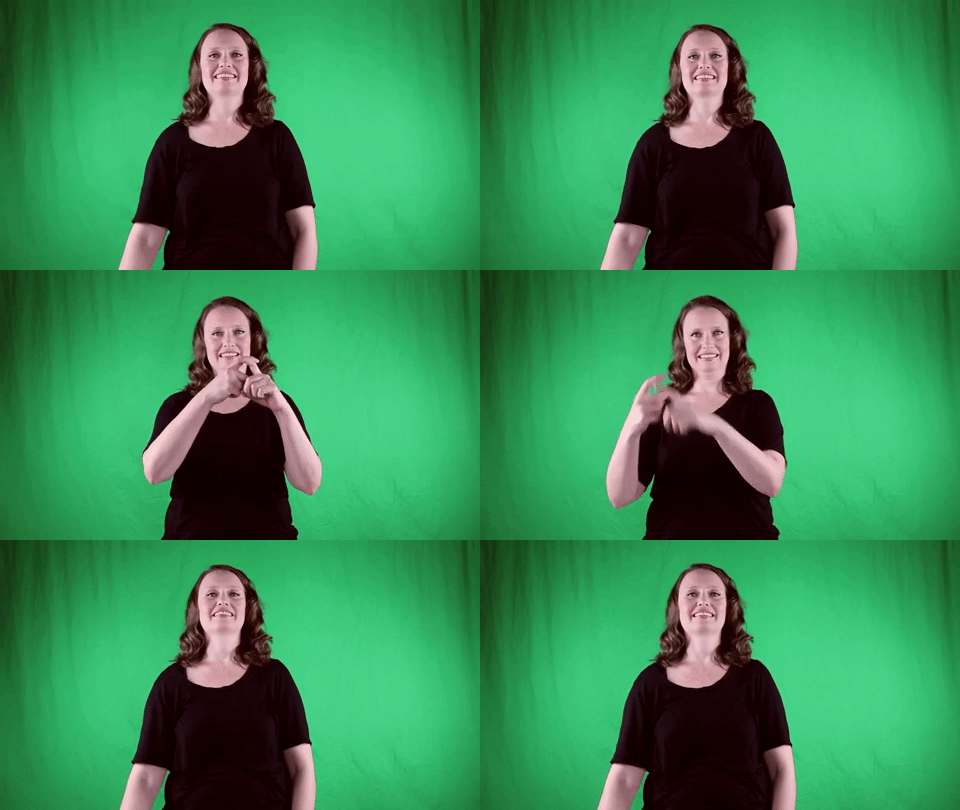
Definition: Symbols used in writing.
Sign for CHARACTERS WRITTEN LANGUAGE in ASL

Practice Activities:
Begin practicing the sign for CHARACTERS WRITTEN LANGUAGE in ASL in isolation by standing in front of a mirror. Repeat the sign several times while checking your handshape, palm orientation, and movement. This helps you build muscle memory and confidence in producing the sign clearly and correctly.
After becoming comfortable with the sign on its own, try using it in simple sentences. Sign phrases like “I study characters written language,” “She loves learning characters written language,” or “Characters written language is different from spoken language.” Practice both signing and lip-syncing to support communication with a variety of signers.
Challenge yourself with a storytelling activity. Create a short story about a student who travels to another country and struggles with new characters written language. Include visual descriptions and emphasize contrastive structure to describe how characters written language differs across cultures. Record yourself signing and review to identify areas for improvement.
For receptive practice, ask a partner or tutor to sign several sentences that include the sign for CHARACTERS WRITTEN LANGUAGE in ASL and try to understand them without voice. Write down what you understood, then check for accuracy. This builds your receptive skills while reinforcing vocabulary.
Try a matching game using flashcards. On one side, draw or print different forms of written language like Chinese, Japanese, or Korean characters. On the flip side, write the language name. Sign the term characters written language each time you flip a card to maintain repetition.
In a group activity, each person chooses a written script and teaches the group one word or symbol from that script using ASL. Incorporate the sign for CHARACTERS WRITTEN LANGUAGE in ASL while introducing the cultural or historical background. This makes the practice more engaging and relevant.
Cultural Context:
In American Sign Language (ASL), the sign for characters written language carries important cultural and educational significance. Deaf communities rely on both ASL and written language to access knowledge and communicate across different contexts. Understanding the sign for characters written language in ASL is key to bridging the gap between visual-manual communication and text-based systems.
Deaf individuals often transition between ASL and written English in settings like schools, offices, and online platforms. The concept of characters written language in ASL goes beyond simply reading and writing—it also connects with the Deaf experience of bilingual navigation. This includes mastering the visual structure of ASL while understanding how characters function in English.
For Deaf children especially, learning the sign for characters written language in ASL supports literacy development. It helps them conceptualize letters, symbols, and meaning through a visual and tactile mode of communication. This bilingual exposure, introduced early with signs that refer to letters, characters, and words, creates more accessible learning pathways.
Cultural context plays a huge role in how Deaf communities interpret characters written language in ASL. It’s not just about translating one system into another. Rather, it reflects the history of Deaf education, the importance of Deaf pride, and the creative use of signs to represent complex ideas from written text.
In Deaf culture, there’s often an emphasis on visual learning and expression. Using the correct sign for characters written language in ASL helps align educational materials with cultural values. It reinforces the idea that visual languages are complete, complex, and equal to spoken and written ones.
The sign for characters written language in ASL is also useful in everyday conversations. Whether browsing a website, reading a text, or learning a new subject, Deaf signers often refer to characters as part of their interaction with written content. Using this sign makes it easier for Deaf users to describe their experiences with digital and printed materials.
Deaf authors, artists, and educators frequently incorporate themes of written language and characters in their work. The intersection of ASL and English print is a source of creativity and identity. The sign for characters written language in ASL is a reflection of how language evolves within visual culture.
Additionally, the sign for characters written language in ASL appears regularly in classrooms, interpreting assignments, and storytelling. It helps maintain fluid communication between signers and readers, Deaf students and their teachers, and ASL interpreters conveying written details in real-time.
Because ASL is a living language shaped by community use, signs evolve to reflect current usage. Characters
Extended Definition:
The sign for characters written language in ASL refers to how written symbols, such as letters, characters, or pictographs, are represented visually through American Sign Language. Since ASL is a visual language, it relies on specific handshapes, movements, and facial expressions to convey the concept of written language and characters across different cultures and writing systems.
In ASL, the sign for characters written language usually combines concepts like writing, symbols, text, or printed materials. The idea is to express not just English letters, but also characters used in other writing systems such as Chinese, Japanese, Korean, or even ancient scripts. This makes the sign versatile for discussing multiple written languages in an educational or diverse community context.
When describing characters written language, the signer often uses a visual-spatial representation. This might include gestures that mimic writing on a surface, or a movement that indicates a string of characters aligned like words on a page. The sign for characters written language in ASL can change slightly depending on the context and the specific language being referenced.
In educational settings, this sign is essential when teaching about literacy, reading, writing, or world languages. Teachers often use the sign for characters written language in ASL to help students understand the differences and similarities between language systems. This helps build a strong foundation in both language and cultural appreciation .
The sign for characters written language in ASL also plays a big role in storytelling and media. When deaf users talk about books, subtitles, digital writing, or texts, this sign helps express the form of language they are seeing or reading. It’s crucial for communication in both academic and informal conversations .
Because ASL is not a written language in the traditional sense, the sign for characters written language in ASL helps bridge the visual world and the concept of reading and writing. It opens a way for deaf individuals to engage with text-based content and express similar ideas used in spoken and written English.
In cross-cultural conversations, someone may use this sign when comparing American characters to Japanese kanji or Arabic script. This allows the signer to dive deeper into discussions about linguistic structures and how meaning is carried through different written expressions. The ability to discuss these topics adds richness to the language and inclusivity into deaf culture.
Parents, interpreters, and educators find the sign for characters written language in ASL useful when teaching or translating complex ideas about communication. Whether explaining that a word is misspelled or exploring literature from other countries, this sign offers a base for
Synonyms: text symbols, written letters, script characters, writing symbols, alphanumeric signs
Educational resources: Find related learning materials in our course bank!
Want more? Check out some of our popular learning activities on the homepage!
Need to look up a sign? Use our highly rated dictionary: https://aslinteractive.com/best-asl-dictionary/
Follow us on tiktok: https://www.tiktok.com/@aslinteractive. More social media links at the bottom of this page!
Long-tail Keywords: what is the ASL sign for Characters Written Language, how do you sign Characters Written Language in ASL, ASL sign for Characters Written Language
Categories:
tags: Characters, Written Language, Languages, Language Learning, Education
Parameters
*Handshape*:
The handshape for the Sign for CHARACTERS WRITTEN LANGUAGE in ASL uses flat hands. Both hands are in the “B” handshape with fingers extended and held together, palms facing the signer. One hand remains stationary as the other mimics writing by gently sliding across it.
This movement represents the concept of characters being written, visually emphasizing the process of forming symbols in a written language. The Sign for CHARACTERS WRITTEN LANGUAGE in ASL effectively conveys written expression through these precise handshapes. ✍️
*Palm Orientation*:
For the sign for CHARACTERS WRITTEN LANGUAGE in ASL, the palm orientation typically involves both hands. For “CHARACTERS,” the dominant hand forms a modified claw shape and taps the non-dominant flat palm twice, with both palms facing each other. When transitioning to “WRITTEN LANGUAGE,” the dominant hand mimics writing, using the index or a flat hand, with the palm facing downward while the non-dominant hand remains palm-up as paper. This orientation effectively conveys the concept behind the sign for CHARACTERS WRITTEN LANGUAGE in ASL .
*Location*:
The sign for CHARACTERS WRITTEN LANGUAGE in ASL takes place in the neutral space in front of the torso. Both hands are positioned around chest to mid-torso height throughout the sign. The dominant hand starts by conveying the concept of individual written characters, while movements progress to demonstrate the connection of those characters to written language.
This location allows for clear visual reference to “writing” and “symbols,” enhancing comprehension of the sign for CHARACTERS WRITTEN LANGUAGE in ASL ✍️. The hands remain comfortably away from the body, making gestures fluid and easily seen.
*Movement*:
The sign for CHARACTERS WRITTEN LANGUAGE in ASL combines elements of writing and symbolic representation. Start with the dominant hand in a flat “B” shape and mimic writing on the palm of the non-dominant hand, which is held flat and horizontal. Then transition to showing character forms by moving the hands outward as if placing symbols or characters in space.
This sign visually conveys the idea of written symbols forming a language. It’s often used when discussing visual or symbolic language systems, especially in reference to Asian written characters or formal scripts. The motion ties the concept of writing directly to unique characters, which is essential for capturing the meaning behind the sign for CHARACTERS WRITTEN LANGUAGE in ASL .
*Non-Manual Signals*:
When demonstrating the sign for CHARACTERS WRITTEN LANGUAGE in ASL, the signer typically maintains a focused facial expression, indicating the conceptual nature of writing and language. Slight eyebrow furrowing and attentive eye gaze help convey precision and clarity, especially as this concept blends abstract and concrete elements.
The sign for CHARACTERS WRITTEN LANGUAGE in ASL may also include subtle head nods to emphasize importance or clarity, particularly when distinguishing between written words versus spoken communication. Keep the mouth neutral or slightly pursed to reflect concentration. ️
*Prosody, Dominant/Non-Dominant Hand*:
The sign for CHARACTERS WRITTEN LANGUAGE in ASL uses both hands to depict the concept of written text and language characters. The dominant hand, typically the right, begins by forming a flat hand that mimics writing on the palm of the non-dominant flat hand using a small circular motion ✍️.
After that, the dominant hand moves outward and forms a C-handshape to represent “characters,” followed by repeated side-to-side motion with both hands flat, palms outward, to show “language.” The sign for CHARACTERS WRITTEN LANGUAGE in ASL clearly combines the idea of writing with symbolic representation.
Tips for Beginners:
When learning the sign for CHARACTERS WRITTEN LANGUAGE in ASL, it’s important to break it down into its components: first sign “CHARACTERS”, then “WRITTEN”, then “LANGUAGE.” Practicing these individually will help reinforce muscle memory and avoid confusion when combining them. Each part of the sign sequence requires clear handshape positioning and smooth transitions.
One common mistake beginners make with the sign for CHARACTERS WRITTEN LANGUAGE in ASL is compressing the movements too closely or skipping parts of the full concept. Such shortcuts can drastically change the meaning or make the message unclear. Be sure not to rush through the signs—clarity always comes before speed in ASL.
When signing “CHARACTERS”, watch that your handshape and circular movement are precise. This sign is sometimes subtle and can be misunderstood if the movement is too small. For “WRITTEN”, remember to show the writing action with clear directionality between the dominant and non-dominant hands. Lastly, during “LANGUAGE”, make sure you extend out from both hands smoothly to indicate the flow of communication.
Using a mirror while practicing the sign for CHARACTERS WRITTEN LANGUAGE in ASL can be a huge asset . It helps you visually correct posture, spacing, and speed. Also, try video recording yourself so you can review for accuracy later.
If possible, ask a Deaf signer or fluent ASL user to watch and give feedback. Live feedback can point out small details you may otherwise miss. Pairing this phrase with common context sentences will increase your fluency and help solidify how and when to use it.
Repetition and patience are key. Don’t feel discouraged if you don’t get the sign for CHARACTERS WRITTEN LANGUAGE in ASL perfect immediately. With consistent practice, muscle memory and comprehension will improve over time.
Connections to Other topics:
The sign for CHARACTERS WRITTEN LANGUAGE in ASL connects closely to the broader concept of communication through symbols. It intersects with signs such as WRITE, LANGUAGE, and SYMBOL, all of which emphasize the idea of expressing ideas visually. Understanding this sign helps reinforce the role of written forms alongside signed and spoken ones.
This sign also relates to ASL concepts like TRANSLATE, ENGLISH, and GRAMMAR, especially in contexts where someone is distinguishing between written English and ASL syntax. Learners often see it used when bilingualism or translation is a topic of discussion, particularly important in educational or legal settings where text must be interpreted into sign.
The sign for CHARACTERS WRITTEN LANGUAGE in ASL can appear in compound signs that deal with literacy, such as READ+UNDERSTAND or WRITE+SENTENCE. It naturally integrates in phrases like WRITTEN LANGUAGE UNDERSTAND or CHARACTERS READ ABILITY, which may describe language learning and comprehension in students or language users.
It also attaches to the broader topic of learning modalities, especially for deaf or hard-of-hearing individuals who may rely more heavily on written forms. Discussions around closed captioning, text-based communication, or written exams often involve this sign. In this way, it becomes part of conversations around accessibility and education.
Additionally, this sign links to vocabulary about media, literature, and technology. Signs like TEXT, EMAIL, and DOCUMENT often occur in the same contexts, emphasizing how characters and written language appear across digital platforms. Understanding how to sign CHARACTERS WRITTEN LANGUAGE along with related terms supports interpreting and communication in tech environments.
In classroom or storytelling settings, this sign is used when analyzing how narrative is conveyed in print vs. sign. For example, comparing a children’s book to a signed version often brings up the need to explain how written characters convey meaning. Such comparisons enhance linguistic awareness among learners.
Summary:
The sign for CHARACTERS WRITTEN LANGUAGE in ASL blends linguistic precision with visual symbolism, drawing from deep cultural and educational frameworks. It typically involves a dominant hand forming a flat “B” palm, mimicking the motion of writing on the non-dominant palm, indicating a visual representation of language via script.
This sign reflects how ASL approaches abstract concepts like written language, which differs fundamentally from its own visual-gestural modality. It requires adapting hearing-centric ideas into a visual framework, revealing the ingenious flexibility of ASL as a language.
The use of the palm to represent paper and the mimed writing action show how ASL communicates meaning through visible metaphor. It emphasizes that, although ASL is not a written language in the traditional sense, Deaf culture still interacts with text-based systems.
The concept of characters, especially tied to written systems, is richly diverse. While English uses alphabets, Chinese or Japanese scripts involve logographic or syllabic characters, requiring distinction in sign when discussing linguistic variation.
In educational settings, the sign for CHARACTERS WRITTEN LANGUAGE in ASL often arises in discussions about literacy, language acquisition, and biliteracy among Deaf individuals. Teachers may use it as they address topics around reading comprehension and written communication competency.
This sign also becomes important in bilingual contexts where ASL and English coexist, especially in Deaf education. The gesture signifies more than just drawing characters—it points to the structured encoding of thought via symbolic systems.
The cultural richness of the sign lies in how it encapsulates visual access to a spoken world’s textual output. It bridges the gap between visual language users and standard written text, making it important for accessibility and social equity.
Grammatically, this sign functions frequently as a noun but can be used in verbs phrases like “to write characters” or “to translate characters from written language”. Its usage varies slightly with context, drawing on classifier handshapes or compound signs for specificity.
Linguistically, it reflects spatial-temporal adjustments that are key to ASL’s structure. The direction, space management, and facial expression all ground the sign within a given discourse, showing the sign’s alignment with ASL’s grammar rules.
From a broader semiotic viewpoint, the sign for characters written language in ASL shows how visual symbols can be layered to represent abstract linguistic content. This demonstrates ASL’s capacity to internalize and represent external language systems in nuanced ways.
When compared to related signs like WRITE, DOCUMENT, and PAPER, this sign takes a narrower focus on the symbolic representations within those mediums. In contrast, WRITE is more about the act, whereas CHARACTERS WRITTEN LANGUAGE emphasizes the symbolic content of communication.
The sign is valuable in translation contexts, especially when relaying information between ASL and printed English, or when translating between ASL and foreign written scripts. Interpreters often refer to it while discussing subtitling, closed captions, or written instructions.
In multilingual public discourse, Deaf individuals may use this sign when referring to multiple language systems. For example, explaining that Japanese kanji or Arabic script constitute different characters and writing systems involves nuanced use of classifiers along with this sign.
Psycholinguistically, understanding this concept requires cognitive bridging between visual-spatial language and linear text. The sign thereby represents an essential educational tool for Deaf children learning to read in English or other languages with written scripts.
Applied linguistics sees this sign as central to discussions about second-language development within the Deaf community. ASL is often a first language, and English is learned as a second through written exposure, making this referential sign foundational in pedagogy.
The sign also appears in academic discourse about script-based vs sign-based communication. ASL scholars and educators use it to identify challenges faced by Deaf individuals navigating written-only institutions like schools or government systems.
In technological advancement, tools like text-to-speech, auto-captioning, and digital keyboards based on written alphabetic inputs connect modern Deaf experiences to the contextual use of this sign. Referencing characters in a coding or data-entry context also highlights the sign’s growing relevance.
Online spaces like social media use written characters constantly, so the sign for CHARACTERS WRITTEN LANGUAGE in ASL is increasingly pertinent in digital literacy instruction. Deaf influencers or content creators use the concept behind this sign when discussing typing, hashtags, and textual responses.
Historical analyses note that literacy campaigns within the Deaf community have long emphasized mastering characters and written language as a means to empowerment. The use of this sign reflects decades of educational activism and language access advocacy.
There’s a deeper cultural significance in how the sign represents accessibility. Being able to navigate written environments through knowledge of characters allows Deaf people more independence and personal agency.
The semiotic load of the sign offers important insights: it blends motion, metaphor, and spatial awareness to gesture an idea usually captured through print in hearing communities. This reinforces how ASL conveys dense details through economical and expressive signs.
For Deaf people
Want more? Check out some of our popular learning activities!
ASL Interactive Resources
ASLInteractive YouTube Channel
Follow us on tiktok: @aslinteractive.com
Follow us on Instagram: aslinteractive
Facebook page: aslinteractive
Facebook group: aslinteractive
LInkedIn: ASL Interactive LLC
Twitter: @ASL_interactive
*Some information on this page is AI-generated. AI can make mistakes. Please check the information.


Responses