Definition: A school that operates independently.
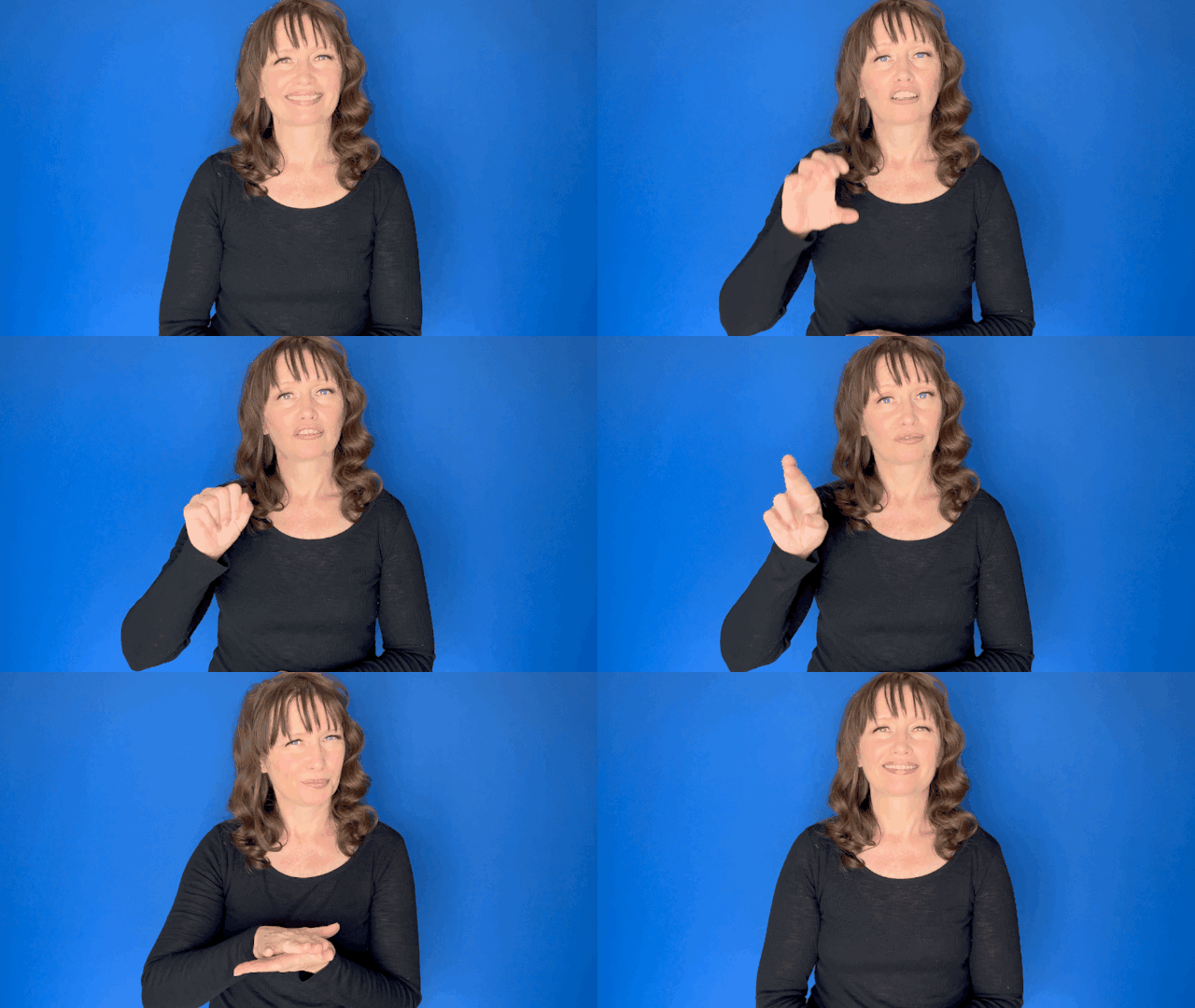
Sign for CHARTER SCHOOL in ASL

Practice Activities:
To begin practicing the sign for CHARTER SCHOOL in ASL, start by isolating each part of the phrase. Begin by fingerspelling “charter” slowly and clearly, focusing on accuracy of each letter. Then review the ASL sign for “school,” which involves both hands in flat “B” handshapes clapping together palm to palm with a slight bounce. Repeat both parts and then practice them together to combine for the complete phrase.
To build fluency, try signing the phrase in front of a mirror while saying the word silently to yourself. Add rhythm to your practice by signing along to a beat or timer. Challenge yourself to alternate between “public school,” “private school,” and the sign for CHARTER SCHOOL in ASL to reinforce the differences and reinforce transitions between terms.
Use the sign in context by creating sample sentences like “My cousin goes to a charter school,” or “Charter schools have different rules.” Sign these sentences while focusing on flow and facial expression. Try writing several new sentences using the vocabulary and practice signing them on your own.
Develop storytelling skills by imagining you’re introducing your school to someone in ASL. Describe its name, if it’s a charter school, and something about the school’s special programs. Use the sign for CHARTER SCHOOL in ASL naturally within your story. Record yourself and review to improve clarity and consistency.
Pair up with another learner for partner practice where one speaks a sentence and the other signs, especially focusing on switching roles. You can quiz each other with flashcards that include phrases like “open a charter school” or “charter school teacher.”
Finish your practice with a role-play where you’re giving a school tour or presenting school choices to parents. Use the sign for CHARTER SCHOOL in ASL multiple times and integrate related signs like teacher, student, education, and learning.
Cultural Context:
Understanding the sign for charter school in ASL is important for anyone navigating both Deaf culture and educational settings in the United States. Charter schools have grown in popularity over the past few decades, and knowing how to express this concept in American Sign Language helps promote inclusive communication in educational discussions.
The sign for charter school in ASL usually combines the sign for “charter,” which can vary based on region or context, with the standard sign for “school.” This reflects how ASL often incorporates visual representations of concepts or uses compound signs to express newer terms. Since charter schools are relatively recent additions to the education system, the sign may be adapted or fingerspelled in certain situations.
Charter schools are publicly funded but operate independently from traditional school districts. They often use innovative teaching methods or focus on specific academic goals. This distinction makes the sign for charter school in ASL especially helpful when discussing educational choices within the Deaf community.
In Deaf culture, education is not just about learning through textbooks or lectures—it’s deeply tied to access, inclusion, and the quality of communication. A signing-friendly environment is a major factor when families choose between charter schools and traditional public schools. Being able to express the sign for charter school in ASL clearly supports meaningful conversations between Deaf students, parents, and educators.
Some charter schools offer programs specifically tailored to Deaf or hard-of-hearing students. Knowing the sign for charter school in ASL can help those students advocate for themselves in meetings, classroom settings, and peer interactions. Representation through language plays a key role in fostering cultural pride and educational achievement.
As more Deaf educators and interpreters engage with different types of schools, including charter schools, having a consistent and recognized sign becomes important. The sign for charter school in ASL connects the Deaf community more strongly with broader discussions about educational policy, school funding, and curriculum choices.
Parents of Deaf children researching educational placements often want to know which schools best meet their child’s needs. When the sign for charter school in ASL is used confidently, it makes conversations across families and professionals clearer and more respectful. This also empowers families to make informed decisions based on both values and logistics.
Within Deaf education, the ongoing development of vocabulary to include modern concepts like charter schools is part of ASL’s rich and evolving identity. The sign for charter school in ASL captures the intersection of language, culture, and education in today’s world. With proper usage, it enhances communication and bridges gaps between Deaf and hearing communities.
Whether used in meetings, casual
Extended Definition:
The sign for charter school in ASL combines concepts related to independent education and school learning, reflecting how charter schools operate within the educational system. In American Sign Language, this sign often involves components that show the specialized and autonomous nature of a charter school compared to traditional public schools. The exact sign can vary by region or context, like many ASL signs, but the meaning remains centered around education governed by a charter rather than standard school board rules.
When signing the word charter, users typically modify signs for permit, license, or agreement to indicate the idea of a charter. It conveys that the school operates under a unique contract or set of guidelines. This is paired with the sign for school, which remains consistent with how school is typically signed in ASL – using open palms clapping together, representing the concept of learning and instruction .
Understanding the sign for charter school in ASL helps communicate more effectively about educational environments that offer different teaching styles or curriculums. Since charter schools often focus on innovation and specific academic outcomes, the sign used can reflect the sense of a customized and alternative educational path. This makes it easier for deaf and hard-of-hearing individuals to discuss school preferences and options.
In casual or conversational ASL, some signers may break up the phrase and sign ideas like independent and school, emphasizing the autonomy of the institution. It’s important to consider context, as some signs may be recognized through fingerspelling, especially for newer terms like charter school. This adaptation is common in ASL since language evolves alongside societal trends in education and culture.
Learning how to sign charter school in ASL opens up opportunities to navigate education-related conversations more clearly. Whether you’re a parent researching education choices, an educator connecting with students, or someone learning ASL, knowing this sign supports better communication. It ensures inclusivity in discussions about where and how students receive their education.
In interpreting or classroom settings, using the sign for charter school in ASL helps identify the type of school being referred to without confusion. This is especially helpful when comparing multiple forms of schooling like public, private, magnet, or home school. Accurate use of the sign helps provide clarity and context for deaf audiences.
Students attending charter schools who use ASL may also use this sign as part of their self-identification when explaining their education background. As the number of charter schools grows across the United States, the use and recognition of this sign are likely to increase as well. The importance of clear and accurate signs becomes essential
Synonyms: charter academy, independent public school, tuition-free public school, school of choice, publicly funded charter
Educational resources: Find related learning materials in our course bank!
Want more? Check out some of our popular learning activities on the homepage!
Need to look up a sign? Use our highly rated dictionary: https://aslinteractive.com/best-asl-dictionary/
Follow us on tiktok: https://www.tiktok.com/@aslinteractive. More social media links at the bottom of this page!
Long-tail Keywords: what is the sign for charter school in ASL, how do you sign charter school in ASL, ASL sign for charter school
Categories:
tags: charter school ASL sign, how to sign charter school in ASL, charter school meaning in ASL, American Sign Language charter school, learn charter school in ASL
Parameters
*Handshape*:
The Sign for CHARTER SCHOOL in ASL uses a combination of handshapes commonly found in ASL educational vocabulary. For the sign meaning “charter,” the dominant hand may take the form of an open flat hand ️ or modified C-hand, depending on the variation, as it represents a formal document or agreement. This transitions into the sign for “school,” which uses both hands in flat B-handshapes, clapping together twice.
When forming the Sign for CHARTER SCHOOL in ASL, it’s important to maintain clear, distinct handshapes throughout the compound sign. The transition between the two concepts—charter and school—should be fluid, using precise fingers and palm orientations to avoid ambiguity. Each part of the sign reflects key elements of the concept, making handshape clarity especially essential.
*Palm Orientation*:
For the sign for CHARTER SCHOOL in ASL, the palm orientation for CHARTER typically involves both hands in a modified “C” shape, with the dominant hand moving forward while palms face each other or slightly downward. When transitioning to SCHOOL, both flat hands face each other with palms clapping together, dominant hand on top and palms facing downward.
This palm positioning allows for a fluid representation of the sign for CHARTER SCHOOL in ASL. The orientation helps differentiate this term clearly while maintaining the natural flow of associated educational signs.
*Location*:
The sign for CHARTER SCHOOL in ASL is typically produced in the neutral space in front of the upper torso, where many educational-related signs are made. The sign for “charter” often involves a movement representing an agreement or document, performed near the chest area, while “school” is signed with both hands in front of the body at chest level, palms clapping together.
When signing the phrase, the components are done sequentially, keeping all parts of the sign within arm’s reach in front of the signer. The location supports clear visibility and fluidity for the sign for CHARTER SCHOOL in ASL, contributing to its effective communication in educational contexts.
*Movement*:
To sign the Sign for CHARTER SCHOOL in ASL, start by forming the sign for “charter” by using the sign for “contract” or “agreement”: bring both index fingers and thumbs together from each hand to mimic holding a document, then tap the fingertips together. This motion suggests a formal document or agreement.
Then sign “school” by clapping both flat hands together—dominant hand over non-dominant—twice in a small, quick motion. Combine both parts smoothly to show that the charter school is a specific kind of educational institution . The Sign for CHARTER SCHOOL in ASL emphasizes both the formal, approved nature of the school and the educational setting.
*Non-Manual Signals*:
When signing the Sign for CHARTER SCHOOL in ASL, maintain a neutral but focused facial expression, showing that this is an educational or institutional concept. Slight head nods can be used for emphasis, especially when transitioning between the concept of “charter” and “school.” Slight eyebrow raises might accompany the first part to indicate specificity or uniqueness.
Use steady eye contact and avoid exaggerated expressions, keeping your demeanor informative or instructional. The non-manual signals help reinforce that the Sign for CHARTER SCHOOL in ASL refers to a specific type of school with a distinct educational model.
*Prosody, Dominant/Non-Dominant Hand*:
The dominant hand usually forms the letter “C” for the sign for CHARTER SCHOOL in ASL, moving it downward along the non-dominant flat hand, palm facing sideways like drawing a line of demarcation. This movement can resemble establishing something official or designated.
After that, the sign for SCHOOL is added by clapping the palms together lightly, with the dominant hand tapping the non-dominant hand. The prosody reflects a formal and structured tone, aligning with the institutional nature of a charter school.
Tips for Beginners:
When learning the sign for CHARTER SCHOOL in ASL, one helpful strategy is to break the phrase into two parts: CHARTER (fingerspelled) and SCHOOL (signed). Start by practicing the fingerspelling for CHARTER slowly, focusing on each letter’s handshape and orientation. Make sure your hand remains steady and at shoulder height, so it’s easy for the viewer to follow. ️
Fingerspelling smoothly takes time, so don’t rush it. Some beginners tend to blur letters together, making the word difficult to understand. Common errors include misplaced fingers or signs moving too fast. To improve, practice in front of a mirror or record yourself to check for clarity and consistency. Use daily practice drills with other fingerspelled words to boost muscle memory.
After the fingerspelling part, move to the sign for SCHOOL, which involves clapping both open hands together palm-to-palm, with the dominant hand on top. Ensure the hands are flat, the motion is child-friendly, and the sign is not too forceful. A slap might come off too strong, while a too-soft motion could be confusing. Balance is key for clarity.
Pay attention to the transition from the fingerspelled word to the sign for SCHOOL. Many beginners forget to pause slightly before signing SCHOOL, which helps with comprehension. It’s also important that your facial expression stays neutral and focused to support clear communication during the entire sign for CHARTER SCHOOL in ASL.
Practice using the full sign in context—during storytelling, mock school situations, or educational discussions—to build fluency. Associating the sign with its meaning helps retention and real-world use. Always watch how fluent signers handle the sign for CHARTER SCHOOL in ASL, especially with pacing and handshape accuracy.
charter school in sign language, sign for education settings, asl sign for charter, fingerspell charter in asl, how to sign charter school in ASL, asl school vocabulary, school signs in american sign language, learn to sign charter school
Connections to Other topics:
The sign for CHARTER SCHOOL in ASL is closely connected to both the signs for SCHOOL and CONTRACT or AGREEMENT. Typically, this compound sign begins with the sign for CONTRACT—often involving a gesture mimicking writing on a surface followed by an agreement-style movement—paired with the standard sign for SCHOOL, which involves clapping both flat hands together. These combinations help reinforce the concept of a school created through a specific legal agreement or charter, differentiating it from traditional public or private schools.
This sign also links to broader educational vocabulary in ASL, such as PUBLIC SCHOOL, PRIVATE SCHOOL, HOME SCHOOL, and BOARDING SCHOOL. Each of these uses a base sign for SCHOOL but adapts it with a descriptive modifier or qualifier. This pattern is common in ASL, where a root concept is expanded by combining it with other descriptive signs, creating nuanced and accurate expressions. For learners, recognizing this structural method can significantly improve vocabulary building and comprehension.
Understanding the sign for CHARTER SCHOOL in ASL also opens the door to discussions about administrative and legal terms in education. Words like PERMIT, LICENSE, LAW, and INDEPENDENT are often integrated into conversations about charter schools and can be valuable vocabulary additions. Learners can extend this by practicing contextual phrases, such as “My child goes to a charter school” or “This program is part of a charter school system,” enhancing fluency and real-world application.
Compounding signs in ASL, like this one, encourages deeper understanding of how concepts are layered and how specificity is achieved. The sign for CHARTER SCHOOL in ASL demonstrates how ASL builds complex ideas through meaningful and logical combinations, a skill that supports learners across academic, professional, and everyday conversations .
Summary:
The sign for CHARTER SCHOOL in ASL is typically expressed using a compound structure. It starts with the sign for CHARTER, often fingerspelled C-H-A-R-T-E-R, followed immediately by the sign for SCHOOL, which is well-established in the ASL lexicon.
The sign SCHOOL is produced by clapping the dominant hand, palm down, against the non-dominant, palm up, in a quick, double motion that mimics the idea of bringing people or ideas together. This represents the educational setting common across many SCHOOL-type signs in ASL.
Since CHARTER is a specialized type of school, it often retains its fingerspelled form. Fingerspelling in ASL is a method used to incorporate loan words, proper names, or terms that do not have widely accepted lexical signs. For new or specific cultural concepts like CHARTER SCHOOL, fingerspelling maintains clarity across the Deaf community.
When combining the two signs, ASL users usually spell out C-H-A-R-T-E-R and transition smoothly into the SCHOOL sign. This combination provides a semantically clear and culturally accurate way to express the concept. For fluidity, proficient signers practice the pace and clarity of the transition between the fingerspelled CHARTER and the iconic SCHOOL.
The reason CHARTER remains fingerspelled ties back to linguistic economy and the ASL community’s evolving consensus. Until a single iconic sign for CHARTER emerges, fingerspelling maintains uniformity and comprehension.
In ASL grammar, this compound aligns with noun-noun compound structures. These are common in constructs like ELEMENTARY SCHOOL, HIGH SCHOOL, and MEDICAL SCHOOL, where a modifier precedes the general concept of SCHOOL.
Linguistically, fingerspelling serves a key role in ASL, filling lexical gaps. The sign for CHARTER SCHOOL in ASL is a good illustration of how ASL accommodates new concepts by blending spelling with established signs.
Fingerspelling functions within ASL’s broader linguistic system and tends to appear more frequently with newer or English-specific terms. CHARTER fits into this category given that CHARTER SCHOOLS are a relatively modern development in American education.
Signers adapt to fingerspelling by mouth morphemes and appropriate pacing. Often, the signer may accompany the fingerspelled CHARTER with silent mouthing of the English term, reinforcing its identity within an academic context.
Mouthing during fingerspelling is an application of multimodal expression in ASL. It aligns visual and oral cues, and while not required, many in the Deaf community use it to parallel the spoken language for clarity.
In an educational or professional setting, accuracy is particularly important. The sign for CHARTER SCHOOL in ASL may also include contextual clues, like topic markers, facial expressions, or association with signs for PUBLIC SCHOOL or PRIVATE.
The cultural context of CHARTER SCHOOL is relevant since the system challenges traditional public education norms. Deaf and hard-of-hearing students in CHARTER SCHOOLS experience unique benefits, such as curriculum flexibility and Deaf-led instructional design.
Thus, the sign for CHARTER SCHOOL in ASL not only conveys literal meaning but also serves as a window into evolving educational philosophies. Within Deaf culture, the ability to differentiate between types of schooling through sign supports critical dialogue about access and inclusion.
Some signers might also include the sign for DIFFERENT or SPECIFIC before or after SCHOOL to emphasize the alternative nature of CHARTER SCHOOLS. This elaboration underlines meaning when the audience may be unfamiliar with the concept.
From an applied linguistics standpoint, the use of fingerspelled CHARTER demonstrates lexical borrowing. It’s an example of interlingual influence, where ASL incorporates English terminology to enrich its own lexicon.
Borrowed vocabulary like CHARTER represents a dynamic aspect of ASL evolution. It reflects how language communities innovate ways to express new social constructs while maintaining grammatical integrity.
When teaching the sign for CHARTER SCHOOL in ASL, educators often scaffold the concept to ensure full comprehension. Introducing the individual components first, followed by the compound usage, aligns with both ASL acquisition strategies and cognitive load theory.
The sign thus becomes a teaching gateway into other education-related vocabulary. From CHARTER SCHOOL, learners can explore AFFIRMATIVE ACTION, TUITION, ACCREDITATION, or even terms like CURRICULUM or SELF-PACED, all of which may be fingerspelled or signed based on community consensus.
Different regional variants might exist. In areas with higher concentrations of CHARTER SCHOOLS or Deaf CHARTER SCHOOLS, a shortened or initialized sign for CHARTER may emerge over time, representing a case of language variation and innovation.
If an initialized sign eventually arises, like modifying the SCHOOL sign with a ‘C’ handshape, it will need wide community adoption and context-sensitive usage to replace the standard fingerspelled form. This transition should be
Want more? Check out some of our popular learning activities!
ASL Interactive Resources
ASLInteractive YouTube Channel
Follow us on tiktok: @aslinteractive.com
Follow us on Instagram: aslinteractive
Facebook page: aslinteractive
Facebook group: aslinteractive
LInkedIn: ASL Interactive LLC
Twitter: @ASL_interactive
*Some information on this page is AI-generated. AI can make mistakes. Please check the information.


Responses