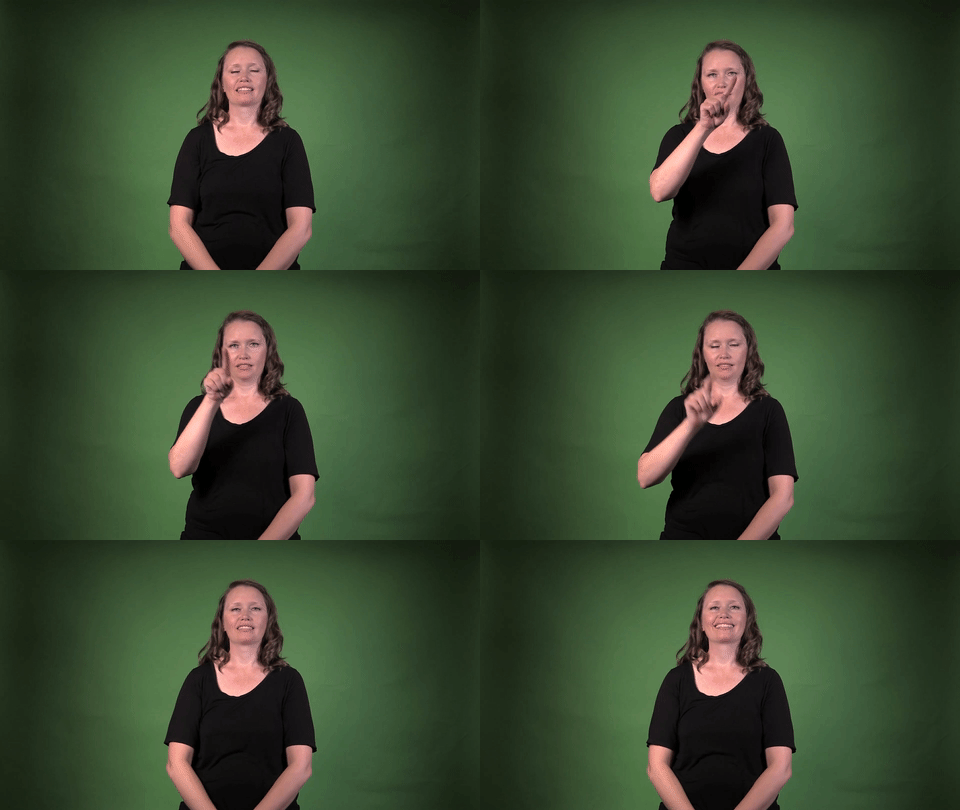
Definition: A symbol indicating verification.
Sign for CHECKMARK in ASL

Practice Activities:
To build fluency with the sign for CHECKMARK in ASL, start by practicing the sign in front of a mirror. Focus on accuracy and clarity of movement. Repeat it multiple times, first slowly, then at a natural conversational pace. Say the English word in your head or out loud as you sign it to build a brain connection between spoken and signed language.
Once you are comfortable signing it in isolation, begin using the sign for CHECKMARK in ASL within short phrases. Sign simple sentences like “I finished, checkmark” or “Put a checkmark here.” Try creating daily checklists and signing each item with its corresponding completion using the checkmark sign.
Engage in storytelling activities where a character completes tasks or reaches goals. For example, make up a narrative like, “Jamie studied for the test, checkmark. Jamie cleaned the room, checkmark. Now Jamie can relax.” Use the sign for CHECKMARK in ASL each time a task is completed. Add facial expressions to match the satisfaction or excitement of getting things done.
Partner activities are another great way to reinforce this concept. Create to-do lists with a partner and take turns signing them while using the checkmark sign for each item completed. You can also quiz each other: your partner signs a task, and you respond with the appropriate signed reaction, including the checkmark as a visual indicator of success.
For a fun game, label objects around the room with picture labels and check them off using the sign once named correctly in ASL. This supports both vocabulary expansion and mastery of the checkmark concept.
Use emojis ✅ in written practice or flashcards to make it more visually engaging. Associating the visual checkmark with the ASL sign builds recall across multiple modalities. Mixing visual, tactile, and expressive methods deepens overall retention.
Cultural Context:
In American Sign Language (ASL), cultural context plays an important role in how certain concepts are interpreted. The sign for checkmark in ASL is one such example that blends visual understanding with everyday usage in the Deaf community. Since a checkmark is commonly used to indicate correctness, completion, or agreement, understanding when and how to use the sign for checkmark in ASL is key for smooth communication.
The Deaf community often uses visual symbols naturally as part of expression. The checkmark is universally recognized in written and visual forms, so the sign for checkmark in ASL adapts well within daily interactions. It may be seen in educational environments, workplaces, or personal task lists, just like it is in the hearing world.
In classroom settings, Deaf students and teachers might regularly use the sign for checkmark in ASL to signify that something is done correctly ✅. Teachers grading assignments or giving instructions can use the sign to provide quick feedback. This builds efficient communication without needing extra explanation, which is essential in visual language settings.
Outside of education, the sign for checkmark in ASL also appears in informal and formal conversations. For example, when someone finishes a task, others might sign checkmark as a way to show approval or acknowledgment. It’s a great example of how ASL borrows visual metaphor from the hearing world while still adapting it to signed conversations.
Another important cultural point is how Deaf signers modify signs based on context. The sign for checkmark in ASL could change slightly in pace or intensity depending on whether it’s showing approval or confirming a list item. Because ASL is expressive and spatial, the sign often reflects emotional tone, not just the literal idea of a marked check.
Technology and accessibility have also played a role in how the sign for checkmark in ASL is used today. With the expansion of digital learning tools, Deaf users are more likely to see visual icons like checkmarks on screens. Signing the checkmark has become natural when referencing app notifications, task completion, or even approval on social media.
Cultural familiarity with concepts from both Deaf and hearing worlds adds richness to signs like the one for checkmark. Kids growing up in Deaf households may begin seeing and signing checkmark from a young age, especially during early education. This common gesture supports their visual learning and becomes integrated into everyday signing.
In group discussions or meetings among Deaf individuals, the sign for checkmark in ASL may be used to show consensus quickly. Rather than interrupting the flow of ideas,
Extended Definition:
The sign for checkmark in ASL refers to the gesture used in American Sign Language to represent the visual symbol of a checkmark ✅. This symbol is commonly used to indicate that something is correct, completed, or verified. In ASL, the sign for checkmark visually mimics the shape or concept of placing a mark that signifies approval or confirmation.
To produce the sign for checkmark in ASL, signers often use their dominant hand to trace a small check-like motion in the air, usually starting from the upper left and moving downward to the right, following the motion of a traditional checkmark. This gesture may differ slightly depending on the signer or regional variation, but the overall idea remains the same. The movement emphasizes the action of marking or completing a task, making it a highly visual and intuitive sign.
The sign is typically used in educational or professional settings where marking correct answers or completed tasks is common. For example, a teacher might use the sign for checkmark in ASL to indicate that a student answered correctly. In work environments, it can be used in project meetings to show that an item on the task list is done. The clarity of the sign makes it useful in any context where visual check-ins or confirmations are needed.
The concept of a checkmark is deeply tied to validation and success. By using the sign for checkmark in ASL, Deaf and hard-of-hearing individuals can easily express approval or completed actions during conversations. It provides an efficient and culturally appropriate way to communicate progress or correctness without needing to write it out or point to physical checkmarks.
When learning this ASL vocabulary word, it helps to think about the function of a checkmark in daily life. Whether it’s a checklist, a test marked by a teacher, or online submissions, the checkmark plays a vital role in indicating completion and success. Translating this idea into a visual sign makes it accessible for communication in a variety of situations.
The sign for checkmark in ASL can also be paired with other ASL signs to form phrases and sentences, like signing checkmark next to complete, all done, or correct to provide context. This gives signers the flexibility to express more detailed messages while emphasizing the meaning of confirmation or approval. It’s especially useful in interactive settings like video calls, classrooms, or remote work meetings.
In addition to educational and workplace use, this sign might appear in social contexts. If someone completes a challenge, receives good news, or finishes a task, another
Synonyms: check, tick, checkbox, mark, verified
Educational resources: Find related learning materials in our course bank!
Want more? Check out some of our popular learning activities on the homepage!
Need to look up a sign? Use our highly rated dictionary: https://aslinteractive.com/best-asl-dictionary/
Follow us on tiktok: https://www.tiktok.com/@aslinteractive. More social media links at the bottom of this page!
Long-tail Keywords: What is the ASL sign for checkmark, How do you sign checkmark in ASL, ASL sign for checkmark
Categories:
tags: checkmark in American Sign Language, how to sign checkmark in ASL, ASL sign for checkmark, checkmark gesture in sign language, learn ASL checkmark sign
Parameters
*Handshape*:
The handshape used in the sign for CHECKMARK in ASL typically involves the dominant hand forming the “L” handshape, with the thumb and index finger extended. The thumb remains stationary while the index finger traces a quick, curved checkmark motion in the air ✅. This distinct curved path mimics the shape of a written checkmark.
This handshape and movement combination is crucial for visually representing the sign for CHECKMARK in ASL. It’s especially clear when used in educational or approval-related contexts.
*Palm Orientation*:
The palm orientation for the sign for CHECKMARK in ASL typically involves the dominant hand in a flat “B” shape or extended index finger, oriented palm down or slightly turned inward depending on stylistic variation. The hand then makes a quick motion resembling writing or drawing a checkmark on an invisible surface.
When using the sign for CHECKMARK in ASL, the fingertips often face downward and glide across the palm of the non-dominant hand or in the air. This mimics the visual appearance of marking or confirming something, reinforcing the meaning of the sign.
*Location*:
The sign for CHECKMARK in ASL is typically produced in the neutral space in front of the chest, slightly off to the dominant side. The hand begins near the center of the body and moves outward in a check shape, resembling the motion of writing a checkmark.
While the exact size and position may vary slightly based on individual style, the location remains mostly consistent in mid-air, not touching the body. The sign for CHECKMARK in ASL stays within the comfortable reach zone just in front of the torso.
*Movement*:
The sign for checkmark in ASL uses the dominant hand in an index finger shape, mimicking the motion of drawing a checkmark in the air. Start slightly above and to the left, then move diagonally down to the right before curving up and to the right again, creating a “✓” shape.
The sign for checkmark in ASL closely resembles writing or verifying something. It is typically done near the palm or in front of the body, depending on context. This sign may also be paired with facial expressions to indicate approval or correctness .
*Non-Manual Signals*:
The non-manual signals for the sign for CHECKMARK in ASL typically include a focused gaze and slight head nod to indicate affirmation or confirmation . This expression helps emphasize the intended meaning of approval or verification associated with a checkmark.
When using the sign for CHECKMARK in ASL, the signer may show certainty or satisfaction through a confident facial expression. The overall demeanor reflects agreement, reinforcing the positive and affirmative nature of the sign.
*Prosody, Dominant/Non-Dominant Hand*:
The sign for checkmark in ASL typically uses the dominant hand in a modified “V” or index finger shape to mimic the motion of drawing a checkmark. The non-dominant hand is usually inactive or neutral at the side.
To perform the sign for checkmark in ASL, the dominant hand starts at the top left and moves diagonally down to the right, then sharply upward to create the visual shape of a checkmark ✅. This visual representation conveys the concept clearly without needing support from the non-dominant hand.
Tips for Beginners:
When learning the sign for CHECKMARK in ASL, it’s important to remember that this sign is often mimicked by drawing a checkmark shape in the air with your dominant hand. Using your index finger as if you’re holding a pen, trace a small checkmark in front of you. This is a conceptual sign and might not be used in every context, so be sure to familiarize yourself with fingerspelling the word CHECKMARK when needed for clarity.
A particularly helpful tip for beginners is to practice the shape of the checkmark in the correct direction: typically starting from the top left down to the bottom right, then up to the upper right. Keep your movement smooth and deliberate, but not exaggerated. Doing the sign too large or quickly can lead to confusion in fast-paced conversations.
One common beginner mistake is over-rotating or twisting the wrist while making the sign. Remember to stay relaxed and let your finger lead the movement with minimal wrist action. Check your positioning in a mirror or record yourself—visual feedback is essential as you develop muscle memory for the sign for CHECKMARK in ASL.
Another useful strategy is to incorporate the sign while signing sentences, such as when indicating approval or checking off items in visual storytelling. Combine it with related deaf-friendly concepts like LIST, FINISH, or RIGHT to practice fluid phrasing and get comfortable with everyday usage.
Little adjustments make a big difference, so pay attention to handshapes and spacing. If you’re not sure your movement is clear, don’t hesitate to ask a fluent signer or teacher for feedback. Consistent small practice sessions, rather than long occasional ones, are most effective for retaining the sign for CHECKMARK in ASL and using it confidently in real-world situations. Keep practicing and enjoy the process ✔️
Connections to Other topics:
The sign for CHECKMARK in ASL is often associated with visual confirmation concepts, making it closely related to signs like CORRECT, RIGHT, or COMPLETE. These signs convey approval or acknowledgment, and they use similar handshapes or directional movements. When learners understand the sign for CHECKMARK in ASL, they also gain insight into how ASL conveys ideas of validation and completion.
This sign can also connect to educational or task-related vocabulary such as TEST, GRADE, or HOMEWORK. In classroom settings, the sign for CHECKMARK in ASL might be used to indicate that an assignment is correct or has been reviewed. It acts as a visual metaphor for accomplishment, allowing deaf and hard-of-hearing students or professionals to mark success.
Another useful connection involves the sign FINISH which can sometimes be used in combination to indicate a task is both done and approved. For example, in workplace meetings or team check-ins, one might sign TASK FINISH ✔️ to show that a specific goal has been met and validated. This layered use enriches language fluency and teaches learners how to express tasks and progress effectively.
Additionally, the sign ties in with digital vocabulary like EMAIL, FILE, or DOCUMENT when indicating that a form has been submitted or an online checkbox has been selected. In tech-based conversations, the sign for CHECKMARK in ASL becomes useful for navigating systems and stating user actions clearly.
Signs with similar visual features, such as DRAW or WRITE, also help learners understand how ASL uses space and visual symbols to symbolize abstract concepts. Since the checkmark icon is an abstract symbol, interpreting it through a visual language like ASL highlights the importance of spatial awareness and iconic representation.
Understanding the sign for CHECKMARK in ASL enhances competence with feedback loops and decision-making vocabulary. It links to affirmations like YES and support signs like SUPPORT or AGREE, which are vital in collaborative settings. These associations deepen meaning and provide practical value in daily communication.
Summary:
The sign for CHECKMARK in ASL does not carry a universally standardized version across all contexts, but it draws heavily on visual representation. Most often, signers utilize a classifier movement or draw a check shape in the air with the index finger or a closed 5-hand. This mirrors how a checkmark is typically written on paper ✅.
Depending on context, the sign for CHECKMARK in ASL can be adapted to show approval, validation, or completion. These pragmatic functions often influence how signers conceptualize and produce the sign. As there’s no single lexicalized form, the principle of iconicity plays a crucial role here.
In visual-gestural languages like ASL, iconic signs are those that closely resemble what they represent. Because a checkmark is already a highly stylized mark symbolizing correctness, it translates easily via mimetic gestures. For example, the sign might mimic the traced action of writing a check on a form or list.
Some signers use the index finger to draw the check shape downward and upward in the air with a swift motion. The movement reinforces a mental association with assessment and confirmation. These types of classifiers—frequently called “depictive classifiers”—let the signer use the handshape to represent visual features of the object or action.
In educational or testing contexts, the sign for CHECKMARK in ASL may be paired with signs like RIGHT, CORRECT, or FINISH. This allows for a tight semantic cluster that emphasizes approval and completion of tasks. Signers might also modify the expression to emphasize positivity or correctness when marking answers.
For digital or graphic design references, some signers will visually trace a gesture in the air toward a screen or document. Others will couple the movement with a focused look to build specificity into the referent. Eye gaze integration in ASL is crucial in indicating where action happens or what is being affected.
Linguistically, the sign for CHECKMARK in ASL engages spatial reference strongly. The starting point and endpoint of the tracing gesture establish the vector of action, similar to pointing (deixis) or agreement verbs. The spatial awareness introduces a grammar that rewards placement, movement, and orientation as modifiers.
In ASL grammar, it’s significant that signs can function either lexically or in classifier-based expressions. The sign for CHECKMARK in ASL tends to occur more within classifier or constructed action frameworks than as an atomic, fixed sign. This flexibility allows it to work fluidly across classroom, workplace, bureaucratic, and casual settings.
Grammatically, the sign is not typically used as a subject or object per se but rather as an adjectival or adverbial nuance—a sign that modifies or completes another concept. For instance, after signing the word ANSWER, one may sign CHECKMARK to express that the answer is correct. Thus, it aligns with common usage where the checkmark conceptually marks correctness.
In comparing signs like X or CROSS-OUT, the sign for CHECKMARK in ASL gains more depth in opposition. Where an X denotes wrong, the checkmark affirms righteousness or acceptance. The duality reinforces the broader narrative structuring of approved versus disapproved in ASL discourse.
In educational environments, the use of gestures that align with the sign for CHECKMARK in ASL can help reinforce comprehension for deaf students. Instructors often note that such referencing signs provide semantic scaffolding. They give visual cues that reinforce abstract approval without needing additional explanation.
In Deaf culture, symbolism operates deeply through visual representation. The idea of a checkmark carries associative meaning beyond its written form—invoking feelings of success, validation, and authority. When used by Deaf professionals or educators, these gestures mirror structural frameworks often seen in mainstream society but adapted into visual norms.
Cultural resonance for checkmarks also intersects with bureaucratic procedures—forms, approvals, checklists. The sign for CHECKMARK in ASL may be used symbolically in narrative storytelling to capture moments of official success or ironic contrast. A visual tick in an invisible box signals something deeper: validation through recognition.
Non-manual signals like head nodding, facial affirmation, and eye focus amplify the meaning of the sign. A plain sweeping check shape can mean different things when coupled with different facial expressions. Smiling while performing it may reinforce positivity; a neutral face may connote repetition or matter-of-fact action.
From a sociolinguistic standpoint, the versatility of the sign for CHECKMARK in ASL reflects the fluid nature of emerging signs. It’s typical for newer signs—especially those paralleling written forms—to be more iconically driven before becoming standardized across Deaf communities. Therefore, this sign sits on the edge of conventionalization.
The clarity of the sign also benefits from comparison to similar gestural customs in other signed languages. International sign or other national signed languages like British Sign Language (BSL) also rely on tracing or offline mimicry to denote check-like ideas. This shows how visual communication strategies adapt universally for common symbols.
In discourse structure
Want more? Check out some of our popular learning activities!
ASL Interactive Resources
ASLInteractive YouTube Channel
Follow us on tiktok: @aslinteractive.com
Follow us on Instagram: aslinteractive
Facebook page: aslinteractive
Facebook group: aslinteractive
LInkedIn: ASL Interactive LLC
Twitter: @ASL_interactive
*Some information on this page is AI-generated. AI can make mistakes. Please check the information.


Responses