Sign for CHEERFUL in ASL | 😃 ASL Dictionary

Definition: Full of cheer.

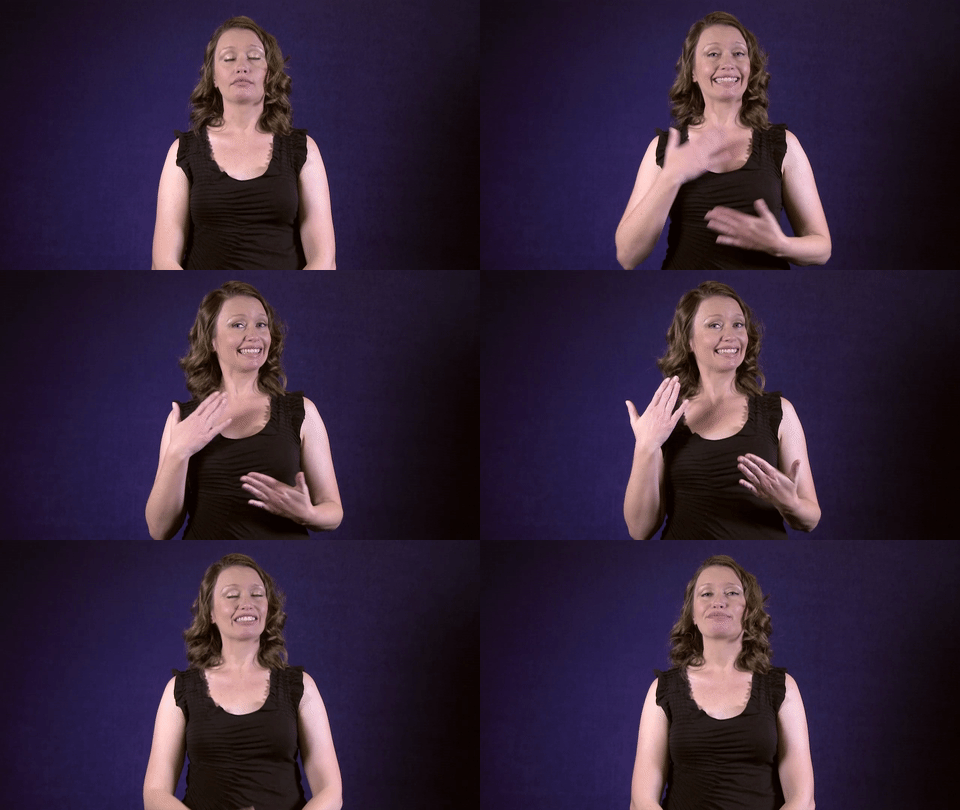
Sign for CHEERFUL in ASL

YouTube player

Practice Activities:

To practice the sign for CHEERFUL in ASL, start by signing it in front of a mirror. Focus on keeping your non-manual signals (NMS) like facial expressions bright and positive, because they enhance the overall tone of the sign. Repeat the sign multiple times while smiling to reinforce the emotional quality it conveys.

Next, try using the sign for CHEERFUL in ASL in several short phrases like “I feel cheerful today” or “She is always cheerful.” Practice slowly at first, then increase speed as your comfort improves. Record yourself signing to analyze how clearly the movement and expression match the meaning.

A helpful activity is to describe cheerful situations. For example, imagine getting a good grade or seeing an old friend. Use simple ASL sentences like “I saw my dog—cheerful!” or “My mom made cookies—I was cheerful!” This will build your vocabulary while reinforcing the emotional tone that comes with the sign.

Act out mini skits with a partner. One person can act out a cheerful scenario, such as finding a lost item, while the other describes it in ASL using the sign for CHEERFUL in ASL in context. This type of interactive storytelling strengthens vocabulary recall and expression.

Give yourself storytelling prompts like “My best birthday” or “A surprise party.” Use at least three sentences that incorporate the sign naturally. You could say something like, “I saw balloons—I felt cheerful,” or “My friends sang to me—I was so cheerful.” Telling emotional stories strengthens your connection to the sign.

Finally, create daily journaling videos using ASL. Each day, sign a sentence about how you felt using the sign for CHEERFUL in ASL. Over time, this enhances fluency and emotional expression through consistent practice. Emoji reactions like and can help visualize the feeling alongside your sign use.

Cultural Context:

In American Sign Language, expressing emotions through facial expressions and body language is just as important as using hand signs. The sign for cheerful in ASL reflects this cultural value, portraying not just the word but the feeling behind it. Deaf culture places strong emphasis on visual communication, so a sign like cheerful in ASL is more than a hand movement—it shows a connection to mood and energy.

When using the sign for cheerful in ASL, signers usually pair the hand movements with a bright, smiling expression . This adds meaning and shows that the emotion is genuine. Without the facial expression, the message might not come across as truly cheerful. In ASL, visual tone is essential, and it supports the literal meaning delivered by the hands.

Social interaction in Deaf communities is often lively and expressive, making signs for emotions, like cheerful, commonly used. In conversations, stories, or jokes, people frequently express happiness and positivity. Using the sign for cheerful in ASL helps those in the community bond and connect during social events, storytelling, or daily exchanges.

Deaf culture also values authenticity and directness. When someone uses the sign for cheerful in ASL, it’s expected to be sincere. Exaggerated or fake expressions can be seen as misleading. This is why proper use of this sign includes an appropriate emotional tone, not just correct hand placement.

Children learning ASL early are taught to connect emotion with signs. The sign for cheerful in ASL is one of the early signs introduced when teaching feelings and emotions. It helps both Deaf and hearing children become emotionally expressive and confident when communicating.

During ASL storytelling or performances, the sign for cheerful in ASL is used to represent characters or moments filled with happiness and joy. Storytelling is an important cultural practice for teaching lessons, sharing history, or entertaining. So this sign often plays a role in conveying mood, enriching communication beyond spoken or written language.

Many Deaf events or gatherings, from festivals to casual meetups, include expressions of joy. Being able to use the sign for cheerful in ASL helps participants fully engage in the shared experience. It represents more than just a word—it reflects a cultural value centered around emotional openness.

Deaf artists and performers frequently incorporate signs like cheerful in ASL into their creative work to emotionally connect with their audience. Whether through ASL poetry, visual vernacular, or performance art, this sign conveys energy and positivity. It’s a reminder of how ASL blends form and feeling.

The sign for cheerful in ASL

Extended Definition:

The sign for cheerful in ASL expresses a positive and lighthearted emotion. It is commonly used to show happiness, joy, or an upbeat attitude in daily conversations. This sign is frequently taught to ASL learners because it’s used often and reflects an important emotional state.

To make the sign for cheerful in ASL, both hands are typically used in a circular motion near the chest or shoulders, palms facing inward. The motion and facial expression are key. A bright smile or an enthusiastic display will help reinforce the meaning of the sign.

Facial expression plays a powerful role in ASL since it enhances emotional clarity. When signing cheerful in ASL, it’s important to let your face match the tone. A dull or neutral look won’t give the full feeling of the word you’re trying to express.

The sign for cheerful in ASL may vary slightly based on regional dialects or personal signing style, but the concept remains clearly understood. It can be used when talking about moods, personalities, or specific moments that bring happiness. For example, someone might describe a cheerful child or recall a cheerful memory.

In daily interactions, this sign helps share emotional well-being with others. It can lift conversations when someone asks how you feel or describe how someone else is acting. When used with other signs, cheerful can add depth to your storytelling or expressions.

This sign is often introduced in beginner ASL classes because it helps learners practice movements, facial expressions, and incorporates emotional vocabulary. Teachers may pair it with signs like happy, excited, or friendly to build an emotional vocabulary set. Using the sign for cheerful in ASL adds color and positive energy to your signing practice.

The sign is not usually confused with other happy-related signs because of its distinct circular hand motion and placement. However, practicing it in context will help distinguish it from signs such as happy or excited. This helps build clearer signing comprehension and expressive accuracy.

The sign for cheerful in ASL also connects well with cultural values in Deaf communities, where facial expressions and clear emotional signing are both respected and encouraged. Using this sign fluently can make your conversations more engaging and emotionally rich.

If you want to describe someone as always cheerful, this sign becomes even more useful. Pair it with time indicators or descriptive words to expand your conversation. It can also be used when giving compliments or describing someone’s attitude.

Learning the sign for cheerful in ASL not only improves your vocabulary but also expands your emotional awareness in sign language. Whether you’re learning ASL for personal use,

Synonyms: happy, joyful, upbeat, merry, lighthearted

Educational resources: Find related learning materials in our course bank!

Want more? Check out some of our popular learning activities on the homepage!

Need to look up a sign? Use our highly rated dictionary: https://aslinteractive.com/best-asl-dictionary/

Follow us on tiktok: https://www.tiktok.com/@aslinteractive. More social media links at the bottom of this page!

Long-tail Keywords: what is the sign for cheerful in asl, how do you sign cheerful in asl, asl sign for cheerful

Categories:

tags: Telling how one is, Emotions, Activities, Farewells and greetings, Responses

Parameters

*Handshape*:

The handshape for the sign for CHEERFUL in ASL uses open, relaxed hands with fingers spread slightly apart. Both hands begin near the chest with palms facing the body.

As the sign is made, the hands move in circular or upward motions, expressing lightness and joy. This open handshape and motion reflect the uplifting feeling conveyed by the sign for CHEERFUL in ASL .

*Palm Orientation*:

The palm orientation for the sign for CHEERFUL in ASL typically involves both hands with palms facing inward toward the chest. The fingers are spread slightly and the hands move in small circular motions upward on the chest area.

This movement and orientation helps convey a light, uplifting feeling associated with being cheerful . When performing the sign for CHEERFUL in ASL, maintaining relaxed hands and inward-facing palms is essential to properly express the emotion.

*Location*:

The sign for CHEERFUL in ASL is produced in the area slightly above the chest and below the chin, in front of the torso. Both hands move in small, upward circular motions away from the body, typically starting about mid-torso.

When signing the word visually, the location emphasizes a bright, uplifting expression to match the sentiment. The placement allows clear visibility, helping convey positive emotion through the sign for CHEERFUL in ASL.

*Movement*:

To produce the sign for cheerful in ASL, use both open hands with fingers spread slightly apart. Place the hands near the chest or upper torso, palms facing your body. In a circular or upward bouncing motion, move the hands upward and slightly forward, as if showing joy emanating from the chest.

Repeat the motion a couple of times to emphasize the feeling. The sign for cheerful in ASL reflects a joyful or happy disposition through expressive movement and facial expression .

*Non-Manual Signals*:

When doing the sign for cheerful in ASL, the non-manual signals play a key role in conveying positivity and warmth. A bright, genuine smile is essential to show cheerfulness.

Eyebrows should be raised slightly, and eyes can have a soft squint to reflect happy emotions. The face should remain relaxed and expressive to enhance the meaning of the sign for cheerful in ASL . Avoid neutral or flat expressions, as they can change the meaning entirely.

*Prosody, Dominant/Non-Dominant Hand*:

The sign for cheerful in ASL uses both hands to show a joyful expression. The dominant hand is open and fingers spread, circling outward near the chest in a small upward motion, while the non-dominant hand mirrors or remains steady depending on individual variation.

Facial expressions play a key role in conveying the emotion behind the sign for cheerful in ASL, often including a broad smile and bright eyes. Both hands should maintain a fluid and light movement to reflect a happy and cheerful demeanor.

Tips for Beginners:

When learning the sign for CHEERFUL in ASL, it’s important to focus on using broad, open-handed circular motions near the chest with a bright facial expression. A common error beginners make is using too small or too sharp of a movement, which can distort the meaning. Maintaining a joyful facial expression is just as important as the hand movement since emotional signs in ASL rely on facial grammar.

The sign for CHEERFUL in ASL uses two open hands facing inward and circling upward on the chest area, simulating a warm, happy feeling radiating outward. Beginners might mistakenly keep their hands too rigid or move them too fast, which can appear aggressive rather than joyful. Slow, intentional motions paired with a smile can help convey the full intent of the sign.

One great way to practice the sign for CHEERFUL in ASL is to stand in front of a mirror and ensure your body language matches the meaning. Ask yourself, “Do I look cheerful?” This reflective technique helps align your face and hands to express the correct emotion. Also, watching fluent signers and mimicking their pacing and energy can help improve overall clarity.

Paying attention to natural pauses in conversation where this sign fits can also be valuable. The sign for CHEERFUL in ASL is often used when describing moods, reactions to positive experiences, or when you want to uplift someone. Practicing it in context will help you internalize the movement and expression better than repetition alone.

Lastly, don’t forget to relax your hands and shoulders. Tension can make the sign appear forced or unnatural. If you’re feeling unsure, slow down the sign and exaggerate the movements slightly until you gain confidence. The more relaxed and expressive you are, the more accurate and clear your signing will be.

Connections to Other topics:

The sign for CHEERFUL in ASL is closely related to a family of signs that convey positivity and emotion, such as HAPPY, JOYFUL, and EXCITED. These emotion-based signs often feature upward circular motions near the chest or face, which aligns with how emotions are often expressed physically. Understanding these related signs builds a better mental framework for recognizing nuanced emotional expressions in ASL conversations.

In everyday signing, the sign for CHEERFUL in ASL can be used as part of compound signs or incorporated into visual storytelling to enhance emotional tone. For example, pairing it with the sign for PERSON can give a sense of describing someone as a cheerful person . This form of compounding helps add detail and enrich descriptions, a key element in more advanced ASL communication.

ASL frequently combines expressive facial grammar with signs like CHEERFUL to clarify intensity or context. For instance, exaggerating facial expression while signing can indicate someone is very cheerful or only slightly. This aspect ties into ASL’s reliance on non-manual signals for meaning, a central topic in understanding fluent signing and narrative flow.

The sign for CHEERFUL in ASL also connects to mood-based classifiers and pronoun references. In storytelling or qualifying statements, users may reference back to a previously mentioned individual and renew the description with CHEERFUL, forming a cohesive narrative. This ties in closely with topics like role-shifting and indexing, both core practices in natural ASL discourse.

Additionally, this sign is useful in expressing states of being and mental health status, bridging discussions around emotional wellness or social behaviors. When used in conjunction with signs like FEEL or BEHAVIOR, learners can form expressions like “feel cheerful” or comment on another’s cheerful attitude, supporting ASL fluency through descriptive depth .

Summary:

The sign for CHEERFUL in ASL expresses a positive emotional state that combines element of joy, brightness, and inner contentment. This sign is deeply rooted in facial expression as well as hand movement, emphasizing the integration of physical and emotional language within ASL.

To produce the sign for CHEERFUL in ASL, start with both hands in open-5 handshapes facing the torso near the chest area. The fingers are relaxed and slightly curved, and then the hands move in small, upward circular motions, going away from the body slightly.

The motion should be light, almost bouncing, illuminating the connection to happiness or cheerfulness. Facial expression is crucial—eyes slightly squinted, eyebrows raised, and a genuine smile enhance the clarity and intention of the sign. Without the matching facial joyful expression, the message can look incomplete or be misunderstood.

The sign for CHEERFUL in ASL differs from signs like HAPPY or JOYFUL, though they may look similar and seem interchangeable to non-signers. ASL has subtle variations in facial grammar and motion to reflect nuances. CHEERFUL leans more towards a bubbly disposition, often sustained, while HAPPY may be more reactive or momentary.

Context matters greatly. The sign for CHEERFUL in ASL is often used to describe a general mood or personality trait. You might sign it when describing someone’s usual demeanor, as in “She is always cheerful,” rather than a temporary mood like “He is happy now.”

Linguistically, the sign reflects ASL’s use of spatial referencing and affective cues built within the language. It is both a production and reception challenge because it requires knowledge of emotional contouring, not just hand placement.

Culturally, being cheerful is viewed with appreciation in most communities, but in Deaf culture, being open and visually expressive holds high value. Demonstrating cheerfulness visually, through signs, facial behavior, and body language, is consistent with the cultural norm of being direct and expressive.

Children learning the sign for CHEERFUL in ASL often explore the concept simultaneously with emotional intelligence. Teachers often use this sign in classrooms to encourage group morale and promote emotional vocabulary development. It is sometimes taught alongside emotion words like KIND, FUNNY, or NICE to build emotional fluency.

Grammatically, the sign for CHEERFUL in ASL functions as an adjective. It typically follows ASL syntax and can come after a noun or pronoun when describing a subject, for example, “MY BROTHER CHEERFUL.” It does not require copulas such as “is” in English since ASL syntax operates without those linking verbs.

Like many emotion-based signs, CHEERFUL cannot be accurately understood if signed without facial expression. This is a prime example of non-manual signals in ASL, which complement the grammar and emotional tone of a signed message.

In storytelling, the sign for CHEERFUL in ASL can be used as part of character depiction. ASL narratives heavily rely on affective expression, so describing a character in literature or a story as cheerful involves signing with tones of playfulness and positive energy. Storytellers exaggerate the rhythm and expression in this sign to draw visible imagery for the audience.

The sign is slightly regional, though generally standardized among most users of ASL. Some dialectal variation appears in the speed or intensity of the movement—slower for calm cheerfulness, quicker for bubbly exuberance. Both are accepted when the facial expressions match.

In the broader visual grammar of ASL, signs like CHEERFUL overlap conceptually with signs like EXCITED, LOVING, or OPTIMISTIC; they all require internal emotional states to be exteriorized. The natural embodiment of feeling in ASL makes even abstract states tactile and real to the audience.

The sign for CHEERFUL in ASL sometimes appears in Deaf poetry or visual vernacular performances. Performers rely on the visual rhythm of the movement and the glow of the facial display to communicate layered emotions. This shows how layered and performative even simple emotion signs can be in Deaf expression.

Families often use the sign daily, especially around children, to express encouragement, social bonding, or reinforcement of positive behavior. “Stay cheerful,” signed with gentle intonation and smile, becomes both a directive and an emotional gesture that fosters connection.

The keyword phrase had also seen increasing use among content creators producing ASL-learning videos. Teachers use the sign for CHEERFUL in ASL in themed vocabulary lessons such as moods, holidays, or family traits. Its animated quality makes it engaging and memorable for new signers.

Cross-linguistically, the sign corresponds to similar signs in other signed languages but may differ in handshape or movement. In British Sign Language, a similar sign involves different rhythms or may rely more on one-handed variations. These differences illustrate fascinating paths of language development within signed modalities.

Applied linguistics shows how emotion vocabulary, including the sign for CHE

Want more? Check out some of our popular learning activities!

ASL Interactive Resources

ASLInteractive YouTube Channel

Follow us on tiktok: @aslinteractive.com

Follow us on Instagram: aslinteractive

Facebook page: aslinteractive

Facebook group: aslinteractive

LInkedIn: ASL Interactive LLC

Twitter: @ASL_interactive

*Some information on this page is AI-generated. AI can make mistakes. Please check the information.

Sign for CHEERFUL in ASL

Responses