Sign for CHEMICAL COMPOUND COCL2 in ASL | ⚗️ ASL Dictionary

Definition: A toxic, colorless gas also known as phosgene, used in chemical manufacturing and as a chemical warfare agent.

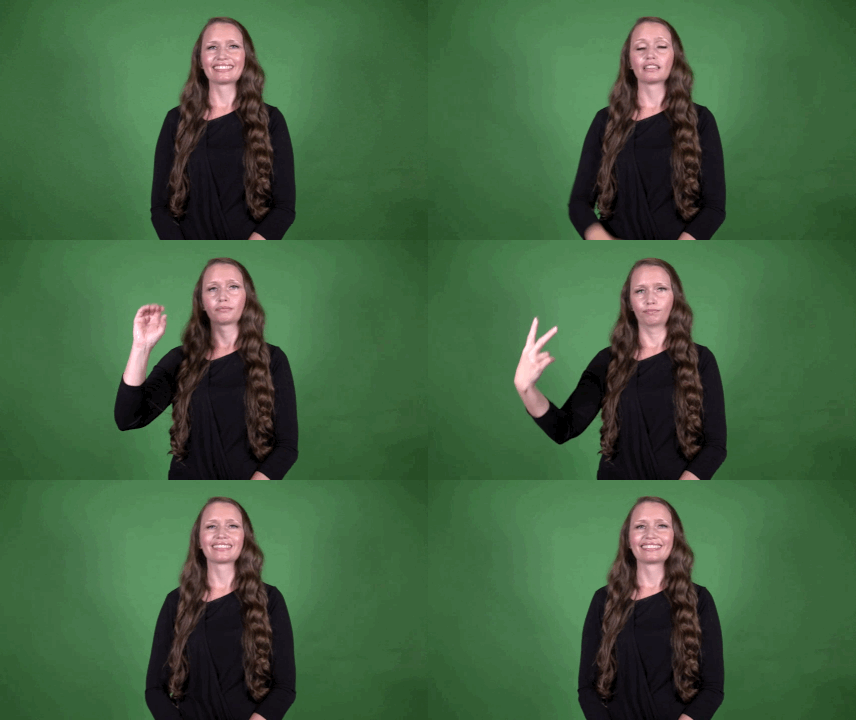
Sign for CHEMICAL COMPOUND COCL2 in ASL 

YouTube player

Practice Activities:

To build fluency with the sign for CHEMICAL COMPOUND COCL2 in ASL, begin by practicing the individual components. First, fingerspell COCL2 clearly, emphasizing accuracy in spelling. Then, pair this with the general sign for CHEMICAL COMPOUND, which may involve compound classifier use or signs for “chemical” and “compound” linked together. Repeat these motions in front of a mirror to ensure clarity and consistency.

Practice using the sign for CHEMICAL COMPOUND COCL2 in ASL within scientific contexts. For example, describe a classroom experiment: COCL2 is used to test for water because it changes color. You can also sign: In the lab, we mixed COCL2 with water and observed a reaction. These contexts will reinforce the meaning and application of the sign, especially in academic and STEM-related environments.

Create flashcards with different chemical compounds, including COCL2, and fingerspell each while signing relevant information about them. Work with a partner and quiz each other, switching roles between signer and interpreter. Add a challenge by timing each other to improve speed and recall.

Use storytelling prompts that incorporate the sign for CHEMICAL COMPOUND COCL2 in ASL to encourage spontaneous use in narrative. For example, tell a short story about a scientist discovering a new use for COCL2 in a lab experiment. Include at least three signs related to chemistry to support vocabulary retention.

Incorporate visual aids like diagrams of the compound COCL2 along with its ASL representation. Practice describing the diagram in ASL to build visual and linguistic associations. Use emojis like and to make practice sessions more engaging, especially for younger learners or ASL science clubs. Repetition and contextual use will make the sign for CHEMICAL COMPOUND COCL2 in ASL a strong part of your academic and scientific vocabulary.

Cultural Context:

In American Sign Language (ASL), scientific and chemical terminology continues to evolve as new concepts are introduced into academic and everyday conversations. The sign for CHEMICAL COMPOUND COCL2 in ASL is part of this expanding vocabulary that aims to represent complex scientific ideas visually and effectively. This is especially important for Deaf students and professionals working in science, chemistry, and education across both high school and college settings .

The sign for CHEMICAL COMPOUND COCL2 in ASL helps create accessibility in chemistry learning environments. It allows for easier communication of laboratory concepts, chemical safety procedures, and molecular discussions among Deaf individuals who are engaged in STEM fields. Having a standardized sign like this supports educational equity .

Language adaptation in ASL is driven by need and usage. As more Deaf people enter specialized fields like chemistry, signs like the sign for CHEMICAL COMPOUND COCL2 in ASL are either created or adapted by the community. These signs may begin in academic settings like colleges or scientific conferences where Deaf scientists collaborate and teach, then gradually spread through online content and ASL dictionaries.

The cultural significance of developing and using signs like the sign for CHEMICAL COMPOUND COCL2 in ASL also ties into representation and inclusion. Deaf academics, interpreters in science courses, and teachers of the Deaf all benefit from having clear, concise visual language to support comprehension. It ensures that students learning about cobalt chlorides, for example, are not disadvantaged due to inaccessible content or vague visual representations .

ASL allows the visualization of otherwise abstract concepts. Molecules, reactions, compounds such as COCL2, and even their structural properties can be conceptualized through spatial and dynamic signing techniques used in the sign for CHEMICAL COMPOUND COCL2 in ASL. This visual-spatial nature supports a deeper, more intuitive understanding of chemistry content.

The development of signs like this one reflects ongoing collaboration between linguists, ASL users, scientists, and educators. The sign for CHEMICAL COMPOUND COCL2 in ASL may differ slightly depending on regional variations or classroom usage, but its goal remains the same: to make scientific knowledge accessible and expressive using the richness of American Sign Language.

In Deaf culture, clarity and precision in communication is vital, especially in fields involving technical or sensitive information. Complex compound signs such as the sign for CHEMICAL COMPOUND COCL2 in ASL help minimize confusion and support barrier

Extended Definition:

The sign for chemical compound CoCl2 in ASL represents the concept of cobalt(II) chloride, a chemical substance often used in science labs and industry. In American Sign Language, scientific terms like this are usually fingerspelled or represented by a combination of initialized signs and classifiers that depict the nature or function of the compound.

Fingerspelling is commonly used for chemical formulas such as CoCl2. The letters C-O-C-L-2 are spelled out clearly, with proper spacing for clarity. This method is often the most accurate way to communicate complex chemical names to both deaf and hearing individuals who are familiar with scientific language.

The sign for chemical compound CoCl2 in ASL may also include classifiers or descriptive gestures, depending on the context in which the term is used. For example, a signer might show a visual representation of a chemical reaction using hand shapes that describe how the compound interacts or changes under certain conditions.

When used in academic or science-related discussions, the sign for chemical compound CoCl2 in ASL might be accompanied by signs for words like chemistry, science, experiment, or color, since cobalt(II) chloride is often recognized for its important role in chemical reactions and its deep blue color when hydrated. If being explained in an educational setting, the signer may also provide visual context, such as pretending to pour liquids or mix substances, to support understanding.

In ASL, communication often involves more than just one sign—it includes facial expressions and movement that enhance meaning. When signing about something technical like a chemical formula, a clear and steady rhythm helps the viewer understand. The sign for chemical compound CoCl2 in ASL depends not only on what is being said but how it’s being shown.

This approach to conveying scientific vocabulary in ASL helps bridge the gap for Deaf or hard-of-hearing students in educational settings. Terminology like chemical compound CoCl2 might not have a single, standard sign because the field of chemistry is broad and frequently changing. Therefore, ASL users rely on a mixture of fingerspelling and descriptive signs that provide context and clarity.

Understanding the sign for chemical compound CoCl2 in ASL can also support accessibility in science videos, tutorials, and classroom instruction. Teachers and interpreters often collaborate to ensure scientific content is both accurate and understandable to deaf students. When new compounds are introduced, interpreters and educators may develop mutually agreed-upon signs within the classroom community.

The use of signs for chemical names like CoCl2 makes it easier

Synonyms: phosgene, carbonyl chloride, COCl2 gas, COCl₂ compound, phosgene gas

Educational resources: Find related learning materials in our course bank!

Want more? Check out some of our popular learning activities on the homepage!

Need to look up a sign? Use our highly rated dictionary: https://aslinteractive.com/best-asl-dictionary/

Follow us on tiktok: https://www.tiktok.com/@aslinteractive. More social media links at the bottom of this page!

Long-tail Keywords: what is the ASL sign for chemical compound COCl2, how to sign chemical compound COCl2 in American Sign Language, chemical compound COCl2 sign language translation

Categories:

tags: science, chemistry, chemical compound, educational content, language learning

Parameters

*Handshape*:

The handshape for the Sign for CHEMICAL COMPOUND COCL2 in ASL starts with both hands in the “C” handshape, representing the chemical component cobalt. The dominant hand may shift to an “L” handshape to denote the presence of chlorine. These distinct handshapes visually demonstrate the structural components in the Sign for CHEMICAL COMPOUND COCL2 in ASL , helping to mimic the molecular essence of this compound.

Each transition between shapes is done with a slight bounce or directional change to simulate bonding. This careful combination allows the Sign for CHEMICAL COMPOUND COCL2 in ASL to reflect both the elements and their connection.

*Palm Orientation*:

The palm orientation for the Sign for CHEMICAL COMPOUND COCL2 in ASL typically involves both hands in a “claw” or curved “C” shape, with palms facing each other to represent the interaction between molecules. These handshapes may move slightly or remain stationary to indicate the bonded elements in the compound.

When fingerspelling the chemical abbreviation COCL2, the dominant hand stays upright with palm facing outward. Each letter is clear and distinct, with the palm facing forward throughout the entire fingerspelled portion of the Sign for CHEMICAL COMPOUND COCL2 in ASL .

*Location*:

The sign for CHEMICAL COMPOUND COCL2 in ASL is typically produced in the neutral space directly in front of the upper chest. This placement allows visibility and focus for both the classifier signs representing molecules or structures and the fingerspelling of specific chemical elements.

For the sign for CHEMICAL COMPOUND COCL2 in ASL, the hands stay within the signing space between the shoulders and slightly in front of the torso. This consistent location supports clarity when referencing scientific or chemical terms.

*Movement*:

Begin by fingerspelling C-H-E-M-I-C-A-L, then transition into a two-handed movement where both hands form closed “C” shapes. Rotate the “C” hands toward each other in a circular motion, as if representing mixing or a compound forming.

To complete the Sign for CHEMICAL COMPOUND COCL2 in ASL, fingerspell C-O-C-L-2 clearly with a slight emphasis on spacing between each letter and number. Maintain steady hand rhythm and neutral space in front of the torso to signify the scientific term clearly .

*Non-Manual Signals*:

Facial expressions are neutral to slightly intentional when using the sign for chemical compound CoCl2 in ASL . Eyebrows may raise slightly to show attention or topic introduction, especially if explaining the components of the compound.

When fingerspelling the formula CoCl2, maintain eye contact and mouth the components softly for clarity . This helps ensure that the sign for chemical compound CoCl2 in ASL is understood clearly in a scientific or academic context.

*Prosody, Dominant/Non-Dominant Hand*:

For the sign for chemical compound CoCl2 in ASL, start by fingerspelling the element symbols C, o, C, l, and 2 in sequence using the dominant hand. Maintain a steady rhythm and clear hand positioning each letter near shoulder height, facing outward. The non-dominant hand remains neutral or relaxed at the side of the body throughout.

Since the sign for chemical compound CoCl2 in ASL involves detailed letter articulation, ensure facial expressions remain neutral to support clarity. Emphasize precision in wrist and finger movements, especially during letter transitions, to convey the compound accurately.

Tips for Beginners:

When learning the sign for CHEMICAL COMPOUND COCL2 in ASL, clarity and precision are essential. Since this term includes a specific chemical formula, the majority of the sign will rely on fingerspelling the elements (C-O-C-L-2). Be deliberate and consistent with each letter, especially the “C” and “L,” which can easily be misread if your handshape is not distinct. Slowing down slightly when fingerspelling technical details like chemical formulas can help avoid confusion.

Practicing the sign for CHEMICAL COMPOUND COCL2 in ASL requires a strong foundation in the ASL alphabet. Repeatedly drilling the structure C-O-C-L-2 with both dominant and non-dominant hands for symmetry and muscle memory is helpful. It’s also a good idea to rehearse in front of a mirror so you can track how legible your fingerspelling is from the viewer’s perspective.

One common pitfall is rushing through the numbers or using incorrect number handshapes. In this case, the final character “2” must be articulated with the standard ASL number two handshape, palm orientation facing outward for best readability. Avoid curling the fingers or collapsing the sign, which can lead to misinterpretation.

Another useful tip: whenever you present the sign for CHEMICAL COMPOUND COCL2 in ASL, be sure to establish context—perhaps using the general sign for CHEMICAL or SCIENCE as a lead-in. This helps the viewer understand that a technical term is about to be fingerspelled.

Finally, consider practicing this term in realistic discussions with peers or tutors, especially if you’re learning in a chemistry or academic environment. The more you embed the sign for CHEMICAL COMPOUND COCL2 in ASL into real-life contexts, the easier it will be to remember and perform accurately.

Connections to Other topics:

The sign for CHEMICAL COMPOUND COCL2 in ASL connects directly to scientific lexicons, which often require fingerspelling for clarity and specificity. In this case, individual elements such as C-O and Cl, representing carbon, oxygen, and chlorine, are typically fingerspelled to accurately convey the molecular formula. These individual signs may also be grouped under a classifier or category sign for “chemical” to set context before continuing with the detailed naming of the compound.

This sign is closely related to the topic of science and chemistry in ASL, where specialized vocabulary often includes both initialized signs and fingerspelled terms. The sign for CHEMICAL COMPOUND COCL2 in ASL may begin with a sign for “chemical” using a C-hand moving in a mixing motion, followed by the fingerspelling of COCL2. This closely mirrors how other chemical compounds, such as H2O or NaCl, are communicated in ASL, emphasizing the importance of understanding elemental abbreviations and their signed representations.

Moreover, the sign for CHEMICAL COMPOUND COCL2 in ASL serves as a model for how compound terms are constructed in scientific contexts. For instance, much like COCL2, more complex molecules or formulas are handled via fingerspelling with possible contextual signs like “compound” or “reaction.” This mirrors how ASL treats complex terms in other fields, such as math or medicine, where core concepts may be signed, and specifics are fingerspelled.

Learning this sign also enhances learners’ familiarity with fingerspelling speed and clarity, since chemical compounds often demand precision. It can also provide an entry point into discussing periodic table vocabulary in ASL, showing learners how element symbols interface with signs. Thus, the sign for CHEMICAL COMPOUND COCL2 in ASL is not only useful scientifically but is also an excellent example of classifier, initialization, and fingerspelling integration in advanced ASL topics.

Summary:

The sign for CHEMICAL COMPOUND COCL2 in ASL combines several elements for clarity and scientific specificity. Typically, the phrase is expressed through a blend of general chemistry signs followed by the fingerspelling of the letters C-O-C-L-2. This fingerspelling ensures the exact molecular identity is conveyed without ambiguity.

In a classroom or research setting, this sign is often preceded by a general sign for CHEMICAL or CHEMISTRY to establish context. Then COMPOUND is signed, which may resemble the ASL sign for JOIN or COMBINE, depending on the signer’s preferred variation or regional usage. The actual compound COCL2 is communicated via fingerspelling to reflect its chemical accuracy.

It’s important to note that fingerspelling is often used in ASL to represent exact scientific terminologies that don’t have commonly used sign representations. The sign for CHEMICAL COMPOUND COCL2 in ASL, therefore, depends heavily on the signer’s clarity and speed with the fingerspelled portion. This emphasis on precision ensures that scientific discussions remain accurate and understandable.

Within ASL linguistics, fingerspelling plays an essential syntactic role in adding specificity to lexically dense concepts. For instance, COCL2, known as phosgene, does not have a widely standardized sign, so the need to fingerspell remains strong. This represents how ASL adapts to fields like chemistry, where symbols, letters, and numerals often carry critical meaning.

This adaptation also reflects the broader theme of how ASL integrates borrowed elements from written English, especially in academic or specialized fields. The sign for CHEMICAL COMPOUND COCL2 in ASL bridges original ASL signs for broader scientific concepts with direct transliteration when necessary. This hybrid structure is common in other scientific terminologies, too, such as in biology or physics.

ASL users discussing inorganic chemistry, greenhouse gases, or toxic substances may routinely use the sign for CHEMICAL COMPOUND COCL2 in ASL in lectures, labs, or environmental reports. Since COCL2, or phosgene, has historical significance as a chemical warfare agent, signers might also pair this term with historical or safety signs to provide emotional context. This adds a layer of linguistic richness to the term.

Grammatically, the sign for CHEMICAL COMPOUND COCL2 in ASL flows as a noun phrase or title. CHEMICAL and COMPOUND may be stacked or connected through movement, indicating the joined nature of the terms. The transition into the letters C-O-C-L-2 requires a smooth shift into fingerspelling mode, often with a slight pause or change in eyebrow movement to signal importance.

The role of nonmanual markers (facial expressions, eye gaze, head tilts) while using this term is significant. For instance, raised eyebrows might indicate a question about the compound, while a head nod could emphasize the compound’s presence or danger. These embodied elements offer layers of meaning beyond just the manual signs themselves.

The visual-spatial nature of ASL allows for certain complex molecular structures to be “mapped out” in space. Some advanced signers may represent chemical bonds conceptually by showing how atoms are positioned or linked. However, this is rare and usually reserved for in-depth discussions within scientific or academic communities.

Because of phosgene’s dangerous properties and industrial applications, the sign for CHEMICAL COMPOUND COCL2 in ASL could show up in workplace safety instructions for Deaf scientists or interpreters working in manufacturing settings. In this way, ASL not only accommodates academic knowledge but also supports occupational safety and compliance.

In discussions about World War I or chemical warfare, educators may incorporate the sign for CHEMICAL COMPOUND COCL2 in ASL to teach history. This reflects how signs evolve and adapt based on relevance to users’ lives and knowledge bases. Cultural knowledge related to the keyword is often layered with emotion and context.

The rigidity of fingerspelling within ASL allows for high-fidelity transfer of scientific labels. At the same time, it challenges interpreters to balance visual pacing with semantic accuracy. When the sign for CHEMICAL COMPOUND COCL2 in ASL is interpreted at conferences or meetings, visual fluency is essential.

The sign is also valuable within bilingual ASL-English settings where terminology must cross over cleanly. For Deaf chemists, researchers, or students, fingerspelling COCL2 communicates exactly what is needed, preserving academic integrity. This is especially vital during lab work or when analyzing data where miscommunication could have serious consequences.

In terms of language pedagogy, ASL teachers might use the sign for CHEMICAL COMPOUND COCL2 in ASL to illustrate how science vocabulary is treated differently than everyday conversation. The sign shows students how to manage long technical terms efficiently and expressively. Emphasis is put on rhythm, clarity, and chunking of fingerspel

Want more? Check out some of our popular learning activities!

ASL Interactive Resources

ASLInteractive YouTube Channel

Follow us on tiktok: @aslinteractive.com

Follow us on Instagram: aslinteractive

Facebook page: aslinteractive

Facebook group: aslinteractive

LInkedIn: ASL Interactive LLC

Twitter: @ASL_interactive

*Some information on this page is AI-generated. AI can make mistakes. Please check the information.

Sign for CHEMICAL COMPOUND COCL2 in ASL 

Responses