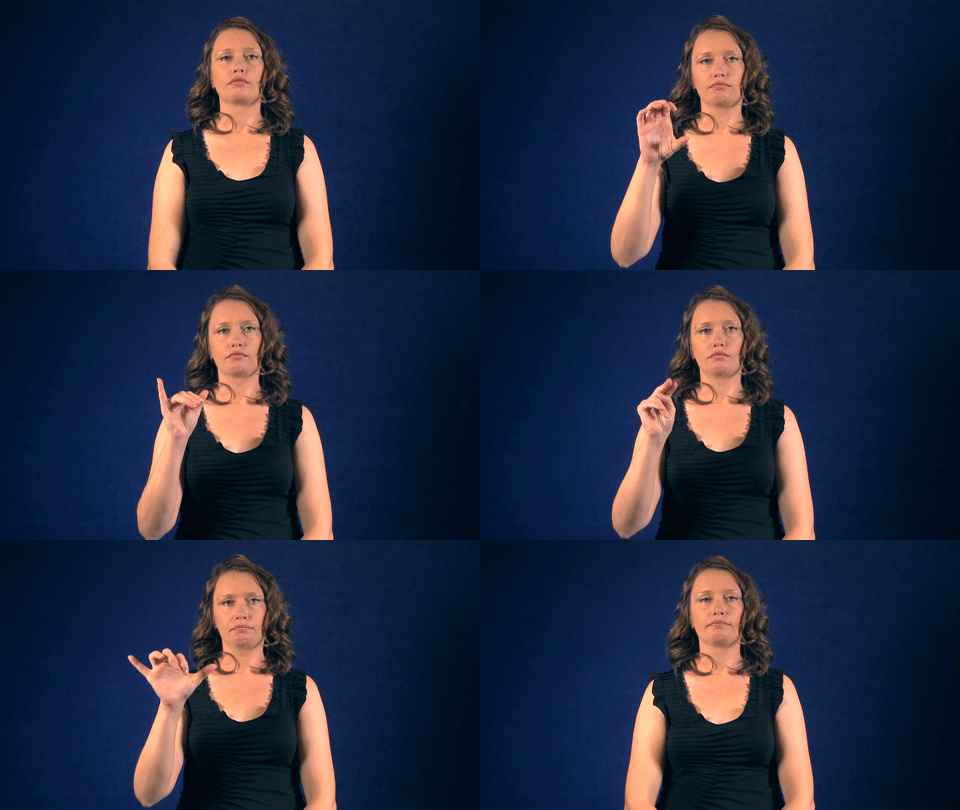
Sign for CHIMNEY in ASL | 🔥 ASL Dictionary

Definition: A vertical structure for smoke.

Sign for CHIMNEY in ASL

YouTube player

Practice Activities:

To practice the sign for CHIMNEY in ASL, begin by signing it repeatedly in front of a mirror. Focus on handshape accuracy and spatial orientation over the roof area. Try signing it slowly, then gradually build up speed while keeping the motion smooth and clear.

Next, use the sign as part of simple sentences. For example, “House have chimney” or “Smoke come out chimney.” Create a list of vocabulary related to houses or buildings and add CHIMNEY into each sentence. This will help establish context and improve fluency.

Practice describing a house using multiple signs including the sign for CHIMNEY in ASL. You could sign, “Big red house, white roof, and black chimney.” Try changing adjectives and design features to create new sentence combinations. This helps expand your signing vocabulary while reinforcing memory of the sign.

Work with a partner and take turns describing different types of buildings. One person can describe a cabin, another can describe a city apartment with no chimney, and another could describe a traditional house with a tall chimney. Challenge each other to sign details clearly with correct structure.

Use storytelling to reinforce the sign. Tell a winter story that includes concepts like snow on the roof, family inside the warm house, and smoke coming from the chimney. Incorporate signs for cold, fireplace, roof, snow, and the sign for CHIMNEY in ASL to give depth and imagery to the story.

Draw a simple house scene with your learner group, then take turns pointing to different parts and signing them. When pointing to the top of the house, sign CHIMNEY and relate it to concepts like fire, Santa Claus, or smoke to create memorable associations. These multi-sensory angles help cement the sign in long-term memory.

Cultural Context:

In American Sign Language, family traditions and seasonal imagery often influence the signs used to describe everyday objects. The sign for chimney in ASL reflects not only the object’s shape and function but also its cultural presence in stories, holidays, and historical architecture. Understanding this sign involves more than just hand movements—it connects to shared visual experiences and social history.

The sign for chimney in ASL is frequently associated with scenes from winter and holiday traditions. In many Deaf homes, the chimney becomes a focal point in storytelling, especially around Christmas, when Santa Claus is said to come down the chimney. Signs connected to holiday themes often carry warmth and nostalgia, and the sign for chimney in ASL is no exception.

In Deaf culture, visual storytelling is a powerful tool, and elements like the chimney are woven into narratives that span generations. Whether describing old houses, cozy fires, or holiday surprises, a chimney represents more than just a structural feature—it becomes part of the visual language of family, celebration, and comfort. So when using the sign for chimney in ASL, users are often evoking a deeper emotional connection rooted in collective experiences.

Architecturally, chimneys have been a key part of both rural and urban homes, often symbolizing the heart of the household. The warmth of the fireplace, the smoke rising through the flue, and the shared moments around it are expressed through the descriptive power of ASL. The sign for chimney in ASL doesn’t just identify an object—it paints a picture rich in mood and meaning.

Some signs in ASL adapt depending on regional influences or context within stories. The sign for chimney in ASL can vary slightly according to whether one is referring to a residential structure or an industrial one. In stories or ASL poems, the chimney might become a metaphor or symbolize warmth, dreams, or even escape.

Children growing up in the Deaf community learn early how to incorporate home elements like the chimney into their storytelling. Whether acting out bedtime tales or performing in a school play, using the sign for chimney in ASL becomes an early way to reinforce visual language skills and cultural values. These shared signs and stories become a foundational part of Deaf identity and heritage.

The chimney plays a role in everyday experiences during colder months. Gathering around the fireplace, hanging holiday decorations, or discussing weather patterns—all these moments may involve using the sign for chimney in ASL. Thus, this sign is not only used for literal communication but also for rich descriptive context in seasonal events and personal anecdotes.

Cultural events

Extended Definition:

The sign for chimney in ASL is a visual representation designed to resemble a typical house chimney. American Sign Language often uses space and movement to reflect the actual appearance of the object being described. For chimney, the handshape and motion mimic the structure and purpose of a chimney, making it easy to remember and use.

In ASL, classifiers can be very helpful to describe something like a chimney. To show the sign for chimney in ASL, you might use a combination of flat hands to represent the roofline, then show a vertical upward motion to indicate the chimney rising out of it. Signs may vary slightly depending on regional dialects or personal signing style, but the concept remains generally consistent.

This sign is frequently used when discussing topics related to homes , buildings, fireplaces , or holiday scenes that involve houses. For example, during the winter season or in classroom activities around holidays, children might learn the sign for chimney in ASL as they talk about Santa Claus coming down the chimney. Learning this sign helps enrich vocabulary related to the home and offers a way to share vivid, real-world imagery through gesture.

The sign for chimney in ASL allows for storytelling and description, fitting naturally into narratives. Whether telling a personal story or describing a building, this sign supports clear and engaging communication. It’s commonly used in educational settings, especially when teaching about house parts or discussing different types of architecture.

Using the correct sign for chimney in ASL is important when giving directions or painting a mental picture for the viewer. It’s a perfect example of how American Sign Language can translate complex or abstract ideas into easy-to-understand visuals. The sign brings the concept to life in a way spoken English may not be able to capture as clearly or quickly.

This sign is particularly useful for ASL interpreters, Deaf educators, and students who are discussing safety features of a home. When participating in fire drills or emergency preparedness training, the sign for chimney in ASL can help convey essential information visually. Pairing this sign with house and fire-related vocabulary supports deeper understanding and communication.

For younger learners and new signers, understanding the sign for chimney in ASL builds confidence and promotes language development. Learning object-based signs helps create a foundation for higher-level describing and storytelling skills. Combining this with signs for house, roof, fire, and winter vocabulary makes for a richer language experience.

When looking for consistency or clarity in how to represent chimney in ASL, consider the context. If you’re describing a

Synonyms: smokestack, flue, vent, stack, exhaust

Educational resources: Find related learning materials in our course bank!

Want more? Check out some of our popular learning activities on the homepage!

Need to look up a sign? Use our highly rated dictionary: https://aslinteractive.com/best-asl-dictionary/

Follow us on tiktok: https://www.tiktok.com/@aslinteractive. More social media links at the bottom of this page!

Long-tail Keywords: what is the ASL sign for Chimney, how do I sign Chimney in ASL, ASL sign for Chimney

Categories:

tags: Chimney, winter, Christmas, housing, fireplace

Parameters

*Handshape*:

The handshape for the sign for CHIMNEY in ASL typically uses two flat B hands . One hand is held vertically to represent the house wall, while the other moves upward behind it to suggest smoke traveling up through a chimney. This motion mimics the structure and rising smoke from a chimney.

This representation helps clarify the meaning behind the sign for CHIMNEY in ASL, combining spatial awareness with visual imagery. It’s a straightforward but effective depiction, reinforcing the concept visually.

*Palm Orientation*:

The palm orientation for the sign for CHIMNEY in ASL typically involves both hands. The non-dominant hand is held vertically, palm facing in, to represent the structure of a house or wall. The dominant hand moves upward alongside it, fingers wiggling or slightly spread, palm facing out or at an angle. This motion mimics smoke rising from a chimney.

The dynamic palm orientation helps convey the imagery behind the sign for CHIMNEY in ASL . Proper orientation enhances clarity, especially when emphasizing the vertical nature of a chimney on a house.

*Location*:

The sign for CHIMNEY in ASL is typically made in the space in front of the torso, approximately chest to shoulder height. Both hands are used to represent the sides of a chimney, moving upward to suggest a vertical structure. This location allows the signer to clearly show the motion and shape relevant to the concept.

Staying at this mid-body level keeps the sign for CHIMNEY in ASL visible and easily understood. The hand movements remain close to the body but not touching, highlighting the chimney shape without conflicting with other nearby sign areas.

*Movement*:

To show the sign for chimney in ASL, begin with both hands in bent “B” handshapes. Place your non-dominant hand vertically in front of you to represent the wall of a house. The dominant hand starts behind it, then wiggles upward and slightly forward while moving above the non-dominant hand, mimicking the path smoke would travel up a chimney.

This motion represents smoke rising through a chimney and out into the air above. The sign for chimney in ASL clearly depicts the structure and function of a chimney, making the concept visually intuitive.

*Non-Manual Signals*:

When performing the sign for chimney in ASL, the facial expression is neutral to mildly descriptive depending on context. If referring to smoke rising or describing the chimney’s height or condition, slight upward eye gaze or a mild puff of cheeks can add visual detail. Raised eyebrows may accompany the sign if emphasizing how tall or large the chimney is. Non-manual signals help clarify the context and enhance the meaning of the sign for chimney in ASL .

*Prosody, Dominant/Non-Dominant Hand*:

The sign for CHIMNEY in ASL typically uses both hands. The non-dominant hand is held vertically with the palm facing to the side, representing the structure. The dominant hand mimics smoke or fire rising by wiggling the fingers while moving upward alongside the non-dominant hand. This motion captures the imagery of smoke going up a chimney.

When using the sign for CHIMNEY in ASL, prosody and facial expressions can emphasize size or activity—such as big, puffy smoke or a narrow flue. Incorporating directional movement upward enhances the visual-spatial grammar central to ASL storytelling.

Tips for Beginners:

When learning the sign for CHIMNEY in ASL, start by visualizing a house structure. The sign usually mimics the vertical shape of a chimney rising from a roof. Using both hands, one flat hand can represent a roof while the other hand moves upward, demonstrating the chimney. Be conscious of spatial orientation—keeping the structure logical in your handshape and movement adds clarity.

New learners may struggle with keeping the sign proportionate and aligned. It’s common to angle the hands incorrectly, making the sign confusing. Practicing in front of a mirror can help you monitor spacing and direction. Slow, deliberate movements at the start will build muscle memory and better control over hand placements.

When signing in conversation, make sure your movements are fluid but not rushed. Speed isn’t the goal; clarity always comes first. Overly stiff hands can cause the sign to look awkward or be misunderstood. Hands should maintain a relaxed but intentional motion while staying firm in their form.

Remember that facial expression isn’t crucial for the sign for CHIMNEY in ASL, but keeping a neutral or context-appropriate expression helps maintain natural communication flow. If you’re telling a story, using enthusiastic expression adds to the clarity and engagement of your signing.

Consider watching native signers perform the sign in context, such as describing a house or a winter scene. Seeing the sign used naturally within stories helps reinforce its structure and rhythm. Try recording yourself to review what adjustments might be needed.

Look out for signs with similar vertical motions like TREE or FACTORY and be careful not to confuse them. Each sign depends on specific handshapes and movement paths. Paying attention to these details will make your rendition of the sign for CHIMNEY in ASL more accurate and trusted by native users.

sign for CHIMNEY in ASL, chimney ASL sign, how to sign chimney in American Sign Language, chimney hand sign ASL, chimney sign language meaning

Connections to Other topics:

The sign for CHIMNEY in ASL connects directly to environmental and household concepts frequently used in home descriptions or during seasonal discussions, especially around winter or holidays. Since a chimney is a structural part of a house, this sign is often used along with signs such as HOUSE, ROOF, and FIREPLACE, helping learners understand spatial relationships in a home. These signs are commonly grouped when describing a house in detail using classifiers or when telling stories.

This sign also frequently appears in cultural contexts, especially when discussing Christmas or stories involving Santa Claus. In ASL storytelling, the sign for CHIMNEY in ASL may be combined with signs like SANTA, PRESENT, or TREE to convey events unique to holiday traditions. These compound ideas create natural opportunities to explore how multiple ASL signs can come together to share visual narratives efficiently.

Learners often encounter the sign for CHIMNEY in ASL while discussing air flow, building safety, or pollution. In these contexts, it connects with signs like SMOKE, FIRE, or AIR. For example, in conversations about a fire drill or smoke coming out of a chimney, the sign is naturally incorporated alongside these related terms to convey a vivid concept.

Beyond environmental or cultural storytelling, the sign is also useful when explaining occupations. For instance, discussions involving a chimney sweep or home builder would include the sign for CHIMNEY in ASL combined with JOB, PERSON, or SWEEP. These combinations help learners understand how individual signs are incorporated into broader occupational contexts.

The visual-spatial nature of ASL allows for creative use of directionality and location when signing CHIMNEY, often involving the upward movement of smoke or the structure reaching above a roof. This supports a more intuitive grasp of three-dimensional space, aiding learners in thinking about how signs relate to physical structures.

Summary:

The sign for CHIMNEY in ASL is often represented through a visual-gestural depiction that mimics the structure of a chimney stack. It draws on spatial elements and classifiers to show where a chimney might be on a house. This use of iconicity in signs—where the meaning resembles the structure—enhances visual understanding.

To create the sign, one common version includes forming the shape of a house with both hands, then using dominant fingers to illustrate a vertical “pipe” sticking up from the roof. This movement mirrors how a chimney extends upward to vent smoke. The motion may vary slightly depending on the signer’s dialect and region.

Another variation might use classifiers to indicate building structures, then insert the chimney on that framework. Sometimes the sign uses both metaphor and function, incorporating gestures that simulate smoke rising. This brings together visual elements that show both the object and its use.

The sign for CHIMNEY in ASL is an excellent example of classifier use in the language. Classifiers are handshapes that can represent categories of things, such as buildings or cylindrical items. They help show the relative size, shape, and position of objects in space.

Grammatically, the sign for CHIMNEY in ASL fits within nominal structures. It can be incorporated into larger sentences that discuss architecture, holidays, or even fires. Its placement in syntactic structure follows general ASL sentence order, typically topic-comment or subject-verb-object.

In ASL storytelling, particularly during winter or holiday tales, the sign for CHIMNEY in ASL appears frequently. When describing Santa Claus, for example, it’s common for signers to visually show him descending the chimney. This enriching detail adds to the spatial narrative techniques within ASL.

Culturally, the word “chimney” evokes traditional and symbolic meaning in American life—especially in rural and suburban imagery. From cozy winter nights to Christmas myths, chimneys hold emotional resonance. This symbolic aspect influences the way the sign is performed—with added emphasis on height and flow, especially within poetry or signed songs.

ASL often localizes visuals that fit cultural contexts, and the sign for CHIMNEY in ASL updates with evolving meanings. For example, newer homes might not have chimneys, more common in older architecture. Still, culturally embedded holidays like Christmas keep the idea alive in storytelling and education.

In conversations about fire safety, architecture, or construction, the sign for CHIMNEY in ASL joins other signs like HOUSE, SMOKE, FIREPLACE, or CLEAN. In these contexts, the sign becomes a practical term, contributing to broader discussions in everyday conversations or emergency preparedness.

Within applied linguistics, the sign for CHIMNEY in ASL showcases how objects are conceptualized three-dimensionally. ASL’s spatial grammar allows nuances like where the chimney is located, whether smoke is coming out, or if it’s been cleaned. This use of space makes the language dynamic and visually rich.

Signed languages such as ASL lean on iconicity, and the sign for CHIMNEY in ASL is no exception. The resemblance between form and meaning facilitates sign recognition for both language users and learners. Learners can easily visualize and remember the sign due to its illustrative form.

The sign can also feature in compound concepts, forming part of signs like SMOKESTACK, FACTORY CHIMNEY, or EVENT CHIMNEY CLEANING. Through compounding or sequential description, ASL builds new meanings from core signs. It increases the expressiveness of limited vocabulary sets by combining signs contextually.

When interpreting between English and ASL, accurate visual representation of environments plays a role. That’s where the sign for CHIMNEY in ASL demonstrates the interpreter’s spatial thinking skills. The interpreter must capture architectural setup and create a cohesive image for the viewer.

Kids learning ASL naturally incorporate the sign for CHIMNEY in ASL during holiday storytelling or play. Particularly in December settings, children sign stories about Santa, sleighs, and rooftops. Including the sign provides visual completeness to familiar tales.

From a linguistic anthropological view, the way ASL users reference a chimney tells us about shared experiences and collective symbolism. In Deaf culture, visual storytelling is central, making such signs crucial. Descriptions of environments—like homes—often begin with broader features like walls and lead up to axes like chimneys.

The sign’s prominence wanes outside cultural or seasonal use, but it serves as a tool for teaching spatial language concepts. Educators in visual language curriculum often use signs like this to teach perspective, directional verbs, and location description. Learning about chimneys becomes a lesson on location.

The role of indexes and pointing also affects how the sign for CHIMNEY in ASL is contextualized. After indicating a house area, the signer may shift gaze and fingers upward to the chimney’s position. This technique in ASL, known as indexing to locus, anchors the narrative in space.

Linguistically, it’s interesting how

Want more? Check out some of our popular learning activities!

ASL Interactive Resources

ASLInteractive YouTube Channel

Follow us on tiktok: @aslinteractive.com

Follow us on Instagram: aslinteractive

Facebook page: aslinteractive

Facebook group: aslinteractive

LInkedIn: ASL Interactive LLC

Twitter: @ASL_interactive

*Some information on this page is AI-generated. AI can make mistakes. Please check the information.

Sign for CHIMNEY in ASL

Responses