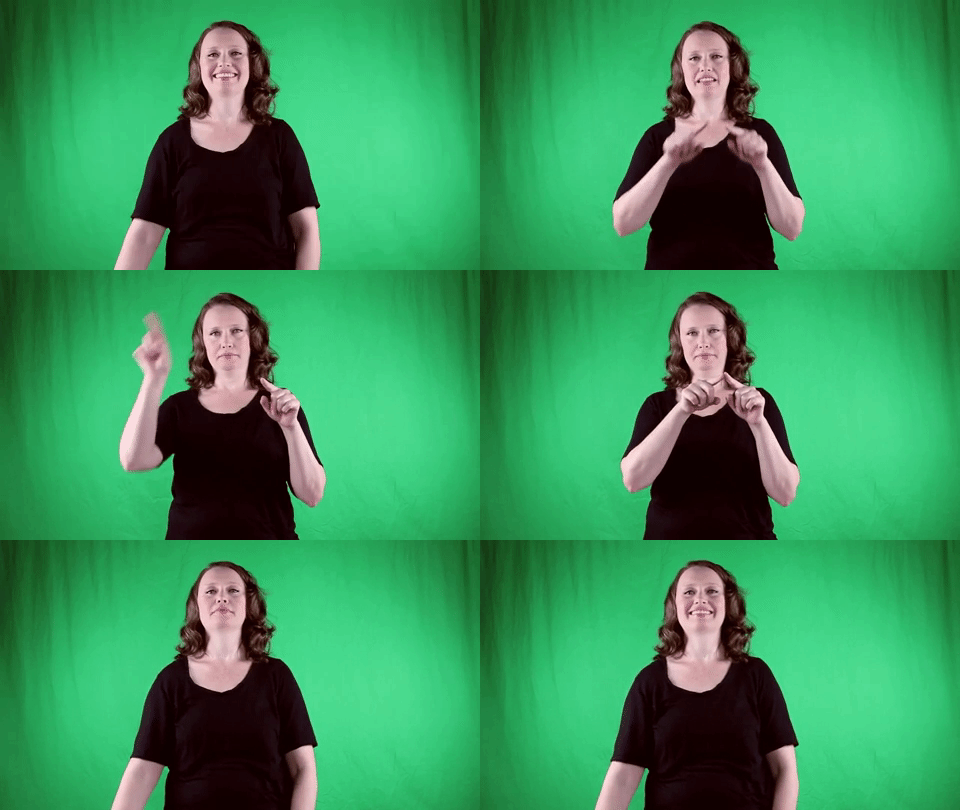
Sign for CIRCULAR in ASL | ⭕️ ASL Dictionary

Definition: Having a round shape.

Sign for CIRCULAR in ASL

YouTube player

Practice Activities:

To build fluency with the sign for CIRCULAR in ASL, start by practicing the sign repeatedly in front of a mirror. Focus on maintaining the correct handshape and motion — a circular path in the air to visually communicate the concept. Do slow repetitions and then speed up gradually to build muscle memory.

Next, try incorporating the sign into short ASL phrases. For example, sign “circular table,” “circular motion,” or “path is circular.” Say each phrase out loud in English first, then visualize how you would express it in ASL using proper non-manual markers and the correct spatial setup.

Try creating short stories or descriptions that involve circular shapes or motion. You might describe a child running in circles, a toy car going around a track, or a planet orbiting the sun. Each time, integrate the sign for CIRCULAR in ASL to reinforce real-world usage of the concept in context.

Use flashcards with images of circular objects like wheels, coins, rings, or clocks. Without looking at the word, sign what you see. This will help you associate the image and concept directly with the sign for CIRCULAR in ASL without relying on English.

In partner practice, play a charades-style game where one person describes or signs an item that includes a circular shape, and the other guesses. For instance, sign “circular pizza” or “circular mirror.” You and your partner can also take turns identifying things in your environment that are circular and sign them during a walk or while looking around a room.

Finally, record yourself signing a short explanation using the sign for CIRCULAR in ASL, then review the video to analyze clarity and fluency. Re-record the same content as needed to improve. Visual feedback is especially useful for perfecting hand motion and spatial accuracy.

Cultural Context:

In American Sign Language, the sign for CIRCULAR carries more than just a visual representation; it also reflects cultural nuances about how ideas are communicated within the Deaf community. The concept of circularity is often associated with smooth movement, cycles, and continuity—ideas that hold both practical and metaphorical importance in ASL storytelling and conversations.

The sign for CIRCULAR in ASL typically uses a circular motion, which immediately suggests the continuous nature of the word. This mirrors the Deaf community’s strong sense of connection and inclusivity. Just like in a circular formation where no one is first or last, ASL culture values equality and shared experiences.

ASL users often include circular shapes and signs in storytelling to represent ideas like time passing, seasons changing, or events coming full circle. The sign for CIRCULAR in ASL is a visual extension of that symbolic continuity. It’s not just about a shape; it’s about flow, connection, and repetition in communication.

In Deaf education settings, children learn the sign for CIRCULAR in ASL alongside concepts like wheels, clocks, or cycles of nature. This highlights a bilingual-bicultural approach, where signs are taught not just as vocabulary, but as part of a broader worldview. The shape reinforces the meaning, and the motion inspires broader conceptual thinking.

The use of space and motion is an essential feature of ASL, and the sign for CIRCULAR illustrates how movement conveys meaning. Unlike static printed words in English, signs like this one engage the signer’s body and the viewer’s perception. The circular motion invites attention to the idea’s completeness or ongoing state.

In Deaf theater and performance, the sign for CIRCULAR in ASL can be elaborated or stylized to emphasize emotional or narrative depth. Whether it represents a repeating event or a circular object, this sign can be adapted to fit the rhythm and pacing of visual storytelling. The flexibility of ASL makes cultural expression deeply dynamic.

In community conversations, using the sign for CIRCULAR in ASL can also symbolize inclusion and continuity within group dynamics. It’s common for signs with circular motion to signify unity, making them important in discussions about collective goals or shared memories in community events.

The more frequently a sign appears in cultural contexts like art, education, and community life, the deeper its meaning becomes. The sign for CIRCULAR in ASL is not just learned—it’s experienced. It connects to both practical concepts and cultural expressions.

Learning the sign for CIRCULAR in

Extended Definition:

The sign for circular in ASL is used to describe shapes, motions, or concepts that involve a round, looping, or non-angular movement or form. In American Sign Language, this concept is visual and often mimics the shape or motion associated with circular things or actions. This word may be used frequently in conversations about objects, movements, or repetitive cycles.

When signing the concept of circular in ASL, the hands often move in a round motion, sometimes in the air or around another hand or object. These motions symbolize the continuous or looping nature of something circular. The exact movement of the sign can vary depending on the context and what is being described as circular.

The sign for circular in ASL can be adapted to show differences between something physically circular like a wheel or something abstract like circular reasoning. In this way, the language remains flexible and visual. For young learners or new signers, understanding the motion behind the meaning makes ASL easier to grasp.

In daily interactions, this sign may appear in descriptions like circular table, circular motion, or circular design. By adding specific classifiers or handshapes, signers can offer detailed imagery about the size, direction, and type of circular object. Classifiers enhance the richness and clarity of what is being communicated through the sign for circular in ASL.

Learning how to sign circular in ASL can also help in academic or science-related discussions. Teachers who use ASL may employ the term when explaining cycles, patterns, or planetary movements. Because of ASL’s visual nature, concepts like this are often more intuitive than in spoken language.

The use of the sign for circular in ASL helps reinforce the visual-spatial grammar for learners. It shows how motion, shape, and space work together to convey full meaning. Using this sign strengthens the understanding of how ASL uses the body and space to communicate.

Signers can also modify the speed or size of the circular motion to match intent or emotion. A slow, wide circle might describe a rotating platform, while a tight, small sign could represent a coin or button. These variations help bring vivid detail to conversations.

In storytelling or visual descriptions, the sign for circular helps bring scenes to life. A signer might use the circular motion when discussing the path of a character walking around a tree or a dog running in circles. The movement itself adds action and context that matches the narrative.

Consistent use of the sign for circular in ASL can build fluency and confidence. It’s a common

Synonyms: round, spherical, curved, ring-shaped, orbital

Educational resources: Find related learning materials in our course bank!

Want more? Check out some of our popular learning activities on the homepage!

Need to look up a sign? Use our highly rated dictionary: https://aslinteractive.com/best-asl-dictionary/

Follow us on tiktok: https://www.tiktok.com/@aslinteractive. More social media links at the bottom of this page!

Long-tail Keywords: what is the sign for circular in ASL, how do you sign circular in American Sign Language, ASL sign for circular

Categories:

tags: language learning, verbs, activities, circular motion, basic grammar

Parameters

*Handshape*:

The handshape for the sign for CIRCULAR in ASL typically involves using the dominant hand in a curved index finger handshape, resembling the letter “C.” The fingertips maintain this “C” formation while moving in a circular motion to visually represent a round shape.

This handshape helps convey the concept of something round, curved, or cyclical. Using the specific curvature of the fingers is essential to accurately show the sign for CIRCULAR in ASL.

*Palm Orientation*:

The palm orientation for the sign for CIRCULAR in ASL typically involves either the dominant hand in a loose “1” or flat handshape. The palm usually faces downward or slightly sideways depending on the movement pattern chosen. As the hand traces a circle shape in the air to depict something round or rotating, the palm maintains a consistent orientation to emphasize the circular motion.

In the sign for CIRCULAR in ASL, orientation remains stable to highlight the spatial concept of a circle. This visual cue helps reinforce the shape and motion implied in the sign, making it clearer to the viewer.

*Location*:

The sign for circular in ASL is located in the neutral space in front of the torso, typically at mid-chest level. The dominant hand moves in a circular motion, mimicking the shape of a circle, while staying comfortably in front of the body.

This central location helps emphasize the concept of round or continuous motion, which is key to conveying the sign for circular in ASL accurately. The movement stays within a small, contained area to maintain clarity.

*Movement*:

To show the sign for circular in ASL, use your dominant index finger and make a small circular motion in the air, usually in front of the chest or shoulder area. The direction of the circle is typically clockwise, though it may vary slightly based on context.

The sign for circular in ASL mimics the shape of a circle being drawn. Keep the motion smooth and consistent, emphasizing the round, continuous nature of the concept.

*Non-Manual Signals*:

When producing the sign for circular in ASL, the facial expression should show focus or slight concentration to emphasize the continuous or round motion. Slight puffing of the cheeks may be used to illustrate the roundness or size of the circular object being described.

Raised eyebrows can also indicate that the signer is elaborating or comparing circular shapes. These non-manual signals help reinforce the concept behind the sign for circular in ASL, contributing to clear visual communication.

*Prosody, Dominant/Non-Dominant Hand*:

The dominant hand forms the index finger and moves in a circular motion in the air, typically in front of the torso. The non-dominant hand may remain at rest or support the motion if showing a larger circular shape. The movement is smooth and continuous, emphasizing the concept of roundness or repetitiveness.

The sign for circular in ASL visually represents the shape and flow of something round. This movement-driven sign reinforces the meaning through motion, making the sign for circular in ASL intuitive and visually descriptive.

Tips for Beginners:

When learning the sign for CIRCULAR in ASL, it’s essential to focus on the movement and shape your hand creates. This sign typically involves tracing a circle in the air using the dominant hand, often with a bent “1” handshape or index finger extended. Make sure your circular motion is smooth and fluid to clearly convey the idea of something being round or continuous.

Beginners sometimes struggle with the circular motion being too angular or small. Stay relaxed in your wrist and arm to avoid choppy shapes. The size of the circle should reflect what you are describing—larger for things like wheels, smaller for items like buttons. Use appropriate facial expressions to match the sign’s context, as non-manual signals in ASL are crucial for clear communication.

Practicing in front of a mirror can help you perfect the motion and ensure your sign looks round enough to be understood. If the movement turns into more of a square or oval, the meaning might be lost. Watch native signers perform the sign for CIRCULAR in ASL online to get a clearer sense of natural hand motion and rhythm. Repetition and muscle memory are key to mastering this kind of movement-based sign.

Avoid holding your hand too stiffly—it should feel more like drawing in the air than pointing rigidly. Some learners may accidentally turn the hand in place instead of creating a spatial circle. Remember, ASL is very spatial in nature, so visual clarity and accurate space usage are important.

Pay attention to the context when using the sign for CIRCULAR in ASL. It can also describe circular reasoning, routine processes, or round-shaped objects. Describe what’s circular when needed for added clarity. The more examples you use in practice, the more natural your signing will become

Connections to Other topics:

The sign for CIRCULAR in ASL is closely related to other shape-based signs like ROUND, OVAL, and SPHERE. Each of these signs uses spatial movement to convey form, often involving circular hand motions that represent the object’s outline. This connection facilitates visual learning through ASL’s iconic nature, helping learners map abstract shapes to physical gestures ✋.

In compound signs, the sign for CIRCULAR in ASL can be integrated with signs like MOTION or PATH to describe continuous or looped movements. For example, describing a circular track or a racetrack uses this sign along with additional modifiers to express detailed imagery. It also appears in phrases like CIRCULAR ROUTE or CIRCULAR ARGUMENT, often paired with classifiers or facial expressions to indicate repetition or enclosure .

ASL frequently uses spatial referencing and non-manual markers (NMMs) to expand meaning, and the sign for CIRCULAR in ASL works particularly well in describing layout or direction. For instance, when explaining a roundabout in driving, the signer may use a circular motion combined with directional signs. This application illustrates how geometry and orientation play a key role in fluency.

There’s also a connection to concepts like ROTATE, LOOP, and WHEEL, which share similar hand movements. Although their meanings differ, they all use rotation or curved motion to indicate movement or structure. This overlapping use of space helps learners understand how subtle changes in direction or handshape alter meaning .

Learning the sign for CIRCULAR in ASL deepens understanding of size and shape classifiers. Classifier handshapes can be used to describe the scale or type of circular object, such as a plate, ring, or pizza. These connections encourage richer vocabulary and storytelling within ASL discourse.

Understanding how the sign for CIRCULAR in ASL fits into broader categories allows learners to describe abstract ideas as well, such as cycles, repetition, and holistic processes. When paired with time-related signs, it can help visualize patterns, like moon phases or life cycles .

Summary:

The sign for CIRCULAR in ASL usually mimics the shape of a circle being drawn in the air. Using the index finger, the signer moves their hand in a smooth, rounded motion, often in a horizontal plane. The movement resembles tracing a circle, reflecting the shape’s defining feature.

This sign emphasizes the visual-spatial nature of ASL. Instead of representing the word phonetically as in spoken English, the signer enacts the concept with gesture and shape. The round, sweeping motion echoes the geometry of a circle.

The concept of circularity in ASL can be extended to indicate anything with a round form or a repeating, cyclical nature. For example, one might use the sign for CIRCULAR in ASL when describing a circular table, a roundabout, or a system that loops continuously. This connection between form and function is central in ASL grammar and semantics.

Circular movement in signing taps into classifiers if describing physical objects more specifically. A flat round object might be represented with a specific classifier, using both hands to show its size. These classifiers are key grammatical tools in ASL and bring spatial mapping directly into communication.

Culturally, the idea of circularity can also symbolize continuity and wholeness. In Deaf culture, this symbol resonates with community and lifelong connectivity. Signs that incorporate round shapes reflect that ongoing sense of shared space and collective experience.

In the context of storytelling or narratives in ASL, describing a journey as circular might convey a character returning to their origin, repeating history, or achieving closure. The visual metaphor of circling adds emotional and symbolic power to ASL narratives.

The sign for CIRCULAR in ASL supports this metaphorical richness. The rounded gesture can be used literally or figuratively, giving it flexibility in various settings. Its movement-based core allows it to blend naturally into discussions of cycles, routines, and patterns.

ASL often relies on visual metaphors to describe abstract concepts. Using the sign for CIRCULAR in ASL to describe systems like weather cycles or daily routines adds clarity and dimension. The continuous circular movement mimics repetitive processes effectively.

From a linguistic perspective, the sign’s iconicity is high—its form visually matches its meaning. This is a useful teaching point when introducing ASL concepts to new learners, helping them grasp the meaning quickly. Iconic signs like this serve as bridges between concrete image and abstract idea.

Phonologically speaking, the sign involves handshape, movement, and orientation, making it a multi-layered production. The dominant hand traces a circular pattern, with palm orientation and handshape contributing to its proper execution. Consistent rhythm and smooth curvature are essential.

Learners sometimes default to random hand movements that look circular but lose grammatical nuance. It’s important that the signer maintains a consistent plane of movement and proper non-manual signals if relevant. Smooth rate and movement size differentiate casual depiction from more formal references.

Syntactically, the sign for CIRCULAR in ASL usually sits before the noun it modifies. You might say “CIRCULAR TABLE” using the order preferred in ASL grammar. Just like other adjectives, the placement and intensity convey additional contextual clues.

Pragmatically, tone is communicated through the signer’s facial expressions and speed. Exaggerated circular movements can signal surprise, humor, or irony. Subtle rotations may suggest precision or seriousness, especially in technical or academic contexts.

The sign also intersects with related vocabulary such as ROUND, SPHERE, and LOOP. Though similar in motion, each has slightly different directionalities or additional components. ROUND may involve puffed cheeks or a different level of abstraction depending on what’s being described.

Within the broader themes of ASL lexicon development, signs like CIRCULAR show the creative potential of space and motion. They represent how Deaf communities have historically generated vocabulary grounded in the visible world. The body becomes a medium of symbolic geometry.

Deaf culture’s strong visual orientation naturally gave rise to signs that mimic physical properties instead of phonetic sound. This reflects a broader epistemology that centers lived, seen experiences over abstract sound-based representations. The sign for CIRCULAR in ASL embodies this foundational principle.

In classrooms or workplace settings, this sign is vital for describing shapes in math, science, or art contexts. Teachers may rely on it when discussing area, wheels, planets, or even time cycles. Students quickly internalize the meaning due to its unmistakable imagery ✔️.

Children learning ASL also tend to acquire iconic signs faster. The sign for CIRCULAR in ASL offers early success in vocabulary development due to its simplicity and transparency. Teachers and interpreters can scaffold more complex lessons from this foundational concept.

In storytelling or poetry, the sign gravitas may amplify metaphorical messages. For example, discussing life’s circular nature, reincarnation, or habits that repeat allows for expressive, layered interpretations. Repetition, speed, and hand size enhance the expressive range available.

Linguistic research

Want more? Check out some of our popular learning activities!

ASL Interactive Resources

ASLInteractive YouTube Channel

Follow us on tiktok: @aslinteractive.com

Follow us on Instagram: aslinteractive

Facebook page: aslinteractive

Facebook group: aslinteractive

LInkedIn: ASL Interactive LLC

Twitter: @ASL_interactive

*Some information on this page is AI-generated. AI can make mistakes. Please check the information.

Sign for CIRCULAR in ASL

Responses