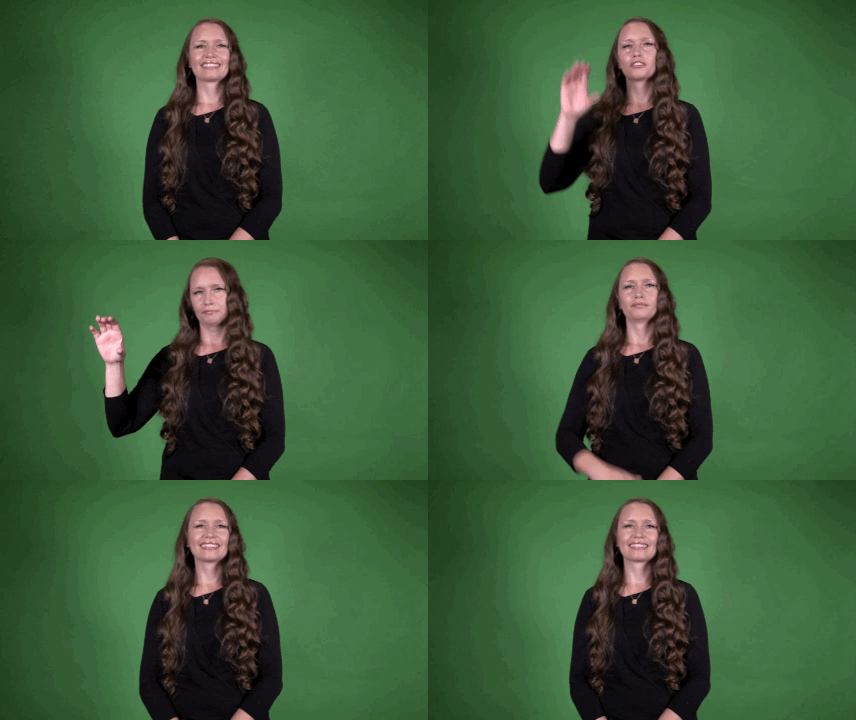
Definition: Closed captioning: Text display of spoken dialogue and sounds in videos, aiding accessibility for deaf or hard of hearing viewers.
Sign for CLOSED CAPTIONING in ASL

Practice Activities:
To begin practicing the sign for CLOSED CAPTIONING in ASL, start with isolated repetitions in front of a mirror. Focus on accuracy of handshape, palm orientation, and movement. Signing slowly will help reinforce correct muscle memory and make adjustments easier.
Once comfortable, practice the sign in short phrases such as “I watch TV with closed captioning” or “Closed captioning is helpful.” Repeat these phrases while watching content with captions turned on to create natural associations. Incorporate the sign into short daily dialogues, even if done solo, like narrating your media habits.
Partner up with someone or join an ASL study group to practice the sign for CLOSED CAPTIONING in ASL in conversations. One person can describe a situation where closed captioning might be needed, and the other can respond using the sign in a sentence. For example, “What do you do if the volume is too low on a public TV?” and answer with, “I turn on closed captioning.”
Use storytelling as an effective way to reinforce meaning. Create a short story or scenario about a deaf individual trying to watch a movie at the theater or online. Make sure to use the sign for CLOSED CAPTIONING in ASL appropriately within the context. Keep the story simple and try to include the visual idea of turning on or using captions.
Record yourself signing a review of your favorite movie or show and talk about whether it had closed captioning. Watch the video afterward to check for clarity and fluidity, and edit your performance as needed. This helps you gain fluency while staying focused on the use of the term.
Using visual media with captions on while practicing can help reinforce both English and ASL concepts. Compare your sign usage to real-world contexts and try to mimic native signers to build confidence with natural expression.
Cultural Context:
The sign for closed captioning in ASL represents more than just a visual aid. It reflects the values of accessibility, inclusion, and respect for Deaf and hard-of-hearing communities. Closed captioning allows Deaf individuals to access audio content in real time, whether on television, online videos, or streaming services.
The use of closed captioning has become an essential resource for communication in both educational and entertainment settings. The sign for closed captioning in ASL helps bridge the gap between spoken language and visual understanding. It enables users to fully participate in conversations, storytelling, and public information.
In American Deaf culture, access to language is a basic right. The sign for closed captioning in ASL supports this principle by making sure that information is never limited to only those who can hear. With captions, Deaf individuals gain deeper engagement with content that others might take for granted.
In schools and universities, the presence of closed captioning allows Deaf students to follow lectures, documentaries, and class discussions. The sign for closed captioning in ASL becomes a tool for students to request this support and advocate for equal access. It empowers individuals to take control of their learning environment and communicate their needs.
In mainstream media, accessibility has become more visible. You’ll often see programs labeled with CC to show that captions are available. The sign for closed captioning in ASL allows Deaf viewers to ask for or discuss whether content includes captions, helping them choose shows or videos aligned with their communication needs.
Technology plays a big part in spreading the use of the sign for closed captioning in ASL. From YouTube videos to conference presentations, more platforms use auto-caption features. The ASL community uses the sign for closed captioning to discuss these tools, recommend them, or critique their accuracy.
This sign is also important during public events. Whether attending a conference, political rally, or performance, using the sign for closed captioning in ASL lets event staff know that captions are needed or expected. It’s a simple but direct way to request access and raise awareness.
In family settings, the sign for closed captioning in ASL helps Deaf children and adults communicate their preferences while watching TV or movies together. It creates a shared experience that values everyone’s ability to understand and enjoy content equally. It reduces barriers while strengthening bonds.
For many Deaf professionals, the sign for closed captioning in ASL is used when discussing virtual meetings or workplace content. Captioning allows for smoother communication among hearing and Deaf team members. This
Extended Definition:
The sign for closed captioning in ASL is a specific visual representation used to indicate when text captions are being displayed on a screen, usually for the benefit of individuals who are deaf or hard of hearing. It’s commonly used in a variety of settings, from classrooms and public places to video content, movies, and live broadcasts. Knowing the sign for closed captioning in ASL is essential in communicating about accessibility features.
This sign typically mimics the concept of captions appearing on a screen. It often involves both hands forming the letters C and C, moved in a square-like motion to suggest a screen display. The gesture makes the concept highly recognizable to ASL users, especially in technological or educational contexts.
Understanding and using the sign for closed captioning in ASL is important for promoting inclusion and awareness in conversations around accessibility. It allows signers to easily refer to captioned content and ensures that deaf individuals are informed about the availability of this resource. It also supports advocacy for equal access in multimedia environments.
With the increase in streaming services, online education, and video content, the need to know the sign for closed captioning in ASL has grown significantly. It empowers deaf individuals to request captions and encourages content creators to include inclusive features. In many community discussions, this sign is now standard when talking about media accessibility.
Teachers, interpreters, and accessibility coordinators often use the sign for closed captioning in ASL when giving presentations, instructing students, or setting up televised material. It allows them to quickly reference whether captions are available or need to be turned on. The sign is effective in saving time while delivering clear communication about media settings.
In everyday settings such as meetings or classrooms, people utilize the sign for closed captioning in ASL to ask if captioning has been activated or to suggest enabling this function. This shows a proactive approach to making information environments more inclusive for everyone. It’s particularly useful where rapid communication is needed.
Learning the sign for closed captioning in ASL is an important part of expanding ASL vocabulary and engaging with digital content in a meaningful way. It not only reflects linguistic knowledge of ASL but also an understanding of the technology used in modern communication. Featuring this sign in ASL education helps reinforce the importance of communication equity.
Parents of deaf children and educators benefit from knowing the sign for closed captioning in ASL to help incorporate more accessible tools into their teaching or parenting. It helps them advocate for better learning environments and digital tools that support their children’s needs
Synonyms: closed captions, CC, subtitling, captioning, closed-caption texts
Educational resources: Find related learning materials in our course bank!
Want more? Check out some of our popular learning activities on the homepage!
Need to look up a sign? Use our highly rated dictionary: https://aslinteractive.com/best-asl-dictionary/
Follow us on tiktok: https://www.tiktok.com/@aslinteractive. More social media links at the bottom of this page!
Long-tail Keywords: what is the sign for closed captioning in ASL, how do you sign closed captioning in ASL, ASL sign for closed captioning
Categories:
tags: Language Learning, Accessibility, Media, Communication, Education
Parameters
*Handshape*:
The handshape used in the sign for CLOSED CAPTIONING in ASL involves forming both hands into the “C” handshape, with fingers curved and thumb opposite the fingers, resembling the letter C. The hands move slightly across the chest area, indicating a captioned screen or enclosed text.
This specific “C” handshape is symbolic for the sign for CLOSED CAPTIONING in ASL, representing the abbreviation seen on television screens. Both hands remain open in the “C” shape without contacting each other as they move to symbolize visual descriptors.
*Palm Orientation*:
The palm orientation for the sign for CLOSED CAPTIONING in ASL begins with both hands in a “C” handshape. The palms face each other and slightly inward toward the chest, with the fingertips of each “C” pointing slightly forward.
As the sign progresses, the hands move side to side in a small alternating motion while maintaining the same palm orientation. This movement mimics captions appearing on a screen. The palm position is crucial for accurately conveying the sign for CLOSED CAPTIONING in ASL .
*Location*:
The sign for closed captioning in ASL is typically made within the signing space located at chest level, centered in front of the body. Both hands are used and remain in this space throughout the motion, making it easy for the viewer to see clearly.
In some versions of the sign for closed captioning in ASL, the hands move slightly side to side at chest level. The position remains close to the body to maintain visibility and alignment with other similar signs.
*Movement*:
To show the sign for CLOSED CAPTIONING in ASL, begin by forming both hands into the letter “C” handshape. Position the hands in front of the body, about shoulder-width apart horizontally. Move them inward toward each other at the same level, then repeat the motion once or twice, simulating two “C” shapes coming together like parentheses.
The movement mimics captions appearing on a screen. This sign for CLOSED CAPTIONING in ASL is often paired with a slight bounce or repeated motion to emphasize text being displayed. Keep facial expression neutral or slightly informative, depending on the context.
*Non-Manual Signals*:
Facial expression for the sign for CLOSED CAPTIONING in ASL is typically neutral, with slight emphasis from focused eye gaze to reflect attentiveness to the concept of translated or displayed text. The brows may slightly raise when emphasizing the additional language access component.
When expressing the sign for CLOSED CAPTIONING in ASL, maintain steady head positioning and a slight narrowing of the eyes to convey intent and precision. Mild head nods or lip movements may occur if contextually reinforcing accessibility or comprehension.
*Prosody, Dominant/Non-Dominant Hand*:
The sign for closed captioning in ASL uses both hands, typically mirroring each other. Both hands are in a “C” handshape, positioned in front of the chest with palms facing each other. The hands alternate moving forward and back slightly, simulating the concept of text appearing on a screen.
This motion mimics captions scrolling or appearing. The sign for closed captioning in ASL can also involve a slight bounce or rhythm to emphasize accessibility.
Tips for Beginners:
The sign for CLOSED CAPTIONING in ASL involves fingerspelling both words. Since there isn’t a standardized iconic sign for this term used universally, clear and practiced fingerspelling is the most accurate method. When practicing the sign for CLOSED CAPTIONING in ASL, focus on fluidity and consistent pacing. It’s important not to rush through the fingerspelling—each letter should be distinct and readable to the viewer.
A common mistake is dropping or slurring letters, especially in longer words like “captioning.” Practicing in front of a mirror can help you build muscle memory and spot any unclear motions. Using videos with accurate finger formations also helps reinforce correct technique. Make sure your hand is positioned in your signing space, ideally at chest height and slightly away from your body, so it is easy for others to see.
Fingerspelling gives you flexibility in communicating technical or lesser-used terms like the sign for CLOSED CAPTIONING in ASL, but it can also be tiring. Build endurance by practicing commonly used fingerspelled words regularly. Try not to rely solely on your dominant hand’s speed—clarity is far more important than being fast.
Remember that eye gaze plays a huge role during fingerspelling. Keep eye contact with your conversation partner and rely on peripheral vision to monitor your hand. If someone didn’t understand, calmly repeat the word without frustration. Many Deaf users understand fingerspelling differently based on their own language background, so clarity really matters.
If you attend Deaf events or watch Deaf media, you might see subtle variations, such as abbreviations (like CC) being fingerspelled instead. This can also be acceptable in casual contexts. Stay open to these variations but master the full fingerspelling first to ensure you’re always understood. Practicing the sign for CLOSED CAPTIONING in ASL boosts both your vocabulary and spelling skills—two essentials for ASL fluency.
Connections to Other topics:
The sign for CLOSED CAPTIONING in ASL connects closely with concepts related to accessibility and multimedia communication. It is often used in conversations about inclusive technology, education, and rights for the Deaf and hard-of-hearing community. It commonly appears alongside signs like ACCESS, DEAF RIGHTS, and EQUAL, emphasizing its role in advocacy and digital inclusion .
This sign is also contextualized with other media-related terms. For instance, it pairs well with signs such as TELEVISION, VIDEO, and STREAMING. In educational or professional environments, the sign for CLOSED CAPTIONING in ASL may be seen in tandem with PRESENTATION or WEBINAR, giving learners a broader understanding of its usage in digital and public formats.
The sign for CLOSED CAPTIONING in ASL may also be constructed as a compound expression. It combines elements of the sign for CLOSED and the sign CAPTION, though some use a more fluid or initialized version depending on familiarity with the audience. Learners often encounter variations in fingerspelling CAPTION or abbreviating CC to fit the context, particularly in technical or casual settings.
It also connects with signs that deal with technology and devices, like COMPUTER, PHONE, or SCREEN. Knowledge of the sign helps in discussions about enabling captions on apps, platforms, and live events. This real-world relevance helps cement the sign’s importance in a modern ASL vocabulary set .
Moreover, the sign for CLOSED CAPTIONING in ASL is conceptually connected to other forms of communication access like INTERPRETER, SUBTITLE, or TEXTING. Understanding this sign lays the foundation for deeper discussions about communication modes and can lead into explaining how Deaf individuals access information in mixed communication environments.
This sign supports broader educational themes, such as literacy and language exposure, particularly for Deaf children. By bridging visual content and language, it links to signs like READ, LEARN, and UNDERSTAND, enriching the learner’s linguistic and cultural understanding.
Summary:
The sign for CLOSED CAPTIONING in ASL is a fingerspelled phrase. It usually involves spelling out each letter of the words “CLOSED” and “CAPTIONING”. While not always standardized with a single iconic sign, the use of the manual alphabet is quite common when conveying this term.
Fingerspelling serves an essential function in American Sign Language. It is employed when referring to specific terminology, technical terms, proper nouns, or words with no commonly accepted sign. In this case, the sign for CLOSED CAPTIONING in ASL relies on the clarity and precision of fingerspelling.
This sign is often seen in media access contexts. It appears most often when describing settings or services related to video content that includes on-screen textual transcriptions of spoken dialogue. This is particularly relevant for Deaf and hard of hearing communities.
Because closed captioning is critical for media accessibility, the sign for CLOSED CAPTIONING in ASL carries significant cultural weight. It represents a broader struggle and advocacy for inclusive media services. For the Deaf community, it symbolizes the fight for equal access to information and entertainment.
Technologically, the rise of online streaming platforms has led to more frequent use of the term. This increases the relevance and visibility of the sign for CLOSED CAPTIONING in ASL across digital conversations. More users are encountering or requesting closed captioning—and thus need an effective way to communicate the concept in ASL.
From a linguistic standpoint, the reliance on fingerspelling for CLOSED CAPTIONING highlights the adaptability of ASL to modern terminology. ASL continuously evolves to encompass new ideas, services, and tools, often incorporating fingerspelled or initialized signs when needed. This duality of original signs and fingerspelling is a cornerstone of ASL’s structure.
Grammatically, the fingerspelled sign for CLOSED CAPTIONING in ASL follows typical ASL syntax rules. While English sentences might use the term as a noun or adjective, ASL allows for repositioning or pairing it with classifiers for greater context. For example, describing a TV screen and layering the fingerspelled term can help illustrate the concept more dynamically.
Context enhances the meaning of this sign significantly. When signing about movie theaters, television screens, or video conferencing software, the visual space and classifiers can be used to denote accessibility features like closed captioning. This shows how the sign for CLOSED CAPTIONING in ASL is not just static manual movement but also invites spatial grammar and iconicity.
In educational settings, students learning ASL might practice this sign as part of a larger vocabulary list related to media, technology, or disability rights. It’s commonly covered in ASL classes that address social issues. It’s also often discussed during Deaf Awareness Month and accessibility advocacy events.
The correlation between the spoken term “closed captioning” and the fingerspelled ASL version indicates a linguistic bridge. This bridge enables bilingual communication between English-speakers and ASL-users. While the words may be signed manually, their conceptual weight carries the full power of cultural and legal implications in the Deaf community.
Interpreters often fingerspell the term when translating environments such as technology training, education law, entertainment panels, or advocacy forums. This underlines the importance of precision and professionalism within ASL interpreting, especially in specialized fields.
Culturally, the sign for CLOSED CAPTIONING in ASL is associated with a history of activism. The push for captioned content on television dates back to the 1970s. Landmark legislation like the Americans with Disabilities Act (ADA) fueled this movement by mandating captioning for public content.
The Americans with Disabilities Act made closed captioning a legal requirement in many contexts. This means the sign for CLOSED CAPTIONING in ASL may also carry legal connotations along with communicative ones. It’s not just a word—it’s a statement of rights and compliance.
Conceptually, captioning is more than just visual text—it bridges the gap between sound and visual perception. Highlighting this difference during ASL instruction demonstrates why fingerspelling isn’t merely a last resort. Instead, it’s a precise and respectful way of acknowledging terms that carry deep meaning.
In news broadcasts or presentations with ASL interpreters, captioning offers layered support. Interpreters may sign the content, but closed captioning adds another access point. Consequently, the sign for CLOSED CAPTIONING in ASL can function cooperatively within multi-modal communication environments.
Classification signs or initialized signs are occasionally created for repetitive terms in ASL, but due to the specificity and importance of legal accuracy, fingerspelling is preferred for this term. Users are advised to fingerspell clearly and at a moderate pace when using the sign for CLOSED CAPTIONING in ASL.
Related signs that frequently accompany it include CLOSED, SCREEN, TEXT, or VIDEO. When used together in sentences, these signs help provide context to the concept being fingerspelled. Their inclusion can enhance comprehension for both native users and learners of ASL.
The sign
Want more? Check out some of our popular learning activities!
ASL Interactive Resources
ASLInteractive YouTube Channel
Follow us on tiktok: @aslinteractive.com
Follow us on Instagram: aslinteractive
Facebook page: aslinteractive
Facebook group: aslinteractive
LInkedIn: ASL Interactive LLC
Twitter: @ASL_interactive
*Some information on this page is AI-generated. AI can make mistakes. Please check the information.


Responses