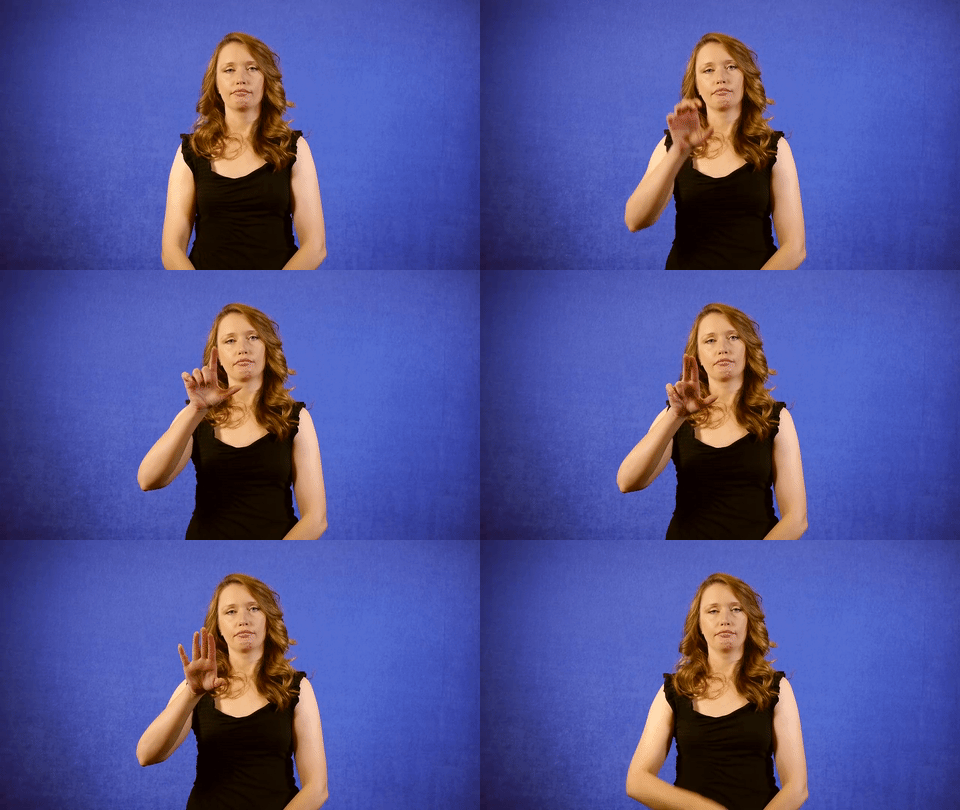
Definition: A place for social activities.
Sign for CLUB in ASL

Practice Activities:
To practice the sign for CLUB in ASL, begin by repeating the sign in front of a mirror to check your handshape and placement. Use slow, deliberate motions to make sure you’re fluent with the movement. Try signing it ten times while saying the English word in your head to reinforce the connection.
Next, integrate the sign for CLUB in ASL into short phrases. Try combining it with locations or activities, such as “book club,” “sports club,” or “school club.” This helps build context and prepares you to use it in conversation. Fingerspell the type of club you’re discussing to give specific meaning.
Create simple sentences like “I join club,” “He loves chess club,” or “My friend and I start club.” Practice signing these to work on grammar, pacing, and expression. Use facial expressions to show enthusiasm or interest depending on the sentence. Record yourself and review your signing for improvement opportunities.
Work with a partner to practice role-plays. Pretend you’re introducing your favorite club during a class presentation. You could start with “Hello! I am in a music club. We meet on Friday!” Have your partner ask questions like “Where is your club?” or “Can I join your club?”
Storytelling prompts are another great way to practice the sign for CLUB in ASL. Tell a short story about a day in a club you belong to or want to start. Include what the club does, who is in it, and when it meets. Focus on using the sign naturally and clearly during your storytelling.
Lastly, test your comprehension and expressive skills by watching videos of Deaf community members talking about clubs. Try identifying whenever they use the sign for CLUB in ASL and copy their facial expressions and sentence flow to build fluency.
Cultural Context:
Understanding the sign for CLUB in ASL involves more than just learning the handshape and movement. In Deaf culture, the concept of a club can cover various social settings, from hobby-based gatherings to school or community groups organized around shared interests. Clubs play a big role in creating community and fostering connection among Deaf and hard-of-hearing individuals.
When you use the sign for CLUB in ASL, you’re not only communicating the idea of a group but also tapping into the importance of togetherness in Deaf culture. Many Deaf clubs have historically offered safe spaces where Deaf individuals can socialize, organize events, and advocate for their rights. These groups also provide opportunities to use sign language fluently and naturally among peers.
The sign for CLUB in ASL might be used in different contexts, such as a school club, a sports club, or even a dance club. Depending on the context, additional signs might accompany the base sign to clarify meaning. For example, when referring to a dance club or nightclub, the sign for music or dance often follows to avoid confusion.
In the past, Deaf clubs formed the cornerstone of Deaf social life, especially in areas where access to communication with the hearing world was limited. These clubs allowed members to share stories, play games, watch performances, and even hold political meetings. Using the sign for CLUB in ASL reflects not just a place, but a shared space deeply valued for community bonding.
Today, while technology and social media have changed how Deaf individuals connect, clubs still hold a special place. Whether it’s a college organization or a local Meetup group, knowing the sign for CLUB in ASL allows users to talk about these important organizations clearly and accurately. These signs help express the diversity of interests and identities within the Deaf community.
The sign for CLUB in ASL also carries the idea of belonging. It highlights the communal nature of Deaf experiences, where members support each other and share common goals. Using ASL to express club membership reinforces identity and pride in Deaf culture.
In events like Deaf Expo or ASL conferences, you’ll often see references to clubs for storytelling, poetry, sports leagues, art, and advocacy. The sign for CLUB in ASL becomes part of everyday vocabulary used to navigate these culturally rich environments. It’s a useful and culturally significant sign that links individuals to wider social networks.
In educational settings, teaching the sign for CLUB in ASL helps hearing students understand how Deaf students participate in extracurricular life. It bridges understanding and encourages inclusion. The use of this sign in
Extended Definition:
The sign for club in ASL can vary depending on the context in which it’s used, such as a social group, organization, or even a physical object like a bat. This entry explains the most common ways to express the concept of a club using American Sign Language. Because ASL is a visual language, understanding the context helps choose the most accurate sign.
When referring to a social or activity-based club, the sign for club in ASL often involves forming a group sign or modifying the sign for team to indicate an organized group of people. You can show this by using both hands in a circular movement to indicate a group or community. In this context, it’s important to use facial expressions and body language to emphasize the type of club, such as a book club, sports club, or school club.
If talking about a nightclub or dance club, the sign for club in ASL shifts toward signs related to dance or party. This could include using the party sign while indicating a specific location or time. Context clues like location, clothing, or music cues can help clarify the exact meaning of the word club in a signed conversation.
When club is used as a noun for a physical object, like a baseball bat or golf club, the sign becomes more action-based. You may use classifiers or mimic the motion of swinging the object to indicate the type of club being discussed. Classifiers play a key role in conveying size, shape, and use of the object in ASL.
Understanding the different interpretations of the sign for club in ASL depends heavily on both context and situational clues. The language allows for modification and personalization, making it dynamic and visually descriptive. This flexibility is one of the unique features of American Sign Language compared to spoken languages.
When learning the sign for club in ASL, students and teachers often use role-play or visual aids to explain the different meanings. Repetition and association with real-life scenarios can help solidify the correct usage. Remember, ASL is a language with its own grammar rules, not a word-for-word translation from English.
Teachers and interpreters often emphasize the importance of learning the cultural context behind each sign. This is especially important with signs like club that have multiple meanings depending on usage. Understanding Deaf culture and community can enhance fluency and comprehension.
Parents teaching their children ASL should incorporate everyday examples, like joining a kids’ club or talking about a favorite sports club. This helps children grasp the sign for club in ASL through real communication instead of
Synonyms: organization, association, society, group, league
Educational resources: Find related learning materials in our course bank!
Want more? Check out some of our popular learning activities on the homepage!
Need to look up a sign? Use our highly rated dictionary: https://aslinteractive.com/best-asl-dictionary/
Follow us on tiktok: https://www.tiktok.com/@aslinteractive. More social media links at the bottom of this page!
Long-tail Keywords: what is the sign for club in ASL, how do you sign club in ASL, how to say club in American Sign Language
Categories:
tags: Activities, Languages, Language Learning, Social Events, Clubs
Parameters
*Handshape*:
The handshape for the sign for CLUB in ASL typically uses both hands in an “A” handshape, resembling a closed fist. These fists come together and may touch or move slightly to indicate the idea of a gathering or group.
This sign visually conveys a sense of unity or membership, essential to understanding the meaning behind the sign for CLUB in ASL. The positioning and repetition reflect the concept of people joining together in one place.
*Palm Orientation*:
The palm orientation for the sign for CLUB in ASL typically involves both hands in “C” handshapes facing each other with palms turned slightly inward or downward, depending on the variation being used. In this version, the hands mimic a motion as if gathering or coming together, representing a group or organization.
Another variation of the sign for CLUB in ASL uses the dominant hand in a “C” shape tapping slightly or circling above the non-dominant hand or chest. The palm usually faces either inward or downward during the motion, maintaining clarity within the context.
*Location*:
The sign for CLUB in ASL is typically made in the neutral space in front of the upper body, around the chest to shoulder height. Both hands start in “S” handshapes and may be brought together or tapped to mimic the idea of a group or gathering.
When expressing the sign for CLUB in ASL, the motion occurs close to the torso but not touching, keeping the movement visible and central. This location emphasizes the collective or social nature associated with the word “club.”
*Movement*:
To produce the sign for CLUB in ASL, both hands take on an “S” handshape, resembling fists. The fists are then brought together in front of the chest and touch lightly, representing unity or a gathering.
This movement symbolizes a group of people coming together, just like in a club setting. The sign for CLUB in ASL uses this symmetrical motion to suggest community or organization .
*Non-Manual Signals*:
When using the sign for CLUB in ASL, maintain a neutral or slightly inquisitive facial expression depending on context. If expressing affiliation or excitement about a specific club, raised eyebrows and a slight head tilt can show engagement or enthusiasm.
Context often drives the non-manual signals in the sign for CLUB in ASL—such as if used to ask about joining or to describe a social group. Match your facial expression to the tone, like friendly or curious, to enhance clarity.
*Prosody, Dominant/Non-Dominant Hand*:
The sign for CLUB in ASL uses both hands in flattened “C” handshapes, palms facing each other. The dominant hand taps the non-dominant hand twice at the wrists or forearms, resembling the idea of a community or group joining together. This motion captures the shared space or gathering nature that the sign for CLUB in ASL represents.
Handedness is important in this sign. The dominant hand leads the action, contacting the non-dominant hand to symbolize unity or inclusion, which reinforces the meaning behind the sign for CLUB in ASL .
Tips for Beginners:
When learning the sign for CLUB in ASL, beginners should first determine the context in which “club” is being used, as ASL differentiates between meanings such as a social club, a night club, or a physical object like a bat or club. For social organizations or groups, the most common sign uses both hands in the “C” handshape and circles them around to form the shape of a group or gathering. Start with both “C” hands held apart in front of the chest, and then bring them together slightly in a circular motion, as if forming a circle around imagined people.
A common mistake when practicing the sign for CLUB in ASL is confusing it with signs for “group” or “team,” which share similar handshapes and movement. To avoid this, focus on the palm orientation and distance between the hands. Stay mindful that the motion should be smooth and deliberate, symbolizing unity or gathering rather than just a circular gesture.
Practicing in front of a mirror helps with symmetry since both hands are active in this sign. Clear handshape formation of the letter “C” is crucial—make sure your fingers are appropriately curved and not too open like a claw or too tight, which can confuse the meaning. Also, keep your movement at chest level and not too high or low for better visibility and clarity.
Reinforce your understanding by watching native signers use the sign for CLUB in ASL in conversation. Context is key—watch how facial expressions and body posture may slightly shift depending on whether someone refers to a book club versus a party-themed night club. Don’t be afraid to ask fluent signers for feedback. With regular use and observation, you’ll grow confident in using the sign naturally and accurately.
sign for CLUB in ASL, how to sign social club in ASL, sign for night club in ASL, club sign ASL, ASL sign for club organization, American Sign Language sign for club, sign CLUB ASL, how to do sign for CLUB in ASL, different ways to sign club in ASL, learn ASL sign for club
Connections to Other topics:
The sign for CLUB in ASL is connected to broader concepts such as “group,” “organization,” and “team.” These related signs often involve classifiers showing assemblage or categories of people, making it easier to distinguish between different social or formal groupings through context.
Learners exploring the sign for CLUB in ASL can benefit from examining how shared motion patterns and spatial placement are used in signs like COMMUNITY, MEETING, and GATHER. These often incorporate circular or enclosing movements to express togetherness or unity, supporting the visual metaphors behind social structures.
In terms of compound signs, CLUB can be used in phrases like SCIENCE CLUB, DRAMA CLUB, or BOOK CLUB. In these combinations, the subject or theme is signed first, followed by the base sign for CLUB to indicate a specialized group. This structure helps in forming new signs while maintaining clarity in communication.
The sign for CLUB in ASL also intersects with school-related vocabulary. It appears frequently in educational settings to describe extracurricular activities, particularly during discussions about STUDENT involvement, CAMPUS opportunities, or WEEKLY events. Understanding this sign lends itself to greater depth in conversations around school and social life in Deaf culture.
Context plays a powerful role in distinguishing the social sign of CLUB from possible interpretations like a physical club for sports. In such cases, signs for BASEBALL CLUB or GOLF CLUB may shift meaning depending on whether referring to a group or an object, and may instead require clarification through description or fingerspelling.
Moreover, the sign for CLUB in ASL illustrates how space can be used to rank or compare multiple group-related signs, such as NATIONAL CLUB versus LOCAL CLUB. This spatial use reinforces comprehension of structure, hierarchy, or affiliation in ASL dialogues related to community or identity.
Summary:
The sign for CLUB in ASL can vary depending on the meaning you’re aiming to convey. Typically, this word may refer to a type of social organization, a sports team affiliation, or even an item to physically strike with. In ASL, context will deeply determine which sign is most appropriate.
For most conversations about social groups or organizations, the sign for CLUB in ASL is made by fingerspelling the word C-L-U-B. It is generally fingerspelled when referring to specific names of clubs or when there is no context pointing toward a more conceptual sign. Club names like Drama Club or Book Club are often signed by stating the pointer noun first, then fingerspelling “CLUB.”
Another sign variation involves forming both hands into “C” handshapes and bringing them together in a downward motion as if enclosing a group. This visual metaphor captures the idea of people coming together in a structured manner. This version is more commonly used in casual or generalized conversation to refer to a club that brings people together under a specific banner or cause.
The sign for CLUB in ASL holds cultural significance within the Deaf community. Deaf clubs historically served as crucial hubs for social interaction, mutual support, job networking, and cultural preservation. These clubs were more than just recreational spaces; they were lifelines in times of widespread communication barriers and social exclusion.
In this cultural context, signing CLUB is often done with pride and nostalgia, particularly among older Deaf adults who remember the golden age of Deaf clubs. These places hosted storytelling, signed poetry, community debates, and civic meetings. By signing CLUB, a signer can evoke an entire history of Deaf social life that predates much of today’s online platforms.
Linguistically, using the sign for CLUB in ASL highlights ASL’s capacity for layered meaning. A single sign might link to an organization, a physical location, or a sense of belonging, all depending on context. That’s where eye gaze, facial expression, and sentence structure come into play in ASL grammar.
Grammatically, fingerspelling CLUB may follow a noun-topic structure. You might sign HS CLUB, raising your eyebrows to indicate the topical subject, then follow with a clarifying statement. This usage demonstrates how ASL often front-loads topics before adding detail, aligning with its visual nature.
In ASL conversations, the sign for CLUB is also context-sensitive. If someone signs FAN CLUB, they would typically combine the concept of “admire” or “support” and then fingerspell CLUB, often using nonmanual markers like an excited or proud facial expression to reinforce the sentiment. The visual-spatial nature of ASL allows for the concept of CLUB to be enriched by expressive modality.
There are also conversations where CLUB might refer to a physical object — like in “golf club” or “baseball club.” In these cases, rather than using the fingerspelled CLUB, signers might mime swinging the equipment, showing the classifier for the object. Then they might clarify or fingerspell it if ambiguity remains.
The sign for CLUB in ASL connects to broader themes of belonging, identity, and group dynamics. Whether referring to a fan club, a student club, or a professional association, the sign demonstrates how humans form social units. In the Deaf community, the concept of CLUB strengthens the collective identity among signers.
Applied linguistics research into ASL often examines signs like CLUB for how they shift across registers and contexts. A sign may appear quite formal in one setting, such as an academic presentation about university clubs, and informal in other settings, like casual storytelling in a social group.
The hybrid usage—fingerspelling mixed with gestural elements—underlines the dynamic structure of ASL. This is a perfect example of multimodality in a signed language, where meaning comes not just from handshapes but also from movement, location, and body posture.
Deaf clubs also historically played a role in language transmission. Before the rise of mainstreaming in schools, Deaf clubs were pivotal in language exposure for young Deaf individuals. Old stories signed in these settings became repositories of cultural linguistics, narrative style, and ASL nuance.
As such, the sign for CLUB in ASL also ties into themes of intergenerational knowledge transfer. Studying the stories, jokes, and rituals shared in these clubs provides linguistic scholars with insights into informal ASL evolution and even regional differences in how CLUB is signed.
In educational settings, signing CLUB often occurs when discussing extracurricular activities with students. Teachers and interpreters frequently need to sign Club Fair, Science Club, or GSA Club in a way students understand clearly. Warm facial expressions help express positive connotations of social involvement.
Within ASL literature and media, the sign for CLUB can become symbolic. For example, in signed dramas or storytelling, a club might represent unity or resistance. Its semantic versatility makes it a powerful tool for visual metaphors and narrative structure.
The semantic field surrounding the sign for CLUB in ASL includes
Want more? Check out some of our popular learning activities!
ASL Interactive Resources
ASLInteractive YouTube Channel
Follow us on tiktok: @aslinteractive.com
Follow us on Instagram: aslinteractive
Facebook page: aslinteractive
Facebook group: aslinteractive
LInkedIn: ASL Interactive LLC
Twitter: @ASL_interactive
*Some information on this page is AI-generated. AI can make mistakes. Please check the information.


Responses