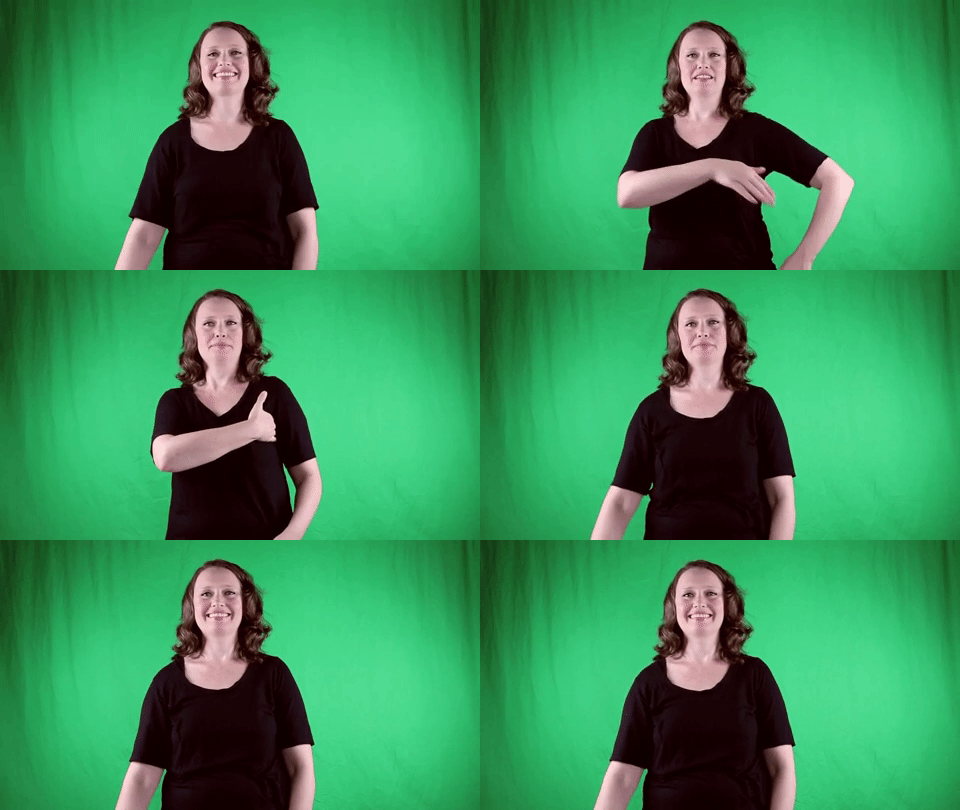
Definition: A pedal in a car.
Sign for CLUTCH in ASL

Practice Activities:
To build fluency with the sign for CLUTCH in ASL, start by practicing the sign in isolation. Stand in front of a mirror and repeat the sign several times to focus on handshape, facial expression, and movement. Try alternating between slow and fast repetitions to gain control and accuracy.
Next, integrate the sign into short phrases or descriptive sentences. Examples include: “I saw her clutch her bag tightly” or “He had to clutch the handle as the car turned.” Emphasize the emotional intensity of the word, reflecting it through your facial expressions and body movement. Practice these sentences using exaggerated expressions for confidence-building.
Try creating small skits or dialogues with a partner. One person can describe a suspenseful or surprising scenario where someone might clutch something, like a sudden noise or a scary movie. The partner responds using the correct sign in an appropriate context. For instance, “The child clutched his blanket when the thunder roared” is a great setting to act out.
Storytelling is another effective activity. Develop a narrative where a character is nervous, scared, or excited, then insert the sign for CLUTCH in ASL naturally into your narrative. Think about scenes like holding on during a roller coaster ride or clinging to a treasured item. Describe the tension in the moment while signing.
You can also play a guessing game where one person acts out the sign for CLUTCH in ASL with dramatic context, and the other guesses the situation. Use prompts like “clutching a purse,” “clutching a steering wheel,” or “clutching a friend for support” to keep it engaging and realistic.
End your session by recording yourself using the sign in spontaneous sentences. Review the video to check for accuracy and emotional impact, then refine as needed.
Cultural Context:
In American Sign Language (ASL), the concept of a “clutch” can be expressed in several ways depending on the context. The sign for CLUTCH in ASL can relate to both a mechanical part in a car and to emotionally clinging or holding on tightly to something. Understanding the difference is key to using the correct sign.
When talking about vehicles, the sign for CLUTCH in ASL often mimics the action of pressing or releasing a foot pedal. It visually demonstrates the motion used when operating a manual transmission. This visual accuracy helps convey the mechanical function of a clutch.
However, the sign for CLUTCH in ASL can also refer to a moment of high pressure, like when someone performs well during a critical situation. In sports contexts, the term “clutch” is used to describe a player who delivers under pressure. ASL users may rely on facial expressions and context clues to clarify this meaning when signing.
In fashion, the term can refer to a small handbag. The sign for CLUTCH in ASL in this case may include classifier handshapes or gestures that depict a small bag being held or clutched under the arm or in the hand. This use of classifiers in ASL allows for a rich, descriptive presentation, and it shows how versatile the language can be.
The cultural context for the sign for CLUTCH in ASL is also important in understanding the Deaf community’s approach to metaphor and nuance. ASL tends to be highly visual and relies heavily on context to convey precise meanings. So one sign can have varied interpretations based on non-manual signals like facial expressions, body movement, and the surrounding conversation.
Deaf culture values visual storytelling, so signs like the one for CLUTCH in ASL are often demonstrated in physical scenarios rather than explained with a single static sign. This helps ensure clarity and strengthens communication among users. In this way, ASL remains a living language, adapting to modern and technical terminology, including mechanical parts, sports slang, and fashion items.
In a driving education setting, especially when teaching Deaf teens, the sign for CLUTCH in ASL becomes crucial. It helps convey fundamental concepts about how a vehicle operates, which is key to understanding car maintenance or safe driving techniques. A clear sign offers both symbolic representation and instructional value.
The richness of the sign for CLUTCH in ASL lies in its adaptability and reliance on context. Whether someone is describing car mechanics, clutch performance in sports,
Extended Definition:
The sign for clutch in ASL depends on the context in which the word is used. In American Sign Language, many terms have multiple meanings, so it’s important to consider how clutch is being used—whether as a verb, noun, or even slang. ASL often uses classifiers or descriptive signs to convey specific meanings when there isn’t a direct one-word sign available.
When referring to clutch as a verb, such as “to hold tightly,” the sign often involves mimicking the action of grabbing or squeezing something close to the chest or in the hands. You might use a handshape that resembles grabbing, followed by a motion that shows an intense grip. This type of gesture clearly communicates the physical action behind the concept of clutching.
In automotive contexts, clutch refers to a mechanism in cars that engages and disengages power transmission. There isn’t a universal, singular sign for the mechanical clutch in vehicles, so signers typically use a combination of initialized signs—such as fingerspelling “C-L-U-T-C-H”—along with descriptive gestures that show the pedal or gear-shifting process. This use of fingerspelling is common for technical terms that don’t have widely accepted ASL equivalents.
When talking about clutch in sports or slang, like saying “that was a clutch performance,” the sign is more about conveying the meaning behind the phrase. You might sign SUCCESS or IMPORTANT paired with facial expressions to show urgency or mastery at a key moment. Context is crucial, and body language helps deliver the intended message.
The sign for clutch in ASL can sometimes involve using classifier handshapes to represent objects or actions. For example, if you’re describing someone clutching a purse or bag, you would use a handshape that mimics grasping an object and holding it close. This type of representation makes it easy to understand based on the scenario.
Because ASL is visually expressive, you can adapt the sign for clutch in ways that match what you’re trying to describe. Whether you’re talking about an emotional reaction, a game-winning play, or holding onto an object tightly, you’ll be using gestures that paint a clear picture of the idea. This flexibility is one of the strengths of American Sign Language.
If you’re unsure of which sign to use for clutch in ASL, consider the context first and whether fingerspelling may be appropriate. It’s also completely natural in ASL to combine signs and gestures to construct the full meaning, especially when a direct translation doesn’t exist. This means the sign can vary
Synonyms: grab, grip, hold tightly, grasp, seize
Educational resources: Find related learning materials in our course bank!
Want more? Check out some of our popular learning activities on the homepage!
Need to look up a sign? Use our highly rated dictionary: https://aslinteractive.com/best-asl-dictionary/
Follow us on tiktok: https://www.tiktok.com/@aslinteractive. More social media links at the bottom of this page!
Long-tail Keywords: what is the sign for clutch in ASL, how do you sign clutch in ASL, ASL sign for clutch
Categories:
tags: Objects, Actions, Language Learning, Everyday Activities, Transportation
Parameters
*Handshape*:
The handshape for the sign for CLUTCH in ASL typically begins with open curved hands, often resembling the “C” or claw shape, poised in front of the body. The fingers are spread slightly but are curved as if grasping an invisible object.
As the sign is produced, the hands close in toward each other or around an imaginary item, mimicking the physical action of grabbing or holding tightly. This emphasizes the intense grasp associated with the sign for CLUTCH in ASL.
*Palm Orientation*:
The palm orientation for the sign for CLUTCH in ASL typically involves both hands starting with open palms facing each other. As the sign progresses, the fingers curl inward into a claw-like position, with the palms gradually rotating to face each other more directly as if grasping or seizing an object.
This hand movement mimics the physical action of clutching something tightly. In the sign for CLUTCH in ASL, palm orientation plays a key role in conveying the sense of gripping or holding firmly. ️
*Location*:
The sign for clutch in ASL is typically formed in the neutral space in front of the upper torso or chest area. The location allows for natural arm movement, often bringing the hands together as if gripping or holding tightly, reflecting the physical act of clutching. This central placement provides a clear visual focus for the sign for clutch in ASL.
Depending on context, especially for mechanical or emotional meanings, the sign may slightly shift closer to the body to emphasize intensity or to mimic the positioning of a car’s clutch. Regardless of variation, the location remains close to the chest area or just in front of it to maintain visual clarity. The sign for clutch in ASL does not generally move above the shoulders or below the waist.
*Movement*:
The sign for clutch in ASL involves forming both hands into clawed “C” shapes. Bring the hands inward toward the chest area simultaneously, as if grabbing an object tightly, then hold the position briefly with a slight squeezing motion. This mimics the physical act of clutching something close with force or urgency.
In some contexts, facial expressions of tension or urgency may accompany the sign for clutch in ASL to emphasize emotion. This helps convey the intensity of the action, whether it’s clutching a physical object or expressing an emotional reaction.
*Non-Manual Signals*:
Facial expression for the sign for clutch in ASL often includes slight tension or urgency in the eyes and eyebrows, conveying a sense of grasping or holding onto something tightly or suddenly. The mouth may be slightly pursed or open, depending on context, to emphasize effort or intensity.
When using the sign for clutch in ASL, a quick inhale or brief head movement forward might accompany the sign to show immediacy or strong intent. Maintain focused eye contact to reinforce the meaning, especially in emotionally charged or descriptive contexts.
*Prosody, Dominant/Non-Dominant Hand*:
The sign for CLUTCH in ASL uses the dominant hand shaped like a claw (C-handshape) to mimic the act of grasping or grabbing something tightly. The dominant hand lunges forward and grasps an imaginary object, then holds it close to the body with slight tension, emphasizing a firm grip.
The non-dominant hand may remain at the side or mimic a secondary object if context requires. Facial expression is important in the sign for CLUTCH in ASL to show urgency or strength, depending on the situation.
Tips for Beginners:
When learning the sign for CLUTCH in ASL, it’s important to first understand the context in which the word is being used. ASL relies heavily on visual concepts, so “clutch” can vary depending on whether it means to grab suddenly, hold tightly out of anxiety, or a mechanical car part. The specific sign you’ll use must closely match the intended meaning through facial expressions, body posture, and precise hand shapes.
Beginners often make the mistake of using a gripping motion without incorporating the non-manual markers like tension in the face or shoulders. For the emotional or physical action of clutching, like holding a bag or grabbing someone’s hand in fear, use a fast motion to show urgency, followed by a firm hold. Practice showing tension in your facial expression to emphasize the tight, urgent nature of the motion.
To master the sign for CLUTCH in ASL, pay close attention to handshape consistency. A common error is changing the handshape midway through the sign, which can confuse the meaning. Keep your movements deliberate and clean. Over-exaggerating can sometimes make the motion look unnatural, so aim for clear but fluid articulation.
Watching videos or practicing in front of a mirror can really help fine-tune the motion. It’s also useful to learn nearby concepts such as “grab,” “hold,” and “grip” to distinguish subtle differences. Immersing yourself with native signers and asking for feedback speeds up your improvement.
If you’re referring to the car part, be aware that the concept might be fingerspelled or described based on context. Always consider your audience and whether they understand technical vocabulary in ASL. Practicing the diverse meanings of the sign for CLUTCH in ASL will help you become more natural and confident in conversations.
sign for clutch in asl, clutch hand movement in asl, car clutch in asl, clutch emotion expression in asl
Connections to Other topics:
The sign for CLUTCH in ASL may relate to the concept of holding tightly or grasping suddenly, which connects it to other action-based signs such as GRAB, HOLD, or CATCH. These variations often show similar hand shapes and movements, helping learners build associations across different ASL vocabulary. Understanding the physicality of the sign for CLUTCH in ASL can also enhance comprehension of emotional or expressive signs related to tension or desperation.
This sign also pairs naturally with signs like STEERING or DRIVE when discussing driving scenarios, especially when describing how a person uses a car’s clutch with a manual transmission. The combination of signs like CAR, SHIFT, and CLUTCH can form compound expressions used in storytelling, particularly in narratives involving car troubles or learning to drive.
Emotionally, the sign for CLUTCH in ASL can be metaphorically linked to the concept of clinging or being in a high-pressure situation, much like in English usage such as “clutch performance” or “clutching onto hope.” This metaphorical usage opens connections to signs like NERVOUS, URGENT, or EVEN DESPERATE, especially in an expressive or dramatic context.
In sports contexts, the sign for CLUTCH in ASL becomes useful when referring to game-changing moments, usually paired with signs like TEAM, WIN, or SCORE. This allows for more vivid storytelling and game analysis in ASL conversations, especially among sports fans and athletes using ASL.
Learners also benefit from recognizing the connection between CLUTCH and signs showing physical control and reaction, such as STOP or CATCH-UP. These dynamic signs support a deeper understanding of timing and force in expression. The sign for CLUTCH in ASL serves as a bridge between physical action and emotional intensity, showing how ASL often blends literal and figurative meaning through movement.
Summary:
The sign for CLUTCH in ASL can vary depending on whether the word is used literally or figuratively. In its most literal sense, such as referring to holding something tightly with one’s hands, it usually mimics a grabbing motion. This movement involves both hands shaped like the letter C or clawed hands coming together quickly to represent gripping or seizing an object.
When referring to a mechanical clutch, such as in a car, the concept may involve initialized signs using the letter C, or the signer may opt to fingerspell the word CLUTCH directly. Some signers combine the motion of shifting gears with a specific facial expression to demonstrate pushing down a clutch pedal, giving context without needing to fingerspell. The movement of the dominant foot pushing down can also be mimed indicating pressing a pedal down in coordination with a shifting motion.
In metaphorical contexts, such as saying someone is in a clutch situation or clutching emotionally, the sign often incorporates emotion-laden facial expressions. The gesture could include hands grasping toward the chest, symbolizing an emotional hold or tense moment. Classifiers, like CL: Claw-5 handshape, might be used to illustrate the emotional depth in a visual way.
The sign for CLUTCH in ASL aligns with the broader category of hold, grab, and grasp signs. This means it shares structural similarities with signs like GRAB, HOLD, or CARRY, enhancing mutual intelligibility among these concepts. The underlying handshapes and general palm orientation stay consistent with many of these related signs, supporting smooth transitional understanding in conversation.
Grammatically, the sign for CLUTCH in ASL often functions as a verb. Its placement within a sentence will follow typical ASL structure—subject-object-verb or topic-comment—depending on whether the meaning is concrete or idiomatic. This flexibility makes it useful in both formal and informal settings.
In performance-based ASL such as Deaf poetry or storytelling, the sign for CLUTCH can be stylized for dramatic effect. A signer may exaggerate the hold or slow the motion to extend tension or emotional stakes in the narrative. This artistic use showcases the fluidity and expressive potential of ASL as a performance language.
Semantic implications of CLUTCH hold relevance in both Deaf and hearing cultures, especially when borrowing metaphorical usage. A person who performs well under pressure might be described as clutch—this usage can be visually represented in ASL through stylized performance and contextual visual metaphors. The sign may be accompanied by affirming nonmanual signals like raised eyebrows or intense eye gaze.
In sports commentary within the Deaf community, the sign for CLUTCH may acquire additional nuances. It’s useful for describing crucial moments in a game, such as a key shot or game-saving move. The signer might combine the basic grasp motion with a strategic classifier or mimic the action symbolically within space.
From a linguistic perspective, the handshape used in the sign for CLUTCH reveals a high degree of iconicity. It closely mimics what the body does when it actually clutches something, grounding the visual representation in physical reality. This natural alignment between form and meaning is a foundational principle in ASL linguistics.
Applied linguistics studies in ASL note how signs like CLUTCH rely not just on handshape, but on the integration of space, intensity, and facial grammar. The space in front of the signer becomes a dynamic canvas where concepts like CLUTCH can compress emotional gravity. Nonmanual cues often convey the tension or urgency encapsulated by clutch moments.
In multilingual contexts, such as international sign or signed pidgins, the concept of CLUTCH may be conveyed through universally interpreted gestures. These may include mimicking a hold or emphasizing the emotional essence with facial expression. Because the English word ‘clutch’ doesn’t always map neatly onto other languages, ASL’s visual framing offers a cross-cultural bridge.
Learners of ASL often encounter the sign for CLUTCH when diving into more expressive or abstract vocabulary. It’s commonly introduced in intermediate courses when students are ready to animate nuanced human behavior and complex emotional states. The sign offers a great test case for visually representing tension and relief.
For Deaf educators, teaching the sign for CLUTCH provides an opportunity to highlight the richness of visual metaphor. Students are asked to consider what “clutch” means beyond its dictionary definition—how it feels, looks, and unfolds in space and time. This opens discussions about where meaning comes from in ASL and how signs are dynamically shaped by the signer’s intention.
In sociolinguistics, the sign for CLUTCH may signal group belonging or shared experience when used in idiomatic phrases typical within Deaf culture. Peer groups may develop their own specific variations depending on regional dialect. There may be slight shifts in movement or intensity to create a local flavor in the way CLUTCH is understood.
Technology has also influenced how the sign for CLUTCH in ASL is taught and learned
Want more? Check out some of our popular learning activities!
ASL Interactive Resources
ASLInteractive YouTube Channel
Follow us on tiktok: @aslinteractive.com
Follow us on Instagram: aslinteractive
Facebook page: aslinteractive
Facebook group: aslinteractive
LInkedIn: ASL Interactive LLC
Twitter: @ASL_interactive
*Some information on this page is AI-generated. AI can make mistakes. Please check the information.


Responses