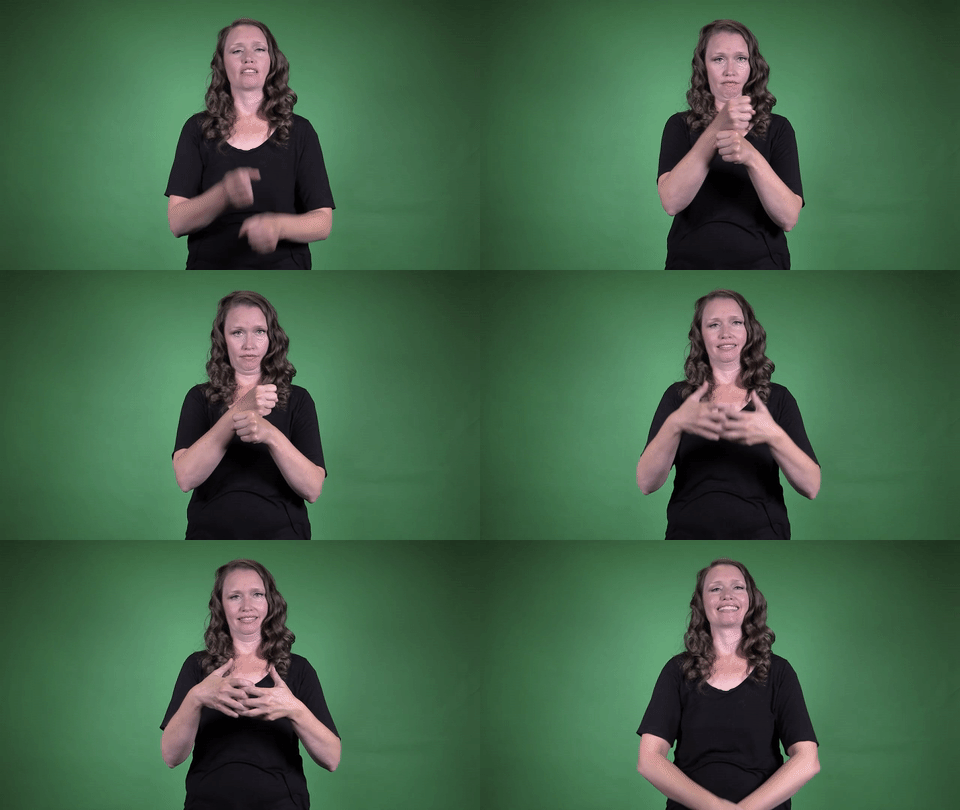
Definition: A machine for making coffee.
Sign for COFFEE MACHINE in ASL

Practice Activities:
To build fluency with the sign for COFFEE MACHINE in ASL, begin by practicing each part of the compound sign separately. Start with the sign for COFFEE by mimicking the motion of grinding coffee beans using two fists. Then move on to the sign for MACHINE, using both open claw hands interlocking at the fingers in a mechanical motion. Once comfortable, practice transitioning smoothly from one sign to the other.
Practice the full sign in isolation several times in front of a mirror. Watch for clarity in your handshapes and fluid movement between the signs. Record yourself and compare your video with a native signer or reliable ASL resource. Try to keep a steady rhythm without speeding or rushing the compound motion.
Use the sign in short sentences like “I have a COFFEE MACHINE,” “The COFFEE MACHINE is broken,” or “My friend bought a new COFFEE MACHINE.” This will help you understand how to integrate the sign into daily conversations. Create five personal sentences using the sign for COFFEE MACHINE in ASL to describe what you do in the morning, at work, or at a café.
Pair up with a partner for a dialogue activity. Take turns asking and answering questions such as, “Do you use a COFFEE MACHINE at home?” or “Where is the COFFEE MACHINE in your office?” Focus on facial expressions and hold eye contact as you sign.
A fun storytelling prompt could be: “One morning the COFFEE MACHINE didn’t work before an important meeting.” Act out the full scene using ASL, emphasizing expressions of surprise, stress, or relief. You can present your story to classmates or on video.
Finish by creating a labeled drawing of your kitchen or office. Label items in it using ASL signs, and place the sign for COFFEE MACHINE in ASL where appropriate. This connects vocabulary to real spaces and boosts retention.
Cultural Context:
The sign for coffee machine in ASL brings together two signs that each have deep cultural significance in the Deaf community. Coffee is more than just a beverage—it often symbolizes social interaction, comfort, and routine. Signing about a coffee machine is likely to occur in everyday conversations, especially in social settings or at work.
In American Sign Language, compound nouns like coffee machine are typically expressed by combining two separate signs. Understanding how to properly sign both coffee and machine provides cultural insight into how ASL users transmit detailed concepts. Learning the sign for coffee machine in ASL is useful for anyone in community settings where meeting over coffee is a shared experience.
ASL is deeply connected to the daily lives of Deaf individuals, and the vocabulary evolves with tools and appliances we use regularly. The coffee machine is one of those familiar items that appears in homes, offices, and community centers, making the sign for coffee machine in ASL a common one. Whether used in describing a task, explaining a routine, or giving directions, knowing this sign supports functional communication.
Deaf culture values clarity and directness. Using the correct sign for coffee machine in ASL shows respect for linguistic norms and improves everyday interactions. It is especially important for interpreters, Deaf educators, and those communicating regularly within the community to be accurate with such signs.
The significance of correctly signing coffee machine also speaks to accessibility and inclusion. When Deaf individuals can talk about details like appliances or preferences with ease, it promotes a more empowering and equitable space. The sign for coffee machine in ASL isn’t just helpful—it’s part of honoring communication accessibility.
ASL often adapts to reflect modern devices and tools. While coffee has long been a part of social life, coffee machines became more popular in the last century, which led to signs for these devices being regularly used in conversations. Knowing the sign for coffee machine in ASL can support conversations ranging from asking where the machine is to explaining how to use it.
Coffee breaks are part of many workplace routines, so being able to sign coffee machine efficiently can support workplace communication. Whether you’re part of a Deaf workforce, a hearing ally, or an interpreter, learning the sign for coffee machine in ASL improves fluency in common discussion topics.
By incorporating this sign in your ASL vocabulary, you’re enabling smoother interactions about routines, preferences, or instructions. When people can easily talk about something as routine as brewing coffee, the overall communication between Deaf and hearing individuals becomes richer and more effective.
The sign for coffee machine in
Extended Definition:
The sign for coffee machine in ASL combines elements from two separate signs to convey the full meaning. To express this concept clearly in American Sign Language, the sign for “coffee” is typically signed first, followed by the sign for “machine.” This sequence helps build the concept where the viewer understands it as a machine that makes coffee.
The sign for “coffee” in ASL uses both hands in a fist shape, mimicking the motion of grinding coffee beans. This action is repeated to emphasize the act of making or preparing coffee. It’s widely understood in the Deaf community and is one of the more iconic food and drink signs.
Following the sign for “coffee,” the sign for “machine” is used. This sign involves both hands in claw shapes interlocking at the fingertips, moving slightly back and forth to represent connected mechanical gears. When combined in sequence after the coffee sign, it clearly means a coffee machine.
When using the sign for coffee machine in ASL, context matters. For example, in casual conversations, you might only need to emphasize “coffee” and point to the machine. In instructional or formal settings, combining both signs gives a clearer and more complete visual concept.
Regional variations exist, and some people may use slightly different movements or sequences. However, using the standard form—coffee followed by machine—ensures a general understanding across most ASL users. This makes it a practical choice whether you’re in a classroom, workplace, or home setting.
The sign for coffee machine in ASL is a good example of how compound signs work in American Sign Language. By piecing together two concepts through their respective signs, you create a new term without needing a separate or unique sign just for it. This is common in ASL vocabulary when talking about modern or technical items.
Unlike spoken languages which may invent new words over time, ASL often uses this layering technique. That’s why learning to sign phrases like coffee machine helps reinforce your understanding of the structure and logic behind ASL grammar. It’s also a great way to expand your vocabulary while using foundational signs.
When teaching the sign for coffee machine in ASL, it helps to demonstrate each part first. Show the sign for coffee, then the sign for machine, and finally combine the two. Visual learning plays an essential role in mastering ASL, so repeating the signs in context helps commit them to memory.
In online ASL dictionaries or video resources, the sign for coffee machine in ASL is typically demonstrated slowly and then at conversational
Synonyms: espresso maker, coffee brewer, drip coffee machine, java maker, bean-to-cup machine
Educational resources: Find related learning materials in our course bank!
Want more? Check out some of our popular learning activities on the homepage!
Need to look up a sign? Use our highly rated dictionary: https://aslinteractive.com/best-asl-dictionary/
Follow us on tiktok: https://www.tiktok.com/@aslinteractive. More social media links at the bottom of this page!
Long-tail Keywords: what is the ASL sign for coffee machine, how to sign coffee machine in ASL, how do you say coffee machine in American Sign Language
Categories:
tags: coffee, machine, objects, everyday activities, beverages
Parameters
*Handshape*:
The handshape for the sign for COFFEE MACHINE in ASL typically begins with both hands in the “S” handshape, symbolizing the act of grinding coffee. The dominant “S” hand rubs on top of the non-dominant “S” hand in a small circular motion, mimicking a coffee grinder. ☕
To complete the sign for COFFEE MACHINE in ASL, transition to a depiction of a rectangular box with both hands, using open “C” handshapes or modified “5” handshapes, showing the structure of a machine. This combination clearly represents both elements of the concept—coffee and machine. ️
*Palm Orientation*:
The palm orientation for the sign for COFFEE MACHINE in ASL involves two distinct positions. For the COFFEE part, both hands are in the “S” handshape with the dominant hand resting on top and grinding in a circular motion. The palms face each other vertically, imitating the action of grinding coffee beans.
For MACHINE, both hands change to open “5” claw shapes, interlocking fingers slightly with palms facing each other at a diagonal angle. This represents mechanical motion or gears working together. Combining both gives a clear representation of the sign for COFFEE MACHINE in ASL ☕ .
*Location*:
The sign for COFFEE MACHINE in ASL is typically produced in two parts. For the sign “coffee,” the hands are positioned in front of the chest, close to the upper torso, where one hand mimics a grinding motion on top of the other. For “machine,” the hands move slightly downward to the mid-torso area, near the stomach, where interlocked fingers mimic machinery gears working. Both elements of the sign remain within the central signing space in front of the body. This consistent location helps maintain clarity when signing the sign for COFFEE MACHINE in ASL ☕⚙️.
*Movement*:
To show the sign for coffee machine in ASL, first use the sign for “coffee” by forming both hands into the letter S handshape and stacking them. The top hand makes a grinding motion in a small circular movement on top of the bottom hand, symbolizing a coffee grinder.
Next, transition to the sign for “machine” by interlocking open C handshapes from both hands at the fingers while keeping the palms slightly angled. Move the hands in a small, gentle back-and-forth motion. This completes the sign for coffee machine in ASL, combining both concepts into a fluid sequence. ☕ ️
*Non-Manual Signals*:
When using the sign for COFFEE MACHINE in ASL, the signer often shows a neutral or slightly focused facial expression, especially when describing or identifying an object like a machine. Eyebrows may raise briefly to emphasize the noun or clarify which machine is being discussed.
To enhance the sign for COFFEE MACHINE in ASL, slight head tilts or nods can help indicate specificity, such as brand or type of coffee machine ☕. There is typically no dramatic emotion, unless the context involves strong opinions about the coffee or the machine.
*Prosody, Dominant/Non-Dominant Hand*:
The sign for COFFEE MACHINE in ASL uses both hands in a coordinated motion. The dominant hand, formed into an “S” shape, mimics the grinding motion of a coffee grinder by rotating on top of the non-dominant “S” hand, like turning a crank. Then, transition into the sign for MACHINE by interlocking the fingers of both slightly curved hands and moving them in a small back-and-forth motion ⚙️.
In the sign for COFFEE MACHINE in ASL, the dominant hand does most of the initial motion during the “coffee” part, emphasizing the functional grinding aspect. The non-dominant hand lends support and anchors the motion before both hands contribute equally in the machine segment. This seamless sequence clearly combines the concepts of coffee and machine into a single cohesive idea.
Tips for Beginners:
When learning the sign for COFFEE MACHINE in ASL, it’s helpful to break it into two separate components: COFFEE and MACHINE. Start by signing COFFEE, which uses both hands in the “S” handshape, where one hand is placed on top of the other and the top hand makes a grinding motion — like turning a coffee grinder. Make sure your wrists are aligned to avoid awkward movement and focus on a fluid, circular motion ☕.
Next, transition to the sign for MACHINE, which uses both hands in open clawed “5” or “C” shapes, interlocking fingers and making a small up-and-down movement to mimic mechanical motion. This sign represents machinery or something mechanical. When combined, sign COFFEE first, then MACHINE, with a slight pause or smooth transition between them to clearly indicate the compound meaning.
Beginners often struggle with timing and transitions between the two signs. Practice them separately at first until you’re confident, then combine them. Make sure each part is clearly signed to avoid confusion — for instance, signing the COFFEE part too low or without the rotating motion could impact clarity.
Facial expressions in ASL are key, but since the sign for COFFEE MACHINE is mostly descriptive and object-based, a neutral or mildly expressive face is ideal. Over-exaggeration isn’t necessary here unless you’re emphasizing a specific context, like a broken machine or a delicious cup brewed fresh ☕️⚙️.
Recording yourself or signing in front of a mirror can be a great way to check alignment and hand shape. Memory cues can help, too — think of grinding beans, then using a mechanical device. Be patient and keep practicing the full sign for COFFEE MACHINE in ASL during real-life conversations or with fellow learners to build confidence.
sign for coffee machine in asl, coffee machine sign language, how to sign coffee machine in asl
Connections to Other topics:
The sign for COFFEE MACHINE in ASL is a compound sign that connects two concepts: COFFEE and MACHINE. Both of these individual signs are used frequently in other contexts, making this compound a strong example of how ASL combines ideas to express more complex objects. The sign for COFFEE typically uses a grinding motion with both hands in fists, reflecting how coffee is traditionally prepared.
The sign for MACHINE is often used to indicate devices or mechanisms, so combining COFFEE and MACHINE logically conveys the concept of a coffee maker. This is similar to how ASL forms other compound terms such as WASH-MACHINE or COPY-MACHINE, where MACHINE gives the sense of an engineered tool or device. Each compound remains deeply rooted in its individual elements, making recognition of base signs important for learner understanding.
Understanding the sign for COFFEE MACHINE in ASL also helps learners see how ASL accommodates modern concepts by building on established vocabulary. For instance, while COFFEE may reference a general beverage, pairing it with MACHINE allows specificity in conversation about daily routines or workplace interactions. This kind of productivity vocabulary is useful in both casual and professional settings.
The COFFEE sign, on its own, can be used in related terms like COFFEE SHOP or COFFEE CUP, by combining it with additional descriptive classifiers or signs. Similarly, MACHINE is part of vocabulary in fields like engineering or maintenance, allowing learners to transfer knowledge between topics. This crossover deepens understanding and supports retention.
Using the sign for COFFEE MACHINE in ASL offers a visual and cultural link to daily life, especially in conversations about morning routines ☕ or social habits. As learners grow fluent, recognizing these structured compounds supports more fluid and descriptive communication. It also highlights ASL’s ability to evolve and incorporate new inventions while maintaining visual clarity.
Summary:
The sign for COFFEE MACHINE in ASL combines two separate concepts: COFFEE and MACHINE. Each of these individual signs carries a specific movement and meaning, and when put together, they convey the full concept effectively. Understanding how these two signs come together gives insight into ASL’s descriptive and compound nature.
The sign for COFFEE mimics the action of grinding coffee beans. One hand, in the shape of the letter “S,” sits on top of the other hand, also in an “S” shape. The top fist makes a circular grinding motion over the bottom one, giving the visual of an old-fashioned manual coffee grinder.
The word MACHINE is signed by interlocking the fingers of both hands slightly and rocking them up and down. This represents mechanical gears or connecting parts of an engine. The sign gives a visual metaphor of working parts and is frequently used in combination with other signs to indicate mechanical devices.
When combined, the sign for COFFEE MACHINE first presents the COFFEE motion, followed directly by MACHINE. This compound sign structures the description visually and chronologically, beginning with the coffee base and ending with its mechanical aspect. It’s a literal, yet effective, way of blending nouns in ASL.
The sign for COFFEE MACHINE in ASL reflects how the language constructs compound ideas in a linear visual format. Unlike English, where modifiers or compound nouns can be reordered, ASL uses proximity and sequence. This shows a profound link between grammar and spatial modality.
The sign reflects American Deaf culture’s deep appreciation for storytelling in communication. Each part of the sign tells a mini-story—grinding beans and using a machine. This narrative structure appears often in ASL signs for tools or appliances.
Coffee culture holds a unique place in both hearing and Deaf social circles. For Deaf communities, coffee shops are popular gathering places due to the typically well-lit and open space, ideal for signing. The sign for COFFEE MACHINE in ASL connects the object to that shared social environment.
There is historical significance in the usage of signs like COFFEE MACHINE in ASL. In early deaf schools, vocabulary for modern appliances evolved as technology developed. Older generations of signers may have different versions or use classifiers to show shape and function for newer appliances like espresso machines or pod brewers.
Linguistically, this sign exhibits the inflectional capabilities of ASL. You can modify the intensity or speed of grinding to indicate different coffee-making styles. For example, miming a quicker or slower circular motion might imply different brewing times or coffee strengths.
Context matters greatly. If you’re in a conversation about household appliances, just the MACHINE sign might suffice once COFFEE has already been established. This practice nods to ASL’s efficiency and reliance on shared context during discourse.
Classifier use also enriches the sign for COFFEE MACHINE in ASL. After signing COFFEE MACHINE, one could use a classifier to describe the size or brand of the machine. For example, a cylindrical classifier might represent a Keurig-style machine.
ASL users often adapt signs creatively as new machines or products emerge. Thus, while the core sign stays consistent, variations cater to specific technologies. Espresso machines or pour-over devices could lead to modified signs or additional descriptive classifiers.
The sign for COFFEE MACHINE in ASL shows the influence of visual metaphor. The COFFEE sign isn’t arbitrary—it directly represents physical motion. This iconicity is central to ASL and provides cognitive ease for learners.
Frequent usage of COFFEE MACHINE in ASL often occurs in everyday situations at home, work, or public places. Signing about coffee machines is practical and reinforces everyday vocabulary. This functional use is a key part of how language thrives in conversation.
When used in storytelling, the sign adds descriptive depth. For instance, a narrative about a morning routine might involve COFFEE MACHINE to emphasize order and tone. This helps express mood and sets scenes visually.
Deaf folks working as baristas, especially in Deaf-owned coffee shops, often adapt the standard sign to reflect specific tasks they do. This creates small community variations of COFFEE MACHINE—sometimes integrating other signs for milk steaming or espresso pulling.
In applied linguistics, COFFEE MACHINE as a compound sign offers insight into ASL morphology and how signs evolve or combine. Learning how signs combine with root concepts and modify for new contexts enhances second language acquisition frameworks.
Children acquiring ASL as a first language often learn signs like COFFEE later on, after learning about concepts like drinks or hot. MACHINE may come via other household appliances like WASHING MACHINE or DISHWASHER. These build a semantic field based on familiarity.
There’s also a sociolinguistic perspective. The use of signs for technologies like COFFEE MACHINE may signal class or lifestyle. Deaf influencers or vloggers who sign about home aesthetics or kitchen gadgets often use these compound signs to engage their audience.
Pragmatically, the sign for COFF
Want more? Check out some of our popular learning activities!
ASL Interactive Resources
ASLInteractive YouTube Channel
Follow us on tiktok: @aslinteractive.com
Follow us on Instagram: aslinteractive
Facebook page: aslinteractive
Facebook group: aslinteractive
LInkedIn: ASL Interactive LLC
Twitter: @ASL_interactive
*Some information on this page is AI-generated. AI can make mistakes. Please check the information.


Responses