Definition: A shop selling coffee.
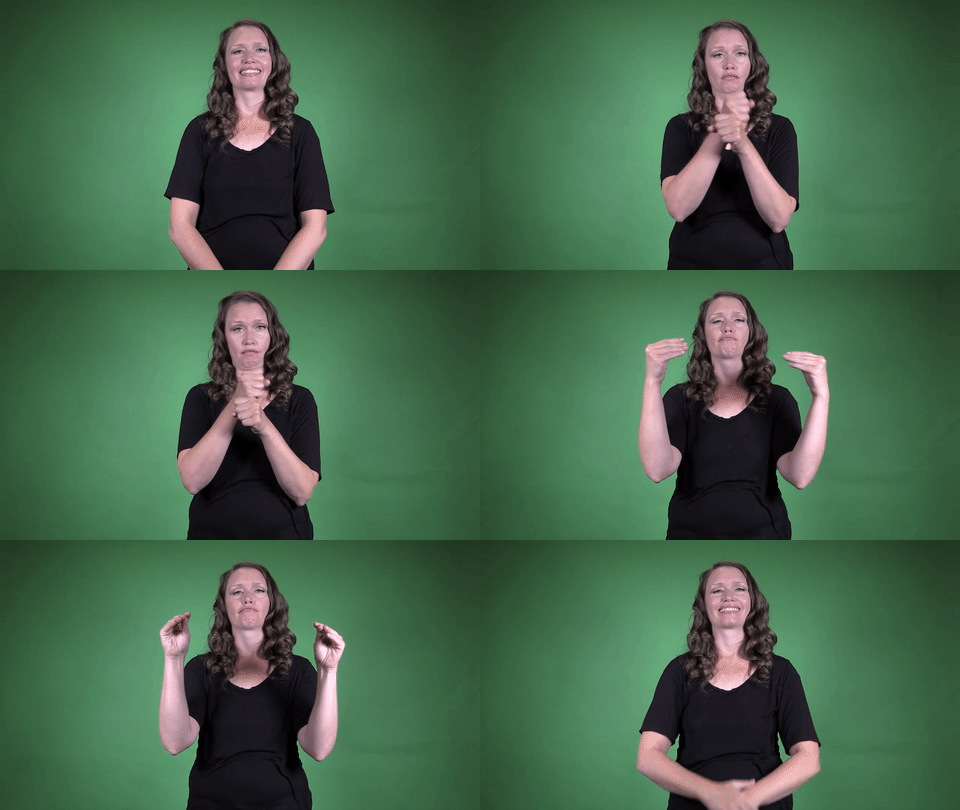
Sign for COFFEE SHOP in ASL

Practice Activities:
To practice the sign for COFFEE SHOP in ASL, start by isolating each part of the sign. Sign COFFEE by mimicking a coffee grinder motion with both fists—one hand grinding over the other. Then, sign SHOP by holding your dominant hand flat, palm down, and tapping the fingertips into the upward-facing palm of the non-dominant hand. Practice these motions separately and then smoothly connect them into one fluid phrase.
Use a mirror to help improve handshape accuracy and motion clarity. Say the word COFFEE SHOP silently in your head while signing, to strengthen brain-to-hand connection. Alternate between slow, deliberate practice and faster, natural-paced movements to improve fluency.
Try using the sign in sentences like: I GO COFFEE SHOP EVERY MORNING, or MY FRIEND MEET ME COFFEE SHOP. Practice forming your own sentences using the sign for COFFEE SHOP in ASL, adding descriptive elements like location, time, or activities. This helps you learn how to incorporate it into real conversations.
If you have a partner, take turns asking each other where you want to go or where you met someone, using the sign for COFFEE SHOP in ASL. Add variety by responding with signs for related places like LIBRARY or RESTAURANT to compare different vocabulary.
Create a short story using the sign for COFFEE SHOP in ASL. Include characters, a setting, and an event—perhaps someone ordering a new drink or running into a friend by surprise. Record your story in sign to review and self-correct, or share it with peers who can give feedback.
Flashcard drills can help reinforce the sign recognition. Use either paper cards or digital tools to mix in COFFEE SHOP with other location signs. This builds your ability to differentiate and recall signs in random order.
Cultural Context:
The sign for COFFEE SHOP in ASL brings together cultural symbols familiar in both Deaf and hearing communities. Coffee shops are not just places to grab a drink; they often serve as community gathering spots and social hubs. In the Deaf community, these spaces are especially meaningful as they offer environments that encourage conversation and connection in American Sign Language.
Knowing the correct sign for COFFEE SHOP in ASL can make a big difference when meeting up with friends or organizing community events. Coffee shops often host Deaf meetups, silent suppers, and other ASL-friendly gatherings. Using the native sign helps you connect instantly with the Deaf community and shows cultural fluency and respect.
The sign for COFFEE SHOP in ASL combines two distinct signs: one for coffee and one for shop. This gives it a layered meaning that reflects how Deaf culture often blends linguistic efficiency with visual clarity. The vocabulary may seem straightforward, but its proper use in social settings carries cultural weight.
When you use the sign for COFFEE SHOP in ASL, you’re tapping into more than just a location—you’re referencing a space where Deaf culture thrives. Whether you’re talking about a local indie café or a national chain, this sign helps build bridges between conversations and people. It also promotes accessibility and a sense of belonging for signers in shared public spaces.
Coffee culture has long had a home in the Deaf community, especially in urban centers and on college campuses where ASL use is strong. Cafés often become informal gathering places where stories are told, lessons are shared, and friendships are formed. The sign for COFFEE SHOP in ASL represents this unique dimension of social life.
Mastering simple phrases like the sign for COFFEE SHOP in ASL strengthens everyday communication for signers at all levels. It empowers both Deaf and hearing individuals to engage naturally and confidently. Sharing a coffee becomes more meaningful when the language used honors Deaf identity.
Deaf-friendly coffee shops are increasingly common, adding visual menus, ASL-trained staff, and even hosting ASL poetry nights or storytelling events. The widespread use of the sign for COFFEE SHOP in ASL supports these inclusive practices and helps raise awareness for Deaf culture. As more people learn and use this sign, coffee spaces become more welcoming and navigable for everyone.
In many areas, knowing the sign for COFFEE SHOP in ASL can guide you to community bulletin boards with events and resources specifically for Deaf visitors. It might also help you find support groups, tutoring circles
Extended Definition:
The sign for coffee shop in ASL combines two distinct signs to represent the meaning of both words. To sign coffee, you use a motion that mimics grinding coffee beans with a grinder, with one fist on top of the other making circular movements. This sign captures the essence of how coffee is traditionally made and is commonly used in everyday conversations.
Next, to sign shop or store, you make a gesture with both hands flat in front of your body, palms facing down, and flicking your fingers outward. This movement suggests the idea of giving or offering something, much like a store provides goods. When used together, the sign for coffee followed by the sign for shop clearly expresses the phrase coffee shop in ASL.
The sign for coffee shop in ASL can be used in many settings, such as making plans, giving directions, or describing a location. Deaf and hard-of-hearing individuals use this phrase often when talking about meeting up with friends, studying, or just grabbing a drink. It’s a common and important term in basic signing vocabulary.
When using the sign for coffee shop in ASL, facial expressions and body language can add meaningful context. For example, tilting your head or nodding while signing can show interest or confirm your intention to go there. These additional non-manual markers make your signing more expressive and natural, making it easier for others to understand.
This ASL phrase is helpful for anyone learning sign language, especially those interested in common social or community locations. Knowing the sign for coffee shop in ASL allows you to comfortably join conversations about everyday activities. It also helps in navigating public spaces and asking for recommendations or directions when communicating in a Deaf-friendly manner.
Like many ASL terms, regional variations might exist for the sign for coffee shop in ASL. Depending on location or community, some people might slightly modify the signs or their order. These small differences don’t usually affect understanding, especially among fluent signers.
Using the correct sign for coffee shop in ASL supports inclusivity and builds better communication between Deaf and hearing communities. It reflects respect for the culture and language of the Deaf community and encourages broader social awareness. Whether you’re an ASL student or a friend of someone who signs, learning this phrase adds useful value to your vocabulary.
To practice the sign for coffee shop in ASL, try forming simple sentences like “Meet at the coffee shop” or “Do you want to go to the coffee shop later?” These practical phrases reinforce learning and prepare you
Synonyms: _cafe_, _coffeehouse_, _espresso bar_, _java joint_, _coffee bar_
Educational resources: Find related learning materials in our course bank!
Want more? Check out some of our popular learning activities on the homepage!
Need to look up a sign? Use our highly rated dictionary: https://aslinteractive.com/best-asl-dictionary/
Follow us on tiktok: https://www.tiktok.com/@aslinteractive. More social media links at the bottom of this page!
Long-tail Keywords: what is the sign for coffee shop in asl, how do you sign coffee shop in asl, asl sign for coffee shop
Categories:
tags: Coffee, Drinks, Cafés, Places, Activities
Parameters
*Handshape*:
The handshape for the sign for COFFEE SHOP in ASL combines two distinct concepts. For “coffee,” both hands form the “S” handshape, with the dominant “S” grinding on top of the non-dominant “S,” mimicking grinding coffee beans ☕. For “shop,” both hands use the “flattened O” handshape and flick outward from the wrists, representing a transaction or store environment .
These handshapes work together to clearly express the sign for COFFEE SHOP in ASL. Each part visually conveys aspects of a coffee shop, reinforcing the meaning through movement and shape. Mastering the proper handshape brings clarity when signing the phrase.
*Palm Orientation*:
For the sign for COFFEE SHOP in ASL, the palm orientation begins with both hands in the “S” handshape. The dominant hand rotates on top of the non-dominant hand in a grinding motion, mimicking a coffee grinder. During this motion, the palms are angled down slightly or toward each other depending on the signer’s style.
Next, to indicate “shop,” both hands form flat “B” handshapes with palms facing downward. They move outward from the sides of the chest in a short, double movement. Together, these palm orientations clearly convey the concept behind the sign for COFFEE SHOP in ASL ☕ .
*Location*:
The sign for COFFEE SHOP in ASL takes place in the neutral space in front of the body, between shoulder and chest level. For the COFFEE part, both hands use the “S” handshape, with the dominant hand on top grinding over the nondominant hand in a circular motion like a coffee grinder.
After signing COFFEE, the sign for SHOP follows immediately. This part occurs in front of the chest as both flattened “O” handshapes face down and flick outward simultaneously, mimicking the idea of showing an open storefront. The combined motion remains close to the body but clearly visible. The sign for COFFEE SHOP in ASL keeps both components distinct while staying within the same signing space. ☕
*Movement*:
The sign for COFFEE SHOP in ASL combines two separate signs. First, to indicate “coffee,” both hands form the letter “S” handshape. The dominant hand circles on top of the non-dominant fist, mimicking a coffee grinder ☕. This movement is typically clockwise and repeated in a smooth, small circular motion.
For “shop,” both hands form flat “O” shapes and move forward from the chest outward in a slight arc . This suggests the action of offering goods. When combining the full sign for COFFEE SHOP in ASL, you sign “coffee” followed by “shop,” maintaining clarity and flow between the two components.
*Non-Manual Signals*:
While signing the sign for coffee shop in ASL, your facial expression should be neutral or pleasant, reflecting a casual or everyday tone. Slight raised eyebrows can indicate a question, like asking if someone wants to go there.
Keep eye contact with your conversation partner, and if you’re describing a specific place, nodding your head in the direction you’re referencing can enhance clarity. The sign for coffee shop in ASL may also include mouthing the word for emphasis, depending on the context.
*Prosody, Dominant/Non-Dominant Hand*:
The sign for COFFEE SHOP in ASL uses both hands. The dominant hand makes an “S” handshape and circles on top of the non-dominant “S” hand to represent grinding coffee, a gesture rooted in traditional coffee making ☕. Next, the sign for “store” or “shop” is made by both hands in a flat “O” shape flicking outward from the sides of the mouth or chest.
This two-part sign combines the concepts of coffee and a retail place. The sign for COFFEE SHOP in ASL visually mimics the preparation of coffee followed by indicating a storefront. This compound sign naturally blends into everyday ASL conversations.
Tips for Beginners:
When learning the sign for COFFEE SHOP in ASL, remember it’s a compound sign made from two separate signs: COFFEE and SHOP. First, sign COFFEE by stacking both hands in fists, one on top of the other, and making circular grinding motions — like you’re mimicking an old-fashioned coffee grinder. Next, sign SHOP by holding both flat hands, palms down, and flicking the fingers outward from the thumbs twice, as if dispersing goods from a store counter.
Practice transitioning smoothly between COFFEE and SHOP to make your sign more fluent and natural. Beginners often either over-exaggerate or rush the movement between the two signs, which can confuse meaning. Pause briefly between signs if necessary until you feel confident with the flow.
A common pitfall with the sign for COFFEE SHOP in ASL is incorrect hand placement or motion in COFFEE. If your grinding motion is too stiff or not circular enough, it may look like a different sign. Take time to mirror a fluent signer or use a mirror to check your own accuracy.
Also, in SHOP, make sure your hand movement is outward and controlled, not flailing or too subtle. This can help non-signers or beginner signers more easily understand your message. It’s a good idea to practice the sign while in a real café setting, connecting the concept to its use in daily life ☕️ .
Remember to maintain eye contact and facial expressions when signing the phrase in conversation. This shows confidence and improves communication. You might fingerspell the proper name of the café after signing COFFEE SHOP in ASL if you’re referring to a specific place. Repetition and context are key to developing smoother, clearer signing over time.
Connections to Other topics:
The sign for COFFEE SHOP in ASL is a compound sign made by combining the sign for COFFEE and the sign for SHOP or STORE. This illustrates a common feature in ASL where new concepts are formed through combining existing signs. Understanding how signs are compounded helps with learning other phrases like BOOK STORE, GIFT SHOP, or FLOWER SHOP, which follow similar structures.
The sign for COFFEE uses a motion that mimics grinding coffee beans, while the sign for SHOP involves a handshape that imitates giving or offering something at a store. Once learners master these foundational signs, they can extend the concept to places like CLOTHING STORE or BAKERY by swapping the first sign to match the goods being sold. The sign for COFFEE SHOP in ASL thus strengthens understanding of how specific location signs are built.
In broader language development, the use of location-based compounds in ASL also relates to learning how classifiers and space are used to indicate spatial relationships. For instance, placing the sign for COFFEE SHOP in a specific space can show its location in relation to another place, like SCHOOL or PARK, using directional referencing. This helps develop visual storytelling and spatial grammar in ASL.
Additionally, the structure of the sign for COFFEE SHOP in ASL demonstrates how cultural and environmental familiarity plays a role in sign formation. The idea of a coffee shop resonates with Deaf community gathering spaces, especially in cities with Deaf-friendly businesses. Knowing this sign and others like LIBRARY or RESTAURANT allows for more fluent and culturally relevant communication.
The sign for COFFEE SHOP in ASL also provides a foundation for discussions about daily routines, preferences, and social habits. Learners can expand vocabulary by integrating time-related signs such as MORNING or EVENING to express when they usually visit a coffee shop, enhancing conversational fluency .
Summary:
The sign for COFFEE SHOP in ASL is a compound sign made by combining the sign for COFFEE and the sign for SHOP or STORE. Each component has its own culturally grounded movement and meaning. Together, they represent not just a place, but the social and sensory experience of being at a coffee shop.
To sign COFFEE, both hands form the S-handshape, resembling fists. One hand grinds the other vertically in a small circular motion, like an old-fashioned coffee grinder. This movement ties the sign back to the cultural roots of coffee preparation, making it more than just a visual metaphor.
SHOP or STORE is typically signed using both hands in a flat O-handshape, starting at the shoulders and moving forward in a small bouncing motion. The gesture is iconic, resembling the action of handing out goods or displaying something for sale. It visually implies commercial transaction and public space.
When using the sign for COFFEE SHOP in ASL, you sequentially sign COFFEE followed by SHOP. There’s a pause between the two signs, but it’s naturally rhythmical rather than stilted. This mirrors how compound nouns often work in ASL—two or more signs brought together to create a shared semantic unit.
In ASL grammar, this compound sign behaves as a noun. You can pair it with directional verbs like GO-TO, VISIT, or WORK-AT. For instance, the phrase “I WORK-AT COFFEE SHOP” uses space setting and verb-directionality, illustrating how ASL conveys subject-object relationships.
From a cultural standpoint, coffee shops are hubs of social interaction. In Deaf culture, such venues are more than places to drink coffee—they are accessible spaces where conversation flourishes. The sign for COFFEE SHOP in ASL captures this socially relevant venue in an instantly recognizable form.
You may also see variations depending on region or signer experience. Some signers fingerspell COFFEE SHOP, particularly in formal settings or when clarity is crucial. Others modify the movement of the COFFEE part to mimic more modern coffee-making tools, indicating flexibility and evolution in the sign.
Linguistically, this compound is iconic and partially arbitrary. The COFFEE component is mimetic of manual coffee grinders. SHOP, on the other hand, carries a more metaphorical representation. Linguistics recognizes this as a blend of iconic and symbolic representation, a hallmark of ASL taxonomy.
The sign for COFFEE SHOP in ASL belongs to a broader class of place-based compounds, such as BOOK STORE, FLOWER SHOP, or ICE CREAM STORE. Each forms by combining the item or service and the general SHOP sign. This pattern demonstrates the productive morphology inherent in ASL.
Applied linguistics recognizes these productive compounds as essential teaching tools. They enable learners to understand how complex ideas are assembled from simpler sign units. The efficient combination of signs illustrates the dynamic structure of visual-conceptual mapping in ASL.
Deaf-friendly coffee shops often feature open seating layouts and good lighting, which are vital for signed communication. Thus, the sign for COFFEE SHOP in ASL becomes more than a label—it becomes a cultural symbol loaded with accessibility and visual comfort. ☕️
In sign storytelling, coffee shops frequently appear as social backdrops. Narrative descriptors like WALK-IN, ORDER, CHAT-WITH are spatially mapped around the sign for COFFEE SHOP. This anchoring helps tellers build visual coherence in ASL storytelling.
There’s a syntactic and morphological efficiency in how the compound works. Instead of fingerspelling or describing a “café” through unrelated concepts, this sign leverages bodily movement to convey meaning directly. It eliminates ambiguity and supports immediate comprehension.
From a semantic angle, COFFEE SHOP in ASL evokes both function and setting. The function is “serving coffee,” and the setting is a commercial public space. This dual anchoring mirrors how location-based nouns align with action schemas in ASL.
Regional accents in ASL may reflect in the sign for COFFEE SHOP, especially in how the SHOP sign is pronounced. Some use a quicker flicking downward motion, while others make it bouncier. These variations don’t change meaning but reflect community nuance.
The sign for COFFEE itself can be modified slightly for adjectives like STRONG or HOT. When discussing preferences, a person may sign COFFEE SHOP followed by STRONG COFFEE or FAVORITE BRAND. This syntactic flexibility reveals what linguists call ASL’s polysynthetic properties.
Younger signers or urban signers might stylize SHOP with a flourish, reflecting current signing trends. Language shift and youth slang can impact how routine signs like this are stylized. It shows the living nature of ASL—visual eloquence adapts to generational aesthetics.
In fiction and visual poetry, the sign for COFFEE SHOP in ASL helps set scene and mood. A signer may mime the act of sipping from a mug,
Want more? Check out some of our popular learning activities!
ASL Interactive Resources
ASLInteractive YouTube Channel
Follow us on tiktok: @aslinteractive.com
Follow us on Instagram: aslinteractive
Facebook page: aslinteractive
Facebook group: aslinteractive
LInkedIn: ASL Interactive LLC
Twitter: @ASL_interactive
*Some information on this page is AI-generated. AI can make mistakes. Please check the information.


Responses