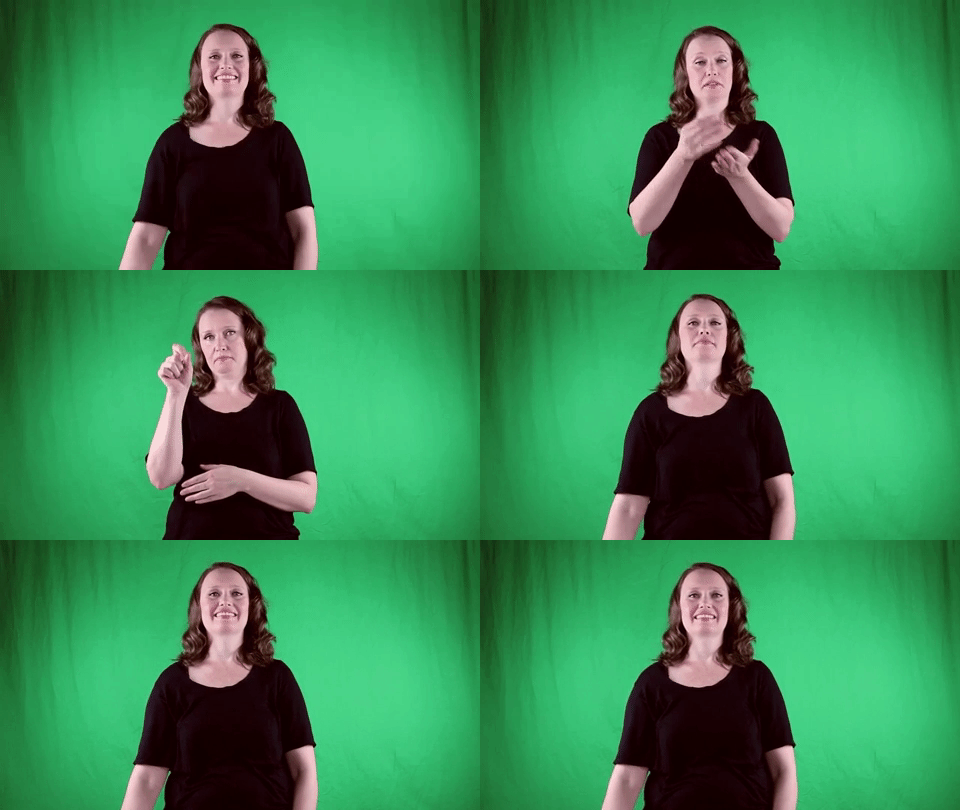
Definition: Coins inserted into a meter.
Sign for COINS IN METER in ASL

Practice Activities:
Begin by practicing the sign for COINS IN METER in ASL in isolation. Sign each component clearly: COINS (made by mimicking the act of placing coins) and METER (signing a meter device by indicating a vertical structure or pretending to insert something). Repeat the full phrase slowly, then gradually increase speed while maintaining clarity.
Use flashcards with different scenarios involving parking meters, vending machines, or other coin-operated devices. For each card, sign an appropriate sentence incorporating the sign for COINS IN METER in ASL. For example, “I need to put coins in meter before going inside” or “No coins in meter, I might get a ticket!”
Pair up with a partner and create short dialogues using the sign for COINS IN METER in ASL. One person plays a driver and the other plays a friend or passerby. Examples include asking for spare change or reminding each other to feed the meter. This builds fluency in common, everyday interactions.
Write a short story involving a trip downtown where finding parking and using a meter becomes part of the narrative. Sign the story to a friend, emphasizing each use of the sign for COINS IN METER in ASL. Include signs like PARKING, TIME, MONEY, and TICKET to create a vivid scene.
Record yourself signing several example sentences to practice expressiveness and clarity. Sentences might include “I forgot coins in meter and got a ticket ” or “My friend helped me find coins in meter just in time ⏱️.” Watching your playback helps identify areas for improvement in both handshape and facial expression.
Finally, practice by observing environments like city streets, imagining what you’d sign as if you were describing them in ASL. Use the sign for COINS IN METER in ASL when imagining what’s happening at each parking spot. This helps reinforce natural usage and builds your vocabulary in real-life contexts.
Cultural Context:
In the Deaf community, understanding how to express common, everyday activities is essential for clear communication. One such useful phrase is the sign for COINS IN METER in ASL, often used in conversations about parking, vending machines, or timed services. This phrase helps describe actions that occur in urban life and is commonly seen in cities where metered parking is the norm .
The sign for COINS IN METER in ASL goes beyond just a literal translation. It carries cultural significance because it reflects how Deaf people interact visually with public spaces where meters are present. Metaphorical and spatial aspects of American Sign Language are used to show putting coins into a narrow slot or device, which is easily visualized through signing.
Cashless systems are becoming more prominent, but coins are still widely used in many areas. Knowing the sign for COINS IN METER in ASL allows Deaf individuals to ask for change, explain a parking situation, or discuss time-limited services. It ensures they can participate equally in daily interactions involving metered systems.
In Deaf culture, access to information and smooth navigation through everyday tasks is a shared value. That’s why accurate and appropriate signs like the sign for COINS IN METER in ASL are essential. Clear signs prevent miscommunication and allow more independence when handling small but necessary tasks, like parking or buying a train ticket ️.
Location-specific knowledge also plays a role. In some areas, meters operate differently, but the general idea stays consistent. Using ASL to express this concept creates both linguistic and cultural connections within Deaf communities nationwide. The sign for COINS IN METER in ASL typically mirrors the act of inserting something, often enhanced by facial expressions to convey effort or urgency.
Also, community members may share variations of the sign for COINS IN METER in ASL depending on regional differences. That makes it important to learn the standard sign while being aware of localized versions. These changes reflect the flexibility and uniqueness of ASL as a living language used across the United States .
The presence of coins in meters has historical and social implications. For many Deaf individuals, learning how to express this concept in ASL has come from real-life necessity—whether it’s preparing for a trip to the city or explaining a frustration with a broken machine. The sign for COINS IN METER in ASL becomes more than a practical term; it’s part of the everyday urban experience.
Engaging with this phrase emphasizes the value of full language access
Extended Definition:
The sign for coins in meter in ASL refers to the specific way signers express the concept of inserting money into a parking meter or similar device. It combines signs that convey the idea of coins, inserting, and a meter as a machine used for time-based services, like parking or laundromats. This phrase is often used in everyday conversation when discussing payment methods in urban environments.
To sign coins in meter in ASL, you typically start with the sign for coins, which involves a motion indicating small metal currency, often mimicked by tapping fingers as if counting change. Then, you follow up with the sign for meter, which can vary depending on context but usually shows a cylindrical or digital device. Putting them together creates a visual representation of the act of adding coins to a meter.
The sign for coins in meter in ASL may differ slightly from one region to another. Regional variations are common in American Sign Language, especially for everyday phrases involving money or technology. Some people may even use classifiers or role-shifting to depict how coins are being put into the meter, making the phrase more dynamic in conversation.
Understanding this phrase is especially useful for ASL learners who want to improve their vocabulary related to transportation, urban life, and daily routines. Whether you’re explaining where you parked your car or describing the process of using metered services, knowing the sign for coins in meter in ASL can add clarity and detail to your signing.
You might see this phrase in discussions about accessible parking or when interpreting public announcements or instructional signage. For example, if a city requires you to pay for parking with coins, being able to use the phrase clearly in ASL helps you communicate more effectively with Deaf individuals in community meetings or formal presentations.
Using the correct sign for coins in meter in ASL conveys not just the objects involved but the action and purpose behind them. This makes the communication more accurate and natural, especially in real-life situations. Since American Sign Language is a visual and conceptual language, this kind of detail is essential for full understanding.
When teaching ASL, instructors often use scenarios like city errands or parking as a way to introduce this phrase. Practicing the sign for coins in meter in ASL within the context of storytelling or role play helps reinforce its use and meaning. It also offers a chance to practice fingerspelling and number incorporation, such as indicating how many coins are put into the meter.
This phrase is also connected to other ASL signs involving public utilities, time-related payments, and
Synonyms: coins in parking meter, money in parking meter, change in parking meter, cash in parking meter, currency in parking meter
Educational resources: Find related learning materials in our course bank!
Want more? Check out some of our popular learning activities on the homepage!
Need to look up a sign? Use our highly rated dictionary: https://aslinteractive.com/best-asl-dictionary/
Follow us on tiktok: https://www.tiktok.com/@aslinteractive. More social media links at the bottom of this page!
Long-tail Keywords: What is the ASL sign for Coins in Meter, How to sign Coins in Meter in American Sign Language, Learn how to sign Coins in Meter in ASL
Categories:
tags: money, parking, object, machines, everyday activities
Parameters
*Handshape*:
The handshape for the sign for COINS IN METER in ASL uses a modified “F” hand to represent a coin. The thumb and index finger touch, forming a small circle, symbolizing the size and shape of a coin being held.
To complete the sign for COINS IN METER in ASL, this “F” handshape moves toward an imaginary meter slot, typically depicted using the non-dominant hand in a vertical or slightly angled position. The dominant hand inserts the “coin” with a small precise flick of the wrist.
*Palm Orientation*:
In the sign for COINS IN METER in ASL, the palm orientation varies slightly depending on each conceptual part. When signing “coins,” the dominant hand usually mimics a small circular dropping motion with the palm facing down or at a slight angle. This captures the motion of putting coins into a slot.
For the “meter” portion of the sign, the hand imitates inserting something into a machine, with the palm generally facing forward or angled upward. Altogether, the palm orientations reflect the physical actions involved in the sign for COINS IN METER in ASL ️.
*Location*:
The sign for COINS IN METER in ASL is produced in the neutral space in front of the torso, typically at or just below chest level. The handshapes move toward an imagined meter, mimicking the action of inserting coins, with the location suggesting a realistic and practical placement of a parking meter.
During the sign for COINS IN METER in ASL, the location reinforces the concept by directing the motion away from the signer’s body and downward slightly, as if engaging with a public device. This spatial positioning helps convey the real-world context of inserting coins into a meter.
*Movement*:
The sign for COINS IN METER in ASL begins by holding the non-dominant hand in a flat, horizontal position to represent the top of a parking meter. The dominant hand uses the modified “F” handshape (like holding a coin) and mimics inserting coins into the slot of the meter. The motion is repeated twice with a slight flick downward to show the coin entering.
This movement mimics the real-world action of placing coins into a meter, making the sign for COINS IN METER in ASL easy to remember. Maintain facial expressions that indicate the task or routine nature of the action. This reinforces the contextual meaning behind the sign.
*Non-Manual Signals*:
When conveying the sign for COINS IN METER in ASL, the signer may use a focused or neutral facial expression, suggesting a routine action or task being described. Slight eyebrow furrowing can add emphasis, especially when talking about inserting coins into the meter.
Eye gaze typically follows the motion of the hand moving toward an imagined meter, helping to provide context. Mouth movements like “cha” or slight puffing of cheeks may be used to represent the size or effort, depending on the context of the sign for COINS IN METER in ASL ️.
*Prosody, Dominant/Non-Dominant Hand*:
The sign for COINS IN METER in ASL uses both hands with the dominant hand mimicking the action of inserting coins into a meter. The non-dominant hand remains steady, simulating the meter itself. The dominant hand, shaped like an F-handshape (thumb and index finger touching), moves in a small, downward flicking motion toward the stationary non-dominant hand. ⛽
This motion represents inserting multiple coins, reinforcing the concept of a meter requiring payment. Facial expressions can emphasize effort or repetition depending on context. The sign for COINS IN METER in ASL visually supports the idea of paying at a parking meter with loose change.
Tips for Beginners:
When learning the sign for COINS IN METER in ASL, pay close attention to handshape and precision. Since “coins” and “meter” are both concrete nouns, use clear classifiers and spatial referencing. For “coins,” a flat O handshape dropping into the palm or mimicking coin insertion is commonly used. Then transition to miming a coin being inserted into a meter, moving in a downward motion toward an imaginary slot. Make sure the motion is smooth and intentional.
Practice the sequence as a whole phrase rather than breaking it up into isolated signs too early. The transition from “coins” to “in meter” should be fluid, showing a real-world interaction rather than a robotic sequence. This helps your expression feel more natural and helps native signers comprehend you better.
A frequent pitfall when trying to learn the sign for COINS IN METER in ASL is over-exaggeration. Many beginners try to make each component of the phrase overly big or theatrical. Instead, keep your signs at chest height, use consistent hand angles, and avoid excessive movement. Clarity is more important than drama in most situations.
Another helpful tip is to observe how Deaf signers use space — mimicking the slot of a meter precisely builds your spatial storytelling skills. This not only improves comprehension but shows cultural awareness and fluency. Watch videos or take live ASL classes to see various interpretations of this commonly needed sign.
When practicing the sign for COINS IN METER in ASL, try to incorporate it into real-life contexts, such as role-playing parking or vending scenarios. Repetition with real-world examples helps commit the sign and its flow to memory. Don’t forget to practice with both your dominant and nondominant hands engaged, especially if classifiers or visual descriptions are needed.
Connections to Other topics:
The sign for COINS IN METER in ASL connects strongly to several money-related and transactional signs such as PAY, MONEY, and PARKING. Understanding how these signs relate helps deepen comprehension of context when discussing real-world scenarios like paying for parking or using vending machines. The action expressed in this compound sign blends the visual idea of inserting coins with a representation of a meter, making it closely related to directional and classifier usage in ASL.
This sign also draws from the idea of sequential actions, aiding learners in expressing other multi-step processes. Similar compound concepts such as PUT-IN-MONEY or COINS-IN-MACHINE follow a comparable structure, allowing learners to generalize this format and apply it to parallel situations. These functional expansions emphasize the utility and adaptability of ASL for describing daily routines and mechanical interactions.
The vocabulary embedded in the sign for COINS IN METER in ASL also shares a link with time-based and location-specific signs like PARKING SPOT, TIME LIMIT, and CITY STREET. When narrating scenarios involving urban environments, it’s useful to use this sign in combination with these related topics to craft clear and coherent descriptions. This showcases how spatial awareness and movement play a key role in ASL communication and storytelling.
Exploring the physical context of the sign also introduces learners to classifiers, especially handshapes used to represent small round items and cylindrical objects like parking meters. This builds a strong foundation for describing size, shape, and function in related situations. For example, understanding the classifier for a METER helps learners expand into descriptions like METER FULL or METER BROKEN.
The sign for COINS IN METER in ASL can also lead to discussions about accessibility, public services, and modern technologies. As meters become digital or card-operated, learners can adapt by learning signs for CARD, SCAN, or PAY-ONLINE, showing how ASL evolves with societal change ️ .
Summary:
The sign for COINS IN METER in ASL is a composite phrase made of individual signs that combine to convey a specific and situational concept. Typically, it involves signing COINS, then referencing INSERT or PUT IN, followed by the sign for METER, which may require a specialized classifier or fingerspelling depending on regional usage and linguistic context. This layered structure reflects ASL’s spatial and visual nature, relying not just on lexical signs, but also on the movement, directionality, and placement of the signs within the signing space.
The concept of the sign for COINS IN METER in ASL falls within the broader theme of transactional and civic vocabulary. It is frequently used in urban environments, especially when referencing parking meters or other timed devices requiring metal currency. In this way, the sign draws upon real-world situations and is rooted in everyday interaction rather than abstract or theoretical dialogue.
Culturally, the sign for COINS IN METER in ASL embodies the Deaf community’s interaction with public spaces and infrastructures. Many parking meters and similar devices have historically presented accessibility challenges. Discussing topics such as inserting coins into meters often opens up broader conversations about visual accessibility and user-friendly design for the Deaf community. Accessibility, therefore, becomes an implicit theme in the usage of this sign.
Each component of the sign carries its own semantic weight. COINS is often signed by tapping an imaginary coin with the index finger into the palm of the opposite hand, or sometimes a more general MONEY sign is used, depending on context. The motion and handshape can be adjusted to mimic dumping a handful of coins or inserting one coin at a time, depending on narrative detail or emphasis.
The act of inserting the coin is often represented with the verb PUT-IN or INSERT, using directional movement from one hand into a location space. This locative motion is key to expressing spatial relationships in ASL. Directional verbs are a fundamental component of ASL grammar, providing syntactic information through visual-spatial shifts rather than linear sentence structure.
METER may be signed using a classifier representing a tall, narrow structure, often vertical in shape, or it may be fingerspelled if no conventional sign is recognized in the region. Classifiers in ASL serve a crucial grammatical function, allowing the signer to describe shape, size, relative position, and interaction of objects. Identifying the correct classifier when using the sign for COINS IN METER in ASL strengthens clarity and reduces ambiguity.
Grammatically, the phrase follows ASL syntax, which would arrange the components in a subject-object-verb order when incorporation is possible. Alternatively, the signer might modify the sequence based on the visual layout of the environment they’re describing. Such adaptability demonstrates ASL’s dynamic grammar, shaped by spatial reasoning and narrative flow rather than fixed order.
The sign for COINS IN METER in ASL may evolve depending on the context. For example, if a signer is describing a situation where the coins didn’t trigger the meter, facial expressions and hand emphatics help convey emotion and relevance. Non-manual signals such as eyebrow movement or head tilts reinforce the grammatical structure and infuse nuance into the communication.
From a linguistic standpoint, this sign offers an opportunity to explore morphology in ASL. The individual signs themselves are morphemes—the smallest meaning-conveying units—but when joined, especially with spatial referencing and classifiers, their meaning can shift or specialize. This morphological richness allows signers to communicate precise ideas in compact sequences, which is especially valuable when signing in time-constrained or crowded environments.
Applied linguistics researchers studying the sign for COINS IN METER in ASL might focus on how signers situate the conceptual frame of the noun-verb-object structure. Observations often show that signers position the implied meter in signing space and then direct their insert motion toward that fixed point. This illustrates the embodied, spatial grammar employed by fluent ASL users and how it differs from spoken English conventions.
Signs like this one also bring in sociolinguistic considerations, like how different regions might prefer variations. For example, some may default to fingerspelling M-E-T-E-R while others adopt a locally developed classifier. This regional variation is common in ASL and often reflects community practices, educational background, or levels of language exposure and fluency.
The evolution of technology has implications for the sign for COINS IN METER in ASL. With fewer parking meters accepting coins and more using app-based systems, signers may adjust or replace the concept over time. Sign languages are living languages and evolve alongside technological shifts, continuing to reflect how Deaf people interact with their environments.
In narratives, this sign is often embedded in storytelling about travel, errands, or urban inconvenience. These stories may include multiple contextual signs, such as PARKING, TIME-RUNNING-OUT, or TICKET as a result of not inserting enough coins. This highlights the sign’s embeddedness within a group of urban infrastructure-related signs which co
Want more? Check out some of our popular learning activities!
ASL Interactive Resources
ASLInteractive YouTube Channel
Follow us on tiktok: @aslinteractive.com
Follow us on Instagram: aslinteractive
Facebook page: aslinteractive
Facebook group: aslinteractive
LInkedIn: ASL Interactive LLC
Twitter: @ASL_interactive
*Some information on this page is AI-generated. AI can make mistakes. Please check the information.


Responses