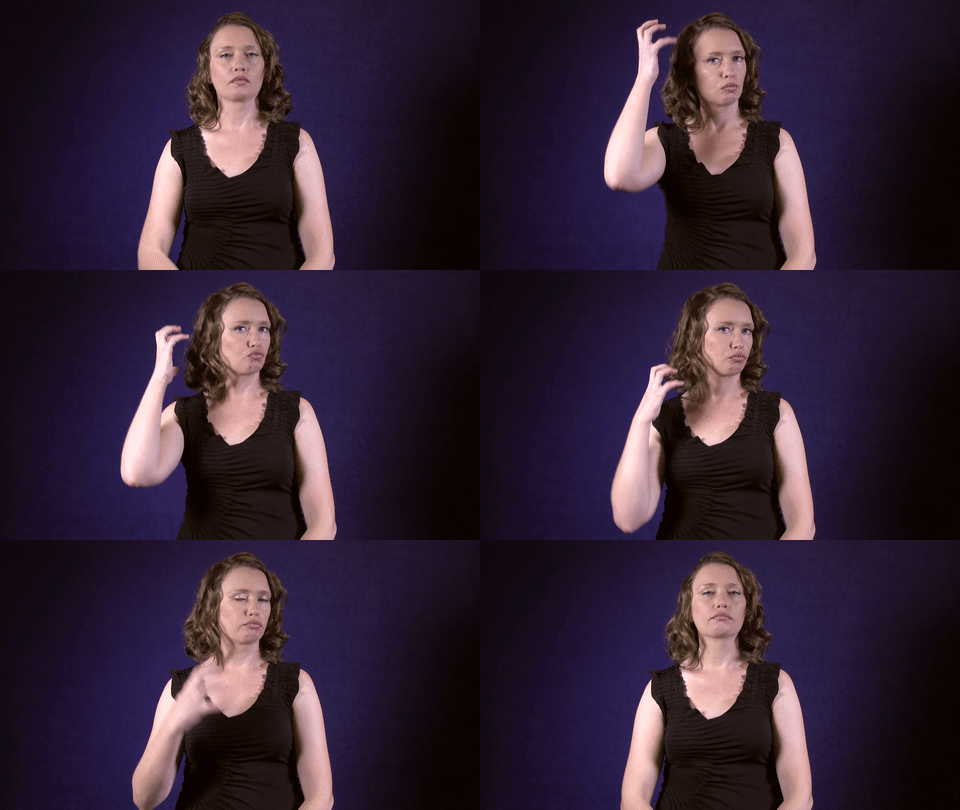
Definition: A tool for hair.
Sign for COMB in ASL

Practice Activities:
To build fluency with the sign for COMB in ASL, start by practicing the sign in front of a mirror. Repeating it slowly at first, then increasing your speed will help with fluidity. Pay attention to the handshape and movement, imagining you’re actually combing your hair.
Transition into using the sign within simple sentences. Try signing, “I need a comb,” or “She combs her hair every morning.” Say each sentence aloud as you sign to connect the meaning with movement. Add other grooming-related signs like BRUSH, HAIR, or SHOWER to expand your vocabulary.
Use storytelling to add context. Create a short story about getting ready for school or a big event. Include details like combing hair before leaving the house. Incorporate sequence words such as FIRST and THEN to show order of actions. This helps reinforce the use of the sign for COMB in ASL along with other common daily routine signs.
Partner practice can be very effective. Take turns pantomiming a morning routine and have your partner describe it in ASL using signs including the sign for COMB in ASL. This lets you practice both receptive and expressive skills by observing and using the sign in context.
Flashcard drills, where you view a picture of grooming items and sign their ASL equivalents, can strengthen recall. Include visuals of different types of combs so you can get used to signing it in a variety of scenarios.
Finish with a game like charades using household routines. When the action is combing hair, be sure to use the correct sign. This fun approach not only builds recognition but helps with confidence and memory retention of the sign for COMB in ASL.
Cultural Context:
In Deaf culture, understanding the sign for COMB in ASL goes beyond simple grooming. It reflects daily routines, self-care practices, and the importance of visual language in conveying everyday needs and actions. The sign for COMB in ASL is used frequently in everyday conversations within the Deaf community, especially in discussions around personal hygiene and getting ready for the day.
The sign for COMB in ASL is often taught early on when people begin learning the language because it represents a basic, universal action. When Deaf children learn sign language, signs like COMB help anchor conversations around daily tasks. Signing this word helps non-verbal children communicate needs or describe their activities without delay.
In Deaf homes and schools, identifying objects like a comb through sign language helps create structure and routine. The sign for COMB in ASL supports independence by giving children and adults a clear way to express regular grooming habits. Teachers and parents often use this sign during morning routines to reinforce personal responsibility and hygiene.
Visual communication in the Deaf community is deeply tied to routine and environment. Using the sign for COMB in ASL is not just about describing an object. It shows how much sign language connects to real-life experiences involving self-care or preparing for special events like school, work, or social gatherings.
Cultural values in the Deaf community emphasize self-expression and individuality. Hair and grooming are often part of that personal expression, making the sign for COMB in ASL a meaningful gesture in everyday life. From casual chats about hairstyles to showing support for someone’s new haircut, the sign ties into deeper social interactions.
When storytelling happens in American Sign Language, signs like COMB are used to describe characters and scenes in detail. A person describing a morning or preparing for a date might naturally include the sign for COMB in ASL as part of their timeline. In this cultural context, signs become tools for painting vivid imagery and emotion.
Events and media made for the Deaf community often include real-world references, and the sign for COMB in ASL is recognizable and relevant in this space. Whether it’s a skit about running late in the morning or a tutorial from a Deaf beauty influencer, the sign finds its place in the narrative. Emojis like ♂️ or ♀️ might also appear alongside the sign in digital conversations.
In group environments like Deaf summer camps or social clubs, shared knowledge of everyday signs boosts connection and community. Seeing someone use the sign for COMB in ASL during a group chat
Extended Definition:
The sign for comb in ASL is a practical and commonly used vocabulary sign, especially in contexts related to grooming, hygiene, or personal care. This sign is often introduced early in sign language learning because it’s part of daily routines. Whether you’re teaching children, engaging in self-care discussions, or narrating daily activities, knowing this sign helps communicate more effectively.
To make the sign for comb in ASL, you typically mimic the motion of combing hair. Your dominant hand forms a claw or slightly bent fingers as if holding an invisible comb, and you move it through the side of your head or down from the top of your head. This movement visually represents the act of combing and can vary slightly depending on regional use or individual style, but it consistently captures the overall motion and intention.
Context plays a big role in understanding how to use the sign for comb in ASL. When used in a sentence, it can refer to physical grooming or be part of a sequence describing morning routines. For example, a person might combine this sign with others like wake-up, brush-teeth, and get-dressed to describe the start of their day. This makes it an essential sign for conversations around health and daily scheduling.
It’s important to use appropriate facial expressions along with the sign. Facial expressions are a key part of ASL grammar and can indicate whether you’re talking about a task, giving instructions, or making a complaint. Signing comb with an annoyed face, for instance, could mean the combing was unpleasant, perhaps due to tangled hair.
Children’s stories and early education programs in ASL often include the sign for comb when illustrating daily tasks. From picture books to interactive videos, this sign helps connect language learning with everyday actions. Because it mimics a real-life movement, many young learners find it intuitive and engaging.
The sign for comb in ASL can also appear in other contexts, like beauty salons, barber shops, or hygiene tutorials. People working in these environments often need to use signs like comb, brush, scissors, and hair to describe the services they offer. Fluency in these signs improves accessibility and enhances communication with Deaf or hard-of-hearing clients.
For those learning American Sign Language, mastering the sign for comb can also lead to better comprehension when watching Deaf storytelling, video blogs, or tutorials. Seeing it in action helps understand the rhythm and pace of fluent signing. It also encourages learners to use more descriptive and accurate vocabulary in their own signing.
Practice makes perfect, and the sign
Synonyms: comb, hair tool, grooming tool, hairbrush, detangling tool
Educational resources: Find related learning materials in our course bank!
Want more? Check out some of our popular learning activities on the homepage!
Need to look up a sign? Use our highly rated dictionary: https://aslinteractive.com/best-asl-dictionary/
Follow us on tiktok: https://www.tiktok.com/@aslinteractive. More social media links at the bottom of this page!
Long-tail Keywords: what is the sign for comb in ASL, how do you sign comb in American Sign Language, ASL sign for comb
Categories:
tags: Objects, Personal grooming, Everyday activities, Bathroom, Household items
Parameters
*Handshape*:
The handshape for the sign for COMB in ASL typically uses a curved or modified claw hand, resembling how one holds an actual comb. The fingers are slightly spread and curved as if gripping the spine of a comb between the fingers and thumb.
To produce the sign for COMB in ASL, the dominant hand moves in a combing motion through the hair, mimicking the natural action. This realistic motion, combined with the clawed handshape, makes the meaning immediately recognizable. ️
*Palm Orientation*:
The palm orientation for the sign for COMB in ASL typically faces inward, toward the head. The dominant hand is shaped like a claw or bent hand and moves across the hair as if imitating the act of combing.
To accurately perform the sign for COMB in ASL, be sure your palm remains inward and fingers point toward the scalp while gesturing. This correct palm orientation helps convey the action naturally and clearly. ️ ♀️
*Location*:
The location for the sign for COMB in ASL is generally in the area near the head. The dominant hand mimics the action of combing through hair, and the sign is typically performed on or just above the side of the head. This placement visually represents the motion and context of using a comb.
When demonstrating the sign for COMB in ASL, keeping the hand near the scalp creates a clear link to grooming. The head region is ideal since the action relates directly to hair care, making the meaning intuitive and easy to understand. ♂️
*Movement*:
To produce the sign for comb in ASL, form a claw handshape with the dominant hand, mimicking the open curve of a comb. Starting near the head, typically at the front or side, move the hand backward through the hair as if combing it.
The movement can be repeated once or twice to emphasize the action. The sign for comb in ASL visually imitates the grooming motion and can vary slightly depending on hair length or location.
*Non-Manual Signals*:
While using the sign for COMB in ASL, the facial expression should remain neutral or slightly focused, reflecting the grooming action being performed. Eyebrows stay at a natural level, and the eyes typically follow the movement of the hand during the combing gesture, as if focused on the imaginary hair being combed.
There is no exaggerated expression required for the sign for COMB in ASL, but slight concentration or engagement may be shown to mimic real combing. This helps visually reinforce the concept and makes the sign clearer to the receiver .
*Prosody, Dominant/Non-Dominant Hand*:
The sign for COMB in ASL is typically made with the dominant hand using an extended claw handshape, mimicking the act of combing through hair. The movement begins near the head and moves downward or back, depending on hair length or direction, as if using a real comb.
The non-dominant hand is usually not involved, allowing the dominant hand to clearly demonstrate the motion. This prosody supports the visual clarity of the sign for COMB in ASL, especially when conveying personal grooming actions.
Tips for Beginners:
When learning the sign for COMB in ASL, it’s helpful to visualize the action of actually combing your hair. This helps you grasp the concept more naturally and make your movements more fluid. The sign typically mimics the motion of holding an imaginary comb and stroking it through your hair, starting near your head and moving outward.
For beginners, exaggerating the handshape initially can be useful, but remember to transition to smoother, smaller movements once you’re confident. Overdoing the motion may cause confusion, especially when communicating at faster signing speeds. Practicing in front of a mirror will help you correct your hand direction and facial expressions for improved clarity.
A common mistake when learning the sign for COMB in ASL is using gestures that resemble brushing rather than combing. To avoid this, focus on the separation between the fingers, mimicking the more rigid and narrow lines of a comb as opposed to the wider strokes of brushing. Repetition and comparison videos can also help solidify the correct movement.
Another tip is to remember the context in which you’ll likely use this sign. Whether you’re teaching self-care habits, getting ready for a day out, or describing a routine, knowing when and how to sign it clearly adds fluency to your overall signing. Facial expressions should match the action—for instance, if it’s part of grooming or complaining about tangled hair, your expression should reflect that.
To improve understanding, try signing this in full sentences like “I need a comb” or “He combs his hair every day.” This builds fluidity and helps reinforce the practical use of the sign for COMB in ASL. Practice often, stay consistent, and don’t hesitate to ask fluent users for feedback. ✋
sign for COMB in ASL, American Sign Language COMB sign, ASL sign for combing hair, how to sign comb hair in ASL, COMB sign meaning in ASL
Connections to Other topics:
The sign for COMB in ASL connects closely with grooming and hygiene-related vocabulary. It often shares elements with signs such as BRUSH-HAIR and HAIR itself, which create a thematic link among personal care actions. These signs tend to mimic the real-life motion of the object they represent, allowing learners to make intuitive associations.
In compound signs, the sign for COMB in ASL may be used together with other signs to express fuller ideas like COMB-HAIR, where the action is more specifically understood as grooming. Similarly, it might be used in storytelling or instructional contexts, such as describing a morning routine, allowing learners to build sequences of actions using multiple related signs.
Contextually, the sign for COMB in ASL might vary slightly depending on who or what is being described. For example, combing a child’s hair could include facial expressions that show tenderness, while combing a pet’s hair might be done with a different rhythm or exaggeration to convey the subject more clearly. These subtle modifications help tie the sign into expressive storytelling and dynamic use of ASL structure.
Learners can also connect COMB to broader topics like body parts, especially when integrating signs like HEAD or HAIR. This makes it easier to describe experiences such as getting ready, going to the salon, or managing long hair. For example, “WOMAN, LONG-HAIR, COMB” could describe someone brushing her hair, which helps reinforce sentence construction and topic-comment structure in ASL.
The sign for COMB in ASL also aligns well with activities used in Deaf-friendly classrooms or visual language environments that emphasize daily routines. Teachers may include this sign as part of vocabulary sets for lessons on morning schedules, self-care, or describing people. This usage helps build fluency through real-life scenarios.
Summary:
The sign for COMB in ASL typically involves a handshape that mimics the action of combing hair. This gesture is often performed near the side or top of the head, using an extended index or claw handshape moving through the hair. The motion simulates the real-world action of grooming, reinforcing the meaning.
This sign visually represents the act of using a comb, making it an example of an iconic sign in ASL. Iconicity in ASL plays a key role in conveying immediate understanding for native and non-native users alike. The sign leverages physicality to bridge the gap between spoken language and visual-gestural languages.
The sign for COMB in ASL doesn’t usually carry inflection for tense directly but can be modified contextually. For example, repetition or speed can indicate thoroughness or frustration. ASL users may also accompany the sign with facial expressions or body language to provide additional nuance.
In spontaneous conversation, the sign for COMB in ASL may vary slightly in motion or handshape depending on regional dialects or personal signing habits. Signers in different parts of the U.S. may adopt slight modifications to suit local signing communities. This reflects ASL’s dynamic and evolving nature.
Linguistically, the sign is a clear example of a classifier-based action. The hand acts not just as a symbol but becomes the object—in this case, the comb—demonstrating how space, form, and movement interact in ASL. Classifiers help represent both objects and actions in three-dimensional space.
The sign often appears in daily life contexts such as discussions of grooming, preparation, or self-care routines. It can also appear in storytelling, when characters are described styling themselves or others. This expands its usage beyond simple pantomime into narrative discourse.
Grammatically, the sign for COMB in ASL functions mostly as a verb but can act like a noun depending on the context. If framed visually as “I need a comb,” referencing the object, that noun use may be fingerspelled or indicated with a different classifier. Otherwise, the common gesture focuses on the action of combing.
The sign can also carry cultural connotations. In Deaf culture, self-presentation is often given importance during social or public events, and grooming signs like this one become part of everyday small talk. Watching someone sign about styling hair may open up personal, communal dialogue.
Parents teaching young Deaf children daily routines often use the sign for COMB in ASL when guiding them in learning hygiene and self-care. Visual accessibility makes the action-oriented nature of the sign ideal for early learning. It builds connection between physical acts and their symbolic representation in language.
This sign sometimes appears in compound phrases, especially during signed storytelling or as part of educational narratives. Sentences such as “I woke up, brushed my teeth, and combed my hair” illustrate time-sequenced activities, and lend themselves to natural storytelling rhythm in ASL.
The bilingual connection cannot be ignored either. When English-speaking parents or educators introduce the concept of grooming to Deaf children using both English and ASL, the sign for COMB in ASL helps link the visual with the auditory language structures. This supports holistic language acquisition.
In academic studies of ASL morphology, this sign is referenced as an example of visual-based semantic representation. The natural gesture resembles the activity itself, facilitating easier retention for second-language learners. This is particularly useful in ASL pedagogy.
The sign can be modulated to show different tools or hair types being combed. For example, a larger handshape or wider motion might suggest a brush instead of a fine comb. Or the technique may shift to reflect thick versus fine hair, adapting the sign to new contexts.
In terms of applied linguistics, the sign supports vocabulary development across multiple domains. Educators use it in conjunction with signs for SHOWER, DRESS, and BRUSH to build routines sequences. This fosters temporal and process-based understanding in curriculum design.
In signed literature and visual vernacular performance, combing actions can symbolize more than just grooming. They might imply preparation, ego, vanity, or change. When performers use the sign for COMB in ASL within stories, it often contributes to character depth or thematic layering.
Many ASL learners recall mastering the sign for COMB in ASL as part of their introduction to daily actions. Because of its simplicity and intuitive gesture, it’s often placed in beginner-level lessons. This also makes it an ideal candidate for early vocabulary retention apps and games.
The versatility of this sign is part of what makes ASL deeply expressive. Signers can modify the pacing, angle, direction, or location of the motion to denote significance or emotional states such as annoyance, calmness, or urgency. These subtle cues enrich natural communication.
Deaf performers might use the combing gesture in expressive movement art and choreography. This allows the sign to travel beyond language and into aesthetic performance. In such contexts, the mundane act of combing
Want more? Check out some of our popular learning activities!
ASL Interactive Resources
ASLInteractive YouTube Channel
Follow us on tiktok: @aslinteractive.com
Follow us on Instagram: aslinteractive
Facebook page: aslinteractive
Facebook group: aslinteractive
LInkedIn: ASL Interactive LLC
Twitter: @ASL_interactive
*Some information on this page is AI-generated. AI can make mistakes. Please check the information.


Responses