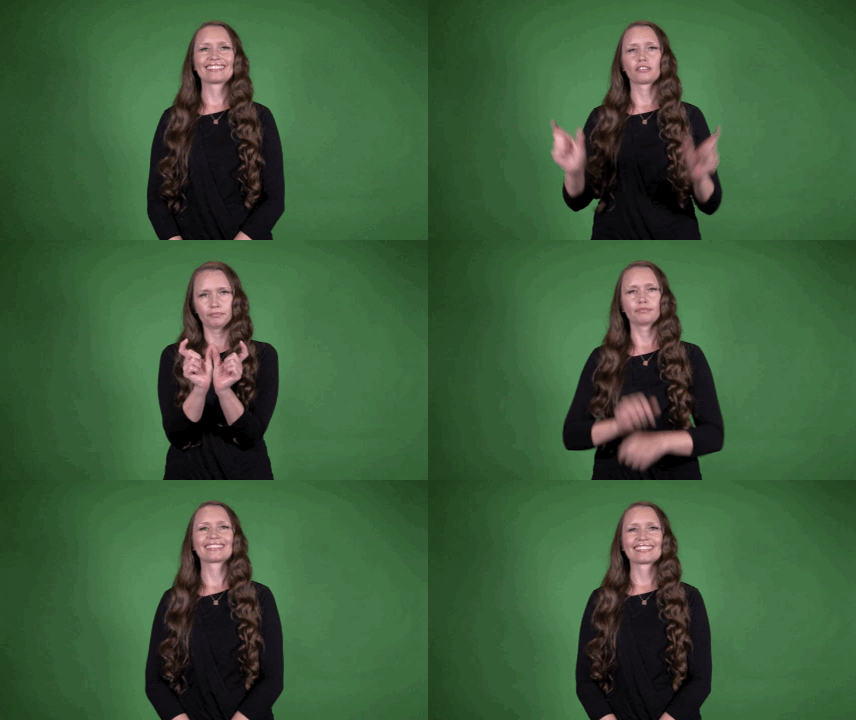
Definition: To bring two or more elements together to form a single unit or mixture.
Sign for COMBINE in ASL

Practice Activities:
Begin your practice by signing in front of a mirror. Repeat the sign for COMBINE in ASL slowly several times, checking your handshape, movement, and facial expression. Try this from different angles to make sure you’re capturing the motion accurately.
Next, practice using the sign in short, relevant phrases such as combine ideas, combine ingredients, or combine efforts. Sign each phrase and say it aloud in English afterward. Switch back and forth between English and ASL to internalize the context of the sign.
Create five short example sentences using the sign for COMBINE in ASL. For instance, you might sign: We combine books and music for the class. Another idea: She combine two teams into one. Try full storytelling by describing how two things become one, such as two puzzle pieces fitting together or two friends combining their skills to complete a project.
Use a flashcard app or index cards that show a visual prompt like two objects becoming one. When you see the card, sign the word COMBINE. Then, add different subject-object combinations to strengthen your fluency with the sign in different contexts.
If you’re practicing with a partner, take turns giving each other situations where the sign would be appropriate. For example, ask your partner how a team might combine ideas for a school project. Your partner should respond in ASL using the proper sign with natural expression.
Record a 30-second self-story using at least two examples of the sign for COMBINE in ASL. Replay the video and look for accurate sign usage and fluidity. You can also swap videos with a classmate to give each other feedback.
For fun, look through a magazine or online catalog and find examples of combinations, like new recipes or hybrid products. Try describing what is being combined using ASL. This helps reinforce the meaning while building vocabulary around the concept.
Cultural Context:
In American Sign Language, the sign for COMBINE in ASL carries more than just a literal meaning. It reflects the cultural value of cooperation and unity in the Deaf community. The ability to express abstract concepts like merging, blending, and unifying helps signers to communicate complex ideas in a visual and powerful way.
The sign for COMBINE in ASL is often used in social and collaborative contexts. For example, Deaf individuals might use it when discussing combining efforts on a community project or blending ideas in a group setting. This reinforces the community-oriented nature of Deaf culture, where shared experiences and teamwork are central values.
Understanding the sign for COMBINE in ASL can also enhance awareness of how the Deaf community perceives connection. Concepts around unity, integration, and collaboration are expressed distinctly through visuals and movements, making the language rich and intuitive. Using signs like COMBINE allows for more dynamic conversations in both formal and casual contexts.
In educational settings, the sign for COMBINE in ASL is helpful for teaching math or science concepts such as merging groups or substances. It shows how language adapts to different subjects while remaining rooted in culture. Educators in bilingual settings especially appreciate the sign’s versatility and cultural relevance.
Within the Deaf community, combining two or more things is often related to sharing resources or creating inclusive environments. The sign for COMBINE in ASL supports discussions about accessibility, teamwork, or family dynamics. It’s commonly used in narratives to illustrate change, growth, or development within a storyline.
When Deaf individuals gather at events, the sign for COMBINE in ASL might come up during planning or collaboration sessions. Planning committee members may combine their skills and strengths to ensure event success. These real-world contexts amplify the sign’s cultural impact and practical usage.
In media and storytelling, the sign for COMBINE in ASL helps convey emotional and relational themes. Whether it’s combining ideas in a negotiation or blending emotions in a dramatic moment, ASL allows storytellers to visually knit concepts together. The sign visually captures the process of integration, making it powerful for performance and poetry.
Artists and creators in the Deaf community often use the sign for COMBINE in ASL when discussing interdisciplinary projects. Whether merging dance with sign language or combining visuals with spoken word, the sign supports artistic expression that honors cultural values. These creative uses keep ASL dynamic and ever-evolving.
The sign for COMBINE in ASL is not just functional; it’s symbolic of how cultures
Extended Definition:
The sign for COMBINE in ASL represents the concept of bringing two or more things together to make one. It can be used in a variety of contexts, such as combining ideas, materials, or efforts. This is a highly visual sign that clearly shows the process of uniting separate elements.
To make the sign for COMBINE in ASL, you bring both hands forward with fingertips touching, almost as if you are blending them into one point. The movement shows a merging effect, symbolizing unity or joining. This sign can be modified slightly to show how many things are being combined, or what the end result looks like.
ASL signs often mirror real-life actions, and the sign for COMBINE in ASL is a great example of that. It can be applied in daily conversation when talking about group work, recipes, or problem-solving. Whether in a classroom or a business setting, this sign is commonly used.
In storytelling, the sign for COMBINE in ASL helps give clarity when talking about partnerships or teamwork. For instance, one might say that two teams combine their forces to tackle a challenge together . This sign helps emphasize collaboration and mutual effort.
The concept behind the sign for COMBINE in ASL is based on visual metaphors. ASL often uses space and direction to give more meaning, so this sign may be combined with facial expressions to show success, struggle, or balance. Facial cues enhance the clarity of what is being combined and how effective the process is.
Learning the sign for COMBINE in ASL can be especially helpful for students and educators. In classrooms, it may be used when explaining how different subjects connect, like combining math and science in a project . It promotes deeper understanding through bilingual support.
This sign also appears in discussions about culture and identity. When different languages, communities, or traditions are brought together, people describe it using the sign for COMBINE in ASL. It adds a visual layer to conversations about diversity and inclusion ❤️.
In the workplace, you might use the sign for COMBINE in ASL during team meetings or planning sessions. It can be used to show how different ideas or departments will work together to reach a common goal. This helps improve communication and productivity.
Parents teaching their children ASL will find that the sign for COMBINE in ASL can help explain abstract ideas in a simple way. It supports early learning and helps children better understand how the world works.
Synonyms: combine, merge, integrate, unite, blend
Educational resources: Find related learning materials in our course bank!
Want more? Check out some of our popular learning activities on the homepage!
Need to look up a sign? Use our highly rated dictionary: https://aslinteractive.com/best-asl-dictionary/
Follow us on tiktok: https://www.tiktok.com/@aslinteractive. More social media links at the bottom of this page!
Long-tail Keywords: what is the sign for combine in ASL, how do you sign combine in ASL, ASL sign for combine
Categories:
tags: combine, actions, language learning, commands, verbs
Parameters
*Handshape*:
The handshape for the sign for COMBINE in ASL begins with both hands in a flat “O” handshape . The fingertips of each hand come together as if grasping something small, and then interlock as they move toward each other in front of the chest.
This movement shows two separate elements coming together, visually capturing the meaning behind the sign for COMBINE in ASL. The fingers stay curled during the motion to maintain the integrity of the “O” handshape.
*Palm Orientation*:
For the sign for COMBINE in ASL, both hands typically form flat “O” handshapes. The palm orientation begins with the palms facing each other diagonally, slightly forward and outward. As the motion progresses, the hands move toward each other and interlock, shifting so that the palms face slightly inward toward the center of the body.
The sign for COMBINE in ASL emphasizes unity or coming together, and the changing palm orientation supports that visual meaning. This palm shift helps illustrate a merging of separate parts into one cohesive unit.
*Location*:
The sign for combine in ASL is produced in the neutral signing space in front of the body, chest level, typically about 6 to 12 inches away from the torso. Hands move toward the center of the body, indicating the concept of merging or putting elements together. Both hands remain within the midline area, making this sign easy to see from a front-facing perspective.
This central location helps clearly show the merging motion that represents the idea behind the sign for combine in ASL. The motion aligns directly in front of the signer for optimal clarity and visibility, which reinforces the concept of two items joining into one. ➡️
*Movement*:
Start with both hands in flat “O” handshapes, palms facing each other and fingers together as if cupping something. The hands begin apart, about shoulder-width, then move toward each other in a smooth, inward arc.
As the hands meet at the center of the chest, they interlock slightly to suggest mingling parts. The sign for combine in ASL visually represents merging or blending two separate entities into one cohesive whole .
*Non-Manual Signals*:
The non-manual signals for the sign for COMBINE in ASL often include a slight head tilt paired with focused eye gaze as the hands move together, indicating merging or unity. Eyebrows may be slightly furrowed to express concentration or effort, especially when describing abstract or conceptual combinations.
Facial expressions help clarify the meaning when using the sign for COMBINE in ASL. A purposeful expression adds intensity and supports context, especially when contrasting separate ideas coming together .
*Prosody, Dominant/Non-Dominant Hand*:
The sign for COMBINE in ASL uses both hands working symmetrically. The dominant and non-dominant hands start in loose “5” or open hands, palms facing each other. They move toward the center of the body and clasp together into interlocked or clasped hands, usually at mid-chest level.
The movement shows two separate things coming together into one, which accurately reflects the meaning of the sign for COMBINE in ASL. This sign emphasizes unity or merging and is commonly used in contexts involving integration or joining.
Tips for Beginners:
When learning the sign for COMBINE in ASL, it’s important to focus on precision in your handshape and movement. This sign typically uses two flat “O” handshapes (or modified “C” forms) that come together in front of the body, symbolizing the merging of two elements. Be sure to start with your hands apart and bring them together smoothly to avoid confusing it with signs for mix or join.
Hand placement and palm orientation are common stumbling blocks for beginners. In the sign for COMBINE in ASL, hands should be at chest level, moving symmetrically toward each other. Be deliberate but gentle in the movement to convey clarity and fluidity. Keep your fingers tight in the “O” shape for consistency and avoid floppy handshapes, which can make the sign unclear or mistaken for another concept.
Eye contact plays a huge role in ASL clarity. While signing, look at your conversation partner and not at your hands. Practicing the sign for COMBINE in ASL in front of a mirror can help you maintain visual focus and fine-tune your form. Repetition is key—sign slowly, then gradually increase speed once you feel comfortable and consistent.
Another helpful technique is to watch native users sign words in context. Seeing how the sign for COMBINE in ASL is used in phrases or storytelling helps build muscle memory and understanding. Try recording yourself and comparing it to authentic examples—this practice strengthens both recognition and production.
Lastly, don’t get discouraged by initial awkwardness. Muscle coordination takes time to develop, especially for symmetrical or two-handed signs. Join a local ASL group or attend signing events to immerse yourself. Regular interaction in real conversations helps reinforce the proper use of the sign for COMBINE in ASL and boosts your confidence .
Connections to Other topics:
The sign for COMBINE in ASL connects closely to concepts like unity, grouping, and synthesis. It can relate to other signs such as JOIN, TOGETHER, and TEAM, since all involve putting separate entities into one functional or cohesive unit. These signs differ subtly in handshape and movement, but understanding their variations helps clarify nuanced meanings such as joining forces versus mixing elements.
In discussion of abstract or academic concepts, the sign for COMBINE in ASL may be used metaphorically, such as in contexts like combining ideas, merging companies, or even integration in social settings. It is often paired with subject-specific vocabulary. For example, in a chemistry class, COMBINE might appear with signs like ELEMENT, MIX, or REACTION to describe compound formation.
The sign for COMBINE in ASL also helps learners understand how compound signs are formed. For instance, in signs referring to collaborative work or merged systems, the concept behind COMBINE is embedded implicitly. Terms like COLLABORATE or ALL-TOGETHER may involve signs conceptually derived from the motion of unifying separate parts.
This sign is associated with common verbs that suggest motion or transformation of multiple components into one. Learners will notice connections when using verbs like MIX, BLEND, or DEVELOP. Noticing these relationships deepens the understanding of sign morphology and how spatial grammar impacts meaning in ASL.
When used in storytelling or expressive signing, the sign for COMBINE in ASL often gets paired with emotion-based facial expressions to enhance the idea of merging ideas or elements. This opens opportunities for learners to practice expressive fluency and connecting conceptual signs. Additionally, understanding this sign supports developing clearer narrative structures where multiple actions or themes are synthesized.
By exploring the sign for COMBINE in ASL within different topics like food preparation, group activity, or software integration, learners expand their vocabulary usage meaningfully and gain a broader picture of how ASL conveys complex relationships.
Summary:
The sign for COMBINE in ASL typically involves two flat “O” handshapes brought together in front of the body. The fingers interlock or merge as the hands meet, visually symbolizing the concept of merging or joining. This is a directional and movement-based sign that depends on accurate hand positioning and timing.
This sign creates a visual metaphor for uniting or blending elements. The act of conjoining hands makes the abstract concept physically tangible, aligning with how ASL frequently uses spatial and visual depictions to express meaning. Facial expressions can subtly influence the tone, adding nuance for emphasis or emotion.
The sign for COMBINE in ASL is used to express concepts involving unity, integration, or bringing elements together. Its usage spans contexts from mathematics or science to interpersonal communication or ideational unity. It can vary slightly depending on the context or regional signing patterns, reflecting ASL’s linguistic fluidity.
Grammatically, the sign for COMBINE in ASL functions as a verb and is often situated within broader sentence structures that reflect ASL’s subject–verb–object syntax. It helps to convey action, often forming the cornerstone of a sentence’s central meaning. Its placement and order may vary based on emphasis or topicalization in expressive contexts.
Multiple concepts may relate to the sign for COMBINE in ASL. These include signs for MIX, UNITE, ADD, or CONNECT, each representing related but distinct nuances. Understanding these connections supports a richer vocabulary and more precise communication.
The sign carries cultural weight, particularly in discussions around community and identity within Deaf culture. Ideas of inclusion, integration, and unity are frequently discussed using this sign. It often surfaces in topics that emphasize mutual cooperation or blending ideas from different people or cultures.
This sign is also central in academic settings. When discussing group projects, chemical unions in science, or statistical data merging, the sign for COMBINE in ASL becomes essential. It functions well across technical and casual conversations, showing its flexibility across educational contexts.
Different regions may perform the sign slightly differently. For example, some signers may use a subtler hand closure or modify the timing of movement. These micro-changes demonstrate ASL’s regional diversity and evolving expressive palette.
In applied linguistics, the sign for COMBINE in ASL exemplifies how ASL creates meaning through spatiotemporal movement. Movement between space and shape reflects cognitive processes in real-time, connecting physical motion to concept understanding. Spatial orientation also allows for metaphorical expressions to become physical.
Language is culture, and in ASL, the sign for COMBINE reflects values such as interdependence and inclusivity. In interpreting settings, the sign might be emphasized when conveying themes of collaboration or fused interests. It visually brings people together in a shared conceptual space.
Children learning ASL might first encounter the sign for COMBINE when grasping concepts like shared toys or putting puzzle pieces together. Early engagement helps build connections between tactile experience and abstract thought. Educators often pair the sign with activities that involve integration or assembly.
In therapy or counseling contexts, the sign helps express integrative healing or combined approaches. For instance, when discussing therapies that merge techniques, this sign becomes communicative shorthand for complex treatment strategies. It allows for nuanced discussion in emotional and psychological realms.
Interpreters utilize the sign for COMBINE in ASL frequently in political or business settings. Situations involving mergers, policy collaborations, or joint ventures necessitate a clear and recognizable sign. The visual aspect helps maintain listener engagement during complex conversations.
Examining the linguistics of the sign reveals that it involves simultaneous parameters including handshape, orientation, and movement. It also interacts with non-manual signals, especially slight nods or focus facial expressions to emphasize the formality or casualness. The integration of these features mirrors how spoken languages use tone and pitch.
In community gestures, the sign often becomes part of call-and-response phrases or metaphors for unity. During public gatherings or collective planning meetings within the Deaf community, the sign may be repeated or emphasized. Its use silently conveys an impulse toward togetherness and cooperation.
In storytelling, especially folk tales or educational animations performed in ASL, the sign for COMBINE can depict magical fusions or symbolic unions. The timing of the sign is often dramatized for effect, lending theatrical weight to the scene. This shows the performative capacity of the sign beyond everyday usage.
The sign frequently appears alongside facial expressions that range from neutral to enthusiastic, depending on the context. A slight smile or raised brow can shift its meaning from purely operational to metaphorically hopeful. Nuance is key in conveying deeper meaning.
Its counterparts in other signed languages may mirror similar visual logic, but differences abound. For example, British Sign Language or French Sign Language might take different routes to signify the idea of combining. This opens up conversations about signed language typology and cross-linguistic gestures.
In business settings, Deaf professionals rely on the sign for COMB
Want more? Check out some of our popular learning activities!
ASL Interactive Resources
ASLInteractive YouTube Channel
Follow us on tiktok: @aslinteractive.com
Follow us on Instagram: aslinteractive
Facebook page: aslinteractive
Facebook group: aslinteractive
LInkedIn: ASL Interactive LLC
Twitter: @ASL_interactive
*Some information on this page is AI-generated. AI can make mistakes. Please check the information.


Responses