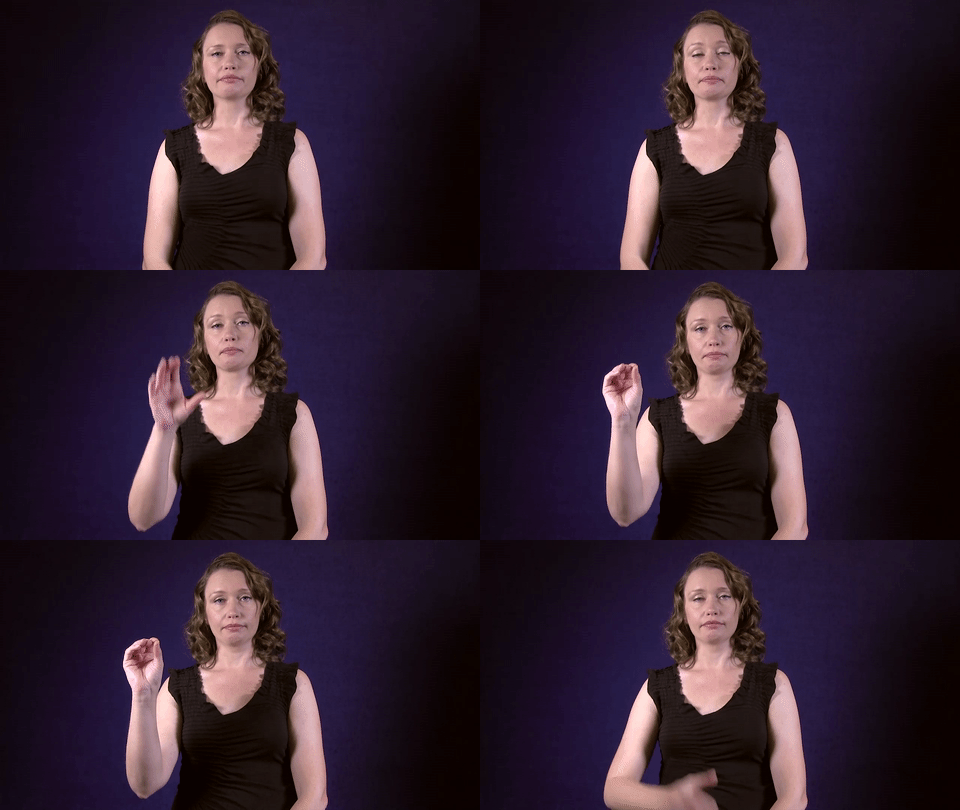
Definition: A company.
Sign for COMPANY in ASL

Practice Activities:
To practice the sign for COMPANY in ASL, start by using a mirror. Practice the handshape, movement, and location repeatedly while watching yourself. Say the word aloud or think it in your head each time you sign. This helps with memory by connecting the visual sign with the concept of “company.”
Next, try incorporating the sign into short phrases. For example, sign: “I work for a big company,” “She owns her own company,” or “Our company is hiring.” Repeat each sentence at least five times while focusing on clarity and smooth transitions between signs. Record yourself and watch the video to assess your handshape consistency and eye gaze.
Create a short story about a company you like. It could be real or imaginary. Include sentences like when the company was founded, what it sells or does, and how many people work there. Incorporate the sign for COMPANY in ASL at least three different times throughout your story. Practice telling the story smoothly with good facial expressions.
If you have a study partner, take turns asking and answering questions using the sign. Some examples include: “What company do you like?” “Have you visited a company before?” or “Do you want to start your own company?” Give each other feedback on accuracy.
Try categorizing types of companies using signs. For example, sign “coffee,” “technology,” or “clothing” before combining them with the sign for COMPANY in ASL to deepen vocabulary connections. You can also create flashcards with company names or logos on one side and practice signing complete phrases with this vocabulary.
Finish your session by fingerspelling a few company names like Apple, Nike, or Disney, then use the sign for COMPANY in ASL alongside the fingerspelled name to reinforce proper placement and context within a sentence structure.
Cultural Context:
In American Sign Language, the sign for COMPANY plays a key role in expressing ideas related to business, employment, and group organization. Understanding this sign not only supports clearer communication but also reflects cultural aspects of the Deaf community, where context and visual clarity are essential.
The sign for COMPANY in ASL typically includes fingerspelling combined with a meaningful gesture that shows association or grouping. This mirrors how the Deaf community values precision in defining relationships and roles within a business or structured environment. In many cases, the visual representation of a company aligns with how it’s experienced—through people, roles, and shared responsibilities.
In Deaf culture, the concept of COMPANY extends beyond the idea of just a business or employer. It also refers to a collective experience, where inclusion and accessibility matter deeply. Whether talking about a small team or a large corporation, using the correct ASL sign for COMPANY ensures respectful and clear communication, especially in professional or educational settings.
Deaf professionals often use the sign for COMPANY in ASL when networking, attending meetings, or presenting. It’s important that ASL learners and interpreters recognize this sign and its variations to be effective in business environments. Using the sign accurately helps avoid confusion and supports smoother collaboration.
The sign for COMPANY in ASL also shows how the language adapts to modern needs. As businesses evolve, so does the vocabulary used by ASL signers, which keeps the language alive and responsive. Understanding the cultural background of signs like this allows signers to stay current and relevant in both Deaf and hearing spaces.
Cultural respect is a key element in using ASL effectively, and this includes knowing the appropriate signs in the right context. For example, someone might sign COMPANY when referencing their workplace or when discussing a partner organization in a project. Using the right tone and expression can help convey the specific nature of that company, whether casual or formal.
In Deaf storytelling and everyday conversation, the sign for COMPANY can take on nuanced meanings. It might express solidarity within a team, pride in an organization, or frustrations with corporate systems. The flexible use of this sign reveals the depth and richness of ASL as a language and culture.
Children in Deaf schools also learn this sign early as part of vocabulary sets that include job titles and community roles. Teaching the sign for COMPANY in ASL helps them understand the role of businesses in their lives and prepares them for adult conversations. This early education promotes language acquisition that reflects real-world themes.
When performing ASL interpretation for events, training sessions, or
Extended Definition:
The sign for company in ASL is a common phrase useful for conversations about work, businesses, or group settings. Understanding how to sign company correctly can help you express ideas related to employment, corporate entities, and social groups with clarity.
To perform the sign for company in ASL, you typically use the letter “C” handshape. The dominant hand starts at the shoulder with the palm facing forward, then moves in a small downward arc and taps near your non-dominant side. This motion can vary slightly depending on region or context, but the core structure of the sign remains consistent.
When learning the sign for company in ASL, it’s important to practice the motion smoothly. Facial expressions and body posture can also emphasize whether you’re referring to a formal company, a group of people, or a specific organization. Context plays a big role in ASL, so signing company might shift slightly depending on whether you’re talking about a business or simply being around others.
Some signers may include spatial classifiers when describing a specific type of company like a tech company, a restaurant business, or a corporate brand. Adding descriptive signs about the type of work involved helps provide a more detailed message visually. This makes the sign for company in ASL a flexible and adaptive vocabulary term for dynamic conversations.
In social settings, the sign for company in ASL can also refer to people as company—like inviting guests over or joining a group of friends. ASL relies heavily on how things are presented spatially and expressed through body language, so understanding how to shift between business-related meanings and social contexts is essential.
Using the sign in real-life conversations about job interviews, business meetings, or talking about where someone works helps you expand your ASL fluency. It’s an essential term when discussing work experience, attending career fairs, or networking in the Deaf community.
Those learning ASL for professional reasons will often use the sign for company when describing workplace roles, employment goals, or corporate values. Knowing this sign also helps when translating spoken English into ASL, especially in educational or workplace interpretation settings.
Because of the common nature of job and employment discussions, the sign for company in ASL appears frequently in workplace vocabulary lessons. It’s also featured in many beginner-to-intermediate ASL courses available in-person and online. Mastery of this sign strengthens your overall ability to talk about career-related topics.
Always consider cultural nuances in ASL when using signs like company. Native signers may use variations or add additional context
Synonyms: business, organization, firm, corporation, enterprise
Educational resources: Find related learning materials in our course bank!
Want more? Check out some of our popular learning activities on the homepage!
Need to look up a sign? Use our highly rated dictionary: https://aslinteractive.com/best-asl-dictionary/
Follow us on tiktok: https://www.tiktok.com/@aslinteractive. More social media links at the bottom of this page!
Long-tail Keywords: what is the sign for company in ASL, how do you sign company in ASL, ASL sign for company
Categories:
tags: Company, Employment Status, People, Business, Language Learning
Parameters
*Handshape*:
The handshape for the sign for COMPANY in ASL begins with the dominant hand forming the letter “C” from the ASL alphabet . This “C” handshape is used at the beginning and end of the motion, transitioning from one shoulder to the other.
Throughout the sign for COMPANY in ASL, the “C” hand maintains its form steadily, symbolizing continuity and structure. It’s a clear and consistent handshape that helps convey the concept of an organized group or business.
*Palm Orientation*:
The palm orientation for the sign for COMPANY in ASL begins with the dominant hand in the letter “C” shape, palm facing forward. The non-dominant hand remains stationary in front of the torso, also in a “C” shape with the palm outward.
To complete the sign for COMPANY in ASL, the dominant “C” hand moves from the shoulder to the opposite lower side of the body while maintaining its palm orientation. Both hands retain a forward-facing position throughout the motion.
*Location*:
The sign for COMPANY in ASL is produced in the neutral signing space, which is located in front of the upper chest. This is the area just below the chin and above the stomach, typically about a foot away from the body. The dominant hand spells out the capital letter “C,” and then moves across the body, changing to the letter “O” in fluid motion.
This location allows for clear visibility of the handshape transition, a key feature in the sign for COMPANY in ASL. The neutral space helps maintain the clarity of the motion, which is essential in differentiating similar signs.
*Movement*:
The sign for COMPANY in ASL begins with the dominant hand in the letter “C” handshape. Start by placing the “C” on the dominant side shoulder, palm facing sideways.
Then move the “C” straight across to the opposite shoulder and tap it there. This symmetrical shoulder-to-shoulder motion represents a uniform group, fitting the concept of a company. The sign for COMPANY in ASL is smooth, deliberate, and clear in its representation of structure and unity.
*Non-Manual Signals*:
When using the sign for COMPANY in ASL, the facial expression should remain neutral to slightly serious, reflecting a formal or business-like tone. Eye contact is important and should be steady, directed toward the person you’re communicating with ️.
Slight head nods or minor brow raises can be used to match the context, especially if emphasizing the organization or trying to clarify which company. The non-manual signals help reinforce the meaning and clarity of the sign for COMPANY in ASL .
*Prosody, Dominant/Non-Dominant Hand*:
The sign for COMPANY in ASL uses both hands. The dominant hand forms the handshape of the letter “C” and the non-dominant hand acts as a surface. The dominant hand moves from one side of the non-dominant hand to the other, repeating the motion once, as if stamping out the idea of organization or sequence.
In the sign for COMPANY in ASL, the dominant hand does the primary motion while the non-dominant hand remains still. This two-handed sign visually conveys a structured or formal concept, making it ideal when discussing businesses, firms, or official groups.
Tips for Beginners:
When learning the sign for COMPANY in ASL, beginners should focus first on understanding whether the signer is using the initialized sign or the fingerspelled version. Both are correct in different contexts. The initialized version uses the letter “C” handshape and can travel in an arc from one shoulder to the other, similar to the sign for TEAM, but with a “C”. Meanwhile, COMPANY is often fingerspelled, especially in formal or legal situations or when referring to a specific business entity.
A common challenge with the sign for COMPANY in ASL is making the initial “C” handshape clear and consistent. Be sure your “C” handshape is distinct and not collapsing into an “O” or “E”. Keep fingers apart and curved properly. For fingerspelling, keep each letter crisp and fluid: C-O-M-P-A-N-Y. Practice pausing briefly after the last letter to help viewers catch the full word.
It’s also helpful to observe native signers use the sign for COMPANY in ASL in various contexts. Look at how they incorporate facial expressions and vary their pacing depending on emphasis or whether it’s part of a name. Repetition without expression can confuse meaning, so practice with emotion and context in mind.
Positioning matters. Signing too low or too close to your face can make it harder for someone to understand the sign. Your signing needs to be in the clear visual field of your conversation partner. Set up a mirror or record yourself signing COMPANY in ASL to visually check your accuracy and clarity.
Lastly, focus on common fluency tips such as maintaining rhythm and confidence. Hesitation during fingerspelling especially can make the communication less natural. Daily practice improves flow and builds comfort using the sign in real conversations.
Connections to Other topics:
The sign for COMPANY in ASL is closely related to signs that represent collective groups, such as organization, business, and team. These concepts all use movement and handshape patterns that indicate a sense of unity or structure, which helps learners recognize category patterns in ASL. Observing how such signs relate spatially can deepen understanding of abstract concepts in a visual language.
This sign often incorporates or mirrors elements from the sign for military COMPANY, forming a compound if discussing contexts like army units. In professional or corporate settings, the sign for COMPANY can combine with signs such as work, office, or partner to create clear, expressive phrases. For example, COMPANY PARTNER might refer to a co-owner or associate.
Learners will also find that the sign for COMPANY in ASL connects with broader economic or occupational signs. It’s commonly used in job interviews, resumes (often fingerspelled), and storytelling about employment history. Pairing it with time concepts like past or future forms phrases like “past company” or “future company goals.”
The same handshape used in COMPANY may appear in signs like school, government, or institute, which also signify structured systems. This overlap demonstrates how handshape and movement lend semantic cohesion across the language. Being able to identify these patterns strengthens receptive and expressive fluency.
Another helpful connection is between COMPANY and the sign for corporation. While often used interchangeably in English, ASL sometimes distinguishes between the broader sign for COMPANY and a more specific sign or fingerspelling for corporation, especially in legal or financial contexts. Understanding these distinctions is crucial for precise communication.
The sign for COMPANY in ASL can also be part of descriptive classifiers when explaining what kind of company is being discussed, such as a tech company, media company, or transportation company. This allows for rich, layered expression that can be tailored to context .
Summary:
The sign for COMPANY in ASL is typically formed by using the dominant hand in the letter “C” shape. The hand starts by the shoulder and moves outward in a semicircle, resembling a similar movement to the sign for “organization” or “corporation.”
One of the most important aspects of the sign for COMPANY in ASL is its foundation in iconicity. The “C” handshape helps maintain a visual connection to the first letter of the English word, facilitating easier understanding across bilingual users. This is a pattern often found in ASL when referring to proper nouns or formal institutions.
Culturally, COMPANY can refer to a business, group, or even the act of being in someone’s presence. In ASL, context is crucial to determining the intended meaning. For example, saying “I enjoy your company” would require a different sign—perhaps more relational than corporate.
This sign is closely related to other signs like “CORPORATION,” “BUSINESS,” and “OFFICE.” Each of these share similar semantic fields, often using initialized handshapes such as “B” for business or “O” for office. These initializations are part of a larger ASL phenomenon influenced by English lexicon norms.
Initialized signs are sometimes subjects of linguistic debate within the Deaf community. Some purists prefer true ASL signs over those that align closely with English. The sign for COMPANY in ASL sits in the middle of this debate, as it is both natural within ASL structure and influenced by English.
In terms of ASL grammar, COMPANY functions as a noun and is often preceded by determiners like “MY,” “YOUR,” or “THEIR” for possessive context. It can also follow verbs such as “WORK-FOR” or “MANAGE.” This flexibility makes it an important sign in business and employment discussions.
In sentences, the placement of the sign for COMPANY in ASL varies depending on focus and topic-comment structure. For example, a sentence may begin with the topic “COMPANY,” followed by a comment like “GROW FAST.” ASL relies heavily on topicalization for emphasis and clarity.
Facial expressions help further specify meaning. A neutral face can indicate generic use, while raised eyebrows or squinted eyes could suggest questioning or doubt. These subtle variations are essential in fully conveying context.
The sign also plays a big role in introductions and job conversations. When someone says “I work for Apple,” they typically sign “WORK FOR” followed by “APPLE,” fingerspelling the company name. But if the name of the company is unknown, users may simply sign COMPANY as a placeholder.
In narratives or presentations about organizations, the sign for COMPANY in ASL shows up frequently. It helps convey structure, involvement, or membership. This makes it a key vocab item in business-related ASL discourse.
Functionally, this sign is also used broadly to discuss corporate culture, entrepreneurship, and start-ups. Deaf professionals regularly incorporate it while networking or building brand identity in ASL-centric spaces. This highlights the sign’s dynamic utility in both casual and formal interactions.
Over the years, the sign for COMPANY in ASL has remained consistent, though slightly regional variations can occur. Some signers might make the circular motion smaller or more contained. These regional accents in signing are a fascinating aspect of ASL’s linguistic richness.
ASL linguistics identifies signs like COMPANY as initialized signs with clear morphological components. The “C” handshape embodies the morpheme that ties directly to the English cognate. Other components include movement path, location (neutral space or shoulder), and palm orientation.
From a morphological standpoint, slight changes in hand movement can alter meaning. For instance, repeating the sign or doubling the circle can create emphasis or suggest largeness in scope. Signs that behave this way often show ASL’s flexibility in morphosyntactic features.
Linguists studying the sign for COMPANY in ASL note how these initialized signs show English influence. Yet, there’s balance in preserving ASL’s foundational grammar and syntax. It demonstrates how natural languages evolve while remaining culturally grounded.
Applied linguistics has looked at how signs like COMPANY are taught to ASL learners. Because it’s so connected to English, it’s often one of the earlier signs students acquire. However, learners must also understand how to apply it with correct grammar, space use, and facial cues.
In terms of cognitive processing, bilingual Deaf individuals may associate the English term COMPANY and its ASL sign quite fluently. Research shows that code-switching between fingerspelling and signing provides flexible communication options. Alignment across languages supports higher fluency.
Signs like COMPANY serve essential roles in Deaf professionals’ ability to communicate industry-specific terms. Many interpreters also rely on this sign when bridging communication in business meetings, HR discussions, or organizational trainings. Its clarity and recognizability make it a staple.
In media or performances using ASL, COMPANY might appear in storytelling or skits about office life. Creative storytellers
Want more? Check out some of our popular learning activities!
ASL Interactive Resources
ASLInteractive YouTube Channel
Follow us on tiktok: @aslinteractive.com
Follow us on Instagram: aslinteractive
Facebook page: aslinteractive
Facebook group: aslinteractive
LInkedIn: ASL Interactive LLC
Twitter: @ASL_interactive
*Some information on this page is AI-generated. AI can make mistakes. Please check the information.


Responses