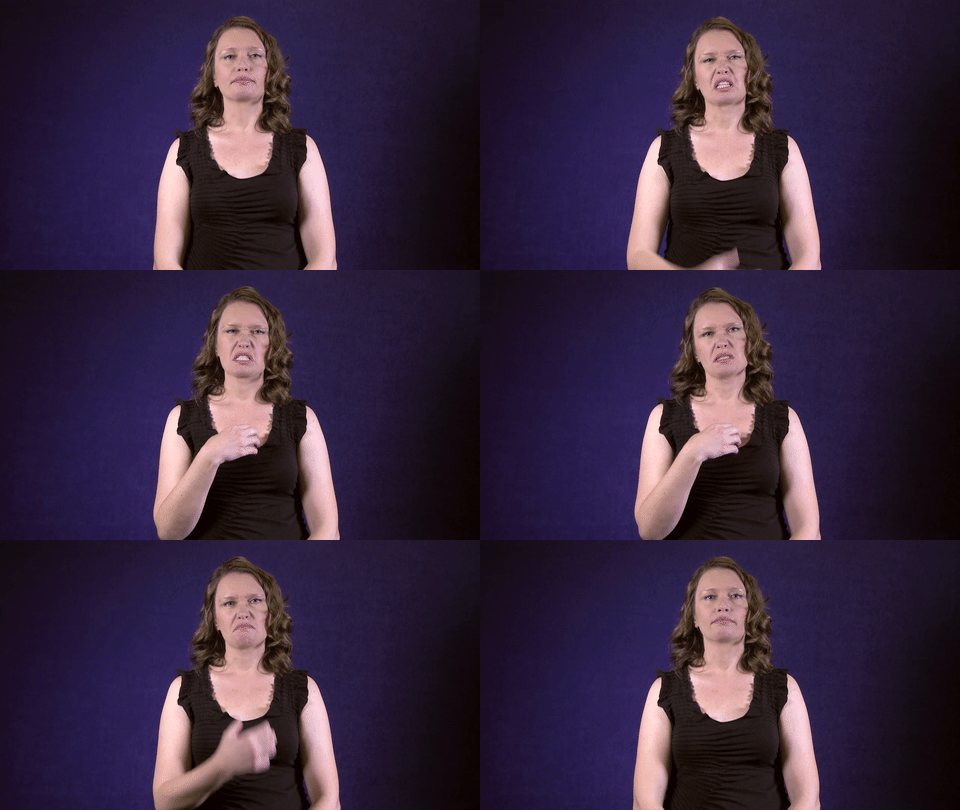
Definition: Complaints.
Sign for COMPLAINS in ASL

Practice Activities:
To build fluency with the sign for COMPLAINS in ASL, begin by practicing the sign in isolation. Use a mirror to monitor your facial expression, which should reflect frustration or dissatisfaction. Repeating the sign slowly, then increasing speed while maintaining clarity, will help develop automaticity.
Next, incorporate the sign into simple phrases. For example, practice signing “He complains all the time,” “She always complains about homework,” and “They complain when it’s cold.” Alternate between first-person and third-person perspectives to work on directional movement and pronoun usage.
Create a list of common topics people might complain about and practice constructing full sentences around them. Topics could include weather, food, school, or chores. Try a few like, “I complain when I don’t get coffee,” or “My brother complains about doing dishes.” This helps you practice the sign for COMPLAINS in ASL in realistic, everyday contexts.
For storytelling, create a short narrative about a character who complains a lot. Sign a story such as: “There’s a student. Every day, he complains. Too much work, too tired, too early. One day, the teacher says, ‘No more complaining!’” This allows you to practice repetitive use of the sign within a controlled storyline.
Partner practice is useful for reinforcement. With a partner, take turns describing scenarios while the other person guesses who is complaining or what they’re complaining about. For example, pretend to act out a child not wanting broccoli or someone frustrated with a long line.
Finally, record yourself using the sign in conversation. Watch it back to check for consistent handshapes, movement, and expression. Summarize a day in your life and include moments where you or others complained to naturally insert the sign for COMPLAINS in ASL into your story.
Cultural Context:
The sign for complains in ASL reflects more than just a word—it represents how emotions and expressions play a central role in American Sign Language. In Deaf culture, expressing dissatisfaction or airing grievances through sign language is a natural and accepted form of communication. The sign for complains in ASL carries with it a nuanced understanding of tone, facial expression, and body language that enhances the intended meaning.
In spoken English, people may complain using voice inflection and word choice, but in ASL the facial expressions are just as important as the hand signs. The sign for complains in ASL often uses a firm movement and an expressive face, depending on the level of frustration or annoyance being communicated. Deaf individuals are taught from a young age how to use these visual cues effectively, forming a strong cultural tie between expression and clarity.
Deaf culture places high value on direct and honest communication. Using the sign for complains in ASL is not seen as negative or impolite when done appropriately. Instead, it shows self-advocacy and confidence in expressing one’s needs or discomforts, which is a respected trait within the Deaf community.
The sign for complains in ASL appears often in social settings, group discussions, and storytelling. It plays a role in helping the community address concerns, whether those are related to social issues, personal matters, or everyday frustrations. Because communication is so visual and direct, the act of complaining can sometimes seem more intense, but it’s ultimately about maintaining transparency.
Humor also plays a role in how people use the sign for complains in ASL. Some storytellers in the Deaf community will exaggerate the sign with dramatic body movements and expressive faces to make a humorous point or satirical comment. This showcases the creativity in how signs are used beyond strict definitions, reflecting the personality of the signer.
It’s important to remember that tone plays a big role in meaning. The sign for complains in ASL may be modified or used in context with other signs to show sarcasm, frustration, or even playful teasing. Mastering this sign includes learning how it interacts with other culturally specific signs and expressions.
Teachers and interpreters use the sign for complains in ASL in educational settings to help students articulate their feelings. It’s especially useful in IEP meetings, conflict resolution, and peer mediation. Teaching this sign encourages Deaf students to express themselves clearly and assertively in academic and social environments.
The authenticity of the sign for complains in ASL depends greatly on the regional and generational variations found across Deaf communities. While
Extended Definition:
The sign for complains in ASL is an expressive movement that conveys dissatisfaction, protest, or the act of voicing a grievance. In American Sign Language, emotions and tone are often added through facial expressions, which are just as important as hand signs. When using the sign for complains in ASL, the context and intensity can vary greatly depending on facial cues and body posture.
This sign typically involves a movement that shows someone is conveying frustration or addressing a concern. The sign often mimics the idea of something being pushed out from the chest area, symbolizing emotional or vocal expression. Because ASL is a visual language, the sign for complains can carry subtle differences based on who is using it and in what situation.
In everyday interactions, the sign for complains in ASL can be used in personal conversations, work settings, or educational environments. It’s not considered overly negative and is often vital for self-expression. From kids telling parents about issues at school to adults sharing concerns about work conditions, the sign helps people communicate their needs effectively.
Facial expressions play a significant role when producing the sign. For instance, a furrowed brow or a frown can emphasize dissatisfaction. These added facial signals help the viewer understand the tone and seriousness of the complaint.
American Sign Language is not a direct word-for-word translation of English, so a single sign like complains may be used differently than the English word. The sign may also change slightly depending on if someone is talking about a person complaining or if they themselves are the one doing it. Grammar in ASL is built around context, making signs flexible in meaning.
Learning the sign for complains in ASL helps improve overall communication skills with the Deaf and hard-of-hearing community. It allows for a better understanding of emotional expressions and creates more inclusive dialogue. Signing accurately and respectfully builds stronger connections within diverse social environments.
Parents often find this sign useful when teaching children emotional vocabulary in sign language. Educators and interpreters also frequently use it while translating conversations or public addresses. The visual nature of the sign makes it easier for learners to connect with its meaning.
The sign for complains in ASL does not require advanced finger spelling or complex movements, making it beginner-friendly. When used correctly, it communicates clearly and effectively. Practice, real-time conversations, and watching fluent signers can help reinforce accuracy and fluency.
Using the sign for complains in ASL also promotes empathy. It encourages listeners or viewers to respond thoughtfully to issues being expressed. By including it in your
Synonyms: whines, grumbles, moans, protests, bickers
Educational resources: Find related learning materials in our course bank!
Want more? Check out some of our popular learning activities on the homepage!
Need to look up a sign? Use our highly rated dictionary: https://aslinteractive.com/best-asl-dictionary/
Follow us on tiktok: https://www.tiktok.com/@aslinteractive. More social media links at the bottom of this page!
Long-tail Keywords: What is the sign for complains in ASL?, How do you sign complains in ASL?, ASL sign for complains
Categories:
tags: Complains, Language Learning, Emotions, Verbs, Everyday Activities
Parameters
*Handshape*:
The handshape for the sign for COMPLAINS in ASL typically involves the dominant hand in a bent B or claw-like shape. The fingertips tap or bounce lightly against the chest near the sternum, indicating a feeling being expressed from within.
This movement and handshape mimic the act of airing discomfort, which aligns well with the meaning of the sign for COMPLAINS in ASL. The non-dominant hand usually stays neutral or relaxed during the sign.
*Palm Orientation*:
For the sign for COMPLAINS in ASL, the palm orientation typically faces inward toward the center of the chest. The dominant hand is usually in a bent “5” or slightly clawed shape, tapping the chest area a couple of times to mimic the idea of expressing dissatisfaction or concern.
This inward-facing palm orientation emphasizes the personal nature of the complaint, drawing attention to the speaker. When signing the sign for COMPLAINS in ASL, be sure to keep the palm relaxed yet firm in position to convey the appropriate tone. ️
*Location*:
The sign for COMPLAINS in ASL is made at the center of the chest, slightly to the right side for right-handed signers. The dominant hand taps the chest near the sternum area, typically where the heart is located, emphasizing the emotional context of the sign.
This location emphasizes internal feelings, aligning with the expression of discontent in the sign for COMPLAINS in ASL. Facial expressions often accompany the motion to add tone or emphasis.
*Movement*:
The dominant hand forms a bent 5 handshape (fingers loosely extended but slightly curved) and taps the chest near the sternum with the fingertips. The motion is a firm, single or double tapping movement.
When performing the sign for complains in ASL, the hand moves directly inward and contacts the center of the upper chest. The movement shows emphasis, reflecting a personal or internal feeling of dissatisfaction or grievance. Use a neutral or slightly frustrated facial expression to match the meaning.
*Non-Manual Signals*:
The sign for COMPLAINS in ASL is often accompanied by a slightly furrowed brow and a tense or frustrated facial expression. The lips may be slightly pursed or show signs of exasperation to match the emotional tone of the complaint.
Using the proper non-manual signals enhances the meaning of the sign for COMPLAINS in ASL, helping to express dissatisfaction or annoyance. These facial cues reinforce the context, making the sign visually clear and emotionally resonant. ♂️
*Prosody, Dominant/Non-Dominant Hand*:
The sign for COMPLAINS in ASL uses the dominant hand in a bent-5 handshape, tapping the fingertips lightly against the center of the chest. The non-dominant hand is not used in this sign. Movement is small and deliberate, showing a sense of persistent vocalizing or expressing discontent.
Facial expressions play a critical role in refining the sign for COMPLAINS in ASL, often conveying frustration or dissatisfaction. Palm orientation faces the body, and the motion reflects an internal release of emotion, mimicking how one might verbally register a complaint.
Tips for Beginners:
When learning the sign for COMPLAINS in ASL, it’s important to focus on your handshape and contact point. This sign typically uses the bent 5-hand or a claw handshape and taps or brushes against the chest near the upper part of the torso. Make sure the motion is deliberate and not too quick so the meaning stays clear.
Facial expressions play a big role in conveying the tone of your message. If you’re discussing someone who frequently complains, a slightly annoyed or exaggerated expression can help reinforce the point. Practice in front of a mirror to match the facial expression with the motion of the sign for COMPLAINS in ASL.
Beginners often confuse this sign with similar chest-based signs like “ANNOUNCE” or “EXPLAIN.” Keep your hand shape and motion consistent, and avoid overextending your arm, which can lead to miscommunication. Start slowly and build up until you can produce the movement smoothly and clearly.
When practicing the sign for COMPLAINS in ASL, try doing it in simple sentences related to real-life scenarios. For example, “My friend complains about the weather” or “He always complains when he’s tired.” Use these opportunities to check your fluency and clarity in context, which is key to mastering the sign.
If you’re fingerspelling as a backup or in situations where the sign is unclear, spell “C-O-M-P-L-A-I-N-S” smoothly. Be sure to articulate each letter cleanly and avoid mumbling with your fingers. Fingerspelling can support learning and help reinforce recognition of the sign.
Recording yourself or signing with a study partner can show you how clear your version of the sign is. Feedback is crucial for avoiding habits that weaken your sign. The sign for COMPLAINS in ASL requires attention to detail, so practicing often will definitely lead to improvement .
Connections to Other topics:
The sign for COMPLAINS in ASL connects to a broader set of signs that express emotion, attitude, and verbal expression. It shares similarities with signs like ARGUE, WHINE, and NAG, which all reflect negative or disapproving communication. These signs use deliberate movements that visually convey dissatisfaction, often involving gestures near the chest or mouth to represent expressive speech or emotion.
Understanding the sign for COMPLAINS in ASL helps clarify the difference between personal expression and criticism. For example, in contrast to the sign EXPLAIN, which is more about clarification or sharing information, COMPLAINS involves a more negative connotation. Recognizing this nuanced distinction enhances conceptually accurate signing and clearer communication.
In compound contexts, the sign for COMPLAINS in ASL might appear alongside signs like BOSS or CHILD to express specific relationships, as in “the child complains often” or “the employee complains to the boss.” This showcases how the sign fits into sentence structure depending on who is doing the complaining and what it’s about. Understanding subject-verb-object constructions is essential here.
The sign also connects with concepts of work and social demeanor. For instance, pairing it with HARD or STRESS can indicate that someone complains because they’re under a lot of pressure. This type of contextual usage helps signers express real-life scenarios with greater depth and accuracy.
Lastly, the sign for COMPLAINS in ASL supports discussions on mental health and everyday social interactions. Combined with signs like FEEL, SAD, or DEPRESSION, it illustrates how communication patterns influence emotional well-being. This creates a bridge to deeper topics such as venting versus emotional expression, helping learners use ASL to represent complex ideas compassionately and precisely.
Summary:
The sign for COMPLAINS in ASL typically uses a movement that begins with a dominant hand in a bent-5 or claw handshape, tapping once or twice over the chest near the heart. The hand may bounce slightly to convey intensity or urgency. This physical gesture symbolizes a person directing dissatisfaction or an emotional experience outward, aligning closely with the English meaning of the term.
This sign carries a tone of emotional release or expression, often conveying distress, frustration, or dissatisfaction. The location near the chest is significant, suggesting feelings emerging from the heart or inner self. ASL often uses body location to add depth and emotion to signs.
In expressive ASL conversations, particularly those dealing with conflict or frustration, the sign for COMPLAINS in ASL is highly contextual. Facial expressions enhance the sign’s meaning, with furrowed brows, a grimace, or a headshake elevating the emotional intensity. Nonmanual markers are vital to ensure receivers grasp the degree of complaint.
Grammatically, this sign functions primarily as a verb in ASL. It can be used transitively, such as “he complains about work,” or intransitively if context supplies the target of dissatisfaction. ASL constructs allow for flexible positioning of the sign within a sentence, depending on emphasis and topicalization.
The use of directional signing is sometimes adapted in colloquial ASL for this sign. Though the traditional sign is not strongly directional, stylized versions may slightly shift forward to represent directed complaints toward a person or topic. This shows ASL’s adaptable spatial grammar.
The sign for COMPLAINS in ASL can be conceptually related to signs like NAG, WHINE, or WHISTLE-BLOWER, depending on context. Each of these has different nuances, but all relate to verbal or outward expressions of discontent. Choosing the correct sign helps preserve the subtle distinctions of meaning embedded in the interaction.
Culturally, complaining in ASL ties into the Deaf community’s value of open, direct communication. Expressions of dissatisfaction or constructive critique are often part of cultural storytelling, conversation, and community advocacy. The visual nature of communicating discomfort encourages clarity and emotional honesty as community norms.
The sign for COMPLAINS in ASL can also emerge in discussions of accessibility, equity, or systemic frustration. For example, Deaf individuals might use this sign when recounting experiences of medical or educational neglect. In those cases, the sign becomes a tool for social justice storytelling.
In classroom settings, teaching the sign for COMPLAINS in ASL opens opportunities to discuss behavioral contexts—who complains, when, and toward whom. Students can explore the pragmatic rules that govern such emotional disclosure. Lessons might compare productive versus chronic complaining using role-play and storytelling.
Linguistically, this sign can be studied in terms of its dynamic movement and placement in space. The tap over the chest displays an iconic relationship between body location and internal emotion. This adds to the richness of ASL’s semantic space, where meaning is often embodied rather than reliant on arbitrary symbols.
Comparative studies show that emotional signs such as COMPLAINS often have correlates in other sign languages that also use the chest area to signify emotion. This suggests a possible cross-linguistic tendency or human inclination to link emotional content with internal bodily representation. Such patterns highlight universal aspects of signed language grammars.
Applied linguistics can explore how the sign for COMPLAINS in ASL is encoded differently by age groups, regions, and identity affiliations. Bilingual contexts may influence whether this sign appears in ASL discourse or whether English borrowings or codeswitches are favored. This makes the sign an excellent candidate for sociolinguistic research.
Moreover, the sign exists in a network of expressive language used when telling personal narratives, such as recounting a problematic teacher, unfair treatment, or family disagreements. Within ASL literature and poetry, COMPLAINS may appear in emotionally charged performances designed to provoke empathy or reflection.
For Deaf-blind individuals who use tactile ASL, the sign for COMPLAINS is still accessible through hand-over-hand communication. The same handshape and chest touch are used, allowing emotional language to transcend visual mediums and still foster communication. This confirms the inclusivity and adaptiveness of ASL structures.
Psychologically, the sign for COMPLAINS in ASL can reflect inner emotional states, thus serving as a valuable tool in therapeutic settings. ASL users undergoing mental health treatment may use signs like this to express internalized emotion, frustration, or burnout. Therapists fluent in ASL benefit from understanding the affective cues tied to such signs.
For interpreters, mastering the sign for COMPLAINS in ASL involves understanding both the technical form and the pragmatic force behind it. Accurately rendering the level of discontent or sarcasm, for example, requires interpreting not just sign choices but accompanying facial grammar. This is especially crucial in legal or medical contexts.
The sign also functions well in artistic expressions such as ASL storytelling (
Want more? Check out some of our popular learning activities!
ASL Interactive Resources
ASLInteractive YouTube Channel
Follow us on tiktok: @aslinteractive.com
Follow us on Instagram: aslinteractive
Facebook page: aslinteractive
Facebook group: aslinteractive
LInkedIn: ASL Interactive LLC
Twitter: @ASL_interactive
*Some information on this page is AI-generated. AI can make mistakes. Please check the information.


Responses