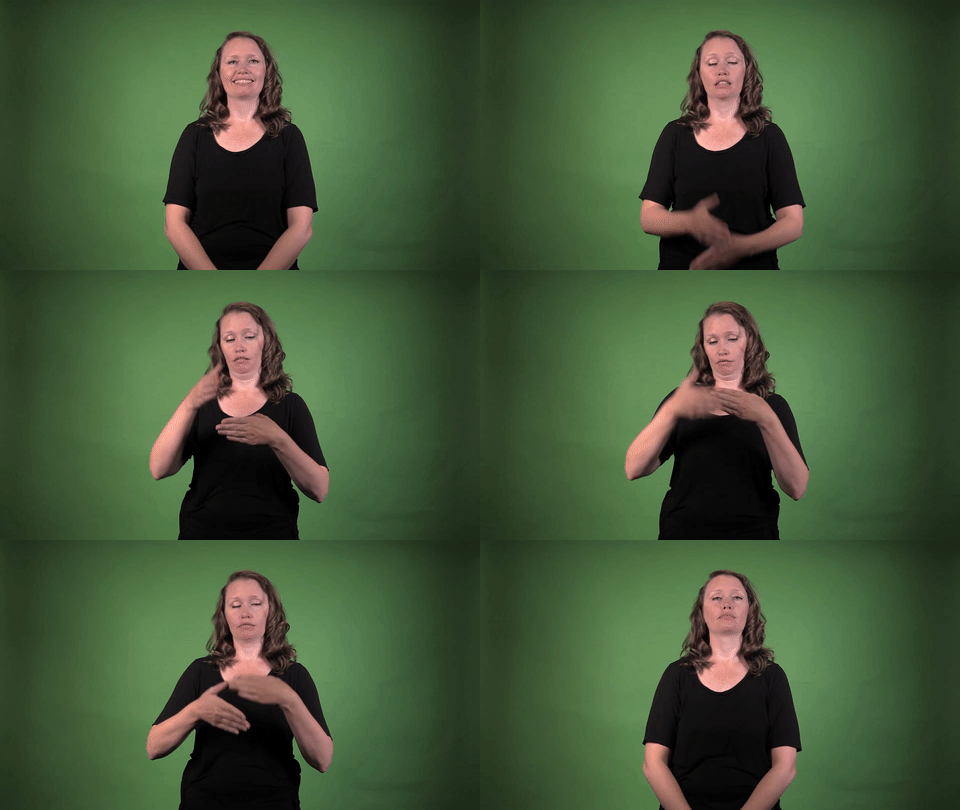
Definition: To complete.
Sign for COMPLETE in ASL

Practice Activities:
Begin practicing the sign for COMPLETE in ASL by isolating the motion. Start by repeating the full sign in front of a mirror, ensuring your dominant hand moves across the palm of your non-dominant hand with a confident, finishing motion. Use the sign slowly at first, then increase your speed and fluency as you become more comfortable.
Next, try using the sign in simple sentences. For example, sign phrases like “homework complete,” “project complete,” or “I complete work.” These short sentence practices help reinforce both the vocabulary and the correct grammatical structure of ASL. Record yourself signing and play it back to review your accuracy.
Develop your expressive skills by creating short narratives. You might sign a story about completing your chores or finishing a book. Encourage yourself to use sequencing and transition signs like “first,” “then,” and “finally” to build coherent descriptions. Emphasize where in the story the action is complete and use facial expressions to show satisfaction or relief.
Interact with a partner by developing question-and-answer dialogue. One person can ask, “Did you complete your task?” and the other can respond with “Yes, I complete it” or “No, not yet.” Practicing turn-taking in this way builds fluency and understanding in conversation settings.
Use flashcards with images or English words that require the sign for COMPLETE in ASL as part of the response. Each time you see a prompt like “test” or “meal,” form a sentence incorporating the sign. This helps cement connections between the concept and the sign.
Finally, play a fill-in-the-blank game where your practice partner signs a full sentence except one part. You’ll step in to complete the missing sign. This sharpens your recognition skills and reinforces your confidence using the sign for COMPLETE in ASL in varied contexts.
Cultural Context:
In American Sign Language, culture plays a crucial role in how concepts are expressed. The sign for complete in ASL goes beyond a basic translation. It reflects the value of clarity and closure, both important in Deaf communication. The Deaf community prioritizes full understanding in conversations, so the concept of completion is significant.
When someone uses the sign for complete in ASL, they’re not just talking about a task being done. They’re expressing that nothing is missing, something is whole, finished, and fully understood. It’s not uncommon to see this sign in educational settings, social gatherings, or storytelling in Deaf culture.
Facial expressions and body movement help add intensity or emotion to this sign. In Deaf storytelling, the sign for complete in ASL can portray strong finality or an emotional ending. This shows how layered and expressive ASL can be compared to a simple written or spoken word.
In community interactions, the sign for complete in ASL can imply more than just a literal meaning. It can symbolize agreement, unity, or a shared understanding. It’s commonly used at the end of presentations or meetings to wrap things up clearly and visually.
Deaf events, such as stage performances or poetry slams, also use this sign for complete in ASL to show the end of a performance. It adds to the visual rhythm and helps the audience understand the structure of the performance. Every detail, including this specific sign, fits into the overall cultural experience.
Educational values in the Deaf community encourage accurate and complete communication. That’s why the sign for complete in ASL is introduced early in ASL learning environments. It helps students understand when they’ve reached the end of a thought, lesson, or task.
In everyday life, the sign is often paired with other signs to show nuanced meanings. For example, someone might use the sign for complete in ASL when they’ve completed an assignment, settled an issue, or even finished a meal. Because of this flexibility, the sign holds an important place in conversational ASL.
Culturally, Deaf individuals value direct and full communication, and the sign for complete in ASL supports that principle. It shows that everyone is on the same page and nothing is left unsaid. This clear conclusion strengthens community bonds and social flow.
Interpreters often rely on the sign for complete in ASL during translations to bridge concepts accurately. This keeps Deaf consumers well-informed and engaged in what’s being discussed. Whether in school, work, or casual conversation, this sign contributes to effective communication.
Extended Definition:
The sign for complete in ASL represents the idea of finishing something fully, with nothing left undone. It communicates that a task, project, or process has reached its end point, emphasizing total accomplishment. In American Sign Language, this idea is conveyed with specific hand movements that clearly express the concept of completeness.
To produce the sign for complete in ASL, one commonly used method involves holding one flat hand palm-up while bringing the other flat hand palm-down and sweeping it across the first, as if finishing or completing something. This movement mirrors the motion of closing a book or sealing the end of a task. Facial expressions often help express the finality or satisfaction that comes with being done.
This sign can be used in a variety of contexts. Whether completing homework, finishing a job, or concluding a meeting, the sign for complete in ASL fits naturally into many real-life situations. It allows ASL users to communicate that something has been successfully finalized or wrapped up.
Deaf and hard-of-hearing individuals use this sign in both casual and formal settings. For example, in a classroom, a student might use the sign to indicate that they’ve completed an exam. In a work environment, someone might use it during a presentation or group meeting to note that a certain task or objective has been finished.
Grammatically, the sign for complete in ASL often functions like a verb. However, its meaning can adapt somewhat based on the sentence structure or the conversation it’s a part of. Its flexibility in use allows ASL speakers to integrate it smoothly into diverse conversations and contexts.
The concept of completeness is important in many cultures, including Deaf culture. The sign for complete holds value beyond just linguistic meaning—it also represents achievement, closure, and satisfaction. It helps establish a sense of resolution and can also suggest readiness to move on to something new.
It’s also important to consider that the sign for complete in ASL might be slightly different across regions or age groups. ASL, like any language, includes some variation based on community, and signs can evolve over time. Despite these small differences, the core meaning of being complete or finished remains the same.
Learning the sign for complete in ASL is useful for people engaging with the Deaf community, interpreting, or learning ASL as a second language. It allows for more natural and fluent conversations, especially when talking about progress, tasks, or accomplishments. The sign’s clarity makes it a practical and essential part of day-to-day ASL communication.
By understanding and using
Synonyms: finish, conclude, accomplish, finalize, fulfill
Educational resources: Find related learning materials in our course bank!
Want more? Check out some of our popular learning activities on the homepage!
Need to look up a sign? Use our highly rated dictionary: https://aslinteractive.com/best-asl-dictionary/
Follow us on tiktok: https://www.tiktok.com/@aslinteractive. More social media links at the bottom of this page!
Long-tail Keywords: What is the ASL sign for complete, How do you sign complete in American Sign Language, Learn the ASL sign for complete
Categories:
tags: Commands, Verbs, Language Learning, Actions, Classroom Picture
Parameters
*Handshape*:
The handshape for the sign for COMPLETE in ASL uses flat “B” hands ✋. Both hands are open with fingers extended and held together, thumbs tucked against the side of the palm. One hand starts palm-up while the other begins palm-down above it.
This configuration is crucial to convey the meaning of totality or completion. The sign for COMPLETE in ASL relies on these specific handshapes to show that something is fully finished.
*Palm Orientation*:
The palm orientation for the sign for COMPLETE in ASL begins with both hands open and flat, palms facing each other, typically with the dominant hand palm down and the non-dominant hand palm up. The dominant hand moves quickly across the non-dominant hand in a sweeping motion.
Throughout the motion, the palms either remain in their respective orientations or briefly touch palm-to-palm as the dominant hand slides over. This sign for COMPLETE in ASL visually emphasizes finality or thoroughness through its finishing motion. ️✅
*Location*:
The sign for COMPLETE in ASL is typically performed in neutral space, slightly in front of the torso at chest level. The hands begin together and then separate outward with a quick motion, indicating the idea of finishing something. This location helps visually express the finality connected with the sign for COMPLETE in ASL.
Because the sign occurs in neutral space, it allows flexibility for size and speed, aiding clarity. The central chest area emphasizes the concept of a task being fully achieved, reinforcing the meaning behind the sign for COMPLETE in ASL.
*Movement*:
To produce the sign for COMPLETE in ASL, place your non-dominant hand palm-up in front of your body, held steady. With your dominant hand open and palm-down, swipe it in a firm, single motion across the top of the non-dominant hand so both palms briefly meet flat.
This movement emphasizes finality or thoroughness, capturing the idea of something being fully done ✅. The clear, deliberate sweep used in the sign for COMPLETE in ASL reinforces the concept of completion or finishing entirely.
*Non-Manual Signals*:
When using the sign for COMPLETE in ASL, the facial expression typically conveys a sense of finality or resolution. The signer may show a brief head nod or raised eyebrows at the moment of completion, signaling that something is fully done or finished ✅.
The overall non-manual signals should reflect clarity and certainty. A focused gaze and confident movement reinforce the meaning of the sign for COMPLETE in ASL.
*Prosody, Dominant/Non-Dominant Hand*:
The sign for COMPLETE in ASL typically uses both hands. The non-dominant hand is held flat, palm facing sideways or slightly up. The dominant hand, also flat, moves in a swift circular motion over the non-dominant hand and comes down flat on top of it with a quick, finishing motion . This gesture visually represents the idea of something being finalized or made whole. The sign for COMPLETE in ASL conveys finality and totality through its precise, clean movement.
Tips for Beginners:
The sign for COMPLETE in ASL involves one palm-up hand and a flat palm-down hand moving in a swift, complete motion across the first hand to indicate something being finalized or finished. When you’re just starting out, be mindful of your speed and accuracy. Many beginners use too much force or rush the motion, which can confuse the intended meaning.
One useful technique is to practice the motion slowly at first, paying attention to your handshape and the direction of your movement. The palm should move in a controlled, clean line, not a circular or loose gesture. This helps maintain clarity and ensures that the sign reads correctly to fluent users.
Facial expression can also amplify the sign for COMPLETE in ASL. A look of finality or satisfaction on your face reinforces the idea that something is done. Don’t overlook expression, as it’s a key part of ASL grammar and tone. Without the right expression, even accurate hand movements can seem unclear or incomplete.
Another common pitfall is using the incorrect starting position. Be sure your non-dominant hand is steady and flat with the palm facing up. The dominant hand should be flat and make a concise movement across the non-dominant hand. Floppy or inconsistent handshapes often lead to miscommunication.
Consistent practice is essential. Use a mirror or record yourself signing to make sure your movement is clean and not over-exaggerated. Accuracy beats speed when learning any new sign. Over time, your fluidity with the sign for COMPLETE in ASL will improve naturally.
Lastly, always watch native signers when possible. Seeing the sign in real conversation sharpens your understanding of pacing and body language. Repeated exposure will boost your confidence and help commit the sign for COMPLETE in ASL to memory.
Connections to Other topics:
The sign for COMPLETE in ASL is closely related to concepts like FINISH, ALL DONE, and DONE, as it expresses the idea that an action or process has ended. It often appears in conversations where clarity about finality is key, such as discussing tasks, projects, or timeframes. Its use helps to mark transitions or closures, making it integral in structuring narratives and discussions in ASL.
This sign shares visual and conceptual similarities with the sign for FINISH, though context determines which is more appropriate. COMPLETE emphasizes wholeness or totality, while FINISH often focuses on the act of conclusion. These distinctions help learners fine-tune their ASL vocabulary and choose signs that best match the message they intend to convey.
The sign for COMPLETE in ASL is also useful when forming compound signs. For instance, signs like COMPLETE-FOCUS or WORK-COMPLETE can be created by combining the base concept of completion with other action signs, helping to provide greater detail in statements. These compound usages are not only efficient but also enrich expression and clarity.
In educational and workplace settings, the sign for COMPLETE in ASL is especially valuable for goals, deadlines, and documentation processes. You might sign COMPLETE to refer to homework, reports, or group assignments being done. It also appears in procedural or instructional communication, underscoring when a step or section is fully addressed.
Understanding the sign for COMPLETE in ASL also lays the foundation for grasping abstract concepts like accomplish, fulfill, or perfect. These higher-level meanings can be communicated through contextual emphasis or accompanying facial expressions, showing how ASL conveys nuanced ideas with few signs. Mastering this sign opens the door to rich, precise dialogue in both everyday and formal situations .
Summary:
The sign for COMPLETE in ASL conveys the meaning of something being finished, wholly done, or brought to a close. It is a sign that communicates finality and conclusion. This idea of totality is a core part of many discussions, whether academic, task-related, or emotional in nature.
To produce the sign for COMPLETE in ASL, one common version starts with the non-dominant hand held flat in front of the body, palm facing down. The dominant hand, also flat, then brushes quickly across the back of the non-dominant hand, palm down as well, in a brisk motion. The motion mimics something being done in one strong sweep — a visual metaphor for something ending entirely.
Another variation of the sign uses a twisting motion where both open hands start facing each other and then twist to face downward. This version emphasizes a change of state — from an incomplete form to a complete one. Either version reflects the core semantic element of finality and transforms.
The sign for COMPLETE in ASL exists in both literal and metaphorical contexts. You can use it when saying you’re done with a task, finished eating, or have fully understood something. The concept of completion is not restricted to physical tasks, but also applies to mental realization or emotional closure.
In ASL grammar, COMPLETE may often occur at the end of a sentence to mark the conclusion of an action. It can also be placed after a noun or verb to emphasize that something has been concluded. The flexibility of sign placement illustrates how ASL structure differs dramatically from English linear syntax.
ASL users sometimes combine the sign for COMPLETE with facial expressions that intensify its meaning. A small shrug or pursed lips can indicate finality. Squinting or head nods often reinforce the meaning, consistent with ASL’s rich use of non-manual signals.
The sign for COMPLETE in ASL belongs to a broader family of signs indicating fulfillment or resolution. Related signs include FINISH, THROUGH, DONE, and ACHIEVE. Each has a nuance, so signers choose based on whether the emphasis is on the transition, the state, or the process ended.
FINISH tends to focus on the moment an ongoing activity ceases, while COMPLETE foregrounds the idea that something has reached its purpose. This distinction adds clarity in narratives or formal presentations. In storytelling, choosing COMPLETE over FINISH can show the conclusion of an emotional arc, not just the end of an action.
Understanding the sign for COMPLETE in ASL provides insight into how Deaf culture views communication holistically. Rather than segmenting phases like start, middle, and end into rigid sequences, signs like COMPLETE embrace the unfolding of meaning through transition. It aligns with how narratives thrive in ASL performance art and literature — arcs that emerge through movement and resolution.
Across academic fields such as applied linguistics, the sign for COMPLETE is a valuable example of how ASL repurposes space, motion, and timing. It uses directionality to anchor the idea of finality. ASL leverages physical motion not just to illustrate action, but to express abstract states like completeness.
The sign also illustrates classifier usage, especially in creative or advanced expressions. Some ASL users integrate it within classifiers to show an object being fully constructed or a process completed. For instance, constructing something with handshapes and then using the COMPLETE sign at the end shows both the process and the conclusion.
Learners of ASL often find the sign for COMPLETE intuitive because the physical movement gives visual closure. It reinforces how ASL is iconic and gesture-based in many ways. That makes it easier to remember and more accessible to both Deaf and hearing users.
In everyday Deaf life, the sign for COMPLETE plays a big role in discussing goals, timelines, and expectations. Whether at school or in professional settings, indicating a task is complete allows for moving forward in paced discussions. Clarity around “complete” versus “ongoing” helps establish shared understanding in group efforts.
In ASL poetry and storytelling, the sign for COMPLETE can mark the climax of the narrative arc. It can carry emotional weight, especially when paired with subtle non-manual markers that deepen its meaning. Artists may stretch or compress the motion of the sign for stylistic effect.
The sign for COMPLETE in ASL also has pedagogical value. In ASL education, instructors often teach this sign alongside FINISH and DONE to highlight semantic fields. Students learn to distinguish not just signs, but context-dependent meanings.
Learning the sign for COMPLETE in ASL signals a shift from beginner-level vocabulary to more nuanced expression. It allows students to comment on the state of things: whether they’ve wrapped up a project, finished their homework, or concluded a thought. It opens up possibilities for more articulate ASL use.
Culturally, completeness ties into ideas of self-worth and accomplishment. In Deaf communities, where access to opportunity hasn’t always been equal, being able to say something is COMPLETE has emotional resonance. It symbolizes tenacity, persistence, and success
Want more? Check out some of our popular learning activities!
ASL Interactive Resources
ASLInteractive YouTube Channel
Follow us on tiktok: @aslinteractive.com
Follow us on Instagram: aslinteractive
Facebook page: aslinteractive
Facebook group: aslinteractive
LInkedIn: ASL Interactive LLC
Twitter: @ASL_interactive
*Some information on this page is AI-generated. AI can make mistakes. Please check the information.


Responses