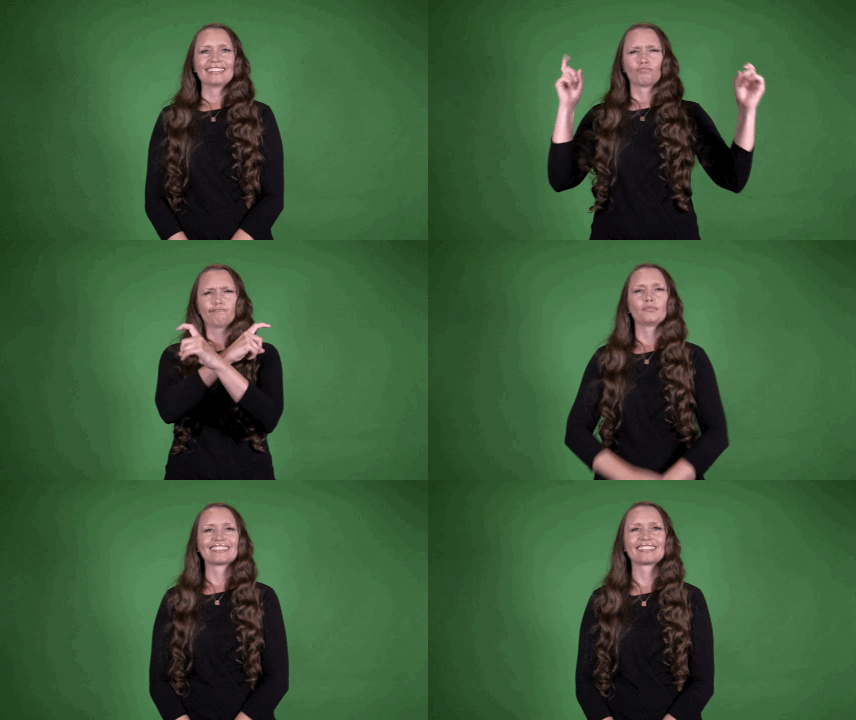
Definition: Difficult to understand, analyze, or solve due to complexity or multiple interconnected aspects.
Sign for COMPLICATED in ASL

Practice Activities:
To practice the sign for COMPLICATED in ASL, begin with isolated handshape drills. Use a mirror to observe the circular and twisting motions of both fingers and wrists. Make sure each repetition is smooth, showing the concept of entangled or intertwined ideas.
Next, alternate between COMPLICATED and related conceptual signs like EASY, SIMPLE, and CONFUSING. Sign each term slowly, then increase speed for fluency. Practicing opposites will reinforce visual contrast and help internalize the meaning behind the movement.
Create short phrases that include the sign for COMPLICATED in ASL, such as math is complicated, relationships are complicated, or the instructions were complicated. Sign each phrase in front of a friend or record yourself to check for clarity and facial expressions.
Storytelling prompts can involve topics like a computer project gone wrong, a misunderstanding between friends, or solving a difficult puzzle. As you tell the story in ASL, pause and emphasize the sign for COMPLICATED in ASL when the situation becomes tangled or layered. Use spatial referencing when describing linked or confusing elements.
For partner activities, take turns describing tasks or situations and ask the partner to repeat the sign appropriately. One person can say or sign a sentence like that game was complicated and the partner signs only the key word. Switch roles for reinforcement.
In group work or class settings, have discussions about real-life experiences and challenges using the sign for COMPLICATED in ASL. For example, describe a school project, a travel mishap, or a recipe fail. Encourage everyone to use the sign as part of their narrative.
Finish practice sessions with brief sign-fluency games. One player signs a phrase including COMPLICATED, and others guess what situation is being illustrated. These repetitive and creative activities will anchor the sign’s form and nuanced use in both formal and casual contexts.
Cultural Context:
In American Sign Language, the sign for complicated reflects more than just its literal meaning—it also gives insight into how Deaf culture approaches abstract ideas. The concept of something being complex or hard to understand is communicated visually, which aligns with ASL’s value on clarity and expressive gestures. The sign for complicated in ASL captures both the mental and emotional weight that can come with difficult situations.
Deaf culture places a strong emphasis on visual storytelling, and the sign for complicated in ASL is no exception. It’s not just about conveying difficulty—it’s also about showing layers, confusion, or parts that don’t fit neatly together. This visual metaphor helps make the idea more relatable and accessible, particularly for native signers.
In the Deaf community, communication is inherently layered. That makes the sign for complicated in ASL useful in daily conversation because life can be full of social, emotional, or logistical twists. Whether talking about relationships, technical problems, or decision-making, this sign succinctly expresses what might take several words in spoken English.
Watching someone use the sign for complicated in ASL gives an immediate sense of how Deaf individuals frame their thinking. Rather than describing through spoken language, the gestures show complexity in a way that feels almost tangible. This physical and expressive nature is deeply rooted in Deaf culture, which values clarity and emotional nuance.
In settings like mental health discussions or conflict resolution, the sign for complicated in ASL often comes up. It’s a key part of how Deaf individuals articulate internal struggle or difficult emotions. It gives room for subtle context, such as how overwhelmed someone feels or how tangled a situation might be.
Within Deaf education, understanding the sign for complicated in ASL helps students better articulate their academic or social challenges. Teachers may encourage students to use it when discussing tough subjects. This fosters a culture of openness and shared understanding using the expressive power of ASL.
Media and storytelling within the Deaf community also use the sign for complicated in ASL to represent plot twists or emotional hurdles. ️ In visual storytelling, like Deaf theater or ASL vlogs, the sign can quickly add emotional depth or tension. It plays a role in shaping how Deaf narratives are told and understood.
It’s important to know that the sign for complicated in ASL can vary slightly based on regional usage or personal expression. Still, the core meaning usually stays the same: representing something not easy to solve or explain. This flexibility supports ASL’s cultural emphasis on diversity within expression.
When learning ASL, understanding how signs
Extended Definition:
The sign for complicated in ASL captures both the concept of something being difficult and the idea of complexity with intertwining elements. To express this in American Sign Language, hand movements typically represent tangled or intertwined ideas that are hard to separate or understand.
When signing complicated in ASL, you generally use both hands in a motion that mimics something being entangled. This sign symbolizes how many parts or layers come together to create a situation that’s not easy to solve or explain. It’s often used to describe problem-solving, emotional situations, or abstract reasoning.
The sign for complicated in ASL is expressive and nuanced. It can also be modified slightly to emphasize just how complicated something seems—whether mildly confusing or deeply intricate. Body language and facial expressions usually enhance the meaning behind this sign, making it clear just how complex the subject is.
In social and academic contexts, the sign is helpful when discussing challenging topics or feelings. People might use the sign for complicated in ASL while talking about personal relationships, technical issues, advanced subjects in school, or even emotional states that are layered and hard to unpack.
ASL signs are rich in visual storytelling, and complicated is a perfect example of this. The sign conveys not just difficulty but also how things become complex through overlapping elements. This makes it great for expressing thoughts that aren’t immediately straightforward or easily organized.
Understanding the sign for complicated in ASL is important for both fluent signers and learners. It helps build more eloquent communication and shows a deeper grasp of nuanced discussions in American Sign Language. Whether you’re talking with friends, classmates, or coworkers, being able to express complexity clearly is crucial.
For example, someone might use the sign for complicated in ASL when explaining a hard-to-follow set of instructions or expressing mixed emotions in relationships. It’s a practical everyday sign found in both casual conversations and professional settings. You’ll often see this sign paired with others like difficult, confused, or problem, depending on the context.
Learning how to use the sign for complicated in ASL allows signers to participate in deeper conversations and connect on more intellectual or emotional levels. When used correctly and with the appropriate tone, it can clearly convey frustration, curiosity, or intrigue about whatever issue is being discussed.
This sign also plays an important role in storytelling and narratives in ASL. When describing drama, puzzles, or mysterious plots, you might find that you need the sign for complicated in ASL to tell your story more vividly. It’s an expressive tool that adds depth and texture to
Synonyms: complex, intricate, difficult, elaborate, challenging
Educational resources: Find related learning materials in our course bank!
Want more? Check out some of our popular learning activities on the homepage!
Need to look up a sign? Use our highly rated dictionary: https://aslinteractive.com/best-asl-dictionary/
Follow us on tiktok: https://www.tiktok.com/@aslinteractive. More social media links at the bottom of this page!
Long-tail Keywords: what is the sign for complicated in ASL, how do you sign complicated in ASL, ASL sign for complicated
Categories:
tags: complex concepts, language learning, vocabulary building, emotions, abstract ideas
Parameters
*Handshape*:
The handshape for the sign for COMPLICATED in ASL typically involves both hands in the “claw” or curved five handshape. Fingers are spread and slightly bent, resembling claws, with palms facing each other. The hands twist alternately in front of the body, suggesting intertwined complexity.
This movement and handshape emphasize layers or intricacies, reinforcing the meaning behind the sign for COMPLICATED in ASL . The alternating motion captures the idea of something tangled or difficult to untangle.
*Palm Orientation*:
The palm orientation for the sign for COMPLICATED in ASL involves both hands in an “S”-handshape. Both palms face inward toward the center, with the knuckles brushing past or rotating around each other in a twisting motion. This twisting movement symbolizes complexity or entanglement, which matches the meaning of the sign for COMPLICATED in ASL. The inward palm orientation is key to expressing how intertwined or challenging a situation may be.
*Location*:
The sign for COMPLICATED in ASL is typically performed in the neutral signing space, slightly in front of the torso and around chest level. This central location allows both hands to move comfortably as they perform the twisting or interlocking movements associated with the concept of complexity.
When producing the sign for COMPLICATED in ASL, keeping the hands at chest level helps convey the intricacy of the idea being discussed. This area is ideal for visibility and clarity, which is important when expressing abstract or detailed concepts.
*Movement*:
Both hands form the number 5 handshape with fingers spread and slightly curved. Starting in front of the chest, the hands rotate around each other in small, alternating circular motions, as if representing tangled or intertwined ideas. The movement in the sign for COMPLICATED in ASL illustrates the concept of something being entangled or not straightforward.
This repetitive motion captures the essence that the sign for COMPLICATED in ASL represents — a situation or concept that’s hard to unravel or understand. The hands remain close together during the circular motion and maintain a level plane, reinforcing the idea of complexity.
*Non-Manual Signals*:
The non-manual signals for the sign for COMPLICATED in ASL often include a furrowed brow and tight lips, reflecting confusion or difficulty. Head movement may involve a slight shake to indicate a lack of clarity or increased complexity.
Eyebrows are typically pulled down, and the eyes may squint slightly, reinforcing the challenge or intricate nature suggested by the sign for COMPLICATED in ASL. This enhances the visual intensity of the concept.
*Prosody, Dominant/Non-Dominant Hand*:
The sign for complicated in ASL uses both the dominant and non-dominant hands. Each hand forms the bent 5-handshape, with fingers slightly apart. Starting with palms facing each other in front of the chest, the hands move in small, alternating circular motions as they pass by each other, suggesting entanglement or complexity.
This motion and shape convey how the idea is tangled or intricate. The sign for complicated in ASL emphasizes the difficulty or layered nature of a situation, making it visually expressive and easy to understand.
Tips for Beginners:
When learning the sign for COMPLICATED in ASL, it’s important to focus on mastering the circular, intertwined hand movements. This sign typically involves both hands in an “X” handshape, rotating around each other in a twisting motion to illustrate the complexity or difficulty of a concept. Beginners should practice this motion slowly first, then gradually pick up speed as confidence grows.
One common challenge is keeping the handshapes consistent. It’s easy for beginners to let their fingers loosen up or relax into different positions, which can confuse the sign or make it harder to understand. Pay close attention to thumb placement and overall finger tension while keeping your wrists relaxed.
A helpful tip is to practice in front of a mirror or record yourself. Watching your own signing helps you notice if your movements are clear and symmetrical. Since the sign for COMPLICATED in ASL involves motion between both hands, being off balance or uneven can reduce clarity.
Facial expressions also play a key role. The sign becomes more effective when you pair it with a furrowed brow or a confused look to visually reinforce the idea of difficulty. Don’t underestimate how much impact expressions have in ASL—practice them just as much as the hand movements.
Another tip is to identify context when using the sign for COMPLICATED in ASL. It might be easy to confuse with similar signs like “different”, so reinforcing your meaning with a sentence or pointer signs can help clarify intent.
Lastly, repetitive practice with native signers or through video resources will improve fluidity. The more you engage with real-life examples, the easier it will be to internalize the proper use and flow of this sign. Be patient and consistent—fluency will grow over time .
sign for complicated in asl, complicated sign in american sign language, how to sign complicated in asl, learn complicated in asl, teach sign for complicated in asl
Connections to Other topics:
The sign for COMPLICATED in ASL connects closely with concepts such as confusion, complexity, and difficulty. These ideas often share overlapping sign structures that involve twisting or interweaving gestures, emphasizing entanglement or lack of clarity. By understanding the differences in context between signs like COMPLICATED, CONFUSED, or HARD, learners can better grasp subtle nuances in conversations.
The sign for COMPLICATED in ASL often uses twisting index fingers to show entanglement, a movement also present in other signs related to interactions or conflict. For example, in signs like ARGUE or INTERACT, two hands engage in movement that suggests dynamic exchange or messy processes. These similarities help learners see how ASL often uses visual metaphors grounded in physical action or spatial representation.
In combination with facial expressions, the sign for COMPLICATED in ASL can be used to show varying intensities of complexity. If you combine it with signs like SITUATION, ISSUE, or TOPIC, it becomes a powerful tool to indicate layered discussions or difficult problems. These compound uses appear often in academic, medical, and professional settings where nuanced descriptions are necessary.
This sign also connects thematically with signs like TECHNICAL or DETAILED, especially when talking about specific problem-solving or analysis. In those contexts, COMPLICATED helps frame a subject as not easily resolved, alerting the listener to prepare for deeper explanation. It works well in conjunction with classifiers to describe overly complex shapes, patterns, or setups.
When signing about emotions or interpersonal relationships, COMPLICATED shares space with signs like RELATIONSHIP or PROBLEM. This shows how ASL can visualize human dynamics in more textured ways. The sign for COMPLICATED in ASL reinforces how ideas can be layered both conceptually and physically through handshape and movement, enhancing expressive range beyond basic vocabulary.
Summary:
The sign for COMPLICATED in ASL is typically produced with both hands in claw-like “5” handshapes. The fingers intertwine in a twisting motion, symbolizing something tangled, layered, or intricate. This visual metaphor appropriately reflects the abstract idea of complexity in a physical form.
The motion of intertwining hands creates a visual-layered representation, expressing the idea of parts interacting in a multi-faceted or confusing way. The palm orientation generally faces inward, and the movement is fluid but somewhat deliberate, invoking the feeling of entanglement.
This sign falls into the broader category of abstract concepts in ASL that are represented through metaphorical movement and shape. ASL often relies on visual-spatial metaphors to convey non-tangible ideas, making this a rich example of how meaning is represented differently in signed rather than spoken languages.
Grammatically, the sign for COMPLICATED in ASL functions as an adjective but can also serve adverbial or descriptive roles depending on sentence placement and non-manual signals. Facial expressions such as furrowed brows or a puckered mouth add emphasis, highlighting the degree of complication being expressed.
In narrative ASL, the sign is often sequenced with others that create a theme of difficulty, challenge, or confusion. It can be partnered seamlessly with signs like HARD, TROUBLE, or CONFUSING. This grouping builds a more nuanced depiction of experiences or emotions related to hardship or entanglement.
The sign for COMPLICATED in ASL showcases how spatial grammar supports clarification of otherwise abstract topics. In English, words like complicated lack visual foundation, but ASL captures these concepts through iconic representation. That contrast reflects broader implications for cross-modal translation work.
From a linguistic standpoint, this sign leverages movement to convey a cognitive state or situational characteristic. The motion and handshape are not arbitrary; they map conceptually to the idea of something that is not simply linear or straightforward. This is a common feature of ASL morphology—where a sign’s components carry compositional meaning.
When teaching ASL, including the sign for COMPLICATED is essential for intermediate learners who are moving from concrete vocabulary into abstract thought discussions. Its form is also good for demonstrating how classifiers or handshapes can symbolize abstract ideas. This form encourages analysis and deeper linguistic reflection.
Within Deaf culture, expressing that something is complicated doesn’t just denote difficulty—it can carry emotional resonance. Deaf individuals often face systemic barriers, from communication access to representation. Saying something is complicated in ASL often refers to more than just logistics—it’s a commentary on structures and misunderstanding.
The sign’s use often appears in discussions of identity, cultural intersectionality, and emotional processing. ASL poetry, for instance, may use the sign for COMPLICATED to describe relationships, multigenerational trauma, or societal dynamics. This shows the symbolic and artistic potential contained within a motion or gesture.
There is some variation in the production of the sign. In certain regions or among certain age groups, the handshapes may be more tightly or loosely intertwined. Though the general concept remains the same, these slight differences indicate the natural linguistic diversity within ASL grammar and usage.
ASL is a living language, constantly adapting to new concepts and expressions. As people incorporate terms like COMPLICATED into discourse around mental health, politics, or interpersonal relationships, the sign becomes an increasingly important vocabulary item. The fluidity of this sign’s motion mirrors evolving discussions in society.
The sign for COMPLICATED in ASL helps us consider how cognition is shaped by language modality. In sign languages, the body becomes the canvas for shaping meaning. That embodied performance deepens emotional resonance and makes abstract words feel more grounded.
Students of ASL often find such abstract signs tricky initially, as they require careful attention to nuance, facial affect, and pacing. But learning them provides a stepping stone to fluency. They allow signers to more fully share their thoughts, observations, and criticisms.
In interpreted settings, the accurate use of signs like COMPLICATED is crucial. Interpreters must carry not just the direct translation but the speaker’s intent, connotation, and emotional register. Signs like this become indicators of tone and context, informing how the content is received by Deaf audiences.
ASL literature and visual storytelling frequently use the sign. Filmmakers, actors, or poets may languidly extend or quicken the motion, adjusting intensity to better reflect mood. Visual rhythm becomes a conveyor of psychological or social depth.
The English word “complicated” may imply a range of nuances—technical intricacy, emotional turmoil, or bureaucratic chaos. ASL’s single sign encompasses all these when augmented by facial expression, pacing, and context. This single form with variable shading illustrates the expressive economy of ASL.
Children learning ASL at home or in school settings encounter this sign as part of emotional literacy development. Describing their own feelings or relational dynamics as complicated empowers them to articulate complexity in their lived
Want more? Check out some of our popular learning activities!
ASL Interactive Resources
ASLInteractive YouTube Channel
Follow us on tiktok: @aslinteractive.com
Follow us on Instagram: aslinteractive
Facebook page: aslinteractive
Facebook group: aslinteractive
LInkedIn: ASL Interactive LLC
Twitter: @ASL_interactive
*Some information on this page is AI-generated. AI can make mistakes. Please check the information.


Responses