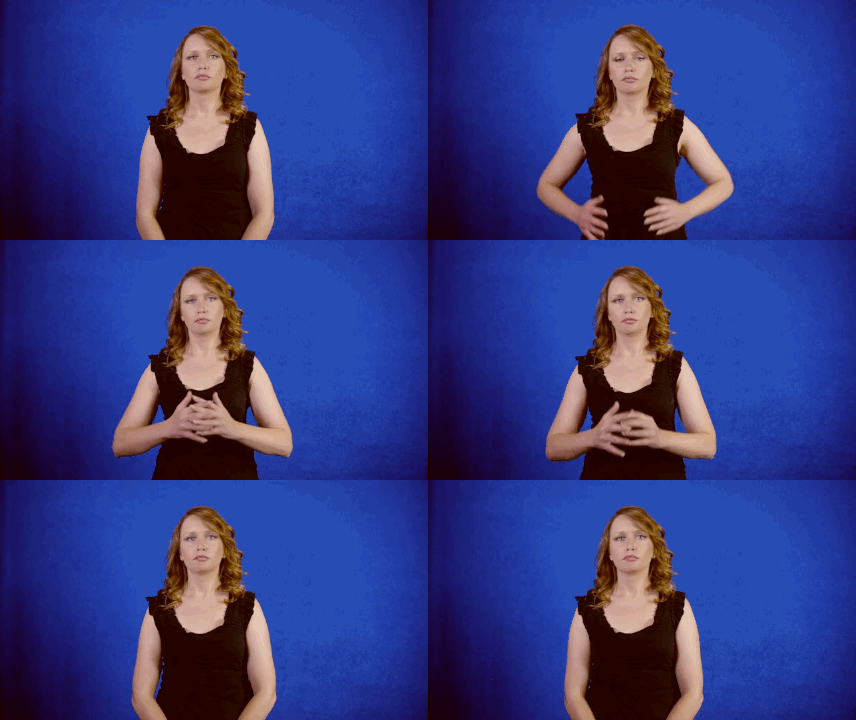
Sign for CONCEIVE in ASL | 🤰 ASL Dictionary

Definition: To conceive.

Sign for CONCEIVE in ASL

YouTube player

Practice Activities:

Start by practicing the sign for CONCEIVE in ASL in isolation. Use a mirror or record yourself signing to check handshape, location, and facial expression. Repeat the sign several times, alternating between slow and natural signing speeds to build comfort and fluency.

Create short example phrases that use the sign for CONCEIVE in ASL. These might include ideas like “I can’t conceive the plan,” or “She conceived a brilliant idea.” Try changing subjects and verbs around the target sign to enhance flexibility—test variations like “They conceived it together,” or “He struggled to conceive a solution.”

Use flashcards with different contexts written in English on each card. For each context, produce a full ASL sentence including the sign for CONCEIVE in ASL. Include both literal and more abstract meanings, such as conceiving an invention versus conceiving a child, to build depth of understanding.

With a partner or group, act out improvised scenes using the sign. Prompt topics like conceiving an invention, an idea for a story, or a plan to solve a mystery. Encourage each person to sign full sentences or explain the thought process behind “conceiving” something within the scenario.

Develop a storytelling prompt using the concept of conceiving an idea. For example: “You are a scientist who has conceived a cure.” Sign a short story about how that idea came to you, emphasizing descriptive signing and including the sign for CONCEIVE in ASL at key points.

Watch videos of fluent signers using complex concepts, and note when you see uses of the sign for CONCEIVE in ASL. Try to mimic their usage and apply it to your own sentences. This builds confidence not only in the vocabulary, but also in how it flows naturally within ASL grammar.

Cultural Context:

The sign for conceive in ASL reflects more than just medical or biological meanings. In the Deaf community, it can also express abstract ideas and creative concepts, depending on the context. Understanding the cultural context behind this sign is essential for using it appropriately in American Sign Language.

Deaf culture places high value on clear visual communication. The sign for conceive in ASL must represent both physical and metaphorical meanings with precision. Whether discussing the beginning of a pregnancy or the inception of an idea, the sign is adapted through facial expressions and body language to convey intent.

When using the sign for conceive in ASL in conversation, the topic at hand helps shape how the sign is received. In discussions about family planning, fertility, or childbirth, the sign leans toward the physical and emotional experience of creating life. This makes emotional tone and personal space especially important to respect.

In other contexts, the sign for conceive in ASL can also refer to coming up with an idea or forming a plan. In creative settings like art or storytelling, people in the Deaf community use this sign to show how a thought forms in the mind. It’s greatly influenced by the signer’s emotions and the artistic nature of the topic.

In classrooms or educational discussions, using the sign for conceive in ASL can connect to learning something new or understanding a complex topic. In these settings, it represents mental conception—grasping a theory or spark of understanding. This reflects a broader view of the word’s meaning outside just physical conception.

In religious or medical discussions, the sign for conceive in ASL often appears in more formal or specific conversations. Deaf individuals may use different versions of the sign depending on their regional dialect or the comfort level of the group. The choice of sign can shift depending on cultural background, religious beliefs, and personal experience.

In some parts of the Deaf community, especially among younger signers or bilingual families, the sign for conceive in ASL may be influenced by sign choices from other languages or cultures. These shifts create rich layers of meaning, and understanding those layers helps avoid miscommunication. That’s why context is an essential part of signing.

Facial expressions and mouth movements also play a key role in the clarity of the message. With the sign for conceive in ASL, the signer often uses eye gaze or a slight eyebrow raise to indicate whether it’s a thought or a pregnancy being described. These smaller details bring depth and help shape how the message is received.

Storytelling is important in Deaf culture, and the sign

Extended Definition:

The sign for conceive in ASL can vary slightly based on the context in which it’s used. In general, the concept of conceive can refer to becoming pregnant or to forming an idea or thought in the mind. American Sign Language captures both meanings through different signs that reflect the intended context. Understanding how to express conceive in ASL depends on whether the reference is to pregnancy or to creative or intellectual thought.

For the meaning related to pregnancy, the sign for conceive in ASL typically involves a gesture that brings two hands together near the lower abdomen. This movement symbolizes the merging of elements, representing conception or the beginning of life. Facial expression can support this interpretation by showing excitement, awe, or surprise. This sign is commonly used in conversations about family planning, fertility, or health.

When referring to the act of forming an idea or imagining something, the sign for conceive in ASL involves gestures near the head. These signs may include pointing to the temple or making a motion suggesting an idea forming in the mind. In this version, the sign aligns closely with other abstract or cognitive signs in ASL like imagine, invent, or brainstorm. Contextual clues are essential to ensure clarity.

In ASL, many words are conceptual rather than one-to-one translations. The sign for conceive in ASL must be chosen based on whether you are describing a physical or intellectual process. Native ASL users often adjust their signs using facial expression, body positioning, and movement to make their target meaning clear. Even if two meanings use different signs, the shared root concept of creation or origination connects them.

When learning how to use the sign for conceive in ASL, it’s important to watch fluent signers or certified interpreters. Their use of handshape, movement, and non-manual cues will help reinforce the appropriate choice for any given situation. Online video dictionaries and ASL apps can also provide helpful visual references. Practicing with a Deaf mentor or instructor will improve accuracy and fluency when using this sign.

In formal or educational contexts, it’s helpful to always clarify the type of conceive you mean. For example, in a health education class, the sign for conceive in ASL will most likely relate to pregnancy and reproduction. In contrast, in a philosophy or literature discussion, the concept of creative or critical thinking might be the focus, and the sign would suggest mental effort. Adapting to the setting improves understanding and communication.

The sign for conceive in ASL also highlights the rich, visual nature of the language

Synonyms: imagine, devise, form, think up, conceptualize

Educational resources: Find related learning materials in our course bank!

Want more? Check out some of our popular learning activities on the homepage!

Need to look up a sign? Use our highly rated dictionary: https://aslinteractive.com/best-asl-dictionary/

Follow us on tiktok: https://www.tiktok.com/@aslinteractive. More social media links at the bottom of this page!

Long-tail Keywords: what is the sign for conceive in ASL, how do you sign conceive in American Sign Language, conceive in ASL

Categories:

tags: Verbs, Actions, Major decisions, Language Learning, Everyday activities

Parameters

*Handshape*:

The handshape for the sign for CONCEIVE in ASL uses both hands in the 5-handshape, with fingers spread slightly apart. The hands start near the temples and then move forward and inward, coming together as if representing a thought forming or an idea taking shape.

This gesture visually represents the concept of an idea being conceived or created in the mind. The open fingers transitioning inward mimic the process of something intangible becoming real, aligning well with the meaning behind the sign for CONCEIVE in ASL.

*Palm Orientation*:

The palm orientation for the sign for CONCEIVE in ASL typically starts with both hands in a relaxed curved 5-handshape, positioned near the sides of the head. The palms face inward toward the temples to suggest the act of an idea forming internally.

As the sign progresses, the fingers may close slightly and move forward or upward, with palm orientation shifting slightly upward or outward. This change supports the visual concept of something originating from within, reinforcing the meaning behind the sign for CONCEIVE in ASL.

*Location*:

The location for the sign for CONCEIVE in ASL typically starts near the forehead, representing the origin of thought or internal realization. Both hands often move outward or downward from the head, symbolizing the development or formation of an idea.

This head-level placement connects directly to mental processes, reinforcing the meaning of the sign for CONCEIVE in ASL. It visually links cognition with the concept of forming or creating something in the mind.

*Movement*:

The dominant hand, in a flat “O” shape, starts near the forehead and moves slightly outward, representing the idea of an idea or concept forming. The fingers gently open into a modified “5” handshape as it moves away, symbolizing the unfolding of a thought or the beginning of something new.

The sign for conceive in ASL mimics the mental or cognitive origin of an idea. This motion reflects the abstract process of conception, whether for ideas or beginning stages of a plan.

*Non-Manual Signals*:

When performing the sign for conceive in ASL, the non-manual signals typically include a thoughtful or focused facial expression, often with slightly furrowed brows to show a deep or abstract idea forming. Slight head tilt may accompany the sign to emphasize the mental or imaginative process.

These expressions help clarify that the sign for conceive in ASL refers to forming an idea or beginning a mental process rather than physical conception. Raised eyebrows may be used if framing the sign as a question.

*Prosody, Dominant/Non-Dominant Hand*:

The sign for CONCEIVE in ASL uses both hands in a thoughtful and symbolic gesture. The dominant hand, typically in a bent 5-handshape, moves inward toward the head, as if representing an idea forming in the mind. The non-dominant hand may remain stationary or serve as a base, reinforcing the abstract concept.

This expressive motion captures the essence of an idea or beginning taking root, effectively communicating the sign for CONCEIVE in ASL. The use of facial expressions adds clarity and emotion, enhancing the overall meaning and prosody of the sign.

Tips for Beginners:

When learning the sign for CONCEIVE in ASL, it’s important to understand that this concept is often visualized metaphorically rather than literally. The sign usually stems from conveying the idea of forming an idea or beginning something internally, akin to the spark of thought or a process starting within the body or mind. This can involve signs like THINK or IDEA combined with a gesture that represents formation or beginning from within.

A common mistake beginners make is assuming the sign for CONCEIVE in ASL refers directly to pregnancy and using signs related to birth or baby. While CONCEIVE can mean becoming pregnant in English, ASL distinguishes between the physical act and the mental metaphor depending on context. So be mindful of which meaning—mental or physical—you need to express, and understand the context thoroughly before signing.

Focus on facial expressions and controlled, deliberate hand movements. Facial grammar plays a huge role in ASL, and for abstract concepts like CONCEIVE, the way you use your face can shift the meaning entirely. Use an expression of realization or formation when describing a new idea conceptually, and a different one for biological conception.

To improve your accuracy, practice in front of a mirror to ensure hand placement stays clean and consistent. Pay close attention to where each sign starts and ends during the sign for CONCEIVE in ASL. Body space is meaningful; signs that indicate internal processes are usually made closer to the torso or head.

Try doing the sign slowly at first, and avoid overthinking hand shapes if you’re combining signs. Instead, focus on fluidity and natural flow. Lastly, ask for feedback from fluent signers or use video analysis apps to track your improvement. Seeing yourself sign can be eye-opening and helps catch subtle errors in conveying the sign for CONCEIVE in ASL.

Connections to Other topics:

The sign for CONCEIVE in ASL is connected to several abstract and physical concepts such as THINK, IDEA, BECOME-PREGNANT, and BIRTH. When used in the context of mental invention or forming an idea, it often overlaps with signs for CREATE or IMAGINE. These relationships show how ASL expresses nuanced meaning by combining or modifying base concepts, creating a more fluid understanding of abstract ideas.

In the context of reproduction, the sign for CONCEIVE in ASL often connects to signs for BECOME-PREGNANT or DEVELOP, particularly when discussing biology or parenthood. This allows the word to shift intuitively between intellectual and biological meanings. For example, in educational or medical discussions, the sign might be used alongside signs like WOMB, EGGS, or BABY to provide clarity and depth.

The sign is also commonly used in combination with THINK or PLAN to form compound ideas such as CONCEIVE-OF-A-PLAN or CONCEIVE-AN-IDEA. These uses highlight the flexibility of the language in expressing intangible concepts clearly. Learners benefit from seeing how the sign can be built upon to create more complex narratives in storytelling or academic contexts.

The mental dimension of the sign for CONCEIVE in ASL links it to signs like UNDERSTAND, FIGURE-OUT, or IDEA. These conceptual relationships deepen the sign’s utility in discussions involving theory, innovation, or imagination. Expressing how something was first CONCEIVED can connect easily to stories of discovery or creativity in both everyday conversations and academic presentations.

By understanding these connections, signers begin to grasp the versatility within ASL vocabulary. The sign for CONCEIVE in ASL becomes a gateway to more sophisticated language use, with strong ties to signs that represent cognitive activity, planning, and both literal and metaphorical birth. This layered understanding enhances fluency and enriches expression ✨.

Summary:

The sign for CONCEIVE in ASL involves a nuanced representation of abstract thought and biological creation. It can be performed through combining elements associated with thinking and internal development. Typically, the dominant hand starts in a flat-O shape at the forehead and then moves outward in a subtle explosion motion, suggesting an emerging idea or concept.

Another version of the sign for CONCEIVE in ASL uses a variation that more explicitly depicts conception in the physical or reproductive sense. In this form, the sign mimics a gestation or fertilization process, bringing the fingers together near the lower abdominal area while suggesting inward formation. This version is often used in medical or biological contexts.

ASL often draws on metaphor, space usage, and facial grammar to emphasize meaning. For the sign for CONCEIVE in ASL, facial expressions provide added nuance—thoughtful expressions tend to be associated with mental conceptualization, while more serious or medical expressions reflect physiological meaning. This duality allows a single concept to exist with multiple layers depending on context.

The cultural aspect of the sign for CONCEIVE in ASL reflects how Deaf individuals convey ideas spanning intellect and biology. In Deaf communities, dialogue around family building, reproductive health, and mental creation is rich and symbolically represented through layered signs. The sign itself invites both interpretation and clarity, balancing artistic and clinical meaning.

Grammatically, the sign for CONCEIVE in ASL operates as a verb and often appears in abstract sentence structures. For instance, when paired with signs like THINK, PLAN, or IDEA, it represents intellectual creation. When linked with signs such as BABY or PREGNANT, it clearly shifts toward a biological or reproductive focus.

This fluid grammatical behavior underscores how ASL verbs can encompass multiple semantic domains depending on movement, handshape, and facial grammar. Like many ASL signs, the sign for CONCEIVE in ASL can be inflected directionally or temporally, depending on the narrative being told. Modifications in speed and location often cue the context for interpretation.

The sign encourages metalinguistic awareness in both learners and native signers. Understanding when to use which variation teaches sensitivity to context, illustrating one of ASL’s strengths: flexibility within a visually based linguistic structure. Language users must distinguish between figurative and literal meaning through embodied linguistic cues.

In linguistics, the sign for CONCEIVE in ASL offers valuable insight into how abstract notions become visible through gesture. The semiotic transition from cognition to movement gives researchers a unique case study in embodied meaning-making. Concepts that are invisible in English are externalized and seen directly in ASL.

This ties to iconicity, one of ASL’s fundamental principles. The sign for CONCEIVE in ASL exemplifies high iconicity when referring to reproduction, and moderate iconicity when symbolizing mental conception. Visual resemblance adds memorability and accessibility, especially for new users.

Applied linguistics appreciates how the sign supports multimodal literacy. Deaf children exposed to signs like CONCEIVE early on not only gain vocabulary, but also learn to connect concepts across bodily gesture and internal cognition. It reinforces holistic learning processes grounded in spatial awareness.

Signs like CONCEIVE also link directly to other conceptually related signs. IDEA, THINK, PREGNANT, CREATE, and PLAN are often part of the same semantic field, and understanding these relationships increases semantic fluency. Learners who connect these signs form more robust mental lexicons.

The historical evolution of the sign for CONCEIVE in ASL shows how signs shift to meet community needs. As reproductive discourse expanded within the Deaf community—especially around family planning and parenthood—the use of biologically-specific variations of the sign grew. Such adaptiveness keeps ASL vibrant and responsive.

Within storytelling traditions, the sign for CONCEIVE in ASL plays a symbolic role. In Deaf poetry or literature, the sign often evokes creative force or origin—whether of ideas, projects, or people. This poetic use elevates the sign from mundane detail to symbol of initiation and possibility.

Deaf artists incorporate the sign dynamically in performance art, blending physical and conceptual meanings to explore creation themes. The motion’s innate symbolism lends itself well to these visual artforms. This enhances cultural richness and allows ASL users to connect deeply with their language.

In mental health dialogues, using the sign for CONCEIVE in ASL helps express ideas around conceptual breakthroughs or internal realizations. Therapists and counselors working within Deaf communities rely on signs with highly conceptual significance to foster introspection and clarity. Language becomes a bridge for emotional insight.

Education curricula for Deaf students often integrate signs like CONCEIVE early in academic vocabulary sets. It introduces students to complex thinking verbs, preparing them for broader academic discussions. Signing CONCEIVE aligns with higher-order thinking skills, useful in science, arts, and philosophy classes.

Links between the sign for CONCEIVE in ASL and scientific discourse make it a powerful educational tool. In biology, science teachers use the

Want more? Check out some of our popular learning activities!

ASL Interactive Resources

ASLInteractive YouTube Channel

Follow us on tiktok: @aslinteractive.com

Follow us on Instagram: aslinteractive

Facebook page: aslinteractive

Facebook group: aslinteractive

LInkedIn: ASL Interactive LLC

Twitter: @ASL_interactive

*Some information on this page is AI-generated. AI can make mistakes. Please check the information.

Sign for CONCEIVE in ASL

Responses