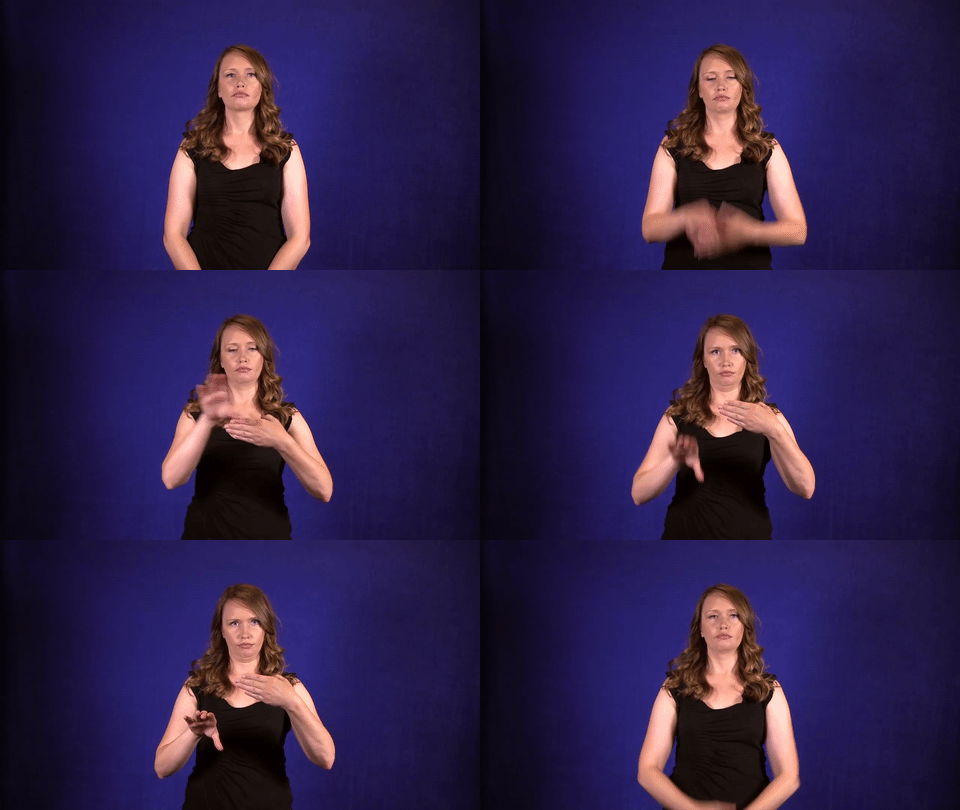
Definition: A conclusion.
Sign for CONCLUSION in ASL

Practice Activities:
Start your practice of the sign for CONCLUSION in ASL by using it in isolation. Stand in front of a mirror and repeat the sign several times, making sure your handshape and motion are produced clearly. Record yourself signing and compare it with reliable ASL videos or a teacher’s demonstration for accuracy.
Once you feel confident with the basic movement, begin incorporating the sign for CONCLUSION in ASL into short phrases. Try creating sentences like “That is the conclusion,” or “In conclusion, we are done.” Sign these slowly and then at a comfortable conversational speed. Switch up the subjects and objects in the sentence for variation.
Create a mini-presentation about a topic you know well. End with a sentence using the sign for CONCLUSION in ASL to simulate presenting a conclusion in a formal or academic setting. For example, talk about your favorite animal and end with, “In conclusion, I love dolphins.” This helps you assign practical meaning to the sign.
Practice storytelling by describing a short event or re-telling a simple tale, such as how your day went, and use the sign for CONCLUSION in ASL to wrap it up. Use transitional phrases like “first,” “next,” and “finally” to lead into the final part where the conclusion logically fits.
For pair work, take turns explaining simple topics to each other, then clearly end by signing “conclusion” to close your thought. Switch roles and provide feedback on fluency and clarity. Challenge each other to insert the sign naturally within the topic.
As a writing activity, compose a paragraph and then translate it into ASL. Pay special attention to how you structure the end of your message and where the sign for CONCLUSION in ASL best fits. This reinforces both narrative skills and sign placement.
Cultural Context:
In American Sign Language (ASL), understanding the cultural context behind a sign is just as important as learning the handshape and movement. The sign for conclusion in ASL is used in a variety of everyday situations, from casual conversations to formal discussions or academic settings. Within the Deaf community, clarity and structure in communication are highly valued, so knowing how to properly sign conclusion in ASL helps maintain smooth exchanges and expresses clear intent.
The sign for conclusion in ASL is often used to wrap up a presentation, summarize information, or indicate the end of a story. It carries more than just a literal meaning; it reflects an understanding that the conversation or topic is reaching its natural endpoint. Whether signing in school, at work, or during casual chats, using conclusion in ASL contributes to effective communication etiquette in the Deaf community.
ASL is a visual language deeply connected to Deaf culture, which emphasizes complete and contextual signing. Using the sign for conclusion in ASL demonstrates not only fluency but also cultural respect. Fluent signers understand how context shapes the meaning of signs, and conclusion in ASL is wrapped in that same context. It can signal agreement, closure, or the final thought in a debate.
In Deaf culture, nonverbal cues such as facial expressions and body language play a significant role in how signs are interpreted. When using the sign for conclusion in ASL, a signer often pairs it with appropriate eye contact and a confident nod to convey certainty. This cultural nuance adds depth beyond the hand motion, helping signers connect more meaningfully with their audience.
Classrooms and educational settings use the sign for conclusion in ASL to teach organization and critical thinking skills. Educators often model the use of conclusion in ASL when summarizing lesson points, encouraging Deaf students to use the sign to develop strong communication habits. In academic discourse, it helps denote the end of an argument or presentation, building structure into ASL expression.
Storytelling is a cherished tradition in Deaf culture, and the sign for conclusion in ASL has a powerful place in this art form. Signers use it to transition from the narrative to its wrap-up, providing audiences with a clear cue that the story is ending. In this context, conclusion in ASL preserves traditional elements of Deaf storytelling while offering modern linguistic clarity.
Group conversations or meetings among Deaf individuals often use specific signs to guide the flow of discussion. The sign for conclusion in ASL signals the moving on to the next topic or the end of the meeting.
Extended Definition:
The sign for CONCLUSION in ASL conveys the idea of something being finalized, decided on, or completed. In American Sign Language, the concept of wrapping something up or reaching the end of a discussion or process is expressed with a specific hand movement that visually summarizes the meaning. This makes the sign for CONCLUSION in ASL intuitive and easy to remember once the concept is understood.
When using the sign for CONCLUSION in ASL, the signer typically shows a motion that suggests “ending” or “closing off” a topic. This could look like pushing something away or signaling the lid closing on an idea. The sign captures not just the word but the deeper meaning it carries, like final thoughts, decisions, or the wrap-up of an event. It’s a great example of how ASL represents abstract ideas using visual gestures.
This sign can be used in a variety of contexts, such as in storytelling, presentations, or classroom discussions. Whether you’re summarizing an argument, finishing a speech, or closing a debate, the sign for CONCLUSION in ASL helps convey that everything has been said and it’s time to finalize. Teachers use it often while summarizing lessons, and students might use it in reports or discussions.
Facial expressions play an important role in the delivery of this sign. A firm nod or a satisfied expression can reinforce the concept of something reaching its conclusion. ASL relies heavily on these visual cues to deliver context and emotion, making communication richer than just hand motions alone. When learning the sign for CONCLUSION in ASL, it’s important to practice these accents.
The grammar of ASL allows for flexible placement of the sign depending on sentence structure. Sometimes it comes at the end of the sentence to reinforce summary or finality, while other times it may be used earlier to preview the closure of a topic. This versatility lets the sign for CONCLUSION in ASL flow naturally in conversations or formal discussions.
For beginners learning ASL, this sign is easy to incorporate into everyday use, especially when telling stories, summing up thoughts, or participating in classroom environments. Advanced signers use the word fluently and add nuances like shoulder shifts, head tilts, or eye gaze to deliver a more nuanced message. Such layers make the sign for CONCLUSION in ASL especially rich in meaning compared to its spoken counterpart.
ASL is a visual language that often relies on the full body to convey meaning, and the sign for CONCLUSION in ASL taps into this by using
Synonyms: end, closure, final decision, wrap-up, summary
Educational resources: Find related learning materials in our course bank!
Want more? Check out some of our popular learning activities on the homepage!
Need to look up a sign? Use our highly rated dictionary: https://aslinteractive.com/best-asl-dictionary/
Follow us on tiktok: https://www.tiktok.com/@aslinteractive. More social media links at the bottom of this page!
Long-tail Keywords: what is the sign for conclusion in ASL, how do you sign conclusion in ASL, ASL sign for conclusion
Categories:
tags: Conclusion, Language Learning, Commands, Activities, Major Decisions
Parameters
*Handshape*:
The handshape used in the sign for CONCLUSION in ASL typically involves both hands starting in a flat B handshape, with fingers extended and together, palms facing each other. The hands come together as if enclosing or wrapping up something. This movement and handshape reflect the idea of bringing elements together to reach a final point, reinforcing the meaning of the sign for CONCLUSION in ASL.
This handshape is symbolic of summarizing or enclosing thoughts, consistent with the concept behind the sign for CONCLUSION in ASL. It visually represents finality or the end of a process, aligning well with how ideas are often wrapped up or finalized during a conclusion.
*Palm Orientation*:
The palm orientation for the sign for CONCLUSION in ASL begins with both hands in open “5” shapes, palms facing each other at a slight angle in front of the body. As the sign progresses, the hands come together so that the fingers brush or move toward contact with the opposite palm, ending flat.
Throughout the sign for CONCLUSION in ASL, palms may shift from inward-facing to downward-facing, depending on regional variation. The motion and palm orientation help convey the sense of something final or wrapping up, aligning with the meaning of conclusion.
*Location*:
The sign for CONCLUSION in ASL typically takes place in the neutral space in front of the torso. Some variations may begin near the forehead or the top of the head but usually transition downward to the center space just in front of the chest or upper abdomen.
This location helps express the idea of finality or arriving at the end. When signing the sign for CONCLUSION in ASL, ensure your movements stay within the central signing area for clarity .
*Movement*:
The sign for CONCLUSION in ASL starts with one open flat hand, palm facing downward, placed above the other open flat hand, palm up. The top hand moves downward in a curved arc, coming to rest on the bottom hand, mimicking something being finalized or ended.
This movement symbolizes wrapping up or finishing. The sign for CONCLUSION in ASL visually suggests the idea of closing a thought or drawing something to an end .
*Non-Manual Signals*:
The non-manual signals for the sign for CONCLUSION in ASL typically include a focused and final facial expression. Slight tightening of the lips or a nod may occur to emphasize certainty or finality.
Eyebrows are often neutral or slightly lowered to show seriousness or affirmation. These facial cues reinforce the definitive nature of the sign for CONCLUSION in ASL, highlighting that something is coming to an end or has been decided.
*Prosody, Dominant/Non-Dominant Hand*:
The sign for CONCLUSION in ASL uses both hands. The dominant hand is typically a flat palm or claw shape while the non-dominant hand remains stationary, also in a flat palm shape. The dominant hand moves forward or down to close over the non-dominant hand, symbolizing completion or finality.
Facial expression plays a role in emphasizing the meaning of the sign for CONCLUSION in ASL, often showing finality or decisiveness. This sign reflects the idea of wrapping something up or reaching the end, aligning visually and conceptually with the word’s meaning.
Tips for Beginners:
When learning the sign for CONCLUSION in ASL, it’s important to remember that clarity and precision in movement are essential. This sign typically involves starting with one hand open and moving another hand in a sweeping motion as if you are “wrapping up” or “closing” an idea. Be sure to keep your facial expression in sync with the tone of the sign—neutral or final, depending on the context.
One common challenge beginners face with the sign for CONCLUSION in ASL is being too vague or loose in their movement. Aim for deliberate hand shapes and consistent sizing in your motion. Avoid overextending your arm or making the sign too fast, as that can compromise clarity and understanding.
Repetition is key when practicing. Use a mirror or record yourself signing to watch for accuracy in hand positioning and transitions. It’s also a good idea to practice this sign in full sentences, not just on its own, so you can see how it flows naturally with connected thoughts. Using the sign properly within context will help reinforce retention.
Another helpful tip is engaging with native or fluent ASL users to get feedback. Interactive learning, like signing with a partner or attending Deaf events, can help you feel how the sign for CONCLUSION in ASL is applied in real-life contexts. Mimicking real conversations will also help you recognize pauses, stress patterns, and how the sign may vary slightly in different regions or dialogues.
Don’t get discouraged if it doesn’t look perfect right away. Mastering the sign for CONCLUSION in ASL takes muscle memory and visual feedback. Keep your practice regular and stay patient. Over time, your motion will feel more natural and your meaning more readily understood by Deaf and signing communities.
Connections to Other topics:
The sign for CONCLUSION in ASL is connected to various academic, logical, and communicative concepts. It often appears in classroom settings, academic discussions, and formal speeches where logical sequencing is necessary. This sign can be closely related to ASL signs like FINISH, RESULT, and DECIDE, as they all deal with finality, outcomes, or judgments.
In narrative ASL, the sign for CONCLUSION in ASL may be used as part of storytelling structures, where a story arc ends with the resolution or moral. This aligns it with transition signs like THEN or AFTERWARDS that help guide viewers through the sequence of events. It’s also heavily tied to debate and analysis contexts, where learners can see it paired with signs like REASON or SUPPORT.
Compound structures incorporating the sign for CONCLUSION in ASL often appear in educational content and interpreting. For example, the sign can merge with FINAL or even a directional use of THINK, creating phrases like FINAL THOUGHT or REACHED CONCLUSION. These combinations allow for more nuanced expression and are especially useful during discussions or ASL essays.
Grammatically, the sign for CONCLUSION in ASL plays a role in helping native and second-language users signal closure in conversation. It functions similarly to conversational markers like SUMMARIZE or IN-SUM, signaling that key points have been discussed. It’s frequently used while interpreting lectures or making persuasive points where wrapping up ideas is required .
This sign also links to broader cognitive and critical thinking lexicons in ASL, including THINK, ANALYZE, and UNDERSTAND. When teaching students to compare ideas or make judgments, integrating the sign for CONCLUSION in ASL into lessons supports higher-order thinking . It showcases how ASL communicates not just language, but also logic and structure.
Summary:
The sign for CONCLUSION in ASL is expressive and grounded in metaphorical motion. It typically involves bringing one or both hands together, mimicking the action of assembling or summarizing separate components into a final thought. This motion represents the conceptual idea of something coming to a close or decision point.
To perform the most common version, one might see both open 5-hands held out in front of the body, then moved inward and flattened into closed hands resembling a summarized point. This visual metaphor mirrors the mental act of bringing together ideas to form a final statement. The sign is direct and elegant, visualizing abstraction through compression and unity.
In some regions, the sign for CONCLUSION in ASL may incorporate a movement that mimics brushing two hands together diagonally, representing the act of brushing away excess details to reveal the essence or final point. This variant underscores how ASL often uses physical space to symbolize cognitive processes. Movement and directionality both reflect the cultural value ASL places on clarity and finality.
When used in ASL sentences, the sign for CONCLUSION in ASL often functions as a noun or can be part of expressions attached to larger contexts like storytelling, academic discussions, or argumentation. It frequently appears near signs such as AGREE, DECIDE, THINK, or FINISH, depending on the user’s intent. This flexibility shows the active, context-driven nature of ASL grammar.
Conceptually, the sign shares terrain with summaries or final statements. It might be used when a person reaches an endpoint in their reasoning, similar to saying “and in conclusion” in spoken English. The sign supports the building of transitions in discourse, helping Deaf speakers navigate storytelling or debate with clarity.
The sign can also relate closely to the sign for FINISH, especially in tonal or sequential narratives. While FINISH can denote literal or temporal endings, the sign for CONCLUSION in ASL is more intellectual—it points to decisions, results, arguments, or interpretations. This distinction is subtle but important in linguistic nuance.
One deeply fascinating aspect of the sign for CONCLUSION in ASL is its metaphorical consistency across abstract domains. Whether ending a story, wrapping up a research paper, or summarizing emotions, the movement of the sign conveys synthesis. It suggests a grasp of abstract cognition via concrete handshapes.
In classroom or professional settings, the sign for CONCLUSION in ASL becomes a critical tool for clear communication. It helps Deaf academics, researchers, and educators mark shifts in themes or arguments during presentation. It also supports classroom learning by aiding students in understanding when to wrap up thoughts or organize main ideas.
Linguistically, the sign’s structure involves a transition from open to closed configuration, aligning with the concept of closure in cognitive and semiotic theory. The open 5-hand often represents expansive or ongoing data, while the closing motion represents a containment or refinement of that data. This compression reflects the mental organization of ideational closure.
Grammatically, it often appears either at the end of a clause or leading into a summarizing statement. For example, a signer may sign SEVERAL POINTS THEN CONCLUSION to highlight that a summary follows. This usage supports ASL’s emphasis on spatial sequencing and visual prioritization.
The sign may integrate facial expressions such as focused eye gaze or raised eyebrows, depending on the rhetorical function. If used to introduce a counterpoint or shift, the signer may intensify expression. These non-manual markers enhance the conceptual clarity and flow of discourse.
From an applied linguistics perspective, the sign is key in teaching new ASL learners how to manage timing and closure in a visual conversation. It plays into broader strategies for sequencing, summarization, and structuring dialogue. Learners quickly understand its rhetorical value when used in debates, presentations or casual discussion.
Culturally, the sign for CONCLUSION in ASL reflects Deaf community values around clarity, structure, and accessibility in discourse. Within Deaf storytelling traditions, reaching a conclusion marks not just the end but the deeper purpose within a narrative journey. It signifies completion with insight.
In interpretation work, this sign takes on special importance. ASL-English interpreters need to deliver accurate renditions of final arguments, wrap-up remarks, or thesis statements. The sign for CONCLUSION in ASL guides these transitions and ensures visual equivalents of complex cognitive shifts are maintained.
Sign language poetry and performance also utilize the sign to layer meaning. Ending a poem or artistic presentation with a visual move representing CONCLUSION can enhance audience comprehension and emotional resonance. It marks not only the end, but a summative twist, often stylized for effect.
Related signs in this semantic family include SUMMARY, END, RESULT, and DECIDE. Each carries its own nuance. While END may be more temporal, and DECIDE more action-based, the sign for CONCLUSION in ASL focuses uniquely on intellectual or analytical closure.
Language researchers have observed how such conceptual transitions are embodied in Deaf communication. The fact that ASL can represent cognitive and
Want more? Check out some of our popular learning activities!
ASL Interactive Resources
ASLInteractive YouTube Channel
Follow us on tiktok: @aslinteractive.com
Follow us on Instagram: aslinteractive
Facebook page: aslinteractive
Facebook group: aslinteractive
LInkedIn: ASL Interactive LLC
Twitter: @ASL_interactive
*Some information on this page is AI-generated. AI can make mistakes. Please check the information.


Responses