Sign for CONFERENCE in ASL | 🏨 ASL Dictionary

Definition: A conference.

Sign for CONFERENCE in ASL

YouTube player

Practice Activities:

To start practicing the sign for CONFERENCE in ASL, begin by isolating the sign in front of a mirror. Repeat the movement and handshape slowly, making sure your fingers are properly shaped and the motion looks fluent. Practice signing it at different speeds to build comfort and fluidity.

Next, use the sign in simple context-based phrases. For example, sign “I ATTEND CONFERENCE” or “WORK CONFERENCE NEXT WEEK”. Use these sentences during your daily practice to build confidence with real-life application. Signing in front of a mirror or recording yourself can help you spot and correct small errors.

Create flashcards with vocabulary like MEETING, DISCUSS, PLAN, and CONFERENCE. Shuffle and sign each word quickly to challenge your memory recall. Include the sign for CONFERENCE in ASL several times in the deck to reinforce its meaning and movement.

Role-play with a partner or tutor by pretending to schedule a conference. For example, take turns asking and answering questions like “WHEN CONFERENCE?” or “WHO ATTEND CONFERENCE?” This activity builds both receptive and expressive skills, and working with a partner will give you live feedback.

Try short storytelling prompts such as describing a professional event you attended, real or imagined. Begin your story with “LAST MONTH CONFERENCE…” and describe who was there, what happened, and what was discussed. The repetition of the sign for CONFERENCE in ASL within the story helps solidify it in your memory.

Watch news clips or professional presentations in ASL and identify when the sign for CONFERENCE is used. This will help with recognizing the sign in natural paced conversation. You can also practice interpreting short passages from English into ASL that include the concept of a conference.

Stay consistent with at least 5-10 minutes of practice daily and challenge yourself by incorporating new vocabulary around the sign to enhance your fluency.

Cultural Context:

The sign for CONFERENCE in ASL is widely used within the Deaf community, especially in professional and academic settings. Whether referring to business meetings, educational seminars, or community gatherings, this sign holds cultural importance in expressing organization and collaboration.

In Deaf culture, a conference is more than just a meeting—it’s a meaningful opportunity to connect, share ideas, and build networks. The sign for CONFERENCE in ASL reflects this sense of purposeful gathering, where individuals come together to discuss shared goals and information.

Using the sign for CONFERENCE in ASL also demonstrates cultural awareness, as it conveys respect for the ways Deaf individuals contribute to group discussions and leadership. When someone uses this sign fluently, it shows an understanding of the roles that Deaf professionals and advocates play in shaping their fields.

Deaf conferences often highlight social justice, accessibility, language rights, and education. When attending or talking about such events, using the correct sign adds clarity and shows engagement with key topics in the Deaf world. The sign for CONFERENCE in ASL becomes a tool not just for communication but for representation.

The structure of the sign visually represents people gathering or coming together, which mirrors the value placed on community and shared dialogue within Deaf culture. Signing CONFERENCE accurately ensures the intended message is received clearly and respectfully.

Social events and conferences hosted within the Deaf community can serve as spaces for knowledge-sharing and cultural celebration. Understanding how to use the sign for CONFERENCE in ASL can help both Deaf and hearing individuals participate in community dialogues more inclusively.

In interpreting and educational environments, professionals often use the sign for CONFERENCE in ASL when talking about school meetings, professional development days, or other group planning sessions. Knowing this sign is useful in both K-12 and higher education settings, where such gatherings are common.

Online or virtual conferences have also made this sign increasingly relevant today. Whether discussing a Zoom call or a professional webinar, using the correct sign for CONFERENCE in ASL will ensure communication remains accessible and culturally meaningful.

Teaching the sign for CONFERENCE in ASL to new learners emphasizes the importance of group communication and collaboration values cherished in American Sign Language and Deaf culture. It is one of many vocabulary signs that help bridge everyday life with cultural fluency.

In workplace settings that include Deaf employees, knowing the sign for CONFERENCE in ASL supports accessible communication and inclusive practices. Using this sign in meetings helps everyone feel informed and involved.

The growing number of events like Deaf expos, advocacy summits, and language conferences also

Extended Definition:

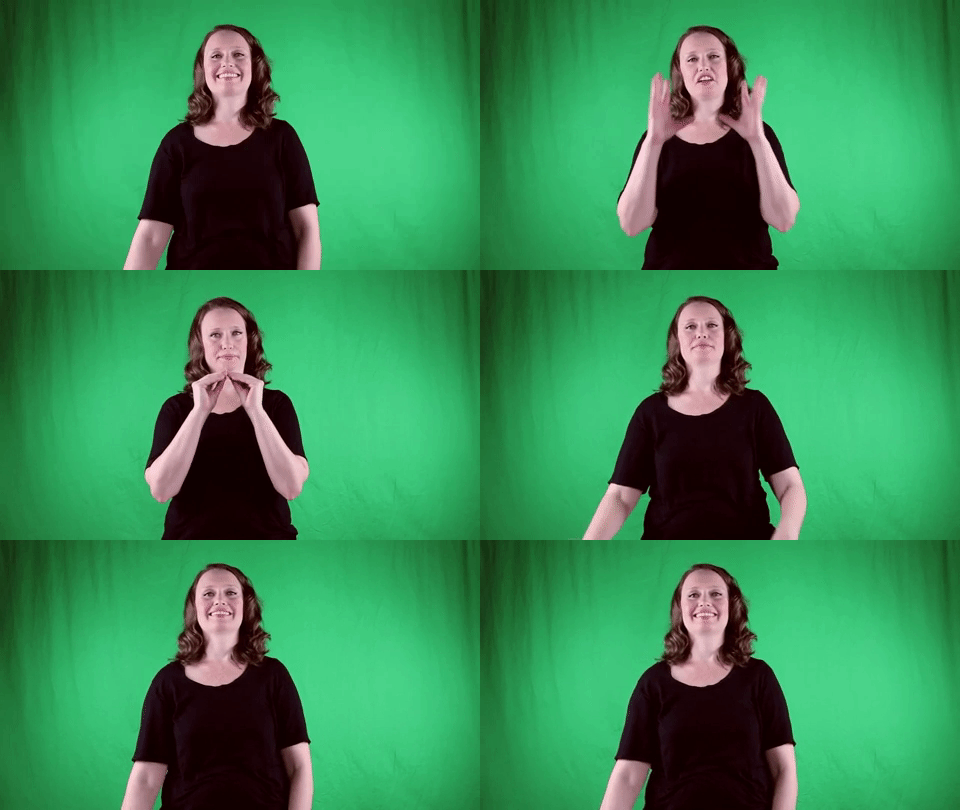
The sign for conference in ASL is typically made by using the handshape for the letter F from the American Sign Language alphabet. Both hands form the F shape, and they are brought together in front of the body with a slight tapping or interaction to symbolize people coming together to discuss or meet. This gesture visually represents a group gathering or a formal meeting.

In American Sign Language, context is everything. The sign for conference in ASL may slightly vary depending on the type of meeting or formal event being discussed. For example, academic, business, or religious conferences might include facial expressions or body shifts to help clarify the setting or seriousness of the meeting.

This sign is closely connected to the signs for meeting, group, and discussion. Many ASL users incorporate these related signs to give more shape to their conversations about specific types of events. Think of the sign for conference in ASL as part of a larger family of communication-related signs that help describe organization, information sharing, and planning.

Regional variations may occur in how this sign is used. Some signers might use alternative signs that reflect local or cultural signing habits, especially if the word conference is commonly used in their day-to-day environments. It’s always helpful to watch for facial expressions and additional signs that may be used in combination for clarity and accuracy.

The sign for conference in ASL is widely used in academic settings, especially in schools and universities where seminars, workshops, and professional gatherings are frequent. It is also popular in business environments for meetings and corporate events. Signers who work in professional settings often rely on this sign when planning or referring to scheduled meetings.

When teaching the sign for conference in ASL, it’s useful to connect it to the idea of multiple people coming together to exchange ideas. This mental image will help new learners remember the motion and meaning more efficiently. Using visual storytelling is a big part of effective ASL learning, and this sign lends itself naturally to that technique .

Like many ASL signs, this one benefits from practice in front of a mirror or with a fluent ASL user. Watching videos or attending Deaf community events are also great ways to reinforce correct usage and better understand when to use the sign for conference in ASL. Signing with intention and accurate handshapes ensures clear communication ️.

Because it represents such a formal and structured concept, the sign for conference in ASL is useful in both everyday and professional communication. Whether it’s a parent-teacher conference, a job-related meeting

Synonyms: meeting, convention, summit, symposium, assembly

Educational resources: Find related learning materials in our course bank!

Want more? Check out some of our popular learning activities on the homepage!

Need to look up a sign? Use our highly rated dictionary: https://aslinteractive.com/best-asl-dictionary/

Follow us on tiktok: https://www.tiktok.com/@aslinteractive. More social media links at the bottom of this page!

Long-tail Keywords: What is the sign for Conference in ASL?, How do you sign Conference in ASL?, ASL sign for Conference

Categories:

tags: Conference, Language Learning, Activities, Colleges/Universities/schools, Events

Parameters

*Handshape*:

The handshape for the sign for CONFERENCE in ASL involves both hands using the flat “O” handshape , where fingertips touch the thumb, forming a closed circle. The fingertips of each hand face each other near the mouth and then open outward slightly in a repetitive motion.

This motion reflects the idea of exchange or communication, which is central to the sign for CONFERENCE in ASL. The use of symmetrical handshapes emphasizes mutual discussion or gathering.

*Palm Orientation*:

For the sign for CONFERENCE in ASL, the palm orientation typically starts with both hands held in front of the body, with fingers slightly spread and palms facing each other. As the hands move slightly forward and away from each other in an arcing motion, the palms remain mostly inward toward each other.

This orientation suggests a gathering or coming together, which fits the meaning of the sign for CONFERENCE in ASL. The palms do not turn outward or downward, maintaining a consistent inward orientation throughout the motion.

*Location*:

The sign for conference in ASL is made in the neutral space in front of the upper chest. Both hands begin in front of the body, typically with fingers touching or close together depending on the variation, before moving outward in a spreading motion. This area of the body allows for clear visibility and is common for signs involving group discussions or meetings.

Because the sign for conference in ASL involves both hands interacting in front of the chest, it’s important to maintain an appropriate distance from the body to avoid touching the torso. The neutral zone also helps distinguish this sign from others that might involve movement across the head or lower chest areas. ‍ ‍

*Movement*:

The sign for CONFERENCE in ASL involves both hands in the “F” handshape. Start with the fingertips of each “F” hand touching together at chest level. Then, move both hands outward and slightly downward in a simultaneous, flicking motion.

This motion symbolizes the idea of exchanging information as in a meeting. The sign for CONFERENCE in ASL is often used to represent formal gatherings, panels, or organized discussions ️.

*Non-Manual Signals*:

When using the sign for conference in ASL, the facial expression should appear focused and slightly serious, reflecting the formal nature of a meeting or organized discussion. Slight raised eyebrows can be used to indicate importance or engagement with the topic.

Head movement should be minimal, keeping attention centered and professional. The sign for conference in ASL often pairs well with slight forward head tilt, suggesting attentiveness and involvement in a discussion setting. ‍

*Prosody, Dominant/Non-Dominant Hand*:

The sign for CONFERENCE in ASL uses both hands in a modified “F” handshape. The dominant and non-dominant hands face each other, palms slightly turned in, and move in small alternating forward motions, as if people are exchanging ideas. The movement is symmetrical and fluid, representing group discussion or meeting.

When signing the sign for CONFERENCE in ASL, maintain a natural shoulder height and keep facial expression neutral or attentive, depending on context. This sign can also resemble similar academic or professional signs, so clarity in motion is key.

Tips for Beginners:

When learning the sign for CONFERENCE in ASL, it’s important to focus on handshape and motion accuracy. This sign typically uses both hands in the “F” handshape, facing each other, and tapping alternately or simultaneously to represent the idea of people gathering and exchanging ideas. Your hands should be at about chest height and your movements clear but not exaggerated.

A common mistake beginners make when performing the sign for CONFERENCE in ASL is blending the motion too quickly or too tightly, which can distort its visual clarity. To avoid this, practice slowly and deliberately in front of a mirror so you can monitor symmetrical hand movement. Keeping your hands relaxed yet precise helps ensure the message comes through clearly during conversations.

Consistency in handshape is also essential. Make sure both “F” handshapes are maintained evenly, without your fingers separating or curling under pressure. Avoid lazily forming the “F” shape as this can make your sign unclear or confused with similar terms like MEETING or DISCUSSION.

Practicing the sign for CONFERENCE in ASL in different contexts can make a big difference. Try incorporating it into full sentences or mock dialogues where you might discuss work, school, or community meetings. This not only enhances your fluency but gives deeper understanding of its appropriate use.

Eye contact, facial expression, and body posture also contribute to effective signing. While the hand motion is key, don’t neglect expressive features which give your message tone and emotion. For example, a slightly serious or focused face may fit a professional or formal conference.

Lastly, watch native signers online and imitate their style to get a feel for natural rhythm. Remember, mastering the sign for CONFERENCE in ASL takes time, so be patient with yourself and keep practicing. Repetition, feedback, and consistent attention to detail will improve comprehension and confidence .

Connections to Other topics:

The sign for CONFERENCE in ASL is closely related to the signs for MEETING, ASSEMBLY, and DISCUSSION. These signs all share similar handshapes and motion, often involving the coming together of two flat or curved “open 5” or “flattened O” hands to symbolize gathering or exchange. This similarity suggests conceptual overlap, reinforcing how these events involve interaction and communication in group settings.

In compound signs, the sign for CONFERENCE in ASL may appear with signs like WORK, BUSINESS, or VIDEO to create more specific meanings such as WORK CONFERENCE, BUSINESS CONFERENCE, or VIRTUAL CONFERENCE. These formulations are useful in modern contexts, especially when referring to frequent occurrences in professional environments. For instance, BUSINESS + CONFERENCE can indicate a formal business meeting, while VIDEO + CONFERENCE is common when describing remote gatherings via videoconferencing technology.

This sign also connects with the concept of EXCHANGE, since a conference typically involves a flow of ideas. In educational settings, LECTURE or PRESENTATION may follow the sign for CONFERENCE in ASL to indicate academic conventions. The flow and directionality of these signs can help indicate whether you are the audience, a participant, or the presenter, adding important context.

Grammatically, when discussing upcoming or past events, temporal signs like FUTURE, PAST, or NEXT WEEK precede the sign for CONFERENCE in ASL. This temporal flexibility allows for rich sentence constructions. The sign can also be paired with location markers such as HERE, SCHOOL, or ZOOM to give more information about the mode or place of the conference.

Learners can better grasp the sign for CONFERENCE in ASL by noticing how similar hand configurations appear in related concepts. Recognizing these patterns not only aids memory but also builds vocabulary through conceptual association, showing how ASL clusters meaning visually.

Summary:

The sign for CONFERENCE in ASL typically involves both hands, usually formed into flattened “O” handshapes or “F” handshapes, depending on the variation. The fingertips of each hand face each other and repeatedly tap or close toward one another, mimicking a gathering or meeting of many individuals.

This visual metaphor directly represents people coming together, which aligns well with the meaning of the word. Like many signs in ASL, it draws from spatial and kinetic representations to convey abstract ideas.

In Deaf culture, the concept of a conference holds significance beyond a simple gathering. Conferences are vital spaces for cultural strengthening, professional networking, and sharing of Deaf-centric research and initiatives.

The sign for CONFERENCE in ASL emphasizes the gathering aspect, not the location or length of time. It is important to note the context; this sign is best used when referencing formal or organized meetings, often predetermined in setting.

There are shared similarities between the signs for CONFERENCE, MEETING, and ASSEMBLY. These signs diverge subtly based on handshape, movement, and repetition—elements ASL users rely on to differentiate meaning.

Grammatically, the sign for CONFERENCE in ASL can be used as both a noun and occasionally a verb depending on sentence structure. In a signed sentence, it typically appears after time indicators or spatial markers to anchor the event.

In linguistic terms, this sign utilizes iconographic structure, where the configuration and movement of hands resemble the abstract formation of people interacting—hallmarks of iconicity in ASL. The act of “coming together” is central to the semantics involved.

The spatial grammar of ASL supports a multidimensional representation of the concept. One may modify the sign depending on the type of conference—such as a science conference or a political conference—through indexing or topical placement in signing space.

The frequency of this sign rises during professional and educational discussions. As the Deaf community continues to grow its contributions in academia and advocacy, the sign for CONFERENCE in ASL reflects this intellectual and cultural expansion.

In applied linguistics, signs like CONFERENCE are excellent tools for illustrating how ASL manages abstract noun construction. This kind of vocabulary merges both social cognition and visual representation to form a complete linguistic entity.

The sign also highlights the importance of movement and rhythm in conveying intensity or frequency. For instance, a rapid repetition may imply multiple conferences or a particularly significant event.

Sign production varies slightly across regions and communities, so exposure to diverse dialects may introduce alternative versions of the sign. These variations are part of ASL’s rich and evolving linguistic texture.

From a cultural-linguistic standpoint, rather than being a direct translation from English, the sign for CONFERENCE in ASL embodies ASL’s unique conceptualization of communication. It leans into the collectivist values often emphasized in the Deaf community.

In academia or formal Deaf events, using the correct sign for CONFERENCE in ASL ensures that communication remains precise and respectful to the language’s norms. Users should be mindful of placement and fluency to maintain clarity.

Sometimes, the sign appears in tandem with topic-specific vocabulary where the domain influences how the sign is framed or emphasized. For example, pairing it with the sign for TECHNOLOGY alters the topic and may affect how it is spatially signed.

This sign exemplifies how ASL uses handshape and movement clusters to convey complex and abstract information. Signers effectively “draw” a gathering, relying on their proprioceptive awareness and natural visual-spatial cognition.

There is often fingerspelling of CONFERENCE when introducing it as a title of an event or a proper noun. Fingerspelling in such contexts signals specificity and sometimes formality.

In storytelling or documentary-style signing, the sign for CONFERENCE in ASL may be expanded upon with accompanying classifiers to show the venue layout or people moving within the conference. This gives additional nuance and depth to the discourse.

While similar to MEETING, the CONFERENCE sign centers on the idea of large-scale or formal gathering, rather than small group sessions. Awareness of this difference is crucial for accuracy.

Cultural context further defines how and when this sign is used. In Deaf schools or universities, a conference might involve parents, teachers, and interpreters, making its accurate signing matter in both academic and relational dynamics.

In Deaf-led organizations, conferences are platforms for empowerment, where accessibility and community values are championed. Thus, the sign represents more than structure—it signals empowerment and inclusion.

Educationally, teaching the sign for CONFERENCE in ASL offers a chance to discuss how collective nouns work within visual grammar. It introduces learners to layered concepts involving social interaction, event planning, and advocacy.

In interpreter training, this sign comes up frequently in preparation for interpreting at professional events. Training includes understanding register, audience, and sometimes modifying the sign slightly to mirror spoken intonation.

The rhythm of the sign—typically a repeated opening and closing movement—can indicate various tones: from formal and planned to impromptu and

Want more? Check out some of our popular learning activities!

ASL Interactive Resources

ASLInteractive YouTube Channel

Follow us on tiktok: @aslinteractive.com

Follow us on Instagram: aslinteractive

Facebook page: aslinteractive

Facebook group: aslinteractive

LInkedIn: ASL Interactive LLC

Twitter: @ASL_interactive

*Some information on this page is AI-generated. AI can make mistakes. Please check the information.

Sign for CONFERENCE in ASL

Responses