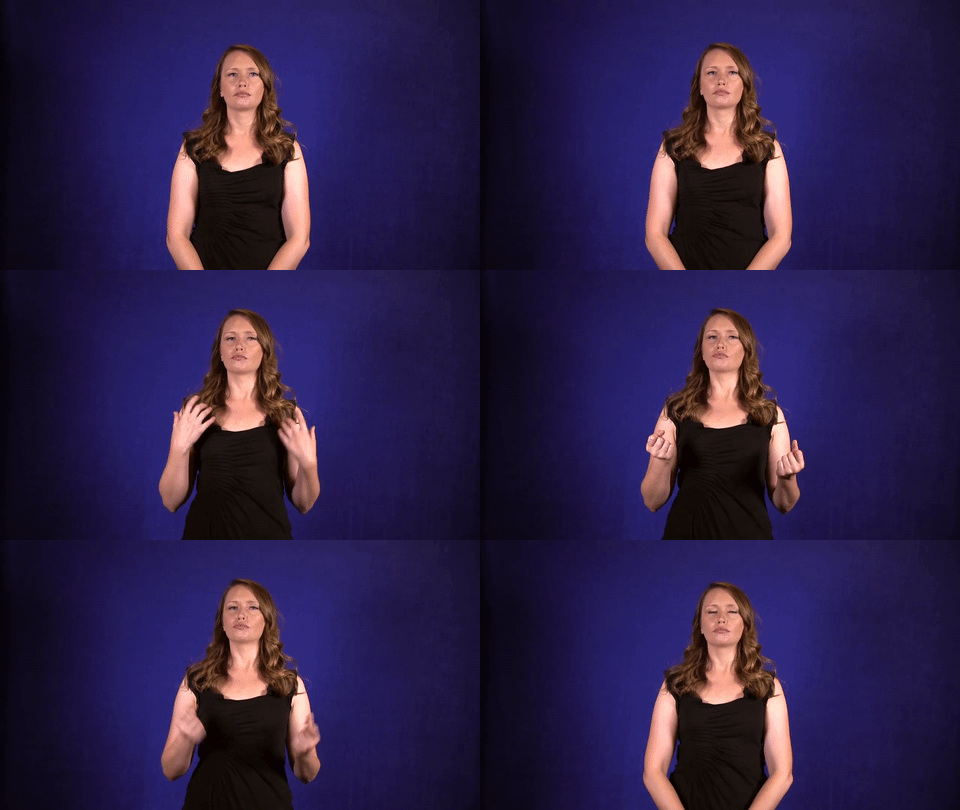
Definition: Being confident.
Sign for CONFIDENT in ASL

Practice Activities:
Start by practicing the sign for CONFIDENT in ASL in isolation. Use a mirror to monitor your facial expression, which should show self-assurance. Repeat the sign slowly and then at conversational speed to build muscle memory.
Next, integrate the sign for CONFIDENT in ASL into simple sentences. For example, sign âI feel confident todayâ or âShe is confident in her answer.â Repeat the sentences multiple times, paying attention to flow and clarity. Try signing daily affirmations that use the word âconfidentâ to build fluency and reinforce positive language.
Work with a partner to role-play situations where you might use the sign. One person can pretend to give a speech, answer a tough question, or lead a group, while the other observes and provides feedback. Focus on how confidently the sign is delivered along with appropriate facial expression and body posture.
Use storytelling exercises to practice the sign in context. Create a short narrative about a person who overcomes self-doubt and becomes confident by the end. Include the sign for CONFIDENT in ASL multiple times during your storytelling. This encourages deeper understanding and helps with retention.
You can also watch ASL videos or stories that include the word confident. Pause the video, copy the sign, and then backtrack to observe how it was used in context. Try to mirror the rhythm and movement.
Label real-life situations where you or others act with confidence. Think about times when you stood up for yourself, made a tough decision, or faced a challenge with courage. Use those memories to create role-play scenarios where you naturally use the sign for CONFIDENT in ASL.
Finally, combine the sign with related signs like brave, proud, or sure. Doing so expands your vocabulary and provides more opportunities for real-world application. Practice repeatedly until the sign feels natural in both casual and formal contexts.
Cultural Context:
The sign for confident in ASL reflects more than just vocabularyâit expresses a mindset deeply valued within the Deaf community. In American Sign Language, concepts like confidence are often portrayed not only through hand movements but also through facial expressions and body language, which are essential parts of the language’s grammar. Understanding the sign for confident in ASL involves embracing the visual and expressive aspects unique to Deaf culture.
Unlike spoken languages, ASL emphasizes emotion and intention through physical expression. When using the sign for confident in ASL, users rely on assertive movement and facial intensity to communicate self-assurance. This builds a cultural connection since ASL is not just performed, it’s embodied through visual presence and community understanding.
Navigating confidence in Deaf culture can also be tied to identity. For many Deaf individuals, showing confidence is about taking pride in their language and heritage. Using the proper sign for confident in ASL becomes a way of affirming that pride and standing strong in environments that may not always accommodate Deaf voices.
Because ASL relies heavily on context, the sign for confident in ASL might vary slightly depending on the setting or emotional tone. A person could use a more exaggerated movement to stress high confidence or a subtler version when showing quiet strength. This flexibility makes ASL a powerful tool for conveying nuanced emotional states such as self-assurance and inner peace.
In classrooms, community events, or everyday conversations, teaching and using the sign for confident in ASL helps promote empowerment within the Deaf community. It supports positive self-expression and encourages users to feel secure in themselves and their language. This sign is often introduced early in ASL education because self-esteem is seen as foundational both linguistically and socially
Deaf culture highly values storytelling and personal experience. When someone uses the sign for confident in ASL during a story or presentation, it’s not just about vocabularyâit’s about showing conviction and connection with the audience. This practice underscores how confidence in ASL is both communicated and felt by everyone involved.
Children learning the sign for confident in ASL are often taught to pair it with upbeat body posture and strong eye contact. These cultural markers help them internalize not just the sign, but the emotion behind it. Teaching it in this way supports emotional literacy in ASL and enriches deeper language skills
The importance of showing and recognizing confidence in ASL can also be seen in Deaf advocacy work. Leaders and organizers use the sign for confident in ASL in rallies, meetings,
Extended Definition:
The sign for confident in ASL communicates self-assuredness, inner strength, and trust in oneâs abilities. To express âconfidentâ in American Sign Language, the sign often involves a motion that begins with both open hands near the shoulders or chest, then moving downward and closing into fists, symbolizing pulling confidence into yourself.
This movement suggests the idea of gathering strength from within. Facial expression plays a key role in conveying the right emotion behind the sign. A calm, assured look adds meaning and clarity when signing this concept, helping others understand the precise message you’re trying to send.
The sign for confident in ASL may vary slightly depending on the region or the background of the signer. Some signers might add slight variations to emphasize different degrees of confidence. Despite these small changes, the core idea remains the sameâprojecting belief in oneself and a sense of certainty.
In ASL, emotions and attitudes are deeply embedded in the facial expressions and body language used with every sign. When you use the sign for confident in ASL, a firm posture and assertive signs help enhance its meaning. Signing with enthusiasm can also reflect high self-esteem or pride about the subject.
Situations where you might use the sign for confident in ASL include encouraging someone before a test, describing a character in a story, or expressing how you feel about facing a challenge. Itâs a versatile sign that’s helpful in social, academic, and professional conversations. Knowing how to use it well can make your signing more expressive and natural.
The visual nature of ASL allows for nuanced expressions like confidence to be shown clearly. This is different from spoken language, where tone may carry the message. In ASL, hand movements combined with facial markers take on that responsibility, letting signers convey complexity in meaning.
When learning new vocabulary in American Sign Language, it helps to connect each sign with an emotion or physical gesture that feels natural. Practicing the sign for confident in ASL in the mirror can help you get comfortable with the motion and expression involved. This approach builds muscle memory, helping reinforce both the meaning and use of the sign.
The sign works well in combination with other signs to build rich sentences. You might say you feel confident before giving a presentation, or describe someone you admire as confident in their work. When used with signs like âtrust,â âbelieve,â or âstrong,â it adds depth to your conversation or storytelling.
Understanding the sign for confident in ASL allows deeper communication about emotions and personality
Synonyms: self-assured, self-reliant, assured, certain, self-confident
Educational resources: Find related learning materials in our course bank!
Want more? Check out some of our popular learning activities on the homepage!
Need to look up a sign? Use our highly rated dictionary: https://aslinteractive.com/best-asl-dictionary/
Follow us on tiktok: https://www.tiktok.com/@aslinteractive. More social media links at the bottom of this page!
Long-tail Keywords: what is the sign for confident in ASL, how do you sign confident in ASL, ASL sign for confident
Categories:
tags: Confidence, Emotions, Appearance, Compliments, Self-Esteem
Parameters
*Handshape*:
The handshape used in the sign for CONFIDENT in ASL begins with both hands in an open, relaxed “5” handshape at chest level. As the motion continues, the hands close into “S” handshapes near the stomach. This transition reflects the concept of pulling confidence inward or keeping it close to oneself.
To produce the sign for CONFIDENT in ASL accurately, ensure the fingers are initially spread apart comfortably and then form firm fists. The shift in handshape plays a symbolic role in conveying self-assurance and inner strength.
*Palm Orientation*:
In the sign for CONFIDENT in ASL, both hands typically begin open with the palms facing inward toward the body. As the movement progresses, the dominant hand forms an “S” handshape and pulls upward from the other hand, often suggesting a gesture of collecting or drawing in confidence.
The palm orientation remains inward throughout the sign. This inward position enhances the expressive intent behind the sign for CONFIDENT in ASL, symbolizing strength or self-assurance originating from within.
*Location*:
The sign for confident in ASL takes place in the upper chest and torso area, starting near the head or chin and moving downward. Hands usually originate near the head with open palms and then move downward while closing into fists.
This location emphasizes a gesture of internal assurance, symbolizing composure or strength. The natural movement near the chest adds depth to the meaning behind the sign for confident in ASL.
*Movement*:
The sign for CONFIDENT in ASL begins with both hands in flat “O” handshapes positioned near the shoulders. The hands move downward simultaneously and close into “S” handshapes near the center of the chest, suggesting the idea of pulling strength inward.
This movement represents drawing confidence internally. The sign for CONFIDENT in ASL emphasizes an assured and steady motion, reinforcing the self-assured nature of the concept.
*Non-Manual Signals*:
When signing the sign for CONFIDENT in ASL, maintain a firm facial expression showing assurance. Slightly raise your eyebrows and keep your chin level or slightly elevated to portray self-assurance clearly.
Avoid smiling too much or portraying uncertainty, as the sign relies heavily on projecting internal strength. The non-manual signals help reinforce the meaning and clarity of the sign for CONFIDENT in ASL .
*Prosody, Dominant/Non-Dominant Hand*:
The sign for CONFIDENT in ASL uses both hands to express control and assurance. The dominant hand starts in an open flat shape near the forehead while the non-dominant hand mirrors it near the chest. Then both hands close into fists and pull downward together, showing a sense of inner strength.
This movement symbolizes gathering oneself and being sure. The sign for CONFIDENT in ASL visually conveys belief in oneself through clear, deliberate motion.
Tips for Beginners:
When learning the sign for CONFIDENT in ASL, focus on mastering the correct handshape and movement. This sign generally involves a gesture where you start with your dominant hand open at your chest and then close both hands into a confident clasp or a pulled-in motion to the center of the body. The meaning of the sign is closely tied to the intention and precision behind your movement, so practice in front of a mirror to build both fluency and confidence.
Facial expressions play a big part when signing emotions or personality traits like just signing the word confident. Make sure your expression reflects assurance and strength; a relaxed but assertive look can help convey that emotion more clearly. Many beginners forget how crucial facial grammar is when practicing signs tied to emotions or identity. Avoid a flat or neutral expression when showing this concept, as it may lessen the strength of what youâre trying to express.
Another useful tip when practicing the sign for CONFIDENT in ASL is to make your movements deliberate but not stiff. Rushed or overly robotic motions can make your signing seem unnatural. Think about how confidence feelsâstable, secure, groundedâand let those ideas inform how you move your hands.
Don’t be discouraged if your early attempts feel awkward. Enlist a practice buddy or record yourself for playback, which can help you notice small issues with alignment or handshapes. Watching fluent signersâwhether in videos or in personâwill reinforce the correct motion and lend greater context to when and how to use the sign.
Steady repetition matters. Like any part of ASL, muscle memory and usage over time will enhance your clarity. To gain fluency with the sign for CONFIDENT in ASL, incorporate it in daily conversations where appropriate.
Connections to Other topics:
The sign for CONFIDENT in ASL is deeply tied to emotional and psychological state vocabulary. It often appears in contexts where related emotions such as secure, self-assured, or bold are discussed. This sign contributes to a wider understanding of showing internal feelings outwardly through body language and facial expressions, which is a cornerstone of ASL grammar.
This sign is visually and conceptually connected to signs like BELIEVE, TRUST, and STRONG, all of which can appear in similar contexts. For example, BELIEVE shares a conceptual similarity as it implies assurance and mental conviction, while STRONG may be used with CONFIDENT to describe someone’s personality. These connections reinforce how emotional states are constructed in layered and meaningful ways within ASL.
The sign for CONFIDENT in ASL is also useful in compound expressions such as SELF-CONFIDENT or NOT-CONFIDENT. For SELF-CONFIDENT, the sign for SELF emphasizes ownership of the emotion, adding depth and clarity. In contrast, with an appropriate negative facial expression or the addition of the sign NOT, it becomes a powerful expression of doubt or insecurity.
Facial expression plays a central role when using this sign. A firm, self-assured expression can enhance the meaning significantly, while a hesitant or withdrawn expression shifts its interpretation dramatically. This link between movement and emotion highlights the performative nature of ASL, making emotional signs more nuanced.
In educational settings, this sign frequently appears in conversations about goal-setting, leadership, or self-perception. Role-play exercises often use the sign for CONFIDENT in ASL to help students practice expressing certainty in interviews, presentations, or social scenarios. It serves as an excellent tool for developing fluency and emotional literacy in ASL.
By learning the sign for CONFIDENT in ASL, students also improve their understanding of related grammar, like affective shifting and non-manual signaling, enriching their overall signing proficiency âš.
Summary:
The sign for CONFIDENT in ASL conveys a powerful and self-assured emotion. It involves both physical expression and subtle elements of attitude, making it a layered and rich concept in Deaf culture.
Typically, the sign uses both hands. The dominant and non-dominant hands start with open claw hands placed on the chest or just above it.
From that position, both hands move slightly inward and then pull away from the chest while forming into “S” handshapes. The movement shows internal strength being projected outward.
This change from open hands to “S” shapes represents one pulling strength or resolve from within. The gesture implies determination, self-worth, or belief in oneself.
Facial expressions play a crucial role in delivering the full meaning of the sign for CONFIDENT in ASL. A composed or slightly smiling face helps reinforce the impression of calm self-assurance.
The sign shares visual features with signs like BELIEVE and TRUST. What distinguishes it is the lack of a specific object or recipientâit’s about a general personal state.
In conversation, the sign for CONFIDENT in ASL often comes with context to specify confidence in something specific, especially when combined with directional signs or grammatical classifiers.
Grammatically, this term functions as an adjective. So it fits within sentence structures where personality traits and descriptions are discussed, such as âI feel confidentâ or âShe is confident.â
ASL syntax might reorder the sentence compared to English use. You might see structures like âFEEL CONFIDENT I,â where facial expression acts as punctuation.
Variations of this sign exist depending on regional dialects and community usage. Some signers may emphasize the chest-to-outward motion differently or use abbreviated forms of the transformation.
The sign for CONFIDENT in ASL is multidimensional. It goes beyond just translating the English wordâit communicates emotional states, self-esteem, and social poise.
In the Deaf community, confidence plays a significant part in identity. Using the sign can also be a form of empowerment, especially when navigating spaces often dominated by hearing norms.
Understanding how to express and spot confidence is essential for successful ASL communication. It allows a speaker to better read social cues and adapt their responses.
This sign can be compared to expressions of pride and independence. It suggests that the person trusts their instincts and has assurance in their ability.
Contextual use can alter the intensity of the meaning. A highly animated performance with strong facial expression could signal great self-assurance or even arrogance, depending on the tone.
Subtle versions of the sign for CONFIDENT in ASL, perhaps with minimal motion and a neutral face, may imply a more humble or quiet form of self-confidence.
In storytelling contexts, this sign serves to illustrate a characterâs internal growth or change. A character may begin with uncertainty and evolve to confidence, expressed through this sign evolving across time.
Linguists studying ASL have noted that abstract emotions like confidence are often conveyed metaphorically. Pulling strength from the core of the body and presenting it outward symbolizes emotional growth.
This metaphor of drawing inward strength is consistent with many ASL signs for emotional or psychological states, such as SAD, HOPEFUL, and DETERMINED.
It highlights how ASL uses spatial and kinetic elements to represent intangible ideas. The sign for CONFIDENT in ASL physically maps the concept onto the body.
In addition, the shift in handshape serves as a visual grammar that hints at transformation or completion. This internal-to-external movement may also link to themes of maturity or self-discovery.
In educational settings, especially Deaf education, the concept of confidence is frequently emphasized. Students are taught not only the sign but encouraged to embody it through expressive communication.
Interpreters must convey this sign with nuance. Especially in emotionally charged settings, like motivational talks, courtrooms, or therapy sessions, the correct intensity and expression is critical.
In the business world, the sign for CONFIDENT in ASL might appear during interviews or presentations. It can serve to affirm someone’s poise and professionalism.
This sign, like others that describe internal states, contributes to what researchers call “affective signs” in ASL. These are signs that reflect how someone feels rather than what they do.
It becomes part of the semantic field of self-image. Related signs might include STRONG, CAPABLE, SECURE, or even LEADERâeach building a portrait of inner strength.
Applied linguistics sees signs like this as windows into cultural attitudes about emotion and individuality. The way confidence is signed and expressed reveals communal values.
Deaf culture places high value on authenticity and presence in communication. A confident signer is typically one who expresses themselves clearly, with intentional cues and strong eye contact.
The sign for CONFIDENT in ASL can also be part of themes within Deaf poetry and performance. It is used symbolically to represent resistance, competence, or even visibility against marginalization.
Music videos using ASL sometimes pair the sign with English lyrics around empowerment. This helps hearing and deaf audiences
Want more? Check out some of our popular learning activities!
ASL Interactive Resources
ASLInteractive YouTube Channel
Follow us on tiktok: @aslinteractive.com
Follow us on Instagram: aslinteractive
Facebook page: aslinteractive
Facebook group: aslinteractive
LInkedIn: ASL Interactive LLC
Twitter: @ASL_interactive
*Some information on this page is AI-generated. AI can make mistakes. Please check the information.


Responses