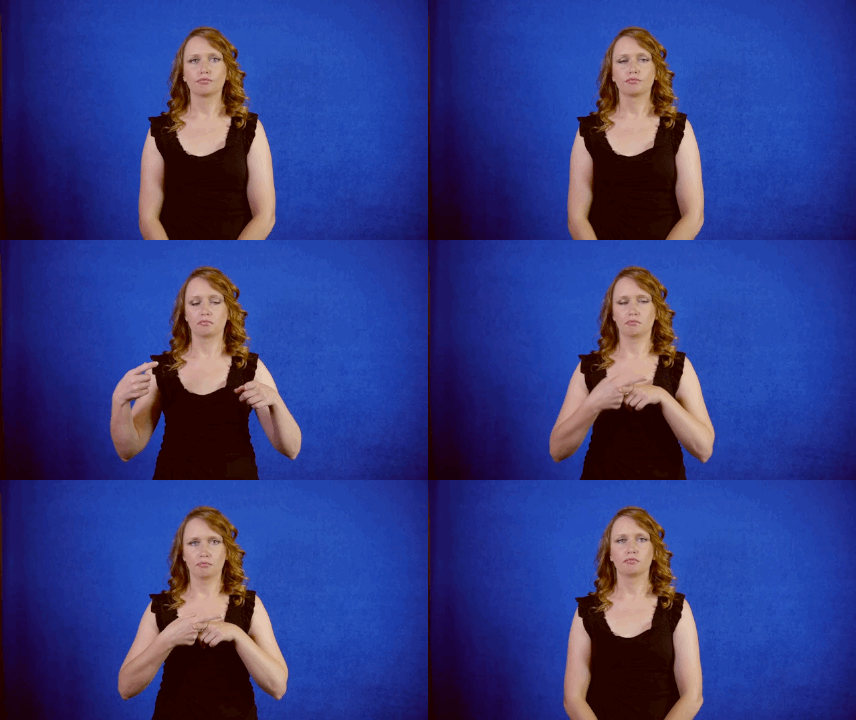
Sign for CONFLICT in ASL | 😐 ASL Dictionary

Definition: A conflict.

Sign for CONFLICT in ASL

YouTube player

Practice Activities:

To build confidence in using the sign for CONFLICT in ASL, begin by practicing the sign in isolation. Use a mirror to observe your handshape, orientation, and movement. Repeat the sign with different speeds and facial expressions to explore how intensity changes meaning.

After gaining comfort with the sign alone, try placing it in short phrases. For example, sign “they have conflict,” “school conflict,” or “conflict between friends.” Practice signing each phrase slowly at first, then build up to conversational pace. Recording yourself can help you identify areas for improvement.

Use example sentences such as “There is a conflict at work,” “The conflict was over money,” or “They resolved the conflict quickly.” Signing full sentences gives you the chance to work on facial grammar and transitions between signs. Add appropriate facial expressions to convey seriousness, empathy, or frustration.

Create short storytelling prompts that incorporate the sign for CONFLICT in ASL. Make up a short situation—like two siblings fighting over a toy—and sign the story using role-shifting and body movement. Focus on matching your expressive signing with the emotion of the story.

Partner activities are also helpful. Pair up with another signer and roleplay scenarios like a disagreement between coworkers or a misunderstanding in a classroom. Practice how to introduce the problem, use the sign for CONFLICT in ASL appropriately, and work toward a resolution. This will help you use the sign dynamically in conversation.

Another activity is interpreting real-life situations. Watch a short clip from a TV show or recall a recent argument you witnessed. Retell the situation in ASL, including the sign for CONFLICT in ASL when it naturally fits. This builds narrative skills and deepens sign retention through contextual use.

Practice journaling in ASL using video. Sign your thoughts about a time you experienced or observed conflict. Describe the feelings and reasons behind it while using the sign accurately. This combines emotional connection with language use for stronger retention.

Cultural Context:

Understanding the sign for CONFLICT in ASL involves more than just handshapes and movement. American Sign Language reflects the cultural values and communication styles of the Deaf community, where clarity and visual expression are key. The sign for CONFLICT in ASL often captures tension visually, using sharp movements that show disagreement or struggle.

In Deaf culture, conflicts are usually addressed through open communication and visual clarity. Facial expressions play a significant role when signing CONFLICT in ASL, helping convey the level of seriousness or intensity in the situation. This helps the person you’re communicating with better understand the emotional tone and context of the message.

The sign for CONFLICT in ASL can be used in various settings, from personal disagreements to political or global disputes. It’s a versatile term that shows how ASL can express both abstract and concrete ideas clearly. In a classroom or educational setting, signing CONFLICT in ASL helps Deaf students discuss social studies topics or personal experiences where there is disagreement or opposition.

When using the sign for CONFLICT in ASL, cultural context matters. For instance, resolving a conflict in the Deaf community often involves deep discussions and visual storytelling, emphasizing resolution and mutual understanding. This means signing CONFLICT is often the beginning of a longer conversation, not just a moment of tension.

ASL users often incorporate signs like CONFLICT when discussing real-world events, such as news, politics, or historical situations. The sign for CONFLICT in ASL may be used in narratives to explain battles, debates, protests, or interpersonal challenges. Including this sign in common vocabulary expands the ability to communicate complex issues using ASL.

In Deaf storytelling and poetry, the sign for CONFLICT in ASL often appears as a way to express emotional turmoil or dramatic tension. Skilled signers modify the movement or intensity of the sign to suit the story’s mood. This artistic use of ASL showcases the richness and flexibility of the language.

It’s common to see variations in how people sign CONFLICT depending on regional sign language differences or personal style. Despite variations, the core meaning remains the same—tension, disagreement, or struggle between individuals or ideas. Understanding these variations is part of being fluent and culturally aware within the ASL community.

It’s also worth noting that the sign for CONFLICT in ASL can reflect different ideas depending on context. It might refer to internal conflict, like a personal decision, or external conflict, like a family argument. Facial expressions, body posture, and additional signs help clarify the specific meaning.

Extended Definition:

The sign for conflict in ASL is a visually expressive and meaningful sign that conveys disagreement, opposition, or a clash between people, ideas, or situations. This sign is often used in conversations where two or more sides are at odds with each other, whether emotionally, mentally, or physically.

To produce the sign for conflict in ASL, both hands are typically in index finger shape, and they move toward each other in a crossing motion, representing opposing sides colliding. This movement suggests direct confrontation or a struggle, which helps the viewer understand the deeper meaning of the interaction. Facial expressions also play a key role, with furrowed brows or a tense face enhancing the sign’s impact.

The sign for conflict in ASL can be used in a variety of contexts, from personal disagreements to political confrontations. It’s a flexible sign that applies to physical altercations, verbal arguments, or even internal struggles a person might be experiencing. Because ASL richly incorporates body language and emotion, the context and how forcefully the sign is made can shift its nuance.

In storytelling or conversations within the Deaf community, the sign for conflict in ASL helps convey tension or challenge in a narrative. It can be paired with subject-specific signs to clarify the kind of conflict being discussed, such as between friends, family, countries, or within oneself. Combining it with facial expressions enhances clarity and emotional depth ️.

When teaching vocabulary, it’s common to teach the sign for conflict in ASL alongside companion signs like problem, argue, and fight. Learning these together supports better understanding and allows users to expand their expressive range in ASL. It helps learners distinguish between different levels of disagreement or opposition.

The sign fits well when discussing news, history, or social justice issues. Students, educators, and interpreters frequently rely on the sign for conflict in ASL while discussing topics involving social movements, legislation debates, or wars. It’s a sign that opens communication around difficult or sensitive subjects, making them easier to address within ASL.

Parents and teachers working with Deaf or hard-of-hearing children also use this sign in behavior discussions. It can help children identify experiences involving peer disagreements or struggles in the classroom environment. Using the sign for conflict in ASL gives learners the ability to process complex social situations clearly .

This sign is also useful in mental health settings, especially when discussing emotional or internal conflicts. Therapists and counselors in the Deaf community often incorporate signs like conflict to discuss challenges their clients

Synonyms: struggle, dispute, clash, quarrel, fight

Educational resources: Find related learning materials in our course bank!

Want more? Check out some of our popular learning activities on the homepage!

Need to look up a sign? Use our highly rated dictionary: https://aslinteractive.com/best-asl-dictionary/

Follow us on tiktok: https://www.tiktok.com/@aslinteractive. More social media links at the bottom of this page!

Long-tail Keywords: What is the sign for conflict in ASL?, How do you sign conflict in ASL?, ASL sign for conflict

Categories:

tags: Conflict, Emotions, Relationships, Verbs, Major Decisions

Parameters

*Handshape*:

The handshape used in the sign for CONFLICT in ASL involves both hands forming index fingers extended, while all other fingers are curled into the palm. This is commonly known as the “1” handshape.

The movement involves bringing the tips of the index fingers together in a striking motion, often done twice to indicate clashing or confrontation. This dynamic action emphasizes the meaning behind the sign for CONFLICT in ASL .

*Palm Orientation*:

For the sign for conflict in ASL, both hands generally take on an index finger handshape. The palms face each other but are slightly angled so the fingers can move towards one another in a jabbing or alternating fashion, imitating opposing forces. This palm orientation emphasizes the idea of two sides clashing or coming together in opposition.

The sign for conflict in ASL clearly uses this specific orientation to convey tension or disagreement. The slightly tilted palm positions give the motion a dynamic feel, enhancing the visual representation of conflict.

*Location*:

The sign for conflict in ASL is typically produced in the neutral space in front of the chest, about six to eight inches away from the torso. Both hands are used and positioned in this space to create a motion that symbolizes clashing or disagreement.

Maintaining the handshape and movement in this centralized area is key to accurately conveying the sign for conflict in ASL. Keeping the location consistent helps ensure clarity and proper expression.

*Movement*:

To form the sign for CONFLICT in ASL, begin with both hands in index finger handshapes, pointing toward each other. Position the hands in front of the chest, about shoulder-width apart. Move the hands inward so the tips of the fingers crash into each other once, as if the fingers are colliding.

This sharp, direct motion represents a clash or confrontation, visually capturing the meaning behind the sign for CONFLICT in ASL. Some signers may repeat the motion for emphasis, depending on context.

*Non-Manual Signals*:

When using the sign for conflict in ASL, the face typically shows tension or frustration. Eyebrows may be furrowed, and the mouth might be tight or slightly open, reflecting stress or disagreement. This matches the concept conveyed by the sign and emphasizes emotional conflict.

The sign for conflict in ASL benefits from strong non-manual signals to enhance clarity. A serious or intense expression aligns with the idea of clashing or opposing forces, helping reinforce the meaning during communication.

*Prosody, Dominant/Non-Dominant Hand*:

The sign for conflict in ASL uses both hands, typically with the index fingers extended and other fingers tucked in. The dominant and non-dominant hands start pointed slightly outward, then move toward each other and “jab” so the index fingers make an X shape, mimicking a clash or disagreement .

When performing the sign for conflict in ASL, both hands are equally active. This bilateral action symbolizes the idea of opposing forces or viewpoints crashing into each other. The motion is sharp and deliberate, reflecting tension or struggle.

Tips for Beginners:

When learning the sign for CONFLICT in ASL, hand orientation and movement are key for clarity. The basic sign uses both index fingers, pointing straight forward, that come together and tap or clash against each other. The motion mimics a collision or argument, which fits the meaning of the sign. Practice making the movement quick but controlled to keep it looking intentional rather than sloppy.

One challenge beginners often face with the sign for CONFLICT in ASL is keeping the hands symmetrical and well-timed. Try practicing in front of a mirror to make sure both index fingers are aligned and moving evenly. If the fingers don’t meet clearly or if the movement lacks firmness, the sign might be misunderstood or seem too vague.

Be aware of your facial expressions while signing. In ASL, facial grammar adds depth to meaning—so showing tension, disagreement, or frustration on your face while signing helps reinforce the concept of conflict. Neutral or happy expressions can send mixed messages when using this sign.

Consistency is more important than speed when you’re starting out. Take your time to make the fingers align and strike together properly. Practicing slowly at first and building up speed will help your muscle memory develop correctly. Watch fluent signers perform the sign for CONFLICT in ASL and note how concise and deliberate their sign is.

Also, be mindful of your signing space. Too close to your face or too far from your centerline can make the sign harder to read. Keep your elbows slightly bent and your hands comfortably in front of your chest.

Finally, remember that the sign for CONFLICT in ASL can also be used metaphorically for debate, disagreement, or contradiction—context matters. Over time, exposure and repetition will help you recognize and produce the sign naturally in different conversations.

Connections to Other topics:

The sign for CONFLICT in ASL often involves movement where two extended index fingers come together and clash in front of the body. This motion symbolizes opposition or clashing ideas, which closely connects with signs like ARGUE, FIGHT, and DISAGREE. These signs all represent tension or opposing views, forming a semantic group that is useful for learners looking to expand vocabulary in emotional or interpersonal contexts.

The concept of conflict can appear in more abstract discussions, such as inner conflict or conflicting schedules. In those cases, the sign for CONFLICT in ASL may be used metaphorically or combined with time or emotional signs to enrich meaning. For example, signing CONFLICT followed by THINK or FEEL gives the impression of an internal struggle, while pairing it with SCHEDULE or PLAN evokes scheduling conflicts.

ASL is highly conceptual, so the sign for CONFLICT in ASL can be integrated into compound expressions like CONFLICT RESOLUTION, which may involve a sequence of signs like CONFLICT followed by SOLVE or SETTLE. This flexibility allows for nuanced communication, particularly in professional or educational settings where conflict resolution is a key topic.

There is also a thematic link to signs indicating disagreement, such as DIFFERENT, BUT, and OPPOSITE. These signs, while less intense, come up in related contexts and may serve as softer alternatives when tempering the tone of a conversation. Understanding the gradient of conflict-related signs helps learners choose the most appropriate expression based on emotional weight and setting.

In storytelling or drama, the sign for CONFLICT in ASL helps set the stage for tension between characters or goals. Its visual strength plays a key role in narrative arcs, helping the audience immediately grasp when characters face opposition or dilemmas. This makes it a powerful sign for both expressive and analytical purposes in ASL communication.

Summary:

The sign for CONFLICT in ASL presents a powerful visual metaphor, encapsulating the nature of struggle through hand movement. This sign typically involves both index fingers pointing towards each other and interlocking or hitting together, symbolizing opposing forces colliding.

When produced with force, the sign conveys heated or intense conflicts, aligning with emotional contexts such as arguments, disputes, or even warfare. A lighter or more neutral movement can refer to situations of disagreement or friction without strong emotion.

The sign’s iconicity makes it easy to recognize even without prior exposure. By mimicking two entities colliding, it captures both physical and metaphorical definitions of conflict clearly and accessibly.

The sign for CONFLICT in ASL can take on different intensities depending on the signer’s facial expressions and speed of movement. Raised eyebrows and a more fluid motion might indicate a hypothetical or light disagreement, while furrowed brows with a quick, sharp motion suggest a real and potentially serious argument.

Facial expressions and body posture play a central grammatical role in the sign for CONFLICT in ASL. In ASL grammar, non-manual markers such as squinting, frowning, or shaking the head offer layers of emotional or contextual nuance, turning a static sign into an emotionally-charged communication.

When used in storytelling or narrative structures, the sign for CONFLICT in ASL can help identify pivotal moments. For example, in Deaf theater, this sign enhances the script by visually emphasizing major character clashes or moral dilemmas.

In academic and professional contexts, the sign may be modified or accompanied by classifiers to refer to interdepartmental conflict, internal conflict, or ideological disagreement. These added signs help specify abstract versions of conflict in formal or intellectual conversations.

Within relational discussions, the sign for CONFLICT in ASL often appears with signs like ARGUE, MISUNDERSTAND, or AGREE (in a contrasting form) to construct more complex ideas around interpersonal dynamics. This layering technique is essential in showing varying degrees of issue escalation or de-escalation.

It’s important to note that the sign can reflect both internal and external forms of struggle. When signed closer to the body and with introspective facial cues, it can mean an internal conflict, such as a moral or emotional struggle.

Culturally, the concept of conflict within the Deaf community can intersect with experiences of marginalization and advocacy. The sign for CONFLICT in ASL is often employed in discussions about systemic inequality, Deaf rights, and historical oppression.

When discussing advocacy within the Deaf community, the sign can appear alongside SOCIAL JUSTICE, OPPRESSION, or RIGHTS to represent broader causes or philosophical conflicts. This shifts the expression from individual friction to collective resistance or activism.

From a linguistic perspective, the sign for CONFLICT in ASL demonstrates high visual motivation. In signed languages, the ability for signs to reflect real-world motion and confrontation enhances comprehension and memorability.

Applied linguistics appreciates the sign for its rich semiotic load. The embodied cognition embedded in this sign—the sense of physically feeling the “clash”—contributes to ASL’s expressive power and symbolic depth.

The use of space in signing CONFLICT also reflects strong spatial reasoning. Placement of the hands in neutral, dominant, or opposing planes portrays the type and direction of the disagreement, helping clarify who is in opposition.

Variations of the sign might exist across different regions or among older and younger Deaf signers. Some might show the conflict with fists to reflect a physical fight, while others prefer the index-finger version to express abstract or systemic issues.

In narratives involving communities or nations, the sign for CONFLICT in ASL may be repeated with directional shifts to show conflict between groups. This non-verbal spatial grammar allows for a complex understanding of relationships without naming specific groups.

It plays an essential role in academic discourse about peace studies, intercultural communication, and human rights within Deaf studies. Signed narratives that explore war or political unrest often use the sign for CONFLICT as a starting point to delve into philosophical dialogues.

Educators use the sign to teach everything from personal conflict resolution to historical wars. It aids bilingual education, helping Deaf students draw connections between ASL narratives and written or spoken English concepts.

Psychological contexts also frequently use the sign. In ASL-based counseling or therapy, the sign for CONFLICT in ASL might accompany expressions of turmoil, internal division, or interpersonal strife to help clients convey emotion.

The sign enhances emotional literacy by giving visual and kinesthetic form to abstract emotional states. Younger Deaf children benefit from seeing conflict enacted visually, allowing them to better identify and resolve emotional challenges.

Social-emotional learning in Deaf education often involves roleplay where the sign becomes central in modeling respectful disagreement. The ability to visualize and sign CONFLICT fosters empathy, communication, and clearer emotional boundaries.

The sign’s presence in signed songs and poetry illustrates its artistic range. Used rhythmically or in repetition, it powerfully marks tension and relapse, becoming a tool for conveying complex emotional journeys

Want more? Check out some of our popular learning activities!

ASL Interactive Resources

ASLInteractive YouTube Channel

Follow us on tiktok: @aslinteractive.com

Follow us on Instagram: aslinteractive

Facebook page: aslinteractive

Facebook group: aslinteractive

LInkedIn: ASL Interactive LLC

Twitter: @ASL_interactive

*Some information on this page is AI-generated. AI can make mistakes. Please check the information.

Sign for CONFLICT in ASL

Responses