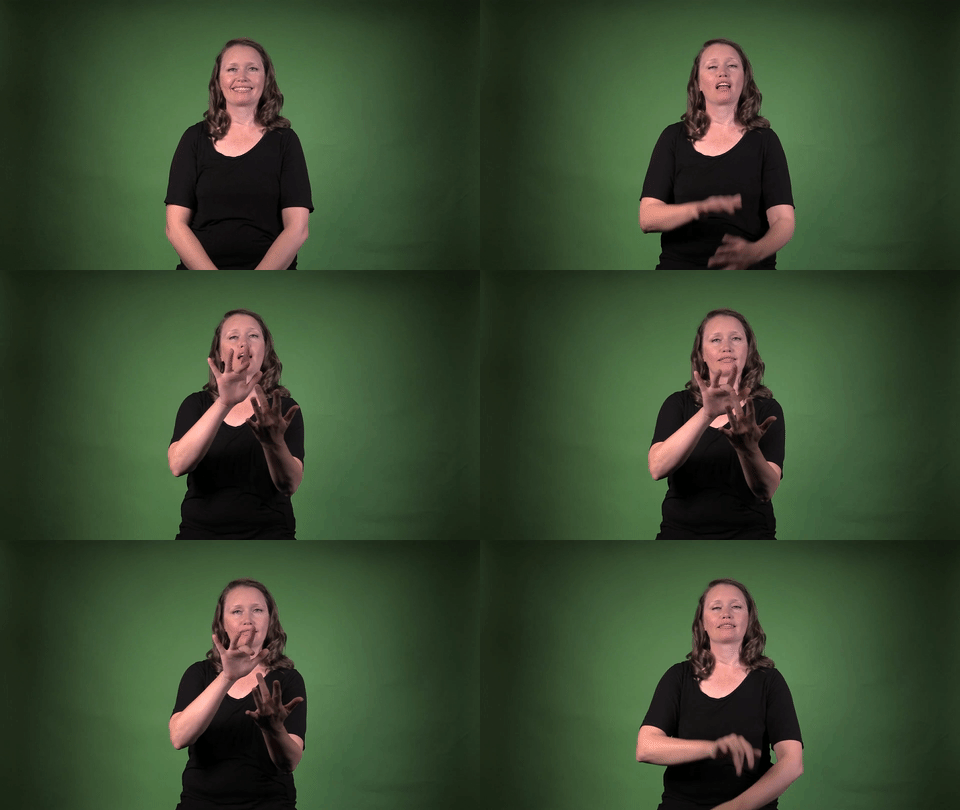
Definition: To make contact with someone.
Sign for CONTACT-TO in ASL

Practice Activities:
To gain fluency with the sign for CONTACT-TO in ASL, begin with daily repetition exercises. Stand in front of a mirror and practice the handshape, movement, and facial expression. Sign the word slowly at first, then gradually speed up to match natural conversation. Repetition helps develop muscle memory and confidence with the sign.
Use flashcards that include different scenarios where contacting someone would be appropriate. Flip through these flashcards and sign the full sentence using the sign for CONTACT-TO in ASL. Example flashcards might include: “Contact your doctor,” “Contact my sister,” or “Contact the school.” Repeating full sentences helps solidify grammar and structure.
Create short dialogues or role-plays with a partner using the sign for CONTACT-TO in ASL. One person plays the role of a doctor, teacher, or friend, while the other uses the sign in context, such as, “I need to contact you tomorrow,” or “Can you contact him tonight?” This helps reinforce natural language use with expressive facial grammar.
Write out a short story that includes multiple uses of the sign. For example, a story about a lost phone and needing to contact several people. Practice signing the story aloud from memory. This activity supports storytelling fluency and repetitive use of the targeted sign.
Watch ASL videos or signed vlogs and identify when native signers use the sign for CONTACT-TO in ASL. Then, pause and copy their sign, noting their facial expressions and rhythm. Mimicking native signers improves accuracy and expressiveness.
End each practice session with a personal journal in ASL. Record a video message to yourself describing who you contacted that day and how. This reinforces memory and encourages daily integration of the sign for CONTACT-TO in ASL into real-life communication.
Cultural Context:
In American Sign Language, the sign for CONTACT-TO in ASL carries both linguistic meaning and cultural significance. This sign is often used in situations where one person is initiating or maintaining communication with another, especially across distance or time. Understanding how and when to use this sign helps deepen your connection with Deaf culture and effective visual communication.
The sign for CONTACT-TO in ASL is not just about making contact with someone. It’s also used to express maintaining relationships, making an effort to reach out, and staying involved with community members. This aligns with core values in Deaf culture, where visual and personal contact are key elements in meaningful communication.
When someone uses the sign for CONTACT-TO in ASL, it can signify more than a casual message or call. In the Deaf community, reaching out is seen as a commitment to maintain strong and respectful communication. Keeping in touch is not just a social expectation but an important part of belonging to the culture .
Historically, visual contact has always played a crucial role in Deaf interactions. The concept behind the sign for CONTACT-TO in ASL respects that tradition, emphasizing sincerity and effort. Whether it’s contacting a friend, family member, or organization, the sign shows intention and care behind that connection.
Within ASL grammar and community principles, using the sign for CONTACT-TO in ASL also indicates relational responsibility. For example, during storytelling or conversation, someone might use the sign to explain that they stayed in contact during a long absence. It shows ongoing effort and relational presence, values cherished in the culture.
The sign is especially relevant in a digital world where communication happens through video calls, texts, and emails. The way Deaf people use the sign for CONTACT-TO in ASL has adapted to include modern forms of visual contact, staying true to the language’s expressive nature .
Classifiers, facial expressions, and spatial referencing all work together with the sign for CONTACT-TO in ASL. Cultural understanding plays a big role here. A fluent user adjusts the intensity and direction of the sign to match the emotional tone and context, showing competence in both language and culture.
When learning ASL, mastering the sign for CONTACT-TO in ASL is a step toward becoming more fluent and culturally aware. It’s more than vocabulary—it’s about respecting and participating in the values of the Deaf community. Using it correctly builds trust and connection with native signers.
Whether used in casual conversation or formal narratives
Extended Definition:
The sign for CONTACT-TO in ASL is often used when referring to making a connection or initiating communication with someone. This sign can be applied in various situations such as calling, emailing, texting, or in-person conversations. It expresses the idea of reaching out and forming a link between two people or entities.
In ASL, the concept of contact is visual and spatial, so the sign for CONTACT-TO usually involves physical gestures showing connection from one person to another. This reflects the idea of one party making a move toward another, either symbolically or literally. The movement is clear and intentional to show the action of creating a contact.
The sign for CONTACT-TO in ASL typically involves both hands. One hand may be stationary while the other moves toward it, symbolizing the act of making contact. This visual representation supports the meaning of approaching or initiating communication.
This sign carries both literal and abstract meanings. Literally, it can be used to describe touching or physically connecting with something. On a more abstract level, it signifies emotional or communicative contact with another person.
In conversational ASL, the context is very important when using this sign. The surrounding signs and facial expressions help clarify whether the signer means to talk to, call, email, or physically meet someone. Facial cues add emotional dynamics to the sign for CONTACT-TO, indicating urgency, intimacy, or formality.
This sign is also useful in professional and everyday settings. For example, you can use it in phrases like need to contact the office, contact me later, or I’ll contact him tomorrow. The flexibility of the sign makes it highly functional across a variety of topics and contexts.
Deaf and hard-of-hearing individuals often rely on this sign when making arrangements, setting up appointments, or following up on messages. For interpreters and ASL learners, understanding the correct handshape and movement is essential for clarity. A slight variation in hand position could change the meaning, so attention to detail is key.
In educational settings, the sign for CONTACT-TO is taught early due to its high frequency in daily communication. Teachers commonly use this sign to demonstrate how visual grammar replaces spoken patterns in ASL. It helps students understand how ideas are conveyed spatially and visually.
Social media, texting, and digital messages have made this sign even more relevant. People sign CONTACT-TO in ASL when referring to someone messaging them or reaching out through platforms like Facebook, Instagram, or WhatsApp . The sign evolves
Synonyms: connect, get in touch, reach out, communicate with, engage with
Educational resources: Find related learning materials in our course bank!
Want more? Check out some of our popular learning activities on the homepage!
Need to look up a sign? Use our highly rated dictionary: https://aslinteractive.com/best-asl-dictionary/
Follow us on tiktok: https://www.tiktok.com/@aslinteractive. More social media links at the bottom of this page!
Long-tail Keywords: what is the sign for contact-to in asl, how do you sign contact-to in asl, contact-to in american sign language
Categories:
tags: Language Learning, Communication, Commands, Verbs, Everyday Activities
Parameters
*Handshape*:
The handshape used in the sign for CONTACT-TO in ASL involves both hands forming flat “B” handshapes . Each hand has fingers extended and together with the thumb tucked in against the palm. The sign for CONTACT-TO in ASL starts with the hands apart and then moves them together so the fingertips of both hands touch as if making a connection.
This sign emphasizes the concept of one person reaching out and establishing a link with another. The flat “B” handshape is commonly used in ASL to represent surface contact or communication, making it fitting for the sign for CONTACT-TO in ASL.
*Palm Orientation*:
The palm orientation for the sign for CONTACT-TO in ASL typically involves both hands in a flat “B” handshape. The dominant hand faces outward while the non-dominant hand faces inward. Both palms face each other as the fingertips touch lightly, as if demonstrating two surfaces coming into contact.
When performing the sign for CONTACT-TO in ASL, it’s important to maintain steady palm alignment. This visual connection reinforces the meaning of making contact or reaching out to someone.
*Location*:
The sign for CONTACT-TO in ASL is typically produced in the neutral space in front of the torso, midway between the shoulders. The dominant hand moves toward the non-dominant hand, making contact at the fingertips or palms depending on the variation, symbolizing a connection or reaching out.
For the sign for CONTACT-TO in ASL, ensure the movement stays close to the center of the body without straying too high or low. This placement helps convey the idea of direct communication or interaction between people.
*Movement*:
The sign for CONTACT-TO in ASL involves a forward movement where the dominant hand, shaped in a flat “O” or loosely closed “5,” moves out from the body and taps the fingertips onto the back of the non-dominant hand, which is held steady in front of the torso, palm facing in. This tap represents the act of making contact or reaching out.
The motion is deliberate and fluid, signaling intentional communication or connection. The sign for CONTACT-TO in ASL is often used in contexts involving reaching out, calling, making contact, or establishing connection via communication.
*Non-Manual Signals*:
The non-manual signals for the sign for CONTACT-TO in ASL typically include a focused expression with slightly raised eyebrows if you’re emphasizing the act of reaching out or establishing connection. If the sign is used in contexts involving urgency or specific intent, a slight forward head tilt combined with direct eye contact may be present.
Facial intensity can vary depending on the emotional tone of the message. The sign for CONTACT-TO in ASL may also be accompanied by slight lip movements like “oo” or tight lips to match the level of formality or personal involvement.
*Prosody, Dominant/Non-Dominant Hand*:
The sign for CONTACT-TO in ASL uses the dominant hand with the index finger extended, pointing outward, while the non-dominant hand remains in a stationary or neutral position. The dominant index finger moves toward and lightly touches a point on the body or the non-dominant hand, suggesting the idea of initiating contact or reaching out.
Facial expression can emphasize urgency or intention. The sign for CONTACT-TO in ASL may vary slightly in placement depending on the context, such as touching the chest to indicate personal contact or a specific location when referencing someone else.
Tips for Beginners:
When learning the sign for CONTACT-TO in ASL, it’s important to understand that this sign conveys the concept of reaching out to, communicating with, or getting in touch with someone. The movement and handshape are both intentional and meaningful, so clarity in execution matters. Use an open flat hand that moves toward the other hand or taps gently on the location associated with the object or person you are referring to, depending on the context.
Beginners often rush the contact motion or use overly exaggerated movements. Keep your gestures clean and natural-looking. Practice the sign for CONTACT-TO in ASL slowly at first, then build up to conversational speed while maintaining accuracy. Use a mirror or video to check for fluid movement without stiffness.
Facial expressions add important context to the meaning. A neutral expression is typical for routine contact, while an inquisitive or concerned expression may show urgency. Making eye contact and using engaging facial cues will help convey the intention behind the sign for CONTACT-TO in ASL clearly.
Use the correct palm orientation. Misorienting your palm by facing it sideways or downward can confuse the meaning or make the sign resemble something else. Stay aware of your thumb and fingers—fingers should be together and extended, not curled or spread far apart.
When working within a sentence structure, location matters. Indicate the subject and recipient clearly in your signing space before producing the sign for CONTACT-TO in ASL. This helps define who is contacting whom and avoids confusion.
Consistency is key—use the same location in space for the person you’re referencing, especially if they’re mentioned more than once. Repetition with mindfulness improves fluidity. Don’t be discouraged by early mistakes. With regular practice and feedback, your clarity and confidence will grow. ✅
Connections to Other topics:
The sign for CONTACT-TO in ASL is deeply connected to other directionally-based verbs such as TELL-TO, INFORM-TO, and GIVE-TO. These verbs utilize spatial referencing, where the direction of movement changes the subject and object of the sentence. Just like CONTACT-TO, these signs clarify who is doing the action and to whom it is being done, promoting a clear exchange of information in ASL.
This sign also shares conceptual links with communication verbs such as CALL, TEXT, and EMAIL. The sign for CONTACT-TO can be used in broader discussions about maintaining communication, connecting virtually, or even meeting someone in person. In fact, it often appears as part of compound ideas like CONTACT-TO-VIA-EMAIL or CONTACT-TO-FRIEND, combining the base sign with location or recipient markers.
CONTACT-TO is especially relevant in narratives or conversations involving plans, coordination, and social interaction. For instance, one might sign CONTACT-TO before referring to a teacher, employer, or doctor when discussing prior arrangements or future follow-ups. It shows intentionality in communication and highlights responsibility in social exchanges.
Learners will benefit from connecting the sign for CONTACT-TO in ASL to related directional or goal-oriented verbs. The visual grammar of ASL allows the signer to establish referents in the signing space, then direct the movement toward that referent to express action. The movement in CONTACT-TO follows this principle, typically moving from the signer outwards, mimicking the act of reaching out.
The sign for CONTACT-TO in ASL can also be differentiated based on context. For example, in emergency or informal contexts, it might be abbreviated or signed more quickly. These variations connect learners to sociolinguistic aspects of ASL, showing how register and context influence signing style. Understanding the sign enriches one’s expressiveness and clarity in ASL conversations.
Summary:
The sign for CONTACT-TO in ASL incorporates both physical movement and directional movement to convey the meaning of reaching out or initiating communication. It generally uses a modified bent handshape, starting from the chest or shoulder area and moving outward toward the recipient of the intended contact. Eye gaze and facial expressions can emphasize urgency, formality, or emotion associated with the communication.
In terms of handshape, the dominant hand usually takes a bent-B form, with fingers together and curved slightly. The movement goes outward, commonly in the direction of the person being contacted, showing the pathway from self to other. This directionality reflects the actor and receiver of the action, allowing dynamic grammatical roles to be shown spatially.
FACIAL EXPRESSION often plays a crucial grammatical role when signing CONTACT-TO. A serious, questioning, or neutral expression can all shift the tone of the message. This makes the sign both functionally complex and rich with nuance, capturing various intention levels depending on context.
In everyday communication, the sign for CONTACT-TO in ASL can be utilized to express meanings like getting in touch, messaging, or initiating a conversation with someone. It’s frequently paired with signs for methods of communication, like EMAIL, CALL, or TEXT, depending on how the contact takes place. This makes the phrase functionally flexible.
Grammatically, the sign for CONTACT-TO in ASL serves as a directional verb. That means it includes both the subject and object within the physical movement of the sign. This spatial design allows sentences to be shorter while still maintaining clear communication.
This verb can be conjugated spatially by indicating who is contacting whom. For example, shifting movement from oneself to the left space shows “I contact her,” while reversing the direction would imply “She contacts me.” Mastery of ASL directionality amplifies one’s fluency in conveying relational dynamics.
The sign also aligns with a broader linguistic pattern in ASL: conceptual verbs paired with facial grammar and spatial agreement. This allows for maximum meaning with minimal signs. It reflects the visual-spatial nature of the language.
Culturally, the act of making contact holds significance in the Deaf community. Showing respect when initiating contact—especially with appropriate eye contact and body orientation—is considered polite and thoughtful. Overstepping or sudden contact without visual warnings may be viewed as abrupt or even disrespectful.
When signing CONTACT-TO in a narrative or storytelling context, users often apply role-shifting techniques. They may adopt body position or shift their facial expressions to reflect the perspectives of both the initiator and the recipient of contact. These strategies enrich communication and allow for multi-person perspectives to be shown vividly in ASL.
The sign is sometimes expanded with qualifiers to show repeated or prolonged attempts at contact. Repeating the motion or adjusting movement intensity can imply persistence, frustration, or effort. This adds dimensionality and emotional texture to communication.
Other signs closely related to the sign for CONTACT-TO in ASL include CONNECT, COMMUNICATE, and INFORM. Each carries distinct meanings but may overlap depending on context. The fluent signer selects among them intentionally to tailor the message.
Within applied linguistics, examining the sign for CONTACT-TO in ASL is useful for understanding verb directionality and how spatial representation maps onto sentence structure. Unlike many spoken languages, ASL physically encodes subject-object relationships through movement.
In academic ASL studies, the sign for CONTACT-TO in ASL offers a meaningful case study in how morphosyntactic features operate through spatial grammar. Researchers can analyze how signers establish referents, use eye gaze, and align movements in order to coordinate meaning.
The sign’s visual dynamics make it particularly effective for real-time digital conversations in ASL video platforms. In educational settings, students can clearly see who is contacting whom, even if the signer only uses a single verb. This makes it a valuable tool for promoting comprehension in remote settings.
Signers might shift the palm orientation slightly to reflect different degrees of formality. A more casual palm-down gesture may suggest informal messages or DMs, while a firmer outward motion can carry greater urgency or importance. These variations demonstrate ASL’s rich paralinguistic layering.
In interpersonal or professional settings, this sign becomes a cornerstone of relational communication. Knowing when and how to use the sign for CONTACT-TO in ASL can affect the tone, intention, and mutual understanding between Deaf individuals or Deaf and hearing individuals.
Educators often teach the sign in beginner classes as part of phone call or appointment vocabulary. It connects logically with other verbs like MEET, TALK-WITH, or MAKE-APPOINTMENT. Its practicality and high frequency make it one of the foundational directional verbs in ASL instruction.
The concept also ties into themes of accessibility and communication equity. For Deaf users, having multiple nuanced ways to express methods of contact in ASL validates their full communicative access. The sign for CONTACT-TO in ASL supports autonomy over methods of engagement,
Want more? Check out some of our popular learning activities!
ASL Interactive Resources
ASLInteractive YouTube Channel
Follow us on tiktok: @aslinteractive.com
Follow us on Instagram: aslinteractive
Facebook page: aslinteractive
Facebook group: aslinteractive
LInkedIn: ASL Interactive LLC
Twitter: @ASL_interactive
*Some information on this page is AI-generated. AI can make mistakes. Please check the information.


Responses